September 1st, 1939. The thunder of Panzers rolling across the Polish border was not just the sound of blitzkrieg—it was the sound of a financial gamble paying off. Inside each tank, a small manual reminded the crew that every shell fired cost their parents a week’s wage, every armor plate represented thousands of hours of labor. This was a war fought on credit, on deception, and on a currency that didn’t officially exist.
How did a bankrupt nation, crushed by reparations and the Great Depression, find the money to build the most powerful war machine Europe had ever seen? The answer lies in a little-known scheme, a conjuring trick so audacious it fooled the world—and nearly worked.
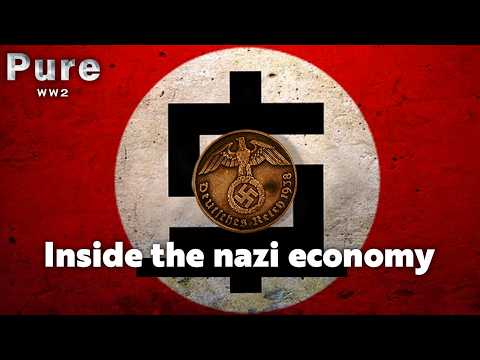
When Hitler seized power in 1933, Germany was on its knees. Six million unemployed. Foreign currency and gold reserves depleted. The Treaty of Versailles had capped the army at 100,000 men and forbidden an air force. The Reichsbank was forced to train with dummy tanks made of wood and canvas. Germany was broke—and Hitler wanted war.
To rebuild the military, money was needed. But where would it come from? The Nazis found their answer in a man named Hjalmar Schacht, a financial wizard who had already tamed hyperinflation in the 1920s. Now, he faced a new challenge: financing rearmament without triggering inflation or alerting the Allies.
Schacht’s solution was brilliant and devious. He created a dummy company called MEFO, capitalized with one million Reichsmarks from Krupp and other steel giants. MEFO produced nothing, hired no one, and opened no factories. Its only product was debt—debts that would secretly finance the Nazi war machine.
The scheme worked like this: any firm contracted to produce weapons was paid not in Reichsmarks, but in MEFO bills—a parallel currency guaranteed by the state. These bills were accepted by arms manufacturers, who used them to pay suppliers. The government didn’t have to pay a single mark until years later. It was money out of thin air, hidden from the outside world.
By 1934, out of four billion Reichsmarks invested in rearmament, less than half appeared in the official budget. The MEFO bills were a smashing success. They kickstarted the economy, filled Krupp’s order books, and put millions back to work. Rearmament became a drug, and Germany was hooked.
But the bills had to be repaid eventually. As Schacht warned Hitler, the economy was overheating. Continuing at this pace was impossible. A violent argument erupted within the Nazi regime. Schacht advocated caution, while Hermann Göring pushed for maximum rearmament. Hitler sided with Göring, and in 1936, the second Four-Year Plan transformed the economy into a war machine.
Göring’s plan aimed for autarky—economic self-sufficiency—at any cost. Synthetic rubber, synthetic fuel, and domestic iron ore were prioritized, regardless of expense. One ton of steel from Göring’s factories cost three times more than imported steel, but the state paid the difference. Nothing was spared for war.
As Germany geared up for conflict, the regime turned its hostility toward money itself—and toward the Jews. Nazi ideology viewed finance as the enemy, a parasitic force embodied by the Jewish banker. The plundering of Jewish wealth became official policy.
In 1938, the Nazis annexed Austria and unleashed the Night of Broken Glass. Jewish businesses were destroyed, synagogues burned, and communities fined billions. An office was set up under Adolf Eichmann to tax Jews on their departure, forcing them to leave behind their possessions. The spoils financed the Reich.
Despite the stolen wealth and the MEFO bills, Germany still lacked the army Hitler needed. The Wehrmacht paraded mostly on horseback and bicycles. The navy had only five battleships, and the air force lacked a single heavy bomber. Was Germany ready for war in 1939? The answer is no—and that is precisely why Hitler attacked.
Hitler understood that Germany’s economy could not sustain rearmament indefinitely. War was not just an option; it was a necessity. “We’ve got nothing to lose and everything to gain,” he told his generals. The invasion of Poland was a gamble to seize resources before the economy collapsed.
But the blitzkrieg that followed was not just a military strategy—it was a financial one. The MEFO bills, the plundered gold, the forced loans from occupied countries—all of it fed the Nazi war machine. The economy was a shambles, held together by theft and improvisation.
As German tanks rolled into Poland, the true cost of the war became clear. The MEFO bills were coming due, and the only way to pay them was through conquest. The war on credit had begun—and the bill would be paid in blood.
Poland fell in weeks, but the victory exposed the lie at the heart of the miracle. A quarter of the assault tanks broke down or were destroyed. Munitions ran dangerously low. Despite six years of frantic rearmament, the German economy was still not producing at the pace the war demanded. The Wehrmacht had won, but it had spent itself doing so.
Then came the strange stillness of the Phoney War. French and German soldiers watched each other across the Maginot and Siegfried Lines, and in that lull, the Nazi regime confronted an uncomfortable truth: nobody was truly in charge of the war economy. Göring’s sprawling empire, the army’s procurement offices, and the party’s rival fiefdoms all pulled in different directions.
Hitler’s response was to appoint a man he trusted completely—Fritz Todt, the engineer who had built the motorways and the West Wall fortifications. Todt was given the impossible task of bringing order to chaos. He was a civilian, and the military bristled at taking orders from him. Worse, whole sectors of the economy lay beyond his reach.
He could not control aircraft production. He could not control labor. He could not set prices or allocate raw materials. Every reform he attempted collided with another Nazi satrap guarding his own turf. Göring, in particular, insisted on continuing his lavish investment programs even as those resources were desperately needed for weapons.
Yet Todt achieved something remarkable. He focused the war industry on short-term, achievable goals. Aircraft production remained outside his grasp, but munitions and shells were another matter. Between January and July 1940, arms production doubled—the most spectacular increase of the entire war.
Hitler made his choices. The navy was sacrificed. Tank production was maintained. But munitions and the Luftwaffe became the twin priorities, with the air force absorbing forty percent of military expenditure. The only thing that counted was immediate war, and nothing but war.
In May 1940, the gamble was called again. Denmark and Norway fell. Then Belgium, the Netherlands, Luxembourg, and France—all within a few weeks. The propaganda films showed Stukas and invincible Panzers, celebrating the triumph of mind over matter. A poor nation, trapped in a territory too small, had found its soul again.
But behind the euphoria, the German people were hungry. The tanks needed fuel, and the war economy claimed what it was owed. The Reich was waging war on credit—MEFO bills repaid with printed money, and printed money backed by the collateral of plundered goods.
From the occupied countries came silver and gold from Poland, coal from the mines, cereals from France. Locomotives, cannons, petrol, tin, copper, nickel—all systematically confiscated and stockpiled. In the end, roughly a third of Germany’s war expenses were met by finances extracted from occupied Europe.
France, the richest prize, was forced to supply enormous sums to fund the German war effort. The Nazi economy had become a parasite, and it could no longer function without its host. Soldiers stole for food. Officials helped themselves where they could. Corruption became so commonplace that no one thought twice about it.
Before 1933, Nazi propaganda had insisted that militant national socialists were victims—of democracy, of the system, of the Jews. After 1933, they felt no moral inhibition whatsoever. When they enriched themselves at the expense of their victims, many believed it was perfectly normal—their entitlement as the strongest.
Hitler and Göring were the most adept of all. They were, by a wide margin, the greatest art thieves in history. Göring alone amassed more than 1,375 paintings, 250 sculptures, and 168 tapestries—a collection worth billions today. The economy, the state, the party, and the private sphere had collapsed into one another, inseparable and indistinguishable.
Germany was short of everything—food, raw materials, money, and weapons. In the occupied lands, pillage was organized, legal, and routine. Mixing improvisation with theft, the German war economy was a vast, improvised shambles.
And yet it kept moving forward, because it had no choice. The bills were coming due. The warehouses were being emptied. The war on credit could only be sustained by more war—and the next target was already being marked on the maps.
By the summer of 1941, the arithmetic had become merciless. The MEFO bills were long overdue, the occupied treasuries were stripped, and the Soviet grain and oil promised by the Hitler-Stalin pact could not fill a war economy that devoured everything it touched. Hitler’s generals warned that the Wehrmacht was not ready for a campaign in the East. His economists warned that the Reichsbank was printing money it could never redeem.
He ignored them both. On June 22nd, 1941, three million men crossed into the Soviet Union—not only to destroy Bolshevism, but to seize the wheat fields, the manganese mines, and the oil of the Caucasus before the whole structure came crashing down. The war had become its own creditor.
It was a gamble that consumed itself. The panzers that had once rolled on MEFO credit now stalled in the mud of autumn, starved of fuel and shells. Behind the front, the machinery of plunder reached its logical extreme: the camps, the ghettos, the systematic murder of the people the regime had first been taught to see as the embodiment of money itself.
The Nazis had set out to conquer the tyranny of gold—and had built in its place a tyranny of blood, theft, and lies. When the Reich finally collapsed in 1945, it left behind a continent in ruins and a ledger of debt that could never be repaid.
So here is the question the numbers cannot answer: was the Nazi economy a brilliant machine that ran on conquest, or a doomed pyramid scheme that could only end in ash—and does it frighten you how thin the line was between the two?
Report this article
Select a reason for reporting:






