December 1943. The winter air cut through the thin uniforms of the Italian soldiers as they stumbled out of cattle cars onto American soil. Giuseppe Marcelli clutched his torn jacket tightly around his chest. His stomach had been empty for three days. Back home in Sicily, his wife Maria was probably standing in bread lines that stretched around city blocks. Their two children hadn’t seen meat in months. Allied bombs had destroyed most of the factories. Food was so scarce that families fought over potato peels.
These Italian POWs knew what happened to captured soldiers. In German camps, men starved to death. In Japanese camps, torture was routine. Fascist newspapers had filled their heads with stories of American brutality. They expected beatings. They expected starvation. They expected to die far from home.
Giuseppe looked around at his fellow prisoners. Marco had a bullet wound in his shoulder that hadn’t healed right. Antonio walked with a limp from shrapnel the doctors couldn’t remove. These men had fought in North Africa, where the desert sun burned them by day and the cold froze them at night. They’d eaten rations full of sand and drunk water that tasted like metal. War had taught them that survival meant expecting the worst from everyone.
American guards approached with their rifles. Giuseppe tensed his muscles, bracing for the first blow. But something strange happened. One guard offered him a cigarette. Another pointed toward a building and said something in broken Italian about food being ready. The prisoners exchanged bewildered glances. This wasn’t what they’d been told would happen.
They walked past rows of wooden buildings that looked sturdy and well-built. Giuseppe noticed the windows had unbroken glass. There were no holes in the roofs. No bomb craters in the ground. Everything looked clean and organized. Back in Italy, most buildings were damaged or destroyed. People lived in basements and caves to hide from constant bombing.
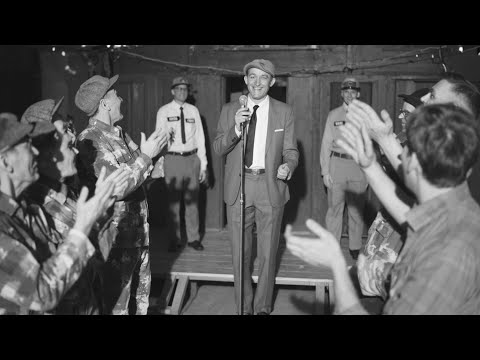
As they neared the main camp, Giuseppe heard something that made him stop walking. Music was playing somewhere nearby. Not the rousing war songs, but something soft and sweet. A voice was singing in English about spacious skies and freedom. The melody drifted through the air like something Giuseppe hadn’t heard since before the war. Marco grabbed Giuseppe’s arm and whispered: “Do you hear that?” The other prisoners stopped walking too. They all stood there, listening to this sound that seemed impossible.
Music in a POW camp felt as strange as finding flowers growing on a battlefield. The American guards didn’t order them to stop listening. They didn’t hit them for slowing down. They waited patiently as the Italian soldiers tried to understand what kind of place they had entered. There was something very different about this American camp, and the prisoners were about to discover just how different it really was.
The first meal changed everything. Giuseppe stared at his metal tray in complete silence. Three thick slices of white bread sat next to a mound of mashed potatoes covered in brown gravy. A piece of roasted chicken, bigger than his fist, was still steaming in the cold December air. Green beans filled one corner of the tray. A cup of real coffee, not the bitter dandelion water from home, warmed his hands.
Marco whispered: “This is more food than my family sees in a whole week.” The other prisoners nodded, but they couldn’t speak. They had expected thin soup and stale bread. Instead, they were eating the same meals as American soldiers.
Giuseppe took his first bite of chicken and closed his eyes. The meat was tender and seasoned with herbs he hadn’t tasted since before the war. In the days that followed, the surprises kept coming. Every morning, a red Coca-Cola truck rumbled through the camp gates. The driver, a cheerful American man with a round belly, handed out ice-cold bottles to anyone who wanted one. Giuseppe had never tasted anything like Coca-Cola. The sweet, fizzy drink seemed like liquid magic. In Italy, finding clean water was sometimes impossible.
The camp had a library with hundreds of books. There was a gymnasium where prisoners could play basketball and lift weights. Men who had been starving weeks earlier were now gaining muscle and weight. The barber shop offered free shaves every week. Clean sheets appeared on their beds every Monday morning. But it was the music that amazed them most of all.
Every evening, that sweet American voice filled the air. The prisoners learned his name was Bing Crosby. His song “Don’t Fence Me In” played repeatedly over the radios in every building. Giuseppe found himself humming the tune while working in the camp kitchen. The words were in English, but the music spoke to something deep inside him.
One afternoon, Giuseppe watched from behind the fence as American families drove past in shiny cars. The vehicles were bigger and newer than anything he’d ever seen. Children in the back seats wore thick winter coats and held toys. Their faces were round and healthy. These people had never missed a meal.
Antonio pulled Giuseppe aside and pointed toward the camp office. “Look at all those letters,” he said. Mailbags, taller than a man, waited to be delivered to prisoners. Giuseppe had received four letters from Maria in just two weeks. The American mail system worked better than anything in wartime Italy.
That night, lying on his clean bed under warm blankets, Giuseppe listened to Bing Crosby singing about spacious skies and freedom. He thought about the abundance of food, the kindness of the guards, the prosperity he saw everywhere. A terrible question began forming in his mind, one that would keep him awake for many nights to come.
Christmas morning arrived with six inches of fresh snow blanketing the camp. Giuseppe woke to the smell of roasting turkey drifting through the barracks windows. He pulled on his boots and stepped outside to find something that broke his heart and his mind at the same time.
The Americans had prepared a feast that looked like a dream. Long wooden tables stretched across the dining hall, covered with white cloths and golden turkeys, each one bigger than Giuseppe had ever seen, alongside mountains of stuffing and cranberry sauce. Sweet potatoes glazed with melted butter gleamed under the electric lights. Pumpkin pies and apple pies and chocolate cakes filled an entire table by themselves.
The camp commander, a kind-faced man with gray hair, stood and wished them all a Merry Christmas in broken Italian. Giuseppe sat staring at his overflowing plate. This single meal contained more food than his village back home would see in an entire month. He thought of Maria and the children eating thin soup made from turnip scraps. He thought of his neighbors fighting over potato peels in the garbage. He thought of the Fascist leaders who had promised victory and glory while their people starved.
That evening, as Bing Crosby’s voice filled the air again, Giuseppe felt something break inside his chest. The song “Don’t Fence Me In” seemed to mock everything he had believed about America and Americans. These were supposed to be his enemies, the people who wanted to destroy Italy and enslave its people. But they had given him better food, better shelter, and more kindness than his own government ever had.
Marco found Giuseppe sitting alone behind the dining hall, staring at the winter stars. Marco said quietly: “I can’t stop thinking about my son. He’s eight years old and he’s never had a full stomach.” His voice cracked as he continued: “But here, even prisoners eat like kings. What kind of wars are we fighting? What kind of leaders sent us to fight people who treat their enemies better than we treat our own families?”
Antonio joined them in the darkness. He whispered: “The American guard showed me pictures of his city today. Every house has electricity. Every family owns a car. Children go to school instead of working in factories.” He shook his head slowly. “They lied to us about everything.”
Giuseppe pulled out the letter he had started writing to Maria but couldn’t finish. How could he tell her that their enemies lived in paradise while Italians suffered under their own government? How could he explain that American prisoners ate better than Italian generals?
As Bing Crosby sang about freedom and open skies, Giuseppe finally understood the terrible truth. They had been fighting on the wrong side all along. America wasn’t the real enemy. The real enemy was the system that had sent them to die while keeping them ignorant of how the rest of the world lived.
In the weeks that followed, Giuseppe began to notice other things. The camp had a small hospital where Italian prisoners received the same medical care as American soldiers. Marco’s shoulder wound was properly treated for the first time. Antonio’s shrapnel was finally removed by a skilled surgeon. The doctors spoke to them with respect, not contempt.
One morning, a young American lieutenant approached Giuseppe with a proposition. “We need workers for the kitchen and laundry,” he said in careful Italian. “You’ll be paid for your work. Real wages, not camp scrip.” Giuseppe stared at him. Paid? In a prisoner of war camp? The lieutenant explained that the money could be sent home to their families through the Red Cross.
Giuseppe signed up immediately. Within a week, he was earning more money than he had made as a factory worker in Sicily before the war. He sent every penny to Maria. Her letters, when they came, were filled with disbelief. She had received the money and bought flour, oil, and even medicine for the children. “How is this possible?” she wrote. “Are you truly a prisoner?”
Giuseppe didn’t know how to answer. He wasn’t sure himself.
Spring came to the camp, and with it came news that would change everything. The Italian government had surrendered. Mussolini was dead. The war in Italy was ending, but for the prisoners, a new question arose. What would happen to them now? Some Italian soldiers had already begun fighting alongside the Allies against the Germans. The camp commander called a meeting and explained that any prisoner who wished could join the Italian Co-Belligerent Forces and fight for the liberation of their homeland.
Giuseppe looked at Marco and Antonio. The three men, who had once expected to die in American captivity, now stood before a choice. They could wait out the rest of the war in comfort and safety. Or they could return to the fight, this time on the side of the people who had shown them what dignity truly meant.
Marco spoke first. “My son deserves to grow up in a country like this one,” he said. “Not a country where children fight over garbage. I’ll fight for that.”
Antonio nodded. “They gave us back our lives. The least we can do is fight for their cause.”
Giuseppe thought of Maria, of the children, of the hungry faces in his village. He thought of the Christmas feast and the Coca-Cola and the clean sheets and the music that had taught him what freedom sounded like. He thought of the letter he had finally finished, the one where he told Maria that everything they had been taught was a lie.
“I’ll fight,” Giuseppe said. “But not for Italy. Not for any government. I’ll fight for what I saw here. For the idea that people deserve better.”
The camp commander smiled and shook each of their hands. “That,” he said, “is the best reason of all.”
Within a month, Giuseppe and thousands of other Italian prisoners had traded their prison uniforms for Allied military gear. They trained alongside American soldiers, learned to use American weapons, and prepared to return to Europe. But Giuseppe carried something more powerful than any rifle. He carried the memory of a camp where enemies were treated like brothers, where music played in the evening, and where a man could learn the truth about freedom simply by watching how others lived.
On the night before they shipped out, Bing Crosby’s voice drifted through the camp one last time. Giuseppe stood with Marco and Antonio, listening to the song that had changed everything. “Don’t fence me in,” the voice sang, and Giuseppe understood now that the fences weren’t made of wire and wood. The real fences were the lies that kept people from seeing the truth. And he was ready to tear them down.
The voyage home was silent. Giuseppe stood at the rail as Naples emerged from the mist, its broken teeth of buildings clawing at a gray sky. The smell hit him first—rotting garbage, unwashed bodies, smoke. He clutched his small bag of American treasures: Hershey bars, Lucky Strikes, a radio that could catch stations from another world.
Maria ran to him from their damaged home, tears streaming down her thin face. She looked older, much older. Their children, now eight and ten, stood back shyly. They barely remembered their father. Giuseppe embraced them and felt how their bones protruded through worn clothes.
That first dinner at home was dry bread and watery cabbage soup. Giuseppe stared at his bowl and remembered the Christmas feast. His family ate in grateful silence, thinking this simple meal a blessing. He couldn’t bring himself to tell them about the turkeys, the pies, the mountains of food he had left behind.
He tried to tell his neighbors about America. “Prisoners don’t eat better than free men,” they said. Some called him a traitor for speaking kindly of the enemy. Others thought the Americans had brainwashed him.
But every evening, Giuseppe turned on his little radio and searched for American music stations. When he found Bing Crosby singing “Don’t Fence Me In,” he closed his eyes and remembered clean sheets, hot meals, and guards who treated prisoners like human beings. The song drifted through the broken landscape of postwar Italy like a message from another world.
Years passed, and Giuseppe never stopped talking about what he had learned in America. He told his children about a country where even prisoners lived better than most free men in Europe. Some listened. Others laughed. But Giuseppe knew something his neighbors didn’t yet understand. War wasn’t just about winning battles or conquering land. It was about two different ways of looking at human dignity and possibility.
In America, he had discovered that abundance and kindness weren’t just for the rich and powerful. They were for everyone, even enemies. America’s greatest victory wasn’t won on any battlefield. It was won in the hearts of men like Giuseppe, who returned home carrying the seeds of a different dream about what human life could become.
And you—if you had been in Giuseppe’s shoes, would you have dared to believe your enemies?
Report this article
Select a reason for reporting:






