The morning of September 3rd, 1939, dawned cold and gray over RAF Wyton. The world held its breath as Prime Minister Neville Chamberlain’s voice crackled over the radio, announcing that Britain was at war with Germany. In that moment, history shifted. But even before the broadcast ended, a 21-year-old flying officer, Andrew McPherson, was already climbing into the cockpit of his Bristol Blenheim bomber. His mission: to fly into enemy territory and photograph the German fleet at Wilhelmshaven—the first RAF operation of the war.
McPherson’s Blenheim was no ordinary bomber. Stripped of its bomb load, it carried instead a suite of aerial cameras and a Royal Navy observer, Commander Thompson, tasked with identifying targets of interest. Alongside air gunner Corporal Smith, they were about to embark on a journey that would test their courage and skill in ways they could scarcely imagine.
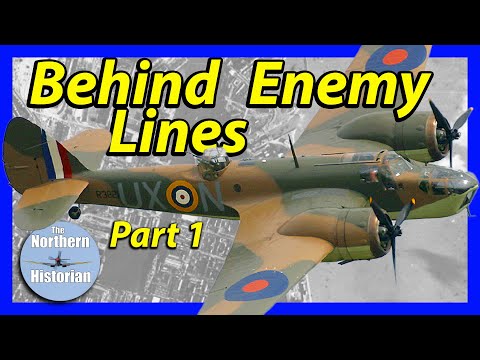
The Bristol Blenheim was a marvel of its time—fast, agile, and born from a civilian airliner design that had caught the eye of the Air Ministry. Its speed and range made it ideal for reconnaissance, and on that fateful day, it would prove its worth. As McPherson accelerated down the runway at precisely noon, the aircraft lifted into the cloudy sky, setting a course northeast toward the German coast.
The flight across the North Sea was eerily quiet. No enemy fighters, no anti-aircraft fire—just the steady drone of the engines and the cold, thin air at 24,000 feet. “It was a very cold morning,” McPherson later recalled, “with cloudy skies.” But the calm was deceptive. Below them lay the Wilhelmshaven shipyard, a vital cog in the Nazi war machine, building U-boats and repairing warships. British intelligence was desperate for photographs of the port, and McPherson’s mission was to deliver them.
As they approached the coastline, McPherson steered the Blenheim directly over the shipyard. The cameras whirred, capturing images of the German fleet. Among the ships identified were the heavy cruiser Admiral Scheer—a pocket battleship—and the light cruiser Emden, which had been laying mines off the German coast. The ships were anchored away from the shore, ideal for avoiding civilian casualties. The reconnaissance was a success.
With the vital images secured, McPherson turned for home. The plan was to radio the findings back to RAF Wyton as soon as they were in range, where further Blenheims stood ready to launch a raid. But fate had other ideas. The freezing temperatures at high altitude had caused their radio to fail. The critical target information would have to wait until they landed.
Almost five hours after takeoff, McPherson touched down at RAF Wyton at 4:50 PM. The camera was rushed to analysts from Bomber Command and the Admiralty, who immediately began planning a strike. But daylight was fading fast. Instead of the Blenheims, a number of Handley Page Hampdens and Vickers Wellingtons were scrambled, but they could not find their targets in the encroaching darkness and returned to base.
The first RAF mission into enemy territory had been a success, but the war was just beginning. McPherson’s photographs would prove invaluable, and the next day, he and his fellow 139 Squadron colleagues, along with Blenheims from 107 and 110 Squadrons, would take off once more, heading back into the heart of enemy territory in search of the German fleet. The skies over Germany were about to become a battleground.
The morning of September 4th, 1939, brought no relief from the bitter cold that had gripped RAF Wyton. Ground crews worked in the half-light, their breath misting as they serviced the Blenheims of 139 Squadron and the newly arrived aircraft from 107 and 110 Squadrons. The photographs McPherson had brought back were still being studied, but the order was clear: the German fleet at Wilhelmshaven was to be attacked before it could slip out into the North Sea.
McPherson, having barely slept, found himself back in the cockpit of Blenheim Mark IV number N6125. Commander Thompson was not with him this time—the observer’s role had been replaced by a full bomb load. Corporal Smith remained in the rear gunner’s position. “We knew what we were going into,” McPherson would later say. “But we also knew the photographs had shown us exactly where the ships were lying.”
The plan called for a coordinated strike. The Blenheims would approach the target at low level, using the early morning haze as cover, while a diversionary force would draw the attention of German anti-aircraft batteries. The crews were briefed on the positions of the Admiral Scheer and the Emden, both still at anchor near the entrance to Wilhelmshaven harbour.
At 6:30 AM, the engines of the Blenheims roared to life one by one. McPherson taxied to the runway, his aircraft heavy with bombs. The sky above was a pale, washed-out grey, promising poor visibility—which might work in their favour. As he pushed the throttles forward and lifted off, he glanced at the faces of his crew. They were young, like him, but their eyes held a grim determination.
The formation crossed the North Sea at low altitude, skimming the waves to avoid radar detection. The cold was even more punishing down low, and McPherson had to fight the controls as the aircraft bucked in the turbulence. “We flew so low that the spray from the waves streaked the windscreen,” Smith recalled. “For nearly two hours, we saw nothing but grey water and grey sky.”
As the German coastline appeared on the horizon, the crews tensed. The harbour defences were alert now—the previous day’s reconnaissance flight had not gone unnoticed. Flak batteries on the islands guarding the approach began to fire, sending puffs of black smoke blossoming in the air around the Blenheims.
McPherson pushed his aircraft into a shallow dive, aiming for the dock area where the Admiral Scheer was berthed. The ship’s anti-aircraft guns opened up, tracer rounds streaking past the cockpit. “I saw the Scheer dead ahead, her guns firing,” McPherson said. “I released the bombs and pulled up hard.”
The Blenheim shuddered as the bomb load fell away. Behind him, Smith opened fire with his rear gun, raking the harbour installations. Other Blenheims in the formation followed suit, their bombs exploding across the dockside. Smoke and flames erupted from the harbour, but the German gunners were finding their range.
One Blenheim from 107 Squadron was hit, its engine trailing black smoke as it veered away toward the sea. Another from 110 Squadron took a direct hit and plunged into the harbour, a plume of water marking its end. McPherson’s aircraft was struck by shrapnel, punching holes in the fuselage, but the engines kept running.
As they climbed away from the target, McPherson risked a glance back. The harbour was a scene of chaos—smoke billowing from the docks, the Admiral Scheer listing slightly at her moorings. But the cost had been high. Of the twelve Blenheims that had set out, only eight were returning.
The formation limped back across the North Sea, nursing damaged engines and wounded crew. McPherson’s Blenheim trailed smoke from a shrapnel hole in the port wing, and Smith had taken a splinter of flak in his thigh, though he refused to complain. “Keep her steady, skipper,” the young gunner called over the intercom. “I’ve got a few more rounds left if any fighters come calling.”
No fighters came. The Luftwaffe, still largely held back by Hitler’s orders, had not yet committed its fighters en masse over the North Sea. The Blenheims crossed the English coast and touched down at Wyton one by one, the ground crews rushing out to meet them with fire extinguishers and stretchers.
McPherson climbed out of the cockpit and stood on the tarmac for a long moment, his hands shaking. The intelligence officers wanted his report immediately, but first he walked to where the crews of the missing aircraft would have parked. Two empty dispersal bays. Two crews who would not be coming home.
The raid on Wilhelmshaven became the first real test of Bomber Command’s daylight tactics, and the results were sobering. The Admiral Scheer had been damaged but not sunk, and the Blenheims had paid a heavy price for a modest return. The Air Ministry, reading the after-action reports, concluded that unescorted daylight bombing against heavily defended targets was suicidal.
But the story was not over. McPherson’s reconnaissance photographs, developed and analysed in the days that followed, revealed something the crews had not seen in the smoke and chaos of the raid. The Admiral Scheer had been moved to a different berth just hours before the attack. The bombs that fell on her old moorings had struck empty water and dock machinery.
How had the Germans known? The answer, when it came, chilled the analysts to the bone. A German radio intercept, decoded at Bletchley Park, suggested that Wilhelmshaven had received warning of the raid the previous evening. Someone had talked, or someone had been listening.
McPherson was summoned to a meeting at Bomber Command headquarters. He sat in a cramped room with Commander Thompson and a pair of intelligence officers who spoke in careful, measured tones. They asked him to go over every detail of the September 3rd flight—the route, the altitude, the radio failure, the exact moment the cameras had begun to roll.
“You’re certain the radio was dead the entire return leg?” one of them asked. McPherson nodded. “It never came back to life until we were on the ground at Wyton.” The officers exchanged a glance. If the radio had been silent, then the leak had not come from his aircraft.
The investigation widened. Ground crews at Wyton were questioned. The dispersal of the squadron, the timing of the briefing, the readiness of the standby aircraft—every detail was picked apart. And then, on the morning of September 6th, a mechanic from 107 Squadron failed to report for duty. His bunk was empty, his locker cleared out.
McPherson heard the news in the officers’ mess, and he set down his cup of tea with a steady hand. The war had barely begun, and already it had shown him two faces: the enemy in the sky ahead, and the shadow that walked among them on the ground. He looked out the window at the Blenheims being patched and refuelled, and he wondered what the next briefing would bring.
The mechanic’s name was Thomas Hale, a quiet man who had worked on the Blenheims for months. His disappearance confirmed what the intelligence officers had feared: someone had passed the raid’s details to the Germans. McPherson was called back to headquarters, where a grim-faced officer slid a photograph across the table. “We found this in his locker,” the officer said. It was a map of Wilhelmshaven, marked with the exact berths of the Admiral Scheer and the Emden.
McPherson stared at it for a long moment. The raid had cost two crews their lives, and for what? A traitor had made sure the bombs fell on empty water. “He knew we’d come back the next morning,” McPherson said quietly. “He knew because he read the same orders we did.”
The investigation would drag on for weeks, but Hale was never found. Some said he had slipped across the Channel to France; others whispered he had been picked up by a German submarine. McPherson never learned the truth. He flew many more missions, but he never forgot the lesson of Wilhelmshaven: the enemy was not only the flak and the fighters, but the silence that could hide a traitor in your own squadron.
Years later, long after the war, McPherson returned to RAF Wyton for a memorial service. He stood before the names of the crews lost on September 4th, 1939, and he thought of the photographs he had taken—the ones that had started it all. “We were young and we thought we were invincible,” he said to the small crowd. “But war teaches you otherwise, quickly and without mercy.”
He placed a wreath at the base of the memorial and walked away, his footsteps echoing on the tarmac. The Blenheims were gone now, replaced by jets that screamed through the sky at speeds he could barely comprehend. But the memory of that first mission, and the shadow that had fallen over it, remained.
What would you have done, if you had been in McPherson’s shoes—trusting your crew, only to discover a traitor among them?
Report this article
Select a reason for reporting:






