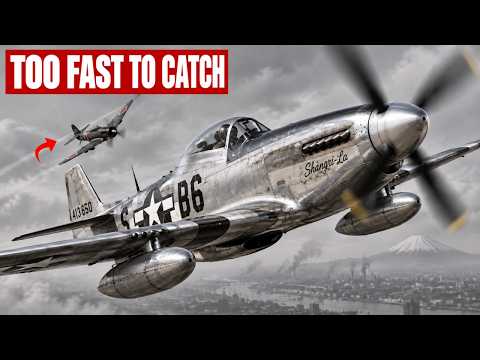
The sulfur hit them first. It rose through cracks in the black volcanic rock of Iwo Jima like the island itself was breathing, and it settled into the fabric of their flight suits, into their hair, into the lining of their helmets. Veterans would swear they could still smell it forty years later—in dreams, in a hot room, striking a match. Eight square miles of ash and sand, alone in the Pacific. In March 1945, it was the most expensive real estate on Earth.
6,821 Americans died to take it. Nearly 21,000 Japanese died to hold it. And the men buried there were never told why.
The answer had four engines and one more. The B-29 Superfortress, flying from the Marianas since November, losing bombers at a rate no one could sustain. Iwo Jima sat almost exactly halfway. An emergency landing strip. A radar station. A rescue base. Any one of those justified the cost.
But there was a third reason—the one that mattered most to the Japanese, though no one in Tokyo had studied it closely. Tokyo was 750 miles to the north-northwest. And on March 6, 1945, the first P-51 Mustangs of the 15th Fighter Group landed on the island’s South Field.
The pilots shut down their engines, climbed out, and stood for a moment on ground still warm from the volcano beneath. Then they were handed shovels. “Dig.” No tents. No revetments. Japanese soldiers in caves half a mile away, coming out at night.
They called themselves the Sun Setters. The name was chosen by a morale officer, and for most of the war it was a name far too big for a mission far too small. That was about to change.
Among the pilots who arrived that month was a major named James Tapp of the 78th Fighter Squadron. He was not a famous man. He had no aerial victories. He had spent years on patrol flights over water where nothing happened, in aircraft that were obsolete when he received them, waiting for a war that always seemed to be happening somewhere else.
He was cautious, methodical, and obsessive about details—qualities that attract no attention in most squadrons. On Iwo Jima, they turned out to be the only qualities that mattered.
Because the mission they had been brought here for was not, by any normal standard, a fighter mission at all. The plan was to escort B-29s from Iwo Jima to Tokyo and back. 750 miles out. 750 miles back. 1,500 miles in a cockpit so narrow a man could touch both sides without extending his arms, strapped to a parachute and an eight-man life raft for eight hours or more.
There were no alternate airfields. No place to land. No coastline to follow, no river, no railroad, no city lights at night. There was water, then more water, and then, if the calculations were right, Japan.
In Europe, a long escort mission ran three hours, and men came back from those with their hands shaking. What Iwo Jima asked was nearly triple that, over open ocean, alone.
The aircraft was the North American P-51D Mustang, the finest fighter America sent to the war. A laminar-flow wing that gave it less drag than any plane its size had a right to possess. A Packard-built Merlin engine making roughly 1,690 horsepower at maximum emergency power. Six .50-caliber guns in the wings, a bubble canopy that let the pilot see behind him, a top speed over 430 miles per hour at altitude—about 80 miles per hour faster than the best Japanese fighter in service in real numbers.
None of that was why it was chosen. It was chosen for the wing—not its shape, but its size. The Mustang carried 184 gallons of fuel inside its wings, and another 85 gallons in a tank mounted behind the pilot’s head. That fuselage tank was the price of the entire mission. When full, it pushed the center of gravity aft, making the plane heavy, awkward, reluctant to recover from a hard turn. A pilot flying with a full tank had to hold back pressure on the stick like leaning against a door in a gale. It was not a fighter when that tank was full. It was a flying fuel truck with guns bolted on.
And even that wasn’t enough. The rest hung beneath the wings. Two external tanks, 110 gallons each, stamped from thin aluminum sheets in American factories turning out tens of thousands every month. Each cost about fifteen dollars. They were not weapons. They were not smart technology. An external drop tank is the least glamorous part of a combat aircraft. It is a container. Fill it, burn what’s inside, drop it in the ocean, forget it existed.
That container was the only reason the war reached the enemy capital.
The Japanese planners ran the same calculations the Americans did. This is the part usually skipped, and it is the most important part. They were not fools, and they were not lazy. They computed the fuel consumption of a single-engine fighter across that distance, and they were right. On internal fuel alone, no fighter could make the trip and return. Their aircraft were built to intercept—short range, fast climb, tight turn. They had drop tanks, but they were crude, leaking, chronically short, and viewed as a burden rather than a weapon in their own right.
What the Japanese failed to calculate was not physics. It was appetite. They could not imagine an enemy willing to manufacture hundreds of thousands of disposable aluminum shells, sacrifice roughly 7,000 lives to seize an island just to bring it within reach, and then ask young men to sit over open water for eight hours with no margin for error.
The Japanese got their arithmetic right. They got the Americans wrong.
All through March, the Mustang pilots trained on the thing that would kill them all at once. Not dogfighting—fuel. They flew practice missions out over open ocean and back, and every flight was an exercise in restraint. Lean the mixture. Reduce manifold pressure. Set the prop to the lowest RPM the engine would tolerate without complaint, then lower it further until the Merlin began to shudder in a way that raised the hair on a man’s neck. Hold altitude with precision. Hold airspeed to the knot. Every unnecessary movement of the throttle handle cost gallons. And gallons at the end of the mission were not measured in gallons. They were measured in minutes of life.
They raided Chichi Jima, 147 miles north, partly to hurt the garrison there and mostly to learn what it felt like to fly over water with no landmark to steer by. There is a particular loneliness in that. A pilot lost over Europe can drop through the clouds and find a church, a road, a shape he knows from photographs. A pilot lost over the Pacific finds more water in every direction until the fuel runs out.
Ground crews worked eighteen-hour days in open revetments amid volcanic ash that worked into every moving part, using too few tools. Spark plugs fouled from the low-power settings the mission demanded. Oil consumption had to be logged and watched as closely as a temperature gauge. Magnetos that were considered weak in the ordinary course of things were not merely weak here. They were a delayed death sentence with a three-hour fuse.
And at night the men talked about what actually frightened them. It was not the Zeros. Every one of them had been told, over and over, exactly what to do about Japanese fighters. Do not turn with them. Never turn with them. Slash from out of the sun, fire a short burst from good range, keep your speed, climb away, come back. The tactics were settled and effective and nobody worried about them.
What frightened them was the last hour of the return leg. Two hundred miles of black water. A fuel gauge settling toward its lower limit, an engine that had been running for seven hours on a lean mixture, and a small island so small that a navigational error of two degrees might carry a pilot past it into open sea without ever seeing it.
That was the arithmetic no one in Tokyo had run. Not the range of a fighter, but the will of a nation to spend men like fuel. The Sun Setters flew until the fuel gauges read empty and the war ended, and then they flew home to an island that smelled of sulfur and graves.
James Tapp never spoke of his four kills. He spoke of the last hour over black water. The gauge. The clock. The two degrees of error. The island appearing out of the haze like a gift.
Philip Schlamberg, nineteen years old, told his flight leader he would not return. He was right. He is still out there, somewhere in the Pacific, one of the last Americans to die in the war.
The Japanese were correct about the ocean. They were wrong about who it would kill. It killed the men who came anyway—more of them than every Japanese fighter on the home islands combined.
Fifteen dollars of aluminum. Eight hours of silence. One question: what would you have done, strapped to a fuel tank and a clock, 750 miles from home?
Report this article
Select a reason for reporting:






