For 27 years, Ivan the gorilla lived behind a glass wall in a shopping center, his world reduced to a concrete enclosure while millions of shoppers passed by. He was a spectacle, a marketing attraction, and a lonely soul. But behind those eyes lay a story far more complex and heartbreaking than any Disney movie could capture. This is the true story of Ivan, the gorilla who inspired The One and Only Ivan—and the shocking reality that Hollywood left out.
Born in the wilds of Central Africa in 1962, Ivan was just a toddler when he was captured and sold to an American businessman for $7,500. His journey to the United States was brutal: lost in transit for eight weeks, malnourished and weak, he arrived barely clinging to life. But fate had other plans. Reuben Johnston, the owner of a pet shop inside the B&I Circus Store in Tacoma, Washington, took Ivan home and raised him as part of his family for three years. “He was like a child to them,” one account recalls. But as Ivan grew, so did the destruction—an estimated $17,000 in damages to the Johnston home. The solution? A custom-built cage inside the store, complete with a TV, heating, and even a small pool. It was a prison dressed as a palace.
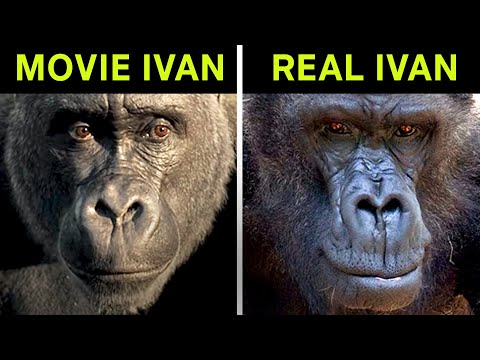
While Disney’s film portrays a charming menagerie of talking animals, the real B&I Circus Store housed a baby elephant named Sammy, a lion, a seal, and chimpanzees—but they never broke out in a daring escape. Instead, they lived in their own confined worlds, just like Ivan. And unlike the movie, Ivan’s caretakers never left him; Reuben’s wife stayed, and the store became a worldwide attraction, all thanks to a gorilla who could paint. His favorite color was red, and he held the canvas without tearing it—a rarity among gorillas. His paintings added to his fame, but they also symbolized his captivity.
As the years passed, protesters demanded Ivan’s release, and the store filed for bankruptcy in 1992. In a bizarre twist, Michael Jackson reportedly tried to buy Ivan for his Neverland Ranch, but the deal fell through because no female companion could be found for him. Finally, in 1994, Ivan was donated to Zoo Atlanta, where he spent his last 18 years. Yet even surrounded by other gorillas, he never formed strong bonds with them—his closest connections were always with humans. Ivan died in 2012 at age 50, equivalent to a human living to 100. His story is one of resilience, loneliness, and the cost of captivity. But what else did Disney change? The truth is even more surprising.
What Disney omitted is the darker truth of Ivan’s early years—the trauma that shaped him long before he became a painting sensation. When Ivan arrived at the Johnston household, he was not just malnourished; he was terrified. For weeks, he clung to Reuben’s wife, refusing to eat unless hand-fed. “He would scream at night, a sound that broke your heart,” Reuben later recalled. The loss of his mother and the brutal journey across the ocean had left scars that never fully healed.
Disney’s film paints Mack as a greedy showman, but the real Earl Irwin was a complex figure—part businessman, part reluctant caretaker. He genuinely believed the enclosure was a kindness, a way to keep Ivan safe from a world that had already nearly killed him. Yet the concrete walls told a different story. Ivan’s daily life was a monotonous cycle: eat, paint, perform, sleep. Visitors tapped on the glass, flashed cameras, and shouted. Some days, Ivan would turn his back on the crowds and sit in silence for hours, staring at the wall. The television inside his cage played cartoons, but it was a poor substitute for the jungle.
As Ivan grew from a cute toddler into a 400-pound silverback, the dynamics shifted. He could no longer be handled without risk. The Johnston family, who had once let him sleep in their living room, now had to communicate through steel bars. Reuben’s children, who had grown up with Ivan as a sibling, were warned not to get too close. “He didn’t understand why we stopped hugging him,” one of them said. “He would reach through the bars, and we had to pull away.” It was a betrayal Ivan never comprehended.
What the movie also glosses over is the role of Ruby, the young elephant who became Ivan’s unlikely friend. In the film, Ruby arrives at the mall and inspires Ivan to promise her a better life. In reality, there was no Ruby at the B&I store—at least not a baby elephant who bonded with Ivan. The real Ivan’s closest companion was a television set and the occasional stray cat that wandered into his enclosure. He would gently pet the cats, a fleeting moment of tenderness in an otherwise sterile existence. Those cats, not a talking elephant, were the ones who saw Ivan’s softer side.
By the early 1990s, Ivan’s world was crumbling. The B&I store was fading, customers dwindled, and the protests outside grew louder. Animal rights groups called his cage a prison, and they were right. Yet Ivan’s caretakers insisted he was happy—he had his paintings, his TV, his routine. But a gorilla who has never climbed a tree, never felt rain on his skin, never heard the calls of his own kind cannot be happy. He can only survive. And Ivan did survive, for 27 years, in a cage that measured just 40 by 40 feet.
When the bankruptcy hit, Ivan’s future hung in the balance. For a moment, it seemed he might be sold to a private collector or worse. Then came the surprising offer from Michael Jackson—a pop star who wanted to give a gorilla a home at Neverland Ranch. But Jackson’s team couldn’t find a female gorilla to keep Ivan company, and the deal collapsed. Some say Jackson was heartbroken; others say it was a publicity stunt. Either way, Ivan remained in Tacoma, waiting.
Finally, in 1994, the Irwin family donated Ivan to the Woodland Park Zoo. But the zoo’s gorilla habitat was full. So Ivan was loaned to Zoo Atlanta, where he would spend his final years. The transition was not smooth. Ivan had never learned gorilla social cues—he didn’t know how to groom, how to play, how to submit. He was a gorilla raised by humans, and the other gorillas sensed it. They kept their distance, and Ivan, in turn, retreated to the corners of his enclosure, painting his red canvases and watching the humans who still came to stare.
Zoo Atlanta’s keepers tried everything to integrate him. They introduced him to a patient female named Machi, hoping she might draw him out. For a while, it seemed to work—Ivan would sit near her, mirroring her movements, learning the slow grammar of gorilla life. But the bond never deepened into trust. When Machi groomed him, Ivan would flinch, unsure what to do with the intimacy. He had spent too many years learning that touch came only through bars.
What the keepers noticed, though, was how Ivan lit up around people. Visitors who came to the zoo’s observation deck found a 400-pound silverback who would press his palm against the glass, locking eyes with them. He was more comfortable with humans than with his own species—a tragic reversal of everything a gorilla should be. Children especially fascinated him. He would watch them for hours, his dark eyes following their movements, as if trying to remember what it felt like to be small and free.
His paintings, meanwhile, became something of a cottage industry. Zoo Atlanta sold prints of his work, and Ivan’s red-splashed canvases raised thousands of dollars for conservation. But there was a bittersweet irony in it: the same talent that had made him a spectacle in Tacoma now made him a celebrity in Atlanta. The cage had changed, but the performance never stopped.
In 2011, a journalist asked one of Ivan’s longtime keepers whether the gorilla was finally happy. The keeper paused for a long moment. “He’s content,” she said carefully. “But happy? I don’t know if Ivan knows what happy feels like.” It was a devastating admission—and one that never made it into the Disney script.
What also never made it into the film was the strange, quiet dignity of Ivan’s final months. As his health declined, he spent more time alone, refusing food and staring at the ceiling of his enclosure. The keepers built him a nest of blankets, and he would curl into it, his massive frame folded into something almost childlike. On his last day, he was visited by Reuben Johnston’s daughter, who had flown across the country to say goodbye. She pressed her hand to the glass, and Ivan, weak as he was, lifted his own hand to meet hers.
He died hours later, on August 20, 2012. The necropsy revealed that his heart had simply given out—a common fate for captive gorillas, whose bodies are not built for decades of stillness. He was fifty years old, an age no wild gorilla is likely to reach, but a lifespan measured in years, not in moments.
The headlines called him “the world’s most famous gorilla.” They praised his paintings, his resilience, his gentle nature. But few mentioned the 27 years of concrete, the television that replaced the jungle, or the cats who were his only friends. Disney gave Ivan a happy ending—a family, a home, a promise kept. The truth was messier: a gorilla who survived captivity but never escaped it, even when the cage door finally opened.
And yet, there was one thing the movie got right. In his final years, Ivan did form a connection—not with another gorilla, but with a young keeper who reminded him of Reuben’s wife. She would sit by his enclosure during her breaks, reading aloud from a book. Ivan would watch her lips move, his head tilted, as if listening. He never learned to be a gorilla. But he never forgot how to be loved.
That keeper, Sarah, was the last person to see Ivan alive. She had been reading him The One and Only Ivan—the book, not the movie—and had just reached the chapter where Ivan paints his first red canvas. “He looked at me that day,” she recalled, “not through me. Like he understood every word.” She closed the book and promised to finish it tomorrow. Tomorrow never came.
After his death, Zoo Atlanta held a small memorial. Reuben Johnston’s grandchildren attended, along with a handful of protesters who had once picketed the B&I store. One of them, a gray-haired woman named Ruth, wept openly. “We fought so hard to free him,” she said. “But we never asked what freedom would mean after twenty-seven years in a box.” No one had an answer.
Ivan’s ashes were scattered in a private ceremony, but his legacy lives on in quieter ways. The book that inspired the movie has been read by millions of children, many of whom write letters to Zoo Atlanta asking if Ivan was real. The zoo’s education director answers every one: “Yes. And he was braver than any story.”
His paintings still sell for thousands. But the most valuable one—a small canvas splashed with red—hangs in the keeper’s office, not for sale. Beneath it, a plaque reads: “For Ivan, who never climbed a tree but taught us how to reach.”
Disney gave us a talking gorilla with a happy ending. The real Ivan gave us something harder: a mirror. He showed us what we do to the wild when we dress it up as entertainment—and what we owe it when the show is over.
So here’s the question that haunts me: if we could ask Ivan, would he choose the cage with the TV and the red paint—or the jungle he barely remembered? What would you choose?
Report this article
Select a reason for reporting:






