My name is Walter Bennett. I’m 65 years old, and for four decades I’ve built things from the ground up—contracts, handshakes, a company that now employs 180 people. I tell you this not to impress you, but because the work is who I am. My wife Margaret used to say I was made of iron and routine. She passed seven years ago. Since then, the person closest to me has been my daughter, Emily.
Emily is 37. She married Derek Hale nearly a decade ago. For most of those years, I liked the man. He ran a renovation company, had an easy confidence, and called me “Dad.” I thought I was watching my daughter build a good life with a good man. I was wrong about a lot of things back then.
It started with a Sunday dinner complaint—the kind so ordinary I almost didn’t register it. Emily rolled her shoulders and said the bed in her room was driving her crazy. Every time Derek shifted in the night, the frame groaned like something about to give out. She laughed when she said it, rubbing the back of her neck.
Three days later was Emily’s birthday. Derek was taking her to Philadelphia for two nights. I decided to use those two days to replace the bed. I ordered a solid walnut frame and the best mattress the store carried. I hired two installers, Caleb and Mason—men I’d used before. They were professionals. They showed up on time.
What happened next I was not prepared for.
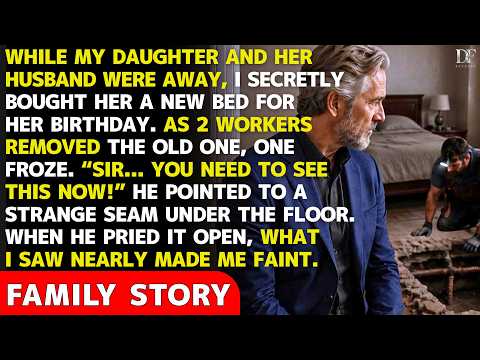
It was a Tuesday morning, October 7th, when Caleb and Mason began breaking down the old bed frame. The mattress came off first, then the side rails, then the headboard. When they gripped the base frame and lifted, something shifted beneath the floorboards. A panel near the center of the room, hidden perfectly under the frame’s footprint, popped loose at one corner and tilted up like a cellar door someone had forgotten to latch.
Caleb was the one who looked down first. He crouched over the opening and I watched his shoulders go rigid. He reached into the gap with both hands and came back up holding a black document bag—the kind used on job sites. Waterproof, sealed with a heavy-duty zipper that was still fully closed. He straightened up and his face had gone the color of dry concrete.
“Sir,” he said, and his voice came out smaller than I expected from a man his size. “Should we call someone?”
I took the bag from his hands. It was heavier than it looked. The outside was clean, no dust, no moisture damage. Whoever had placed it down there had not done so carelessly.
“It’s a family matter,” I said. “I’ll handle it.”
I paid both men in full, added a hundred dollars each, and walked them to the door. When I heard their van pull away from the curb, I locked the front door, carried the bag to the kitchen table, and set it down under the overhead light.
Inside: a phone, old model, powered off. A USB drive. A woman’s bracelet with a broken clasp. A small key on a plastic tag stamped with the number 317. And a Polaroid photograph.
The man in the photograph was Derek. The woman beside him—it took me a few seconds, but I recognized her. Rachel Monroe. She had worked as Derek’s accountant for nearly four years before disappearing six years ago. Derek told everyone she had embezzled from the company and fled to Canada. I had believed him without a second thought.
I turned the photograph over. On the back, written in a hand I did not recognize, was a single line: If I disappear, don’t trust Derek. The USB has everything.
My chest tightened so sharply, I had to press one hand flat against the table to keep myself steady. My jaw ached from clenching it. The kitchen felt smaller than it ever had before. The same counters, the same window above the sink, the same afternoon light coming through—but all of it pressing in now, like the walls had moved three feet closer while I wasn’t watching.
I did not call Emily. I did not call Derek. I pulled out my phone and called the one person I trusted enough to call.
Daniel Hayes picked up on the second ring.
“Walter?” His voice was easy, the way it always was. “What’s going on?”
“I need you to come over,” I said. “Right now. Don’t ask me why on the phone.”
A pause—not the pause of confusion, but the pause of a man recalibrating. “Give me 40 minutes,” he said.
I sat at the kitchen table with the bag in front of me and did not move until I heard his car in the driveway.
Daniel Hayes arrived in 38 minutes, which told me he had not driven the speed limit getting here. I had the front door open before he reached the porch steps. He was 63 years old, broad through the shoulders, with gray at his temples and reading glasses pushed up on his forehead—the way he always wore them, ready for fine print, but never quite believing he’d need them. He was in a flannel shirt and work boots, which was what he wore to go fishing, which was what we’d been doing together every other Saturday morning for the past 18 years.
To anyone who didn’t know him, Daniel Hayes looked like a retired foreman who spent his weekends on a lake and his evenings watching baseball.
He stepped through the door, looked at the bag on the kitchen table, and did something I had never seen him do in 18 years of friendship. He reached into the back pocket of his jeans and pulled out a pair of nitrile gloves.
My stomach dropped.
“Daniel.” My voice came out rough, scraped from somewhere low in my chest. “Why do you have those?”
He snapped the first glove on without looking up. “Old habit.” He pulled on the second. “Before we touch anything else, I need to photograph everything exactly as it sits. Position, condition, contents. Do you have your phone?”
“Why does it matter how we photograph it?”
He looked up at me then, and his eyes held something I hadn’t seen there before. Not alarm, but a focused, practiced calm that had nothing casual about it. The look of a man who had walked into rooms like this before and knew exactly what came next.
“Because chain of custody matters,” he said. “If what’s in that bag is what I think it might be, the way we handle it right now will determine whether it ever sees the inside of a courtroom.”
“Sit down, Walter. Let me work.”
I sat down. Daniel spent four minutes photographing every item in place. The bag, the open zipper, each object laid out on the table in the order we removed it. He narrated quietly as he worked, his voice low and even—the voice of a man reciting a procedure he had followed a thousand times.
When he finished, he set his phone down and looked at me directly.
“Walter, I worked for the federal government for 22 years,” he said. “Financial Crimes Division, FBI. I retired out of the New York field office 11 years ago.”
He paused, letting that land. “I don’t talk about it. When you’re in that work long enough, you learn to leave it where you left it. But the habits don’t go anywhere.”
The kitchen felt like it tilted slightly. I gripped the edge of the table with both hands, my knuckles pressing hard against the wood.
“You were a federal agent,” I said.
“Special agent, yes.”
“18 years,” I said. “18 years of fishing and bad jokes, and you never said a word.”
Something moved across his face—not quite guilt, not quite apology. Something older than both. “No,” he said. “I never did.”
I wanted to be angry about that. I filed it away for later because there were more important things sitting on my kitchen table.
Daniel picked up the bracelet first, turning it carefully in his gloved hands. The clasp was broken cleanly—not worn through, snapped the way metal snaps when it’s pulled hard and fast. He set it down and examined the small key on its plastic tag, the number 317 stamped in faded black ink.
“Self-storage,” he said. “Most likely. I can run the number.”
Then he picked up the phone. It was an older model, the screen dark and unresponsive. He connected it to a small portable charger he pulled from his jacket pocket. Another old habit, apparently.
And we waited.
Forty seconds later, the screen flickered. A lock screen appeared, asking for a six-digit passcode. Daniel picked up the bracelet again. He turned it slowly under the kitchen light until the interior of the clasp caught the beam. Six small numbers stamped into the metal on the inside curve.
He entered them. The phone unlocked.
My throat tightened so sharply I had to swallow twice. On the screen were photographs, text messages, and a folder of audio files. Daniel opened the audio folder. There were nine files, each labeled with a date. He looked at me over the top of his reading glasses.
“Do you want to hear the last one first?” he asked.
Every instinct I had told me no. Every instinct told me that whatever was in that file was going to change the shape of everything I thought I knew. And that once I heard it, I could not unhear it. And that there was a version of this afternoon where I put the phone back in the bag, put the bag back under the floor, and went home and never thought about it again.
“Yes,” I said. “Play it.”
Daniel pressed the screen.
A woman’s voice came through the speaker, first tight with fear, the words pushed out fast like she was running out of time to say them.
“Derek, Miguel is dead.”
Then a man’s voice. A voice I had heard at my dinner table, at my daughter’s birthday parties, at every holiday gathering for 10 years. A voice that had called me Dad with what I had believed was genuine affection. The voice was completely calm.
“I know.”
The woman again, her breath audible now, ragged at the edges. “You knew he was down there.”
“Locked the back door.” And Derek’s answer delivered with the flat, empty patience of a man discussing something that had already been decided. “He wasn’t supposed to be there.”
Then a second male voice, lower, harder, familiar in a way that sent a cold line straight down my spine. “Stop talking. Delete everything and go.”
I knew that voice, too.
My hand came up and covered my mouth before I understood it was moving. My eyes burned with a heat that had nothing to do with tiredness, and I put one hand flat over my mouth and stood very still, breathing slowly through my nose, because the alternative was falling apart in my daughter’s kitchen, and I was not going to do that.
“Play it again,” I said.
Daniel looked at me carefully. “Walter—”
“Play it again, Daniel. Please.”
He played it again. I listened to every word a second time with my hands flat on the table and my jaw so tight I could feel it in my back teeth.
When it ended, I stood up, walked to the window, stood there with one hand braced on the frame, looking out at the ordinary afternoon street below—at a neighbor walking a dog, at a UPS truck pulling away from the curb two houses down.
“Miguel Alvarez,” I said. “Tell me what you remember about him.”
“Electrician,” Daniel said. “He died in a house fire. One of Derek’s renovation projects in Brooklyn six years ago.”
My voice came out steadier than I deserved credit for. “Derek organized a fundraiser for his family. I wrote a check for $5,000.”
Daniel set the phone down on the table very carefully—the way you set something down when you want to make sure it doesn’t break.
“Then we need to talk,” he said, “about what comes next.”
Daniel made coffee without asking if I wanted any. He moved through my daughter’s kitchen the way a man moves through a space when he needs his hands doing something while his mind works—opening cabinets, finding the filters, filling the carafe. I watched him from the table and said nothing, because the alternative was talking and I wasn’t ready to talk yet.
The recording was still playing on a loop somewhere inside my skull. Derek’s voice. That terrible flat calm. He wasn’t supposed to be there.
When Daniel set a mug in front of me, I wrapped both hands around it even though the evening was warm. My hands needed something solid to hold on to.
“Victor Shaw?” I said. “That was his voice on the recording. The second one.”
Daniel pulled out the chair across from me and sat down. He took his reading glasses off his forehead and set them on the table. “Tell me about him.”
“He and Derek have been close for years. Business partner, more or less, though I don’t think it was ever formalized on paper. Victor brokers real estate deals in Los Angeles—connects buyers with off-market properties, takes a percentage. Derek used him to source renovation targets on the West Coast.”
I pressed my thumb hard against the rim of the mug. “He’s eaten Thanksgiving dinner at this table three times.”
Daniel nodded slowly, the way he nodded when he was filing information rather than responding to it. “And six years ago, the fire. Walk me through what you remember.”
I breathed in through my nose and pushed it out steadily. “Brooklyn. One of Derek’s projects—a three-story brownstone he was gutting and flipping. The fire started sometime around midnight. By the time the crews got there, the ground floor and basement were fully involved.”
My throat tightened around the next part. “Miguel Alvarez was a subcontractor Derek had hired for the electrical work. He’d been sleeping in the basement because he had an early start the next morning. The official finding was faulty wiring—accidental.”
I stopped. “Derek set up a memorial fund within the week. He stood up in front of everyone and talked about what a tragedy it was.”
“And you donated.”
“$5,000.” The words tasted like something rotten. “I felt good about it.”
Daniel picked up his coffee mug but didn’t drink from it. He turned it slowly in both hands, and I recognized the gesture. It was what he did when he was deciding how much to say and in what order.
“I made a call before I came over,” he said.
I looked up sharply. “To who?”
“Someone I trust at the FBI field office in Manhattan. I didn’t give details. I told him I might have something worth looking at and asked him to stand by.” He set the mug down. “The way you sounded on the phone, Walter—I’ve heard that specific tone before. People find things they were never supposed to find. I wanted to have a line open before I knew what this was.”
The back of my neck went cold. “You called the FBI before you even saw what was in the bag.”
“Yes.”
“Daniel, I don’t even know what we’re dealing with yet. You’re already—”
“I know enough.” His voice didn’t rise, but it landed with a weight that stopped me mid-sentence. “That recording is evidence of prior knowledge in connection with a fatal fire. If the official finding was accidental and that recording exists, someone suppressed information during the investigation. That is obstruction of justice, Walter. And if Miguel Alvarez died because someone deliberately prevented him from escaping that building—” He stopped, and the pause carried more weight than any word he could have chosen. “That is not a family matter. That is a federal matter.”
My chest ached with a pressure that had nothing to do with my heart rate. I pressed two fingers hard against my sternum and held them there, pushing back against something that wanted to crack open.
“What do we do?” I asked.
“First, and I need you to hear me clearly on this: you do not confront anyone.” Daniel leaned forward, both forearms flat on the table. “Not Derek, not Victor, not Emily. The moment you tip your hand, evidence disappears, people lawyer up, and whatever case exists evaporates before it begins. Do you understand me?”
The word Emily hit me somewhere below the ribs. “Emily doesn’t know anything about this.”
Something crossed Daniel’s face—quick, controlled, there and gone. “Probably not,” he said. “But until we know what we’re dealing with, we keep the circle as small as possible. You and me. Nobody else.”
“Agreed.” The word came out thin. “What’s next?”
“The USB drive.” He picked it up from the table, turning it between his gloved fingers. “I’m not opening this on any device connected to your network or mine. I have a contact—retired forensic specialist, worked digital evidence for 15 years. I’ll have him extract everything by tomorrow morning.” He set the USB down carefully. “And this key.” He held up the small key on its plastic tag. “Self-storage unit, almost certainly. The tag style matches a chain that operates across the five boroughs and into New Jersey. I’ll cross-reference the number tonight.”
He slid the key into a small evidence bag he’d produced from somewhere—another pocket, another old habit—and sealed it.
“Two days, Walter. Give me two days before we move on anything. If we go in with fragments, whoever is behind this has time to build a wall. We go in with everything all at once, and there’s no wall left to build.”
I thought about Derek’s voice on that recording. The absence of anything resembling remorse. He wasn’t supposed to be there—as though a man’s life were a scheduling inconvenience.
My jaw tightened until I felt the pressure behind my ears. “Two days,” I said.
Daniel stood and began carefully replacing each item into the black document bag. His movements were precise and unhurried—the movements of a man who had spent two decades doing exactly this and had learned long ago that patience was not a virtue in this work. It was a weapon.
At the door, he paused with his hand on the frame and looked back at me. For just a moment, the professional composure shifted, and I saw something underneath it—something that looked very much like the face of a man who was sorry for what his friend was about to go through.
“Lock up after I leave,” he said. “And Walter—don’t call Derek tonight. Whatever you’re feeling right now, you hold it.”
“I’ll hold it,” I said. My hands were balled into fists at my sides, the knuckles aching, and I was holding it so hard my whole body was shaking with the effort of it.
Daniel nodded once. Then he was gone.
I stood in my daughter’s kitchen, in the house she shared with a man I had trusted for 10 years. And I listened to the sound of Daniel’s car pulling away from the curb. The overhead light hummed faintly. The coffee had gone cold.
I walked to the window above the sink and gripped the counter with both hands until my knuckles went white, staring out at the dark October street below. And I made myself breathe.
Two days. I could hold it for two days.
But even as I stood there, I knew the truth was already out. It had been waiting under a bed for six years. And now that it was free, there was no putting it back.
Two days later, Daniel called. “The storage unit is clean. But the USB had a hidden partition—Rachel kept a full copy of Derek’s books, including the Brooklyn fire insurance claim.” His voice was flat. “Walter, Derek collected $1.2 million on that building. Miguel died for a payout.”
I sat down slowly on the edge of my bed—the new one, still smelling of walnut and factory plastic. My hands were steady. My heart was not.
“Emily’s coming home tomorrow,” I said. “She can’t walk back into that house.”
Daniel was quiet for a moment. “Then we don’t let her. We bring everything to the FBI tonight. All of it. No more waiting.”
I looked at the empty floor where the old bed had stood, at the faint rectangle of dust that marked six years of secrets. “No more waiting,” I agreed.
But as I hung up, one thought wouldn’t leave me: Derek had called me Dad for ten years. What else had he buried under the life we built together—and who else knew?
If you were Walter, would you tell Emily everything before the FBI moves in—or protect her from the worst of it? Tell me in the comments.
Report this article
Select a reason for reporting:






