In the autumn of 1900, deep inside a gold mine in northern Georgia, a crew heard a hollow ring behind the rock face. They set a small charge, and when the dust settled, they found not a cave but a corridor—its walls dressed smooth, its joints finer than a hair, and at its end, a perfect half-circle archway. The surveyor raised his rod and measured sixteen feet to the underside of the keystone. Nobody builds a sixteen-foot doorway for a man.
At the foot of the arch lay a threshold cut from a single stone, eleven feet long, its center worn into a shallow hollow—like the doorstep of a house that has been crossed ten thousand times. The miners had broken into something that was never meant to be found. And in those mountains, a people who had never seen that arch already had a name for it.
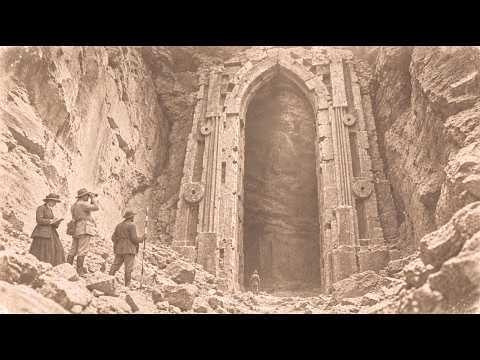
The Cherokee called the place Yahulai—the place of the man who crossed the threshold and did not come back. Nine years earlier, an eighty-five-year-old Cherokee man had told an ethnologist about a doorway at the head of a creek above Dahlonega, a threshold a man once stepped across and never returned from. That conversation was never published. The arch was measured, sketched, and sealed within a week. For seventy years, the two records sat in separate files, each unaware the other existed.
That is where this story begins. But before we can understand what was found behind the stone, we need to understand the mine itself—and the men who dug into the mountain, and the people who were driven out of it.
Today, Dahlonega is a small town about an hour north of Atlanta, at the foot of the Blue Ridge Mountains. An old courthouse stands on its square, and the ridges around it are thick with oak, poplar, and mountain laurel. East of town runs a narrow, cold stream. Its name is Yahula Creek. In this story, the name of that creek matters. We will come back to it.
The name of the town is a translation, too. Dahlonega comes from a Cherokee word meaning yellow—the color of gold. Because these ridges are where America’s first great gold rush happened. In 1829, twenty years before California, gold turned up in the streams of these valleys. Within a few years, tens of thousands of people had poured into the mountains. The creeks were torn apart by pans, sluices, and pits. In 1838, the federal government opened a mint in the town. The gold coins struck there carried a small letter D. And before the Civil War shut it down, that mint turned out more than six million dollars in gold.
That same year, the people who owned this land were driven out of it. The Cherokee had lived in these mountains for centuries. The valleys of North Georgia, western North Carolina, and East Tennessee were full of their towns, their fields, and their council houses. Once gold was found, the state of Georgia gave Cherokee land away to white settlers by lottery. In 1838, the army came. Thousands of Cherokee were rounded up into camps and marched west to what is now Oklahoma. That march is called the Trail of Tears.
But the Cherokee did not disappear. Today, the Cherokee Nation and the United Keetoowah Band live in Oklahoma. And the Eastern Band of Cherokee Indians lives in the mountains of North Carolina. And the stories they tell about these mountains went west with them into exile.
By the 1850s, the gold rush had burned out. The easy gold was gone. What remained was locked inside hard quartz veins, and it could not be taken without breaking the rock. In 1899, a group of investors came back to Dahlonega. They bought roughly seven thousand acres and founded the Dahlonega Consolidated Gold Mining Company with five million dollars in capital, just east of town. They built the largest gold plant ever raised east of the Mississippi. A four-story mill, 120 stamps inside it, each weighing 840 pounds. It could crush 600 tons of rock a day. Tunnels hundreds of feet long were driven into the mountain.
The rock in these mountains does not give itself up easily. The Dahlonega gold belt is made of dark schist and gneiss, crushed and folded over millions of years. It splits into thin sheets, glitters with flakes of mica, and runs from dark gray to the brown of rust. The gold lies in white quartz veins that cut through that dark rock. A miner follows those veins. When a vein disappears, he works blind through the rock, listening to it, watching its color.
That detail matters because the stone found inside the mountain looked nothing like this rock.
To do the work, the company brought in men from the west—engineers, surveyors, and foremen trained in the hard rock mines of California and Colorado. The first record in this story belongs to one of them. His name was Nathaniel Pell.
He was born in 1859 in the gold camps of Grass Valley, California. His father had worked in a quartz mill. At seventeen, Pell went to work as an apprentice on a survey crew, and he spent the next twenty-five years inside mountains, measuring angles and distances by lantern light. In 1899, at forty, he came to Georgia with the engineers the Consolidated brought east.
People who knew him later described him as quiet, exact, and incurious. He never married. In the evenings, he read star charts and he wrote everything down. Pell’s job was to survey every tunnel the company drove into the mountain and put it on a map. The bearing, the grade, and the length of each tunnel, the thickness of each vein. He kept it all in pencil in a pocket-sized field book bound in leather—a number, a short description, and when needed, a small sketch. No commentary.
In October 1900, the company was driving its Number Four adit into the ridge above Yahula Creek. The tunnel entered the mountainside on the level and followed a quartz vein westward, about 140 feet beneath the surface. The crew drilled by hand, blasted with black powder, and advanced about three feet a day. On the morning of Tuesday, October 16th, they were 310 feet in from the portal.
The crew boss was Andy Satterfield, a Lumpkin County man. He had four men under him that morning—two drillers, a mucker to shovel the broken rock into the car, and a boy who kept the candles lit. Old miners had a habit of sounding the face before every blast. A man strikes it with a hammer. Solid rock answers short, dry, and dead.
Satterfield struck, and the sound hung in the air. He struck again and heard the same sound—deep, hollow, ringing somewhere behind the rock. He stopped the work and sent word to the surface.
Pell was at the portal running surface elevations. He went in with a lantern, a leveling rod, and his field book. He ran his own hands over the face. He heard what Satterfield had heard. The first line in his book read, word for word: “310 ft. Face sounds hollow. Not a water pocket. Volume large.”
That afternoon they set a small charge. When the dust cleared, a ragged hole about four feet across had opened in the face. Behind it was darkness. The lantern light fell away downward. The floor of whatever they had broken into lay six feet below the floor of the tunnel.
Pell went first. That was his job. He would decide what they were dealing with before anyone widened the hole. Two men took him by the arms and lowered him through. His boots touched stone.
Years later, the shift foreman, Wyatt Chastain, would describe that moment. Pell went down and said nothing. A minute passed, then two. The men above called to him, and Pell did not answer. At last he said one sentence: “Send down another lantern.”
Chastain carried that sentence for thirty-six years, because the lantern light was coming back off a wall of cut stone.
The second line in Pell’s book was shorter. Walls dressed.
Pell took the second lantern and walked. The corridor ran dead straight. The walls looked like a single solid mass until the lantern came close and the light ran across the surface. Only then did the joints appear. Vertical joints about every four feet. Horizontal courses eighteen inches high. Clean squared blocks—the kind found on the front of a church. The floor was paved in the same pale gray stone.
At the end of the corridor, the lantern light struck a curve. Pell had seen the arch from the far end of the passage, but as he later told Chastain, his eye only accepted it once he had walked right up to its foot. He looked up and found the keystone where his lantern light barely reached. Twenty-five years of habit let him judge the height by eye. Then he extended his rod, fitted its three sections together, and measured.
The third line in his book held the number this entire story rests on. Arch true half round. Keystone inside height to underside of key: 16 ft 0 in. Pell did not round to the half foot. He did not round to the inch. He wrote zero.
And at the bottom of that same page, in pencil, there was a fourth line that had clearly been added later. That line would one day persuade the woman who found this file seventy years on to give the last twenty years of her life to this arch. The fourth line was a single sentence, and it ended with a question mark. In twenty-five years of Pell’s field books, there is no other question mark anywhere.
Sill worn hollow at center two and a half in. Not water feet?
We will come back to that. First, the arch itself.
Pell’s pencil never answered that question. The company sealed the corridor within a week, and the mountain closed its mouth. But the record refused to stay buried. Seventy years on, a librarian named Frances Hail laid Pell’s drawing beside a page from Mooney’s 1891 notebook—a half circle, two rings on either side, four in all—and wrote in the margin: The same hand could not have drawn both. The same thing could have made two hands draw it.
Hail died in 1991, her manuscript unfinished. Her nine boxes sit in a university library, holding Pell’s typed pages, Mooney’s single sheet, and a photocopy of an envelope that once held three photographs nobody ever found. North of Dahlonega, Yahula Creek now lies behind a dam, its old path under a lake that holds the town’s drinking water.
And behind a concrete wall with 1935 scratched into its mortar, the corridor is still there. The arch still stands. The sill still lies where Pell left it, hollowed in the middle. Pell gave it a measurement. Waford gave it a name. Leadford gave it a temperature. None of them gave it an answer.
Doors are not made to be used once. A threshold wears down because it is crossed again and again, going and coming back. If you know these mountains—if you have seen the stone enclosure at the head of the Yahula, or heard a story told on these ridges about a threshold—tell it in the comments. Half the record of this story is still in the mouths of living people.
And one question remains: whose feet wore that threshold down two and a half inches—and the last time they crossed it, which way were they going?
Report this article
Select a reason for reporting:






