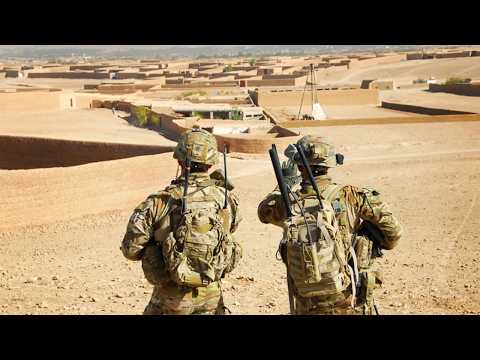
The heat hit first—a suffocating weight pressing down on the small American base near Khas Uruzgan. It was late August 2008, and the air shimmered above dirt the color of dry bone. Green Berets had learned to sleep light, knowing the hills belonged to the enemy after dark. No one said it much. They didn’t have to.
Then the Australians arrived. Four teams of SASR operators, six men each, flown in to hunt a Taliban leader who had already vanished. Their ride home was days away. Most men would have rested. These men didn’t.
Their team leader, Sergeant Troy Simmons, found the American commander and asked a simple question: “While we wait, is there anything we can do to help?”
The Americans had heard the stories about the SASR—men who could lie still in the dirt for days, patient as stone, deadly as a heartbeat. Hearing a story is one thing. Watching it happen is another. They said yes.
By next morning, the plan was set. An Australian sniper and his spotter slipped out past the wall before dawn, smeared dirt on their faces, and walked into enemy country. An American went with them to watch.
He found a rise and settled in beside the man with the long rifle. The Australian lay flat, so flat he seemed to become part of the earth. Sweat ran down his neck. He didn’t wipe it. He breathed slow, then stopped—the way a hunter stops—and waited.
The American didn’t understand it yet. Lying in the open, heat building, hills full of men who wanted you dead—that took a kind of patience he had never seen. He had fought in hard places. He thought he had seen the best. He was about to learn otherwise.
Below them stretched open ground, dry and flat, no cover. The Australians had picked it on purpose. They knew the enemy used it. Hour after hour, the sun climbed. The American shifted and sweated and checked his watch. The Aussie beside him didn’t move at all.
Then three men stepped into the open. Rifles in hand, heads down, walking fast. They thought they were alone. They were wrong.
The Australian breathed out slow and went still. Three shots. The American barely saw the sniper move. One man fell, then the next, then the last. It was done in seconds. The Australians hadn’t made a sound until the rifle spoke.
The American had seen plenty of fighting. He had never seen it done quite like this—this calm, this exact, this cold.
But the day wasn’t over. Word came fast: more Taliban were moving, coming to collect their dead. The Americans shifted position and waited. Soon a vehicle appeared, six men inside, sure no one was watching. A wall of 40-mm grenades tore it apart. All six killed. Later they learned one was a Taliban commander for that region.
Nine enemy dead. Not one scratch on the men at the base.
That night, Americans and Australians ate together in the dark. A quiet settled between them—the quiet of respect. If you had to pick the night the Americans changed their minds about the Australians, it was this one.
They had stopped wondering if the stories were true. They knew.
None of them knew what was coming next. In a few days, they would climb into vehicles before dawn and drive into a valley called Anakale, where up to 200 fighters were waiting in the hills. The hard part hadn’t even started.
The first ambush had worked. That was the problem. When something works in war, men want to do it again. The Americans and Australians looked at a map and saw another valley close by—one that ran east near a village called Anakale. Same kind of ground. Same kind of enemy. If a trap had worked once, why not twice?
They didn’t know the enemy had been counting their dead and was waiting for them to come back.
The date was the 2nd of September, 2008. The first day of Ramadan, a time the fighters in these hills took very seriously.
The plan started at 4:00 in the morning, when the cold was sharp and men moved by whisper. Two small teams of Australians slipped out on foot into the black and began to climb the hills on the north side of the Anakale Valley. They would set their ambush positions the same patient way as before—finding good ground, lying flat, becoming part of the land while it was still too dark to see them.
The rest would ride. Five armored Humvees lined up in the dark, carrying American special forces, Afghan troops, and around a dozen SAS operators. With them were two Australian engineers whose job was bombs—and the dog who helped them find them.
Her name was Sabi. A black Labrador, calm and steady, trained to sniff out hidden explosives that could tear a man in half. Keep her name in your mind. You will need it later.
The convoy rolled out before first light and turned east toward the valley. The idea was simple. The trucks would drive in and stir the enemy up. The enemy would move to attack. And when they moved, they would step in front of the Australian snipers waiting on the high ground.
It had worked only days before. There was no reason to think it wouldn’t work again.
The land didn’t feel like a battlefield. That was the strange part. As the light came up gray and then gold, the men rode past fields that looked almost peaceful. Birds. Running water. A farmer’s world asleep.
It was the kind of quiet that should have warned them. The Australians knew that quiet. They had been taught never to trust it.
The convoy pushed deeper. The valley narrowed. The hills on either side rose up and crowded in, and the open sky shrank to a strip above their heads. High walls on both sides. One road in, one road out. The men in the trucks felt it. Anyone who has been in a tight place with high ground all around feels the back of the neck go cold.
They gripped their weapons. They watched the ridges. They waited for nothing to happen the way it had not happened the last time.
But this time was not the last time.
The enemy was not three men crossing in the open by accident. The enemy was waiting. Somewhere between 100 and 200 Taliban fighters were spread across the high ground above the valley, hidden in the rocks and folds of the hills. They had machine guns. They had rocket launchers that could punch through a truck. They held every piece of ground that mattered.
And they had let the small convoy drive right into the middle of them—the way a man lets a fish swim deep into a net before he pulls it tight.
37 men were in that valley. Up in the hills, more than 100 guns were trained down on them.
Let that number sit for a moment.
Then everything turned to fire.
It came from every side at once. Machine guns opened up from the high ground, long ropes of fire pouring down into the valley. Then the rockets came—RPGs fired from the rocks above, screaming down and bursting against the ground and the trucks. The noise was huge. It filled the whole valley and bounced off the hills and came back doubled.
One moment the convoy was rolling through a quiet green valley. The next, it was sitting in the middle of a storm of bullets and fire with nowhere to hide.
The men in the trucks did the only thing trained men can do. They fought back. Doors swung open. Soldiers dropped out and used the heavy armor as cover, firing up at the ridges, trying to find the muzzle flashes among the rocks. The Australians on the high ground—the snipers who had crept up in the dark—were now caught in a far bigger fight than the trap they had planned.
Bullets came in so thick that one man later said it was like rain falling on water. The ground around them danced where the rounds struck.
Among the Australians in the trucks was a young trooper named Mark Donaldson. He was not famous yet. He was just one more SAS soldier in a bad spot doing his job. He had already had a hard few weeks—back on the 12th of August, only days before, the truck he was riding in had hit a hidden bomb and he had been wounded. Not badly enough to send him home.
Now here he was again, in the worst fight of his life, with the enemy on three sides and then four.
Later he would remember the machine gun fire, the heavier guns underneath it, and the rockets flying through the air. He remembered all of it. The enemy did not just hit them once and run. They held on. This was what the Australians later called a rolling ambush—fighters in the hills did not stay in one place, but moved with the convoy, following along the high ground and firing the whole way.
There was no clean break, no quiet moment to catch a breath. Every time the trucks pushed forward, the guns above pushed forward too. The valley would not let them go.
In the middle of all this, Donaldson made a choice that most men would never make. The wounded needed time—time to be pulled to cover, time to be lifted into the trucks. To buy that time, someone had to take the enemy’s attention.
So Donaldson stood up on purpose. He moved out where the enemy could see him, and he let them shoot at him, so they would shoot at him instead of the hurt men behind him.
He moved from one spot to the next, firing back with rockets and with his rifle, drawing the fire onto himself. It was a simple, terrible kind of brave. He made himself the target, so others could live.
Slowly, under all that fire, the patrol began to pull back. But there was a problem. The trucks were filling up. Every seat, every space was taken by wounded men. There were so many hurt that the men who could still stand had no room to ride.
So they did the hardest thing of all. They got out and ran. They ran beside the moving trucks on foot through the open valley, while bullets cracked past them, while the enemy chased them along the hills. They had to cover about four kilometers like that—fighting and running, running and fighting, dragging the whole bleeding convoy out of the trap one slow meter at a time.
It took hours. Close to four hours of fire and dust and noise that never stopped.
And then, in the middle of the long retreat, someone realized that a man had been left behind. He was a coalition interpreter, an Afghan who worked with the soldiers, who spoke for them and helped them talk to the people of his country. He had been badly wounded. In the chaos of the moving trucks and the running men, he had not been loaded up.
Now he lay out in the open, alone, while the convoy pulled away from him and the enemy fire poured down. To go back for him meant crossing naked ground on foot with no cover into the guns.
The interpreter had only been with them a short time. Days, really. He was not Australian. He was not American. By the cold rules of war, no one would have blamed the patrol for leaving him.
But that is not how these men thought.
Donaldson saw him lying there. He did not wait to be told. He did not ask permission, and he did not look for help. He fixed his eyes on the wounded man lying out in the fire, turned away from the safety of the trucks, and then he was moving out past the last vehicle, running the wrong way back toward the enemy, alone, with the whole valley shooting at him.
There were about eighty meters of bare dirt between Donaldson and the wounded man. Eighty meters of nothing. No wall to duck behind, no ditch to drop into—just beaten earth with the enemy looking down on all of it.
Donaldson crossed it on foot, alone, while the guns in the hills did everything they could to bring him down. Bullets kicked up the ground around him. He kept going.
He reached the interpreter, who lay face down in his own blood, and he did not stop to think. He picked the man up, lifted that full weight onto himself, and carried him back across the same eighty meters, through the same fire, to the trucks. He laid the man down, and then, calm as anything, began to give him first aid right there, working on the wounds while the fight still raged around them.
Up on the high ground, the Americans and the Afghans watched it happen. They saw an Australian trooper run into open fire for a man who was not his countryman, a man he had known for only five days. Men who fight for a living do not forget a thing like that. You can fight your whole life and never see it.
They saw it that morning in the Anakale Valley.
The patrol kept pulling back. Inch by inch, meter by meter, the running men and the crowded trucks dragged themselves out of the trap. After close to four hours, the fire began to thin. The hills fell quiet. The enemy let them go, or could not follow any longer.
The convoy limped the rest of the way back toward the base, full of wounded, low on everything, but moving.
When the count was finally done, the price was clear. One American soldier had been killed. Another American was wounded. Nine Australians were hurt. At least one Afghan soldier was wounded, too. Thirty-seven men had driven into that valley before dawn, and more than a dozen of them came out with holes in them. By some counts, the enemy lost far more—somewhere between twenty and eighty fighters—though out there, no one ever knew the true number for certain.
What everyone did know was that they had been in one of the hardest fights Australian soldiers had faced since the Vietnam War decades before. Men who had seen a lot of war agreed on that.
And yet, against all of it, the wounded interpreter lived. So did every other wounded man the patrol carried out. Because the men in that valley would not leave anyone behind. All of them who were still breathing when the shooting started were still breathing when it stopped.
But there was one member of the patrol who did not come home that day.
In the noise and the fire, something had happened to Sabi, the bomb dog. Her handler, a soldier named David Simpson, had been hit. A rocket burst near him, and the metal pieces tore into his leg. That same blast broke the clip that held Sabi’s lead to his side. For a while, she kept running alongside the trucks, hurt herself by flying metal, brave and loyal, staying with her people as the bullets came down.
But somewhere in that long terrible retreat, in all that smoke and thunder, she was gone. The blast had frightened her off, and with her handler laid broken, there was nothing holding her to the men she loved.
When the patrol made it back and counted heads, Sabi was missing. Her handler was badly wounded and went off to be treated, but even hurt, even drugged against the pain, the loss of his dog sat heavy on him.
They searched. They looked everywhere a dog might go. They found nothing. The valley had swallowed her.
As the days passed and the searchers came up empty, the men began to face the hard truth. Out here, a lost dog in enemy country did not usually have a happy ending. Many of them quietly let go of hope. One of the senior men who knew her later admitted that he and a lot of others had given up on ever seeing her again.
So the battle ended with both grief and wonder mixed together, the way real war so often does. There was grief for the American soldier who would not go home, for the wounded carried out on stretchers, for a much-loved dog believed lost for good.
But there was wonder, too, at what these men had done. They had been outnumbered by maybe five to one. They had been caught in the worst kind of ground, in the worst kind of trap, and they had fought their way out and brought their wounded with them. Every single one.
For the Americans who had spent that week beside the Australians—watching first the quiet snipers and now this—something had settled into place that they would not put into plain words. They had come into the week with stories about the SASR. They were leaving it with something heavier than stories.
They had seen with their own eyes exactly what these men were made of, and the full weight of what that meant was only beginning to come clear.
So where did that respect come from? It was not born in that valley. It had been built year by year long before that week, and to find its roots, you have to go back to the very start of the war.
Go back to the end of 2001. America had been attacked. American forces poured into Afghanistan to hunt the men behind it. And among the very first soldiers to arrive beside them were Australians from the SASR. They came early and they came ready. While some other countries sent men who had to wait for trucks and gear, the Australians brought their own vehicles with them. From the first day, they could move. They could push out into the desert on their own and go looking for the enemy.
In those early days, the Australians worked beside the United States Marines in the south of the country. The man in charge of those Marines was a general named James Mattis. He would later become one of the most famous soldiers in America, but back then, he was simply the commander these Australians had to win over. They did it fast.
The SASR went looking for work the same way they would years later at that small base in Uruzgan. They told the Americans they could do something special. They could push deep into hard country in small mounted teams and bring back the truth about what was out there—where the enemy was, how many, and what they were doing.
Mattis let them try. What they brought back amazed his people. The intelligence those Australian patrols gathered, riding out from a desert camp called Rhino, was so good that the general’s own staff could hardly believe it. Mattis came to value the Australians greatly. He would later say they were a key part of those first hard months. That is a remarkable thing for an American general to say about another country’s soldiers. He did not have to say it. He said it because it was true.
So the men who fought beside the SASR in Uruzgan in 2008 were not the first Americans to be won over. They were part of a long line.
Why does one soldier come to respect another? It is not the flag. It is not the uniform. It is not a fine speech given far from the fighting.
Think about what the Americans at that base had actually watched happen in front of them. A sniper who could wait two days without moving. A patrol that asked for the worst job instead of the easiest. A trooper who ran into the guns for a stranger.
The books had already called the SAS elite, but books had nothing to do with it. Respect like that is earned in the field, in the hardest places, by what a man actually does when the shooting starts. That is the only coin it trades in.
And it went both ways. That is worth saying plainly. The Australians did not look down on the Americans the way men in different uniforms sometimes do. The Green Berets at that little base had been fighting in that valley for a long time. Holding ground far from help. Taking the enemy’s blows again and again, and standing back up each time. The Australians saw that, too.
When the big fight came in the Anakale Valley, it was not one army carrying another. It was Americans, Australians, and Afghans all in the same trap. All fighting the same enemy. All bleeding into the same dirt. An American soldier died there. Australians were wounded there. Afghan troops fought and were hurt there. The cost was shared. So was the courage.
That is how trust is really made between allies. Not in meetings far away, but in valleys like that one where men of three nations stood the same ground, and none of them broke.
It mattered beyond that single morning, too. Fights like Khas Uruzgan taught the people who run wars something important about how the Australians worked. Send them in small. Send them in early. Give them the hard jobs that need patience and skill—the watching and the hunting, the work no one else wants. Trust them to act on their own, far from anyone who could help them.
The SASR proved over and over, in the desert in 2001 and in that valley in 2008, that they could be trusted with all of it. That is why allies kept asking for them. That is why the ugliest work so often landed on their shoulders.
But there is a quiet truth under all this praise, and an honest story has to say it. Soldiers like this rarely talk about the men they fight beside in public. The Americans who watched the SASR at that base did not go home and give speeches. The verdict they carried was a private thing, traded in low voices—the kind of thing said in a quiet room, soldier to soldier, and nowhere else. Some of it never made it onto any page.
The official records tell you the dates, the units, and the guns. What they leave out is the judgment—the thing a soldier decides about the man beside him once he has watched him work. So the full measure of what those Americans took away has to be read between the lines. In their actions, in their choices, in the simple fact that they kept wanting these Australians beside them. That tells you plenty.
To find the rest, you have to follow the men themselves and see where their stories went from there.
Follow Mark Donaldson first, because his story did not end in that valley. What he did that morning—running eighty meters through massed fire to carry a wounded man to safety—did not stay hidden in a report. It was seen. It was written down, and it climbed all the way to the top.
On the 16th of January 2009, in the capital city, the trooper stood before the Governor-General of Australia, a woman named Quentin Bryce, and was given the Victoria Cross for Australia. It is the highest honor an Australian soldier can receive, given only for the rarest kind of bravery. Donaldson was the first Australian to earn it in about forty years. Forty years. Whole generations of soldiers had served and fought and come and gone without one of these being awarded.
The country took him to its heart. The next year he was named Young Australian of the Year. He was later promoted to Corporal. His face and his story became known across the nation—the quiet young man from Dorrigo, a small town in New South Wales, who had done something most people can barely imagine.
But Donaldson himself never seemed to think he was special. When people called him a hero, he pushed it gently away. He said he was a soldier, that he was trained to fight, and that he had simply done what soldiers do. About the man he saved—the Afghan interpreter he had known for only a few days—he was just as plain. He said, “His country’s soldiers do not leave anyone behind.” It did not matter, he said, that they had only known the man a short time. The interpreter was one of them. That was the whole reason. And to Donaldson, it was reason enough.
So what did the Americans really see that week? Not just skill with a rifle. Skill can be trained, and they had plenty of their own. What they saw was men who would not leave a stranger to die in the dirt. That is harder to teach than shooting, and far rarer to find.
And then there is Sabi. You were asked to remember her name, and here is why. The bomb dog who vanished in the smoke of the Anakale Valley—who most of the men had quietly given up for dead—was not gone after all.
For fourteen long months, she was simply missing, somewhere out in that enemy country, while the war went on without her, and her handler healed from his wounds and tried to make peace with the loss.
Then, late in 2009, an American soldier on patrol in Uruzgan saw something that made him look twice. A local Afghan man was walking along with a dog. Even from a distance, the soldier could tell this was no ordinary Afghan dog. It was a black Labrador, the kind that did not belong in those hills. He went closer. He brought the dog in, and when she was finally returned to the Australians, there was no doubt at all.
It was Sabi. After more than a year lost in a war zone, she was alive, and she was healthy. Which meant that somewhere along the way, someone had been caring for her.
Her return became a small, bright moment in a long, hard war. She came back to the Australian base just in time for a visit from the Australian Prime Minister himself, Kevin Rudd, who was photographed kneeling beside her along with the top American general in Afghanistan. The Prime Minister, lost for anything grander to say, simply called her a genuinely nice dog. After everything, that was the truth of her.
For her loyalty and her service, Sabi was given three medals. There is a park named after her, and a statue made in her shape that stands guard, quiet and faithful, the way she had been in life. She lived out her years in peace at home in Australia, far from the noise and the dust, and died in 2015 of an illness—an old dog by then, safe among the people who had never truly stopped looking for her.
So the patrol that drove into that valley before dawn came out changed, and the years that followed showed what each of them was. One trooper became a national hero who would not call himself one. One dog became a legend of loyalty who was loved by a whole country. And the wounded interpreter—the man no one would leave behind—lived because of it. Every wounded man the patrol carried out of that trap survived.
The Americans who fought beside them saw the start of all this. They were there for the run across that killing stretch. They were there when the dog went missing. They knew, before the medals and the headlines, exactly what these men were. And what they took from that knowing is the last thing left to understand.
The valley is quiet now. The fields of Anakale still lie green between the hard hills. And the water still runs the way it did before dawn on that September morning. The trucks are gone. The men are gone. But what happened there did not simply fade away when the last shot was fired. It stayed—the way the hardest days always stay—in the records, in the medals, and in the memory of the men who lived it.
The Battle of Khas Uruzgan became one of the names Australians used to mark this war. It sits in the history books beside the other hard fights. Remembered as one of the fiercest fights Australian soldiers had faced in more than thirty years. It is taught and written about and spoken of on the days when a nation stops to remember its soldiers.
The trooper who ran into the open became a household name. The dog who came home became a story parents tell their children. A park carries her name. A statue holds her shape. These are the ways a country insists we will not forget.
But the cost is part of the memory, too, and it should be. An American soldier died in that valley, far from his home, fighting beside men who flew a different flag. Nine Australians carried wounds out of it. An Afghan soldier was hurt. The years of war that followed Khas Uruzgan took more men still on all sides, in valleys with names most people will never learn. Australia fought in Afghanistan for a long time. And the distance from home did not spare the families who waited for sons and fathers who did not always return. To remember the bravery and forget the price would be a lie, and these men deserve the truth.
What lasts most, though, is harder to put on a page. This whole story began with a question. What did the Americans take away from that week beside the Australian snipers in Uruzgan?
The honest answer is that they never wrote it down in plain words for the world to read. Soldiers like that do not give speeches about each other. The verdict they reached was carried home quietly, in low voices, in the way one hard man speaks of another when no cameras are near. The official record tells us who fought and who fell. It does not tell us what was said between men in the dark after a battle like that.
And yet we can know the answer all the same, because the Americans showed it instead of saying it. They showed it when they trusted the SASR with the jobs nobody wanted, year after year, in the desert in 2001 and in that valley in 2008. They showed it when an American general said plainly that these Australians were a key part of the hardest early days of the war. They showed it when they kept wanting them close, kept asking for them, kept putting their own lives next to theirs in the worst ground a soldier can stand on. You do not do that for men you doubt. You do it for men you would follow.
That is the part the records cannot hold. A war diary can count the dead and name the guns, but it cannot weigh what one hard man decides about another in the dark after a fight like that. The Americans went home and most of them said nothing. They did not write it down. They did not stand up at dinners and tell the story. Some of them carried the names of those Australians the way you carry a debt you can never quite pay—quietly, for years.
The men who fell beside them in that valley were not Australian and not American by the time the shooting stopped. They were simply the men who had been there. And the silence those Americans kept afterward was not forgetting. It was the opposite. It was the kind of respect that does not need an audience. The kind a soldier saves for the very few he would have followed back into that valley without being asked.
So the men who came to that small base near Khas Uruzgan as hosts left it as something closer to brothers. They had bled in the same dirt. They had carried the same wounded. They had buried between them a friend. Whatever words they used afterward, and wherever they said them, the meaning was the same. They had found in the quiet Australians beside them the very best of what their own hard trade can produce.
The men of that patrol scattered after the war the way soldiers always do. They grew older. Some left the service. The young trooper raised a family and told his story so others could learn from it. The dog grew gray and slept in the sun. The valley went back to its farmers and its water and its strange, deceptive peace. And the Americans who fought there carried their private verdict home across the ocean, where most of them keep it still.
In the end, that may be the truest honor of all. Not the medals, though they were earned. Not the headlines, though they were deserved. But the quiet judgment of men who had seen everything war can show—men who did not hand out praise lightly, deciding in their own hearts that these Australians were worthy. They never had to say it out loud. The way they fought beside them said it for them. And it has been saying it ever since.
So now I put the question to you: when the record books fall silent and the medals gather dust, is it the courage we remember—or the quiet, unspoken trust between men who stood together when the whole valley was shooting at them? Tell me in the comments who you think should be remembered next.
Report this article
Select a reason for reporting:






