On the night of November 26, 1942, the streets of Brisbane became a battlefield—not against the Japanese, but between two allied armies. Over 4,000 Australian and American servicemen clashed in a brutal, bloody riot that spanned six city blocks. This wasn’t the war the history books told you about. It was a war within a war, fueled by resentment, inequality, and a single deadly gunshot that would be buried for decades.
The seeds of this explosion were planted months earlier, when American forces first arrived in Australia in early 1942. They came with money—an American private earned nearly three times what an Australian private made. Three shillings a day versus almost twelve. That canyon of pay disparity was just the beginning. Americans had access to luxuries Australians hadn’t seen in months: chocolate, cigarettes, nylon stockings, fresh fruit. They walked through Brisbane like kings, and they shared those luxuries—but not with Australian soldiers. With Australian women.
But the most offensive import wasn’t money or goods. It was Jim Crow. American forces operated under strict racial segregation, and white American military police enforced it with batons and fists on Australian soil. Australian soldiers, who had been fighting since 1939—through North Africa, Greece, Crete, and the jungles of New Guinea—found this alien and disgusting. They drank with black American troops, shared bars and stories, and refused to accept the American brand of segregation. That defiance enraged white American MPs.
“Overpaid, oversexed, and over here.” That phrase wasn’t a joke—it was a verdict. Australian veterans came home expecting gratitude and respect, only to find their city transformed: American accents everywhere, American money, American rules, and their girlfriends on the arms of men who could offer chocolate and stockings. The resentment simmered, then boiled.
By November 1942, Brisbane was a powder keg. Fistfights in pubs, confrontations in streets, arguments over women—the tension was no secret. Officers on both sides knew. Military police knew. Civilians knew. Everyone felt what was coming. Nobody stopped it.
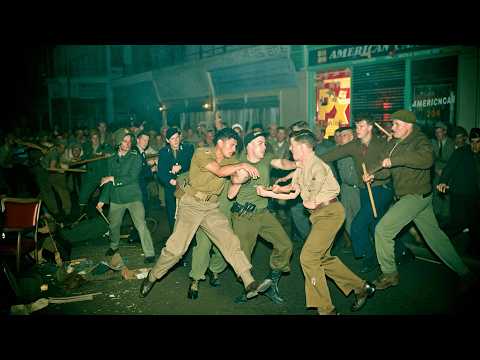
The match was struck on the evening of November 26th near the American PX on Creek Street. An Australian soldier approached the area. An American MP confronted him. Words were exchanged. The MP struck the Australian soldier. That single blow ignited a firestorm. Word spread like wildfire through pubs and barracks: “Your officer hit one of my men.” The language of sides being chosen. Within minutes, the crowd grew—50 to 100 to 500 to 1,000. Australians poured in from every direction, angry and ready.
The first phase was fists. Australian soldiers charged the MPs. Batons swung. Blood appeared on khaki uniforms of both colors. Then the Australians stormed the PX, destroying the symbol of American abundance—shelves overturned, stock scattered, displays shattered. It wasn’t greed; it was rage, pure and accumulated.
The riot spread beyond Creek Street, into alleys and doorways. Civilians locked their doors. Some watched from windows. Brisbane had seen nothing like this—not from the Japanese, but from the people who were supposed to protect them. Estimates put the number of fighting servicemen between 2,000 and 4,000. Half Australian, half American. Allies punching each other bloody while Japanese forces sat less than 2,000 miles to the north.
Then came the gunshot. American MPs, overwhelmed, escalated. An MP drew his weapon. The crowd didn’t stop. He fired. The bullet struck an Australian soldier—Private Edward Webster. He was unarmed, not attacking. He was part of the crowd, part of the chaos. He took an American bullet in an Australian city during a war against Japan. Within hours, he was dead.
An Allied soldier killed by Allied fire—not in combat, but in a street brawl. That fact should be famous. It isn’t. Because the Australian government suppressed the story. Not delayed, not downplayed—suppressed. Newspaper editors were told: no articles, no editorials, no photographs, no mention. The public was not informed that thousands had rioted, that an Australian soldier had been shot and killed by an American MP.
Why? Because the alliance mattered more than the truth. Australia depended on American military support for survival. Public outrage would jeopardize it. So the public must not know. No major Australian newspaper published a substantive account. A riot involving thousands, a death, hundreds of injuries—complete media silence. That happens by order.
Military records were handled with care. American accounts minimized. Australian accounts buried. Official reports were classified. For decades, the Battle of Brisbane existed only in the memories of the men who fought in it—and many didn’t talk about it. The injuries were extensive: hundreds treated for wounds, broken bones, lacerations. Medical files recorded “fights, altercations, falls”—falls. Hundreds of soldiers with combat-like injuries, all from falls on the same night, in the same city.
The cleanup began before dawn. Streets were cleared. Glass swept. Blood washed. Newspapers said nothing. By morning, Brisbane civilians walked to work unaware that their defenders had turned on each other with a fury that had nothing to do with Japan.
But the story doesn’t end there. The men who rioted weren’t criminals or troublemakers. They were veterans of Tobruk, Greece, and the Kokoda Track—combat soldiers, tested and blooded. They still rioted. That tells you everything about how intolerable the situation had become. When soldiers who have endured everything war can throw at them decide the greater insult comes from their own allies, the case is closed.
And yet, the evidence keeps building. The racial dimension: Australian soldiers repeatedly clashed with American MPs over the treatment of black troops. In one documented incident, Australians physically intervened when MPs tried to remove black soldiers from a bar. They told the MPs, in direct and profane language, that in Australia, any soldier could drink in any bar. Period. That defiance threatened the entire American segregation system.
By late 1942, approximately 100,000 American personnel were stationed in and around Brisbane—a city of 300,000. One in four people on the street was an American soldier. For an Australian soldier coming home on leave, his city had been transformed. The accents, the uniforms, the money, the rules—all different. The women were the same, but their attention had shifted. Home didn’t feel like home anymore. That loss, that displacement, sat in the gut and built until it detonated.
After the riot, military authorities scrambled to contain the damage. American commanders were furious—not at their own MPs for shooting an Australian soldier, but at the breakdown in discipline. Australian commanders were caught between outrage and strategic necessity. Meetings were held behind closed doors. The solution was twofold: suppress the press (already done) and separate the forces. Leave schedules were staggered. Areas were designated American or Australian. They didn’t fix the problem—they hid it.
No court-martial was ever held for the shooting of Private Webster. An American MP fired into a crowd of Allied soldiers, killed one, and faced no trial, no public accountability, no consequence. The evidence of institutional protection is as damning as the riot itself. A soldier died. The shooter was identified. Nothing happened. Because the alliance required silence—and the alliance got silence.
The Battle of Brisbane was not isolated. Similar clashes occurred in Melbourne, Sydney, and Townsville—driven by the same forces. The cumulative evidence: a pay gap of three to one, access to luxury goods, enforcement of racial segregation, years of combat service treated as invisible, demographic displacement, escalating violence, a precipitating strike, a riot of thousands, a shooting, a death, no trial, press suppression, institutional cover-up, decades of silence. Fifteen pieces of evidence. Each one damning. Together, they form a case for one of the greatest betrayals of the Australian public during the war—not by the enemy, but by their own government in service of an alliance that demanded Australian blood but could not tolerate Australian anger.
The Battle of Brisbane lasted approximately eight hours. The suppression lasted decades. The consequences never produced a formal inquiry, never produced official recommendations, never produced a public apology from either government. The Australian soldiers who fought that night went back to war. They fought at Buna. They fought at Borneo. They fought beside Americans because the war required it, and because they were soldiers, and soldiers follow orders—even when those orders placed them beside the men whose comrades killed one of their own on a street in Brisbane.
They fought. They did not forget. And neither should you.
But here is the part that rarely makes it into the retelling. The Battle of Brisbane did not end when the sun came up on November 27th. It ended when the men who had been there put down their fists, straightened their uniforms, and walked back into a war that had no room for the truth of what they’d just done. The official version of that night—the one that never got written—died in the offices of censors and commanders who understood exactly what they were burying.
Consider what it took to keep the silence. Not one newspaper. Not one radio broadcast. Not one official communiqué. In a city of 300,000, with thousands of soldiers involved and hundreds wounded, the story simply vanished. That is not the natural behavior of information. That is the product of deliberate, coordinated effort. Someone, somewhere, made a decision: the public would not know.
The men who carried Private Webster’s body to the hospital knew. The doctors who signed the death certificate knew. The MPs who fired the shot knew. And every one of them was told, in one way or another, to keep their mouths shut.
What makes the cover-up so revealing is not just that it happened—it’s what it tells us about the priorities of the Allied command. A soldier was dead. An Australian soldier, killed by an American bullet, on Australian soil, during a war that was supposed to unite them. And the response was not justice. It was damage control. The alliance had to be protected. The truth had to be sacrificed.
And so the story was buried so deep that for decades, most Australians had no idea it had ever happened. It wasn’t in the school textbooks. It wasn’t in the war memorials. It wasn’t in the ANZAC legend that every Australian child grew up hearing. The Battle of Brisbane became a ghost—present in the memories of the men who lived it, absent from the record of the nation that sent them there.
But ghosts don’t stay buried forever. In the years after the war, fragments began to surface. A veteran would mention it to his son, late at night, after a few drinks. A letter would surface in a family archive. A researcher would stumble across a military file that hadn’t been properly destroyed. Piece by piece, the truth clawed its way back into the light.
And when it did, it raised a question that Australia has never fully answered: why did the government choose silence over justice? The answer, uncomfortable as it is, is simple. Because the alliance was more important than the truth. Because American support was more valuable than Australian accountability. Because in the calculus of global war, one dead Australian soldier was a rounding error.
Private Edward Webster was not a rounding error. He was a man. He had a family. He had a life before the war. And he died in the street of his own city, killed by the bullet of an ally, and no one ever answered for it.
That is the wound that never closed. Not the riot itself—wars produce riots, armies produce brawls, alliances produce friction. The wound is the silence. The wound is the knowledge that the men who sent Webster to war decided, in the aftermath of his death, that the truth was too dangerous to tell.
The Battle of Brisbane was eight hours of violence. The cover-up was decades of silence. And the men who fought that night—the Australians who stormed the PX, the MPs who swung their batons, the soldiers who watched it all unfold—carried the memory of it for the rest of their lives. Some of them spoke. Most of them didn’t. The ones who did were often met with disbelief, or worse, with the suggestion that they were exaggerating, that they had misunderstood, that the war had made them see things that weren’t there.
But the men who were there knew what they saw. They knew the sound of Australian boots on Creek Street. They knew the smell of smashed chocolate and spilled Coca-Cola. They knew the face of the MP who fired the shot. And they knew, with the cold certainty of soldiers, that the truth had been traded for an alliance.
Private Webster’s grave carries no mention of how he died. No plaque explains the riot. No museum exhibit tells the story of the night Brisbane’s defenders turned on each other. The silence outlived the men who kept it.
So the question remains, unanswered and uncomfortable: if a government will bury the death of one of its own soldiers to protect an alliance, what else will it bury? And what does it say about us that we only learned the truth decades later, from the reluctant memories of old men?
Private Webster is dead. The record is still mostly silent. The evidence rests. But does silence ever truly close a wound—or does it just teach the next generation to stop asking? What do you think?
Report this article
Select a reason for reporting:






