It’s 2 a.m. in the mangrove swamps southeast of Saigon, and seven men lie motionless in mud that swallows them to the waist. Their faces are painted green and black, and mosquitoes feast on every inch of exposed skin. But no one swats. The sound of a slap carries too far over water at night, and the men they’re waiting for could come gliding down this creek at any moment. These are Navy SEALs—America’s most elite warriors—and if you could crawl close enough with a red-lens flashlight, you’d notice something bizarre about their uniforms. Blue jeans. Ordinary Levi’s, the kind a teenager might wear to a drive-in movie. And underneath, pulled up from toe to waist, a pair of women’s nylon pantyhose.
No one issued them. There’s no supply number, no manual, no training guide that mentions them. The men got them on their own—from the base store, or through the mail, from wives and mothers and girlfriends who must have wondered what the hell was happening over there. And they chose them over the uniform that the U.S. government had designed, tested, and paid for specifically for this war. So why? Why would the most elite naval unit enter one of Vietnam’s deadliest swamps wearing clothes you could buy at any department store?
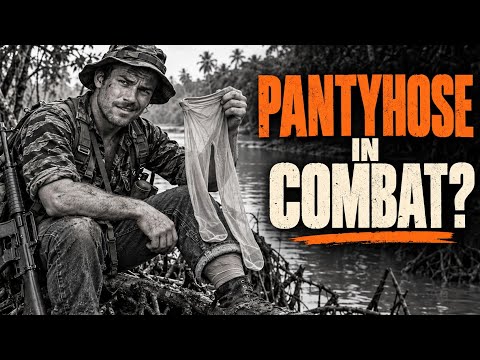
The answer involves mud that can pull a boot off a man’s foot. An animal with three jaws and saliva that prevents blood from clotting. A pair of trousers designed for miners and laborers nearly a hundred years earlier. And a truth about war that official histories rarely pause to consider: the people who design the equipment have often never set foot in the place where it will be used. And the men who have to use it are usually the first to figure that out.
To understand the pantyhose, you first have to understand the swamp. Between Saigon and the South China Sea lies a region called Rung Sat. The Americans who fought there usually translated the name as “Forest of Assassins.” And whatever linguists say about that translation, it had earned the reputation behind it long before any American arrived. For generations, it had been a haven for anyone who needed one. Smugglers, bandits, river pirates, and rebels. In the 1950s, it sheltered the Binh Xuyen, a criminal army that once ran Saigon’s casinos, brothels, and opium trade—and even the police for a time. When the new South Vietnamese government finally broke their power, the survivors fled into the mangroves. The swamp swallowed them as it swallowed everyone.
By the time the Americans came, the area belonged to the Viet Cong. From the air, Rung Sat looks like a green stain threaded with brown veins. Hundreds of square miles of mangrove forest, nipa palm, and mudflats interlaced with rivers, creeks, and canals that split and join and dead-end in every direction. There are almost no roads and almost no dry ground. Twice a day, the tide rushes in from the sea and then retreats again. So the same creek that might float a boat at dusk could become a ribbon of thigh-deep mud by midnight.
Running through the middle of this maze was South Vietnam’s most important waterway. The Long Tau River was the main shipping channel to Saigon. A huge portion of what the war effort consumed—fuel, ammunition, food, vehicles—arrived by sea and had to thread its way through that winding passage to reach the port. Cargo ships and tankers passed close enough to the banks that a man hiding in the mangroves could see the faces of the crew. The Viet Cong could wait in that green wall with a rocket launcher, fire on a passing ship, and vanish before anyone knew where the shot came from. They mined the channel. One large ship sunk in the wrong place could choke the capital’s lifeline.
Someone had to go into the Forest of Assassins and take it back. Large units were nearly useless there. Tanks and trucks couldn’t move. An infantry battalion could hack its way in, sink to its thighs in muck, find nothing, and leave—only for the enemy to return the next night. What the Navy needed was a handful of men who were at home in the water, at home in the dark, and at home operating far from anyone who could help them. As it happened, the Navy had just invented them.
The SEAL teams were barely four years old. Established in January 1962, one team on each coast, with members drawn from the Navy’s Underwater Demolition Teams—the frogmen who had swum into enemy beaches in World War II before amphibious landings to scout obstacles and blow them up. President Kennedy wanted forces built for the kind of wars he believed were coming. Guerrilla wars fought by small groups in places big armies couldn’t reach. The Army had the Green Berets. The Navy created the SEALs, a name derived from the three environments they operated in: Sea, Air, and Land.
In early 1966, a small detachment of SEAL Team One set up at Nha Be base on the edge of Rung Sat and began penetrating the swamp. Soon SEAL Team Two sent its own platoons to operate in the wider Mekong Delta. They were never many. A platoon had 14 men and usually worked in two groups of seven—sometimes fewer—going out at night into territory where every hut, every boat, and every row of trees might belong to the enemy.
Their war was never like the big-unit war fought elsewhere in Vietnam. They didn’t do sweeps. They waited. They slipped off a boat after dark, waded through water to a spot where intelligence said the enemy moved, set an ambush, and stayed there in the mud and water for hours, sometimes all night. Sometimes no one came. At dawn, they’d quietly return to the boat and try again somewhere else. Sometimes a boat loaded with men and weapons would glide down the creek, and their night would erupt.
It worked. The Viet Cong, who had always considered the swamp their own, began to feel hunted in it. They gave the SEALs a name that stuck: the men with green faces.
But look at what this style of fighting demanded. The SEALs didn’t just cross Rung Sat; they lived in it, night after night. They crawled through it, lay in it, sank into its mud, and waited in it without moving—then had to explode out of it and fight. No soldier’s clothing was really designed for that. The SEALs quickly discovered theirs wasn’t either.
The standard American uniform in Vietnam was the jungle fatigue. To be fair, it was a carefully designed piece of gear. The Army had learned hard lessons in the Pacific jungles, and the jungle fatigue reflected them. It was light and loose, to let air pass across the skin. Later versions used ripstop fabric. It had large chest pockets and wide cargo pockets on the thighs, so a soldier could carry maps, bandages, and ammunition without digging through his pack. For an infantryman on a mountain trail, it did its job.
But in Rung Sat, there were no trails. Think about those thigh pockets from the perspective of a man spending his nights in tidal mud. The cargo pocket is designed to expand. That’s the whole idea. It opens to hold more. And in deep water and soft mud, it opens and holds more whether you want it to or not. A man could come out of a mangrove creek with his thigh pockets packed like little sandbags. The loose fabric floated in the water, snagged on roots, and became a drag. And the light fabric that breathed so comfortably on a dry trail was torn apart by the swamp’s actual contents. Roots hard as iron, sharp shells, snags, and cutting grass.
Now imagine the moment of contact. You’ve been lying still for five hours. Your legs are half-asleep and partly submerged. Shooting starts, and one second later you have to get up and move to a new position, to the boat, to anywhere but here. Anything that slows that first step is a problem. Anything that snags or catches or drags could be the reason you die.
So some of the men who went into Rung Sat reached a conclusion that sounds absurd but was deadly serious. They wanted trousers with fewer features—and they found them in the most American garment ever made.
In 1873, a dry goods merchant in San Francisco named Levi Strauss and a Nevada tailor named Jacob Davis received a patent for work trousers reinforced with copper rivets at the points where pockets tear. Their customers were miners, teamsters, and laborers. Men who knelt in dirt, crawled through tunnels, and wore their clothes until they fell apart. The fabric was heavy cotton denim, tightly woven and dyed indigo. The company’s flagship design eventually took a number that would outlive everyone who made it. 501.
Those trousers had gone to war once before. During World War II, the U.S. government treated denim as a war material. Levi’s were classified as essential, and for a time they were sold only to people working in the defense sector. Thread was so strictly rationed that the company stopped stitching the famous double arc on the back pockets and painted it on instead, so that not one meter of thread went to decoration while there was a war to win. And men improvised their uniforms in that war as fiercely as any SEAL would ever do. In Normandy, American tank crews cut steel from German beach obstacles and welded it onto the front of their Shermans, turning them into machines that could break through the hedgerows. In the jungles of Burma and New Guinea, men burned leeches off their legs with cigarette butts and wrapped their ankles in anything that might keep the leeches from reaching them.
Across Europe and the Pacific, soldiers traded, collected, modified, and built everything the supply chain never thought to send. Most of it was never written down. For every trick that reached the history books, there were thousands that lived and died inside a single platoon. A solution one man reached on a Tuesday, told his buddies about on Wednesday, and carried home without ever telling anyone else for the rest of his life. One trench out of hundreds of thousands, one patrol out of millions. The same kinds of stories repeated endlessly in places no one ever pointed a camera at. Most of them lost forever.
I once told 11 stories from that war here on this channel. Each one complete from beginning to end. I recorded them myself. And today, they exist in only one place. An audio collection called Behind the Wire. It’s about 6 hours of narration, all 11 stories complete, with a companion booklet to keep beside you as you listen. If you want more of that war in the same style I tell it here, the link is in the description. And those 11 stories aren’t anywhere else.
By the time the SEALs reached the Rung Sat mangroves, the 501 had become the uniform of a very different America. Cowboys and factory workers, cinematic rebels on motorcycles, and college students. But its basic structure hadn’t changed much. It was still made of heavy, tightly woven cotton. It was still cut to follow the shape of the leg rather than hang away from it. Its pockets were small, shallow, and flat against the body. In Rung Sat, suddenly every one of those old design choices mattered enormously. The tight denim didn’t balloon in the water the way loose fatigues did. The small pockets had almost no room to fill with mud. The heavy fabric resisted the roots and shells and grass that shredded lighter cloth. And the men discovered that jeans could survive operations that left standard fatigues in rags.
When a man came out of a creek, he simply had less wet, loose fabric clinging to his body. It wasn’t a perfect solution, and it’s honest to admit that. Wet denim is heavy and dries slowly. No one starting from scratch would design jeans for a tropical war. But Special Forces operators weren’t choosing between jeans and some ideal fantasy uniform. They were choosing between jeans and what they already had. And given the way they fought, plenty of them decided that trousers made for nineteenth-century miners beat the ones made for them.
Photos of Special Forces from those years often show the result. Camouflage on top, blue denim below—looking more like a crew of heavily armed river fishermen than a military unit. The camouflage tops tell their own story. Many Special Forces men favored tigerstripe, a pattern of bold black and green stripes that was never part of the standard American uniform. Much of it was made by Vietnamese tailors in small shops and bought locally through channels no one scrutinized too closely. Some men swapped their boots for light canvas shoes or dive booties, because Delta mud would swallow a heavy boot right off a man’s foot and keep it.
How did an elite unit get away with wearing clothes from market stalls and mail-order catalogs? Because Special Forces platoons lived by rules that differed from the rest of the Army. They were small units. Their officers went out on operations themselves, and they were judged almost entirely on results. An infantryman who showed up for inspection in jeans would have had a very bad day. A Special Forces operator who showed up in them for a night ambush and came back with the job done had made a purely professional decision. What you wore in the swamp was your own business as long as it worked.
Which brings us to what was underneath the jeans.
There were leeches in the jungles of Rung Sat. For most soldiers, leeches were a disgusting nuisance. For the SEALs, their style of fighting turned that nuisance into something far worse. A man lying motionless in warm water for five hours, breathing and sweating and radiating heat, isn’t a moving target. He’s a beacon. Every leech in the neighborhood has all night to find him.
And a leech doesn’t need a large opening. A wide trouser leg is a front door. A gap at the waistband is another. The tightly woven nylon of pantyhose, stretched from toe to waist, left no door at all. No cuffs, no gaps, no edge to crawl under. The fabric was too fine to bite through.
Wear tight jeans over them, and you had a second layer pressing everything flat, with no loose folds for anything to hide in. The principle still works today. Trekkers in leech-infested rainforests wear leech socks—tightly woven fabric pulled over the trousers and tied below the knee. Same idea.
Then came the matter of actually getting them. A SEAL might find pantyhose at the base store, but more often the request went home by mail. Picture that letter. A wife in San Diego, or a mother in Virginia, reads the war news every morning, waits for word from a man in one of the most dangerous places on earth. The envelope arrives. He’s fine. The food is terrible. And then he asks her, as soon as possible, to send several pairs of pantyhose, large size. We’ll never know how many of those kitchen-table conversations happened in the late 1960s. But you can imagine the long silence that followed.
The men who wore them took their share of ridicule, of course. But the jokes always ended at the same point. After a long night in the water, the man in the pantyhose peeled off his gear and found his legs mostly clean. The man who’d mocked him was picking leeches off places he preferred not to describe. No one had to issue an order. The idea spread the way good ideas always do in combat units. One man tried it, it worked, and the men around him noticed.
The SEALs weren’t the only ones fighting a private war against water. Across the Mekong Delta, the Army and Navy were learning the same lessons on a larger scale, paying for them with their feet. Delta is rice country—vast, flat, flooded with paddies and canals. Marines there could spend whole days waiting. Medics called what happened to their feet “immersion foot.” The men called it “paddy foot.” Skin kept wet for long periods begins to break down. It wrinkles, swells, turns white, softens, then cracks and infects. Boots become instruments of torture. Eventually a man simply can’t walk.
The Army took it seriously enough to send doctors to the Delta to study it. What they found was sobering. After about two days of continuous wading, even the feet of healthy young men began to fail. Entire units could be quietly taken out of action—not by bullets, but by water. Commanders learned to pull their men out of the fields on a schedule and let their feet dry before sending them back in. Water set the rhythm of the war.
Individual soldiers fought back with the same instinct as the SEALs. They begged relatives for wool or nylon socks instead of military cotton, changed them at every stop, and dried the wet pair inside their shirts against their bodies. The Army adapted too, designing jungle boots with a new tread that shed mud instead of collecting it, and small covered drainage holes to let water out. Every soldier in the Delta knew the small plastic bottle of insect repellent that came in his supplies. Everyone called it “bug juice.” It was meant for mosquitoes, but the men quickly learned that a few drops on a leech made it loosen and drop off.
None of this means the people who designed the official gear were fools. A uniform is always a compromise. It has to fit the cook and the clerk and the infantryman, in the highlands and on the coast, in dry season and monsoon, and it has to be produced by the millions. The men in the worst corners of the Delta were living at the far edge of that compromise, where the standard answers stopped working. There, you didn’t need the standard solution. You needed a solution for that night.
Then, one by one, their tours ended and they went home. The SEAL teams kept rotating through Vietnam until the early 1970s, and the last American combat troops left in March 1973. The SEALs came home with a combat record wildly out of proportion to their small numbers, including three Medals of Honor. The official record documents some of it. It documents names, units, dates, and citations. But it does not document what those men wore. Open a service file from the Vietnam era and you’ll find ranks, schools, deployments, and awards printed on government forms. You will not find a line saying he wore Levi’s and women’s nylon pantyhose inside a forest of assassins, because the uniform filled with mud and the leeches ate him alive. None of it was official, so none of it was recorded.
It survives in memory, in a handful of photographs, and sometimes in the belongings. That’s the strange afterlife of any war’s equipment. Long after the men are gone, the things remain, stripped of their stories. A family cleaning out a closet finds a pair of faded jeans, stiff as cardboard, no one remembers wearing, and throws them away. A drawer holds a watch, a patch, and a folded scrap of striped cloth, and no one alive knows what any of it meant.
For the generation before the SEALs, it’s often worse. In July 1973, just months after the last combat troops left Vietnam, a fire broke out at the National Personnel Records Center in St. Louis, where military personnel files were kept. The fire destroyed millions of them, including most records of Army veterans discharged between 1912 and 1960. For countless families of men who fought in World War II, the official paper trail went up in smoke. Maybe one of those men was your grandfather. A name on the back of a photo, a uniform no one in the family knows the whereabouts of, and a box of things that meant everything to him and nothing to those who came after.
For families like that, I’ve put together a guide called Find Your Grandfather’s War. It shows how to reconstruct a soldier’s record from exactly those scraps: a name, a photo, and that box. It’s waiting for you below this video.
As for the men of Rung Sat, the lessons they learned in the mud didn’t stay there. The SEALs who survived Vietnam became instructors and officers, and eventually senior leaders in naval special warfare. They carried with them a conviction they’d learned the hard way. The people closest to any problem are usually the ones who understand it best. And the equipment should serve the mission, not the other way around.
Over time, that conviction found its way into law. In April 1980, an attempt to rescue American hostages in Iran ended at a remote desert landing site when a helicopter collided with a transport plane, killing eight servicemen. That disaster, and others after it, convinced Congress that U.S. special operations forces weren’t getting enough support from the larger military around them. In 1986, lawmakers ordered the creation of a unified command to oversee them. In 1987, U.S. Special Operations Command was born. One of its strangest features was that it had its own budget for equipment. For much of their specialized gear, special operators no longer had to wait for the Army or Navy to decide what they needed. They could identify the problem, find the solution, and buy it. In a sense, the logic of the base store and the letter home had become official policy. What a few Special Forces men had once done with their own money—deciding what worked and going after it—became the approach for the entire special operations world.
The jeans and pantyhose didn’t last long. Military clothing improved. Fabrics became lighter, tougher, and faster to dry. Modern fighters wear clothing designed specifically for the kind of place SEALs once faced in clothes from ordinary stores. But every one of those improvements answers a question first asked out loud by men lying in the mud of a forest of assassins.
Go back to that swamp one last time. It’s almost dawn. The tide has turned and is on its way back in. It fills the creeks and raises the water around the mangrove roots. The ambush is over. Maybe the night was quiet, maybe it wasn’t. Either way, seven men wait as the dark shape of a boat idles in the channel. One by one, they pull themselves over the side and sit heavily on the deck. Back at Nha Be, one of them peels off his heavy jeans, wet with water, and strips away the nylon beneath. There might be a leech or two clinging uselessly to the outside of the mesh. There might be a bite where something found its way in at the waist. But his legs are mostly clean. He washes them, eats something, and sleeps. Tonight he’ll go out and do it all again.
There’s a quiet paradox folded into all of this. The two items that helped him cross the swamp were never meant for soldiers at all. The first was designed in the 1870s for men digging in the dirt of the West. The second was born in the late 1950s and made famous by the miniskirt. Neither maker could have imagined a mangrove creek at 2 a.m. Yet together they did something the military uniform couldn’t. Somewhere, perhaps, a pair of those jeans is still folded on a closet shelf. Faded almost white at the knees from crawling. The denim gone soft where the mud dried. If so, it’s a truer record of that war than most official papers. So why did the SEALs wear pantyhose and Levi’s in Vietnam? Because the swamp didn’t care what the regulations said. And when their lives depended on it, neither did they.
What would you have done—follow the manual and risk the leeches, or improvise like these men? Tell me in the comments below.
Report this article
Select a reason for reporting:






