For nearly a decade, the six children of Albert Speer lived in a world where the most powerful man in Nazi Germany was simply ‘Uncle Adolf’—a neighbor whose front door was just a short walk through the forest from their backyard. They grew up on the Obersalzberg, inside Hitler’s restricted zone, their lives woven into the fabric of the Führer’s private world. Their father was Hitler’s chief architect, the man who designed the monumental halls of a thousand-year Reich, and later, his armaments minister, overseeing a war economy built on forced labor and complicity. But when Germany fell and Speer was sentenced to twenty years at Nuremberg, the family’s world collapsed overnight. They lost everything—except the name, which now carried the weight of millions of dead.
What happened next was supposed to be destitution. Margarete Speer, alone with six children in a requisitioned villa, had no income, no profession, and no future under her married name. Yet in 1948, she wrote a desperate letter to her husband’s former aide, Rudolf Wolters, asking for a hundred Reichsmarks a month just to cover school fees. That letter triggered something no one outside a tight circle was ever meant to know: a secret fund, the Schulgeld Fonds, quietly financed by the very industrialists who had profited from Speer’s war machine. These were men like Willy Schlieker, who would go on to build a shipbuilding empire, and others who had used forced labor in their factories and were now rebranding themselves as pillars of West Germany’s economic miracle. The same hands that had signed wartime contracts were now writing checks for school uniforms and textbooks. The network that built the war economy was raising the war criminal’s children, and the silence around it was a small-scale version of the larger lie post-war Germany told itself.
The money kept the children fed and educated, but it couldn’t answer the questions they were starting to ask. For twenty years, Albert Speer sat in Spandau Prison as prisoner number five, and his children grew up writing letters to a father most of them could barely remember. The youngest had no memory of him at all—just a name on an envelope and a photograph on the mantelpiece. Visits were rare and emotionally devastating. The most remarkable exchange came from Hilde, who by her seventeenth birthday in 1953 was already confronting her father directly in writing, demanding to know how educated, intelligent people like him could have accepted Hitler’s aims and failed to oppose the persecution of Jews. Speer replied with elaborate, defensive justifications, the kind of carefully worded evasions that would later become the foundation of his best-selling memoirs. He acknowledged responsibility in the abstract while deflecting specifics. He expressed regret while insisting on the limits of what he claimed to have known. But at home, the subject was sealed shut. When the children pressed their mother for answers, Margarete shut it down with a single phrase: “Oh, stop with that old nonsense.” The war, the regime, the camps, the name—all of it was filed under old nonsense and locked away. The family lived inside a silence that the letters from Spandau couldn’t break.
On the 1st of October, 1966, exactly twenty years after his sentencing, Albert Speer walked out of Spandau Prison and into a media circus. Within months, he was working on his memoirs, and within a few years, he had become one of the most famous authors in Germany. Inside the Third Reich sold millions of copies worldwide, turning Speer into something unprecedented: a celebrity war criminal, the so-called good Nazi who took responsibility and expressed remorse. The publishing royalties made him wealthy, the television interviews made him famous, and the narrative he constructed—that he had been an apolitical technocrat who got too close to power and looked away when he shouldn’t have—became one of the most successful acts of personal rehabilitation in the twentieth century. But the remorse was for the cameras. At home, his children discovered that the father they had waited two decades for was more interested in rehabilitating his public image than rebuilding his family. Margarete, the fourth child, later said bluntly that the family did not count for him at all. Speer was consumed by his literary fame, his speaking engagements, his role as Germany’s most prominent penitent. He had become a brand, and the brand required constant maintenance. The children who had written letters to Spandau for twenty years now found themselves competing for attention with publishers, journalists, and historians who all wanted a piece of the repentant architect. The myth Speer sold the world wasn’t just for strangers. He sold it to his own children first. And when they needed a father, they got a performance.
So six children, now adults, were left with a name that carried enormous weight and a father who offered no guidance on how to carry it. What happened next split the family in three directions, and the most surprising path is one almost nobody knows about. Margarete Speer married and became Margarete Nissen, but the maiden name followed her like a shadow. She built a career as a photographer in Berlin, quiet, independent work that let her control her own identity. But she described dreading the moment when strangers connected the dots—a casual introduction, a glance of recognition, and then the question she could never escape: “Are you Speer’s daughter?” She avoided television documentaries about the Third Reich because they made her physically uncomfortable. She kept her family history hidden from colleagues and acquaintances for as long as possible, though the silence her mother had enforced during childhood had become a habit she couldn’t shake even as an adult living in a different city under a different name. Eventually, she decided the only way to confront the weight was to write about it. Her memoir, titled with the very question she dreaded, became a raw account of growing up inside a family where National Socialism remained taboo even after her father’s release. The book stripped away any remaining glamour from the Speer name. It described a father who was simultaneously loving and utterly self-absorbed, a mother who preferred silence to reckoning, and a family where the most important conversations were the ones that never happened. The silence wasn’t healing. It was a prison of its own, one without walls, without a sentence, and without any prospect of release.
Margret chose to confront the name by writing about it. Her brother chose something far bolder. He put the name on buildings. Albert Speer Jr. didn’t run from the family legacy. He ran straight into it. He apprenticed as a carpenter, studied architecture, and in 1964, two years before his father even left Spandau, founded his own firm in Frankfurt. The symbolism was impossible to miss. The son of Hitler’s architect was going to be an architect himself, and he was going to do it under the same name. Over the following decades, Albert Jr. built one of Germany’s most successful urban planning practices. He designed the master plan for Expo 2000 in Hanover, worked on the European Central Bank headquarters in Frankfurt, and his firm won contracts for stadiums tied to the 2022 Qatar World Cup. These were enormous, internationally visible projects, and every single one of them dragged the Speer name back into global headlines. He leaned into the contrast deliberately. Where his father had designed monuments to totalitarian power—the Cathedral of Light, the planned capital of Germania with its domed Great Hall meant to dwarf every structure on Earth—Albert Jr. emphasized sustainability, human-scale design, and democratic urban spaces. The philosophy was an implicit rebuke, an architectural argument that the son understood something the father never did. But the irony was inescapable, and the questions never stopped. Every interview circled back to the same territory. Every profile mentioned the father before the son. The man who designed Hitler’s Germania had produced a son who was now building stadiums in the Gulf, and the world could not stop asking whether the name on the blueprints mattered. Albert Jr. navigated it with discipline and professionalism until his death in 2017 at the age of 83. He never fully escaped the shadow, but he built enough of his own work to stand beside it.
Albert Jr. navigated the name. Margret exposed it. But their sister Hilde did something with it that neither of them, and certainly not their father, ever could have imagined. Hilda Speer became Hilda Schramm after marriage, and she built a public life that moved steadily away from her father’s world. She worked as a teacher, then entered politics with the Green Party, and eventually served as vice president of the Berlin Parliament. But her most extraordinary act came in 1994, nearly three decades after her father’s release from prison. Hilda had inherited paintings from her father, art acquired during the Nazi era that had systematically looted Jewish collections across Europe. These were not minor pieces. They were part of the vast river of stolen and coerced property that had flowed through the hands of the Nazi elite, and they had ended up in the Speer household as casually as furniture. Instead of selling them quietly on the private market or hiding them in a closet, Hilda sold the paintings and used every cent of the proceeds to found a new organization. She called it Zurückgeben, literally giving back. The foundation’s purpose was specific and deliberate: funding grants for Jewish women working in arts and scholarship. She had taken contaminated inheritance, art that symbolized everything the regime had stolen, and inverted the mechanism entirely. The possessions of Hitler’s architect were now financing the creative work of the very community his regime had tried to destroy. Her father had spent decades performing remorse for cameras and book tours. His daughter actually did something about it, using his own possessions as the instrument of restitution. No press conferences, no best-selling memoir about her journey to atonement, just a quiet, radical act that spoke louder than anything Albert Speer ever wrote.
Hilda’s act of restitution was remarkable on its own, but it becomes even more devastating when you understand what historians later proved about the man whose paintings she sold. In the years after Speer’s death in 1981, the careful narrative he had constructed began to collapse. Modern historians, working with documents Speer had either ignored or deliberately concealed, compiled mounting evidence that he had known far more about the Holocaust and the extermination camps than he ever admitted publicly or privately. Documentaries like Speer and Er laid out the case methodically, showing that the man who claimed ignorance had attended conferences where the deportation and murder of Jews was discussed openly, had visited facilities where the evidence was impossible to miss, and had benefited directly from the slave labor that fed the camp system. The good Nazi narrative, the one his children grew up inside, the one that shaped their letters and their silence and their shame, was built on a lie he maintained to his grave. Hilda’s teenage letters demanding honest answers had been met with evasions because the truth would have destroyed the myth. Margret’s decades of hiding from her maiden name had been shaped by a fiction her father chose to protect at the cost of his own family’s peace. Albert Jr.’s career-long dance with the Speer name had been choreographed around a version of his father that never existed. The family struggle was never just about inherited guilt. It was about inherited deception. The children didn’t just have to reckon with what their father did. They had to reckon with the fact that he lied to them about it consistently, deliberately, and for the rest of his life.
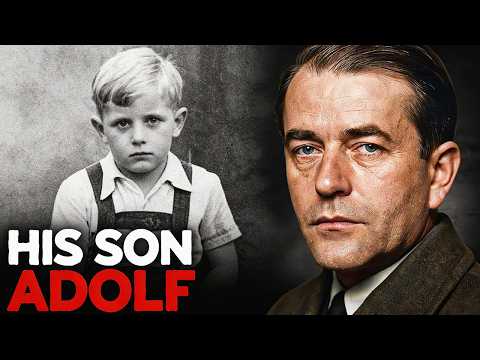
Six children, three responses to the same impossible inheritance. Hilda confronted the legacy head-on, converting it into active restitution, turning her father’s possessions into grants for the people his regime had tried to erase. Albert Jr. and Margret each navigated the name publicly, one through architecture and the other through memoir, building lives that acknowledged the weight without surrendering to it. Fritz, Ernst, and Arnold, the former Adolf, chose near total privacy. Arnold became a community doctor. The others stayed almost entirely out of public view, carrying the name quietly and without explanation. The question that connects all six is one that has no clean answer: Can you atone for something that isn’t yours? And if you can’t, what do you do with a name the world will never let you forget? On the Obersalzberg, the forest path that once ran from the Speer family home up through the trees to Hitler’s front door is gone now. Hitler’s Berghof was demolished. The restricted zone was dismantled. The mountain looks nothing like it did when six children played in its shadow, unaware of what their father was building. The path is gone, but for Albert Speer’s children, the walk never really ended.
Hilda’s foundation, Zurückgeben, still funds Jewish women in the arts today, a quiet counterpoint to the monuments her father once designed. Arnold, the former Adolf, spent decades treating patients in a small practice, the Speer name on his door a daily test of a different kind. None of the six ever reconciled with the father they buried in 1981.
At the memorial, no one spoke of Germania or Spandau. They spoke of a man who loved model trains, who wrote evasive letters, who performed remorse but never offered truth. “He left us the name,” Margret once said. “He never told us how to carry it.”
The forest path is gone. The walk is not. And the question remains for anyone born into a legacy they never chose: if you cannot atone for what isn’t yours, what do you owe the world that remembers? Tell us in the comments.
Report this article
Select a reason for reporting:






