The morning of the mission dawned cold and gray over the English countryside. In dispersal areas scattered across a dozen airfields, ground crews worked frantically in the half-light, their breath misting as they loaded bombs and fueled the massive B-17 Flying Fortresses and B-24 Liberators. Somewhere in the darkness, a young gunner wrote a last letter home. He didn’t know if he’d live to see the sunset.
This was April 1944, and the Eighth Air Force was about to launch one of the most ambitious daylight bombing raids of World War II. Their target: the Focke-Wulf 190 fighter assembly plants deep inside Nazi Germany. The mission would involve over 400 bombers and thousands of men, all risking their lives to cripple the Luftwaffe’s ability to fight.
In the briefing rooms, tension hung thick as intelligence officers pulled back curtains to reveal maps of the target. “Your target is the Arado factory at Anklam,” the briefing officer announced, his pointer tapping a cluster of buildings. “This plant produces wing and tail assemblies for the Fw 190. If you destroy it, you strike a serious blow to Germany’s aircraft production.” The crews listened in silence, their faces pale but determined. Many were veterans of previous missions; others were fresh-faced replacements, their first taste of combat looming.
Outside, the roar of engines began to build as the first bombers taxied into position. The lead aircraft, a silver B-17 named “Lucky Lady,” rumbled down the runway and lifted into the sky, followed by dozens more. The formation assembled slowly, circling over the English countryside until every plane was in place. “This is it, boys,” the pilot’s voice crackled over the intercom. “Keep tight. Watch the skies. And remember—we’re all coming home.”
As the armada crossed the North Sea, the crewmen checked their guns and scanned the horizon. The weather was clear, which meant the German fighters would be out in force. “Fighters at two o’clock high!” a gunner shouted. Suddenly, the sky filled with Fw 190s and Me 109s, their cannons blazing. The bomber formation tightened, each gunner firing back in a deadly dance of tracers and explosions.
In the lead bomber, the bombardier peered through his bombsight, his heart pounding. The target was coming up fast. “Bomb bay doors open,” the pilot ordered. The doors groaned open, and the bombardier’s hand hovered over the release switch. The fate of the mission—and the lives of thousands of men—rested on the next few seconds.
“Bombs away,” the bombardier called, his voice tight with focus. The 500-pounders tumbled from the racks, falling in a tight cluster toward the Arado works below. Through the smoke and flak, the crew watched the explosions bloom across the factory floor—direct hits on the main assembly hall, secondary blasts tearing through the wing shops.
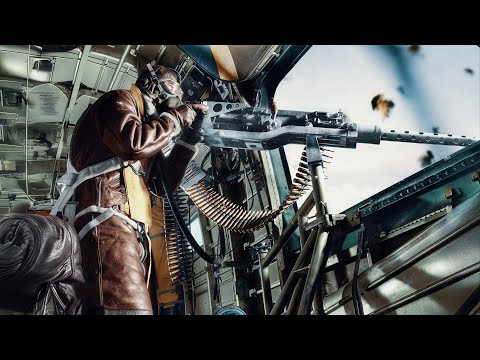
But there was no time to celebrate. “Fighters, three o’clock level!” The intercom crackled with warnings as a dozen Fw 190s tore through the formation, their yellow noses flashing in the sunlight. Tracers crisscrossed the sky, and the bomber shook as a 20mm shell punched through the fuselage, tearing a jagged hole in the metal skin.
In the waist gun position, Sergeant Eddie Malone swung his .50-caliber mount, leading a diving Focke-Wulf and squeezing the trigger. “Got him! He’s smoking!” The fighter rolled over and plunged earthward, trailing black smoke. But another was already coming in from below, cannons flashing. The battle raged for what felt like hours but was only minutes.
Then, as suddenly as it began, the fighters broke off. The German pilots had expended their ammunition and fuel, and the surviving bombers—many trailing smoke, some with wounded aboard—limped toward the rally point. The cost had been steep: of the 18 ships dispatched from one group, only 11 would return.
Back at the English airfields, the tension was unbearable. Ground crews scanned the skies, counting the returning planes, their faces falling with each missing aircraft. “Eighteen dispatched, fourteen returned,” a control tower officer reported quietly into his radio. The words hung in the air like a death sentence.
When the surviving crews climbed from their bombers, they were met with silence and solemn nods. Some men sat on the tarmac, staring at nothing, their hands still shaking. Others embraced, grateful to be alive. “We hit the target,” one pilot said, his voice hoarse. “We hit it hard. But God, the cost…”
That night, in the interrogation huts, the stories poured out—of rockets and cannons, of parachutes and dinghies, of friends who never came back. The intelligence officers wrote it all down, piecing together the puzzle of the mission. And somewhere in the darkness, a young gunner’s letter home would never be mailed.
The interrogation huts stayed lit long after midnight. Intelligence officers sifted through the accounts, cross-referencing claims of kills with gun camera footage and the observations of neighboring crews. “Two hundred and fifty enemy aircraft destroyed or damaged,” one officer murmured, tapping his pencil against the table. “If even half of that holds up, the Luftwaffe felt this one.”
But the numbers told only part of the story. In the photo lab, strike photographs developed in trays of chemicals revealed the truth of the bombing. The Arado works at Anklam had been gutted—assembly halls collapsed, roofs torn open, rail sidings twisted like wire. At Marienburg, the Focke-Wulf plant was a field of rubble. At Danzig, the harbor basin was littered with sunken hulls and burning tankers.
General Arnold’s assessment arrived by teletype the next morning: “Greatest example of precision bombing on record.” The words were read aloud in the officers’ clubs, and for a moment, the men allowed themselves a grim satisfaction. They had done what they came to do.
Yet the war did not pause for congratulations. Within days, the field orders came down again, and the ground crews were back at work before dawn, patching flak holes and swapping out engines. “No rest for the wicked,” a mechanic muttered, hauling a replacement propeller toward a battered Fortress. The men laughed, but their eyes were tired.
In the crew room, the replacements arrived—boys barely out of training, their flight jackets still stiff and new. The veterans eyed them quietly, remembering their own first missions. “Stick close to your element leader,” a seasoned gunner told one of them. “Don’t get fancy. And keep your oxygen mask on, no matter what.” The boy nodded, swallowing hard.
The chaplain moved among them, offering quiet words and cigarettes. Some men wrote letters. Others played cards, the slap of the deck the only sound in the hut. Outside, the English sky was gray again, promising rain—or perhaps another mission.
That evening, the operations officer called the wings for the next conference. The targets were already being selected: more factories, more rail yards, more pieces of the German war machine to be torn apart. The battle of Germany was far from over, and the men of the Eighth Air Force knew they would be called again.
As the sun set over the airfield, a lone B-17 circled slowly overhead, its engines droning. It was a new crew, practicing formation flying. The veterans watched from the ground, their faces unreadable. “Poor bastards,” someone said softly. “They don’t know what’s waiting for them.”
But the veterans also knew something else: they had survived. They had flown through flak and fighters, seen friends fall, and still brought their ships home. That night, in the dim light of the Nissen huts, they shared stories and silence, the bond of combat thicker than any words.
The next morning, the cycle began again. New orders, new targets, new dangers. But the men of the Eighth Air Force didn’t flinch. They had a job to do, and they would see it through—no matter the cost.
As the bombers lifted off once more, their engines roaring into the dawn, one young pilot looked down at the English countryside and whispered a prayer. “Keep us safe. Keep us strong. And bring us home.”
The war in the skies over Europe was far from won, but the men who fought it had already proven their courage. And in the end, that courage would be remembered long after the guns fell silent.
What do you think kept these men going, mission after mission, knowing the odds? Share your thoughts in the comments below.
Report this article
Select a reason for reporting:






