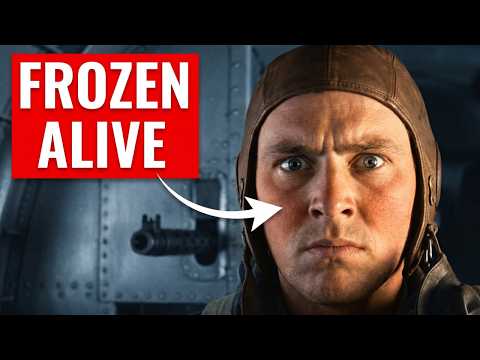
December 20, 1943. The air at 27,000 feet is a merciless -60° Fahrenheit. Franz Stigler, a Luftwaffe fighter pilot, peers through his frosted canopy at a crippled B-17 Flying Fortress. Through gaping holes in the fuselage, he sees the tail gunner slumped dead, the ball turret gunner curled in a frozen sphere, and other crewmen barely moving—yet still fighting. Stigler is stunned. His own cockpit is sealed and warm enough for his 90-minute sortie. These Americans have been in open gun positions for nearly seven hours, exposed to a 200 mph slipstream in temperatures that would kill an unprotected man in minutes. How are they still functioning?
Stigler does something unthinkable: he refuses to fire. Instead, he escorts the battered bomber toward England, a decision that will haunt and ultimately redeem him. But the question gnaws at him: Who solved the problem of cold at altitude? And why, on this December morning, was the solution still failing the men it was meant to protect?
To answer that, we must go back to a peacetime classroom in Alabama, where a theory was born that would send tens of thousands of young men into an environment no human body was designed to survive. At the Air Corps Tactical School at Maxwell Field, officers developed the doctrine of high-altitude daylight precision bombing. The key was altitude: the higher the bomber, the safer from flak and the more accurate the bomb run. The B-17 Flying Fortress was built to fly above 20,000 feet, with a service ceiling exceeding 35,000 feet. It was a marvel of engineering—but it was designed as a weapons platform, not a habitable environment.
What the doctrine did not account for was the human cost. At 25,000 feet over northern Europe in winter, temperatures plunged to -40°F; at 30,000 feet, they hit -60°F. Exposed skin froze in under a minute. Metal bonded to flesh. Gun lubricants thickened. Morphine syrettes froze solid. The B-17’s gun positions—waist windows, tail, and ball turret—were open to the slipstream. The ball turret gunner hung beneath the belly in a Plexiglas sphere, knees drawn to his chest, unable to wear a parachute. These men were expected to function for hours, identify enemy fighters, and fire accurately with freezing hands.
Major John Luckadoo of the 100th Bomb Group called it the four F’s: fighters, flak, frostbite, and fear. Frostbite was not an afterthought—it was a primary threat. A ball turret gunner named George Moffatt described reaching the target so miserably cold that he no longer cared whether he was hit. The men had a saying: “Everything above 20,000 feet belongs to God, and God had not heated it.”
The cold announced itself immediately. In the autumn and winter of 1942, crews reported frostbite after almost every mission. Leather jackets and sheepskin were inadequate at 25,000 feet. Men returned with blackened fingers, skin torn from gun breaches, feet frozen inside boots. Ball turret gunners suffered frostbite so severe that tissue died and had to be surgically removed. The statistics were damning: in the 14 months ending December 1943, 1,634 Eighth Air Force crewmen were removed from flying duty due to cold injuries—more than the 1,207 removed due to enemy wounds. Frostbite grounded more men than the Luftwaffe and flak combined.
A secondary killer was hypoxia. Moisture in exhaled breath froze inside oxygen masks and regulators, blocking valves and allowing ambient air to dilute the oxygen supply. A man could slip into unconsciousness without realizing he was dying. Wounded men faced the cruelest combination: cutting away clothing to treat wounds exposed bare flesh to -50°F, and frozen morphine offered no relief.
The Army Air Forces had an electrically heated suit—the F-1—but it was wired in series, so a single broken wire killed the entire circuit. Wires broke constantly during combat maneuvers, and shorts caused burns. Up to 75% of frostbite cases in the 303rd Bomb Group were caused not by the cold itself but by the failure of the heated clothing. The equipment designed to protect the men was failing them.
But something changed. By the final five months of the war, cold injuries dropped by over 90%—from 1,634 to just 151. That transformation came from a flight surgeon named Malcolm Grow, who treated frostbite as an engineering problem. He collected data, identified failure points, and drove the development of the F-2 suit, wired in parallel, with thermostatic controls. He pushed for enclosed waist windows, improved generators, and trained equipment officers in every bomb group. General Electric manufactured 400,000 heated suits. The Aero Medical Laboratory trained crews in altitude chambers. The cold was engineered into near irrelevance.
Yet before the engineering arrived, the men flew anyway. They flew knowing their suits might fail, their gloves might short, and the ball turret was a frozen cage. They flew because the mission required them at 25,000 feet. And 25,000 feet was -60°, and there was no version of the war where that was different.
Franz Stigler never forgot what he saw through those holes in the B-17. He carried the secret for 46 years, until a letter reunited him with Charles Brown. When Brown asked why he hadn’t fired, Stigler said he had seen too much—the wounded, the dead, the frozen men still fighting. He could not add to it. The cold was part of everything he had witnessed. And the question of how those men endured it—and why their own equipment was killing them—would take decades to answer.
But the story of the cold does not end with Malcolm Grow’s engineering triumph. It ends with the men who flew before the solutions arrived, and with the legacy they left behind. Their suffering was not in vain. The data they generated, the frostbitten fingers and frozen feet, became the foundation upon which the fixes were built. Every failed heated suit, every shorted wire, every case of hypoxia was recorded, analyzed, and turned into a design change. The men who suffered were, in a sense, test subjects in a vast, involuntary experiment conducted at 25,000 feet.
General Electric’s production of 400,000 heated suits was an industrial feat, but it was also a race against time. Each suit that reached a bomb group represented a man who might survive his tour. The F-2 suit, with its parallel wiring, was a direct response to the failures reported by crews. The thermostatic controls of the F-2A eliminated a deadly distraction: the need to fiddle with heating cables in the middle of a firefight. The F-3 suit, with its dual circuits, offered redundancy—a backup system for the backup system. These were not luxuries. They were lifelines.
Yet even as the equipment improved, the fundamental danger remained. The ball turret was still a cramped sphere of Plexiglas and steel, exposed to the full fury of the slipstream. The waist gunners still stood at open windows, their guns the only barrier between the bomber and attacking fighters. The tail gunner still sat alone at the rear, often with his Plexiglas panels removed for a better field of fire. The cold was always there, waiting for a moment of distraction, a torn glove, a disconnected cable.
The men who flew those missions developed their own rituals for survival. They checked their heated suits obsessively before takeoff, testing every wire and connection. They learned to recognize the early signs of frostbite in themselves and in their crewmates—the numbness, the waxy skin, the sudden absence of pain that signaled tissue death. They shared tips: how to clear a jammed gun with a gloved hand without losing fingers, how to reconnect a heating cable in the dark, how to conserve oxygen when the regulator iced over. This knowledge was passed down from veteran crews to replacements, a kind of oral tradition of the stratosphere.
The altitude chambers at Wright Field and other facilities became a crucial part of this education. Crews experienced simulated altitude conditions before ever facing them in combat. They learned what hypoxia felt like, how quickly frostbite could set in, and how to trust their equipment. The chambers were not without risk—there were accidents—but they saved countless lives by removing the element of surprise. A man who had already felt the insidious onset of hypoxia in a chamber was less likely to panic when it happened over Germany.
Malcolm Grow’s legacy extended beyond the war. The principles he championed—that human factors must be engineered into military equipment, that data-driven solutions are superior to guesswork, that the health of the crew is as important as the performance of the machine—became foundational to aerospace medicine. The Aero Medical Laboratory continued its work, contributing to the design of pressurized cabins, ejection seats, and space suits. The heated suits of World War II were ancestors of the thermal protection systems used by astronauts and high-altitude pilots today.
But for the men who flew in 1943, the engineering came too late. They paid the price in frozen flesh and lost limbs. Some, like Forrest Vosler, paid with their sight. Vosler’s Medal of Honor citation does not mention the cold, but his actions were shaped by it. Blinded, bleeding, and freezing, he repaired a radio by touch alone. His heated suit had been shredded, and his hands were frostbitten on top of his wounds. He fought two enemies at once—the Germans and the temperature—and he won.
Stigler’s encounter with Brown’s B-17 was a moment of recognition between two professional airmen. Stigler saw men who had endured conditions he had never faced, and he chose not to add to their suffering. That choice, that act of mercy, was rooted in a shared understanding of the sky’s hostility. The cold was not a German weapon or an American problem; it was the common enemy of all who flew at altitude. The Americans had solved it through engineering, but the solution was imperfect and costly. The Germans had avoided it by design, but their pilots still knew the bite of the winter air.
When Stigler and Brown met in 1990, they did not talk about the cold. They talked about the war, about their families, about the strange bond between former enemies. But the cold was there, unspoken, a silent witness to their first encounter. It was in the frost on Stigler’s canopy and the ice on Brown’s fuselage. It was in the dead tail gunner and the frozen ball turret gunner. It was in the holes that let Stigler see inside the bomber and understand, for the first time, what American airmen endured.
The question Stigler asked himself that December morning—how do they function?—had an answer he could not have known. They functioned because they had no choice. They functioned because the mission demanded it. They functioned because, in the end, the human spirit can endure more than the body should. And they functioned because, eventually, their country sent the engineering to help them. But the men came first. They always came first.
Malcolm Grow died in 1960, but his parallel-wired suits and trained equipment officers outlived him. By 1945, combat wounds outnumbered cold injuries 25 to 1—an inversion no one in 1943 could have imagined. The men had gone up first; the engineering finally caught them.
Stigler and Brown spoke every week until 2008, when both died within months of each other. They never needed to discuss the cold. It was in the frost on the canopy, the dead tail gunner, the frozen ball turret gunner—the silent witness to a mercy no regulation allowed.
So the answer to Stigler’s question is this: they functioned because their country asked them to fight where the air itself was the enemy, and they flew before the solution arrived. The suits came later. The men came first. They always came first.
If your father or grandfather flew bombers in the war, will you share his name and unit below so these frozen crews are remembered?
Report this article
Select a reason for reporting:






