In late April 1945, the bloodiest battle of the Pacific War was raging on Okinawa. Amid the chaos, one man stood out—not for the weapon he carried, but for the one he refused to. Desmond Doss, a medic with the 307th Infantry Regiment, repeatedly braved enemy fire to rescue over 50 wounded men on Hacksaw Ridge. His story is one of unwavering faith and incredible courage, but does the popular narrative match the reality? Using original combat footage and firsthand accounts, we uncover the true story of an unarmed hero.
But Doss’s journey to that ridge was anything but easy. Nicknamed “Holy Joe” and ostracized by his comrades, he refused to carry a weapon due to his Seventh-day Adventist beliefs. Despite bullying and attempts to discharge him, Doss stuck to his convictions. He proved his worth on Guam and Leyte, earning Bronze Stars and the grudging respect of his company. By the time his division landed on Okinawa, his reputation preceded him—a slight, unassuming man who would stop at nothing to save a life.
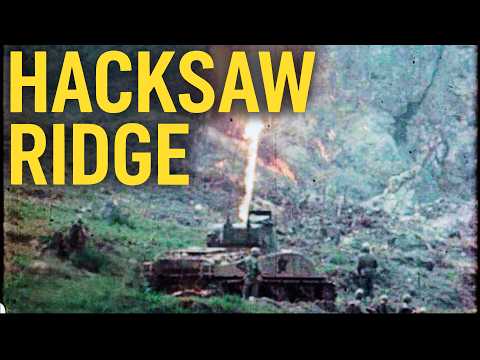
The objective was the Maeda Escarpment, a 400-foot jagged ridge fortified with Japanese bunkers and caves. On April 30, 1945, Doss and two others volunteered to rig climbing nets up the cliff face—a suicidal task under constant fire. Incredibly, a photograph captured Doss standing atop the escarpment, nets secured, as Company B began their ascent.
What followed was days of hellish combat. The ridge changed hands repeatedly, with American troops facing relentless mortar and machine-gun fire. Doss was everywhere, treating wounds and dragging men to safety, often within yards of enemy positions. His actions that week would earn him the Medal of Honor, but the full story is more complex than the movies suggest.
As the battle intensified, Doss’s courage never wavered. On the night of May 5, a massive Japanese counterattack overran the ridge, and Doss ran through artillery and rifle fire to tend to dozens of wounded men. He prayed repeatedly, “Lord, help me get one more,” and lowered men down the cliff by rope. By dawn, he had saved many, including Captain Glover—the same officer who had once tried to get rid of him.
But Doss’s luck ran out on May 21, 1945, near Shuri Castle. While treating wounded, a grenade exploded nearby, peppering him with shrapnel. He treated his own wounds and waited five hours for evacuation, then gave up his stretcher to a more critically injured man. Crawling 300 yards to safety, he was hit by a sniper, shattering his left arm. Yet he survived, and his actions that day would add to his legendary status.
For his repeated gallantry, Corporal Desmond T. Doss was awarded the Medal of Honor by President Truman on October 12, 1945. But perhaps the most fitting tribute came from the men he saved, one of whom said, “Now here is a warrior.” Doss passed away in 2006, leaving behind a legacy of selflessness and faith. His story reminds us that true heroism isn’t about the weapons we carry, but the lives we save.
Yet even as the medals were pinned and the parades faded, a quieter battle was being fought over the record itself. The number seventy-five, so often repeated, was never a precise figure. It came from Doss’s own modest estimate, offered years later, and was accepted largely because no one had a better count. Company rosters, aid-station logs, and the recollections of survivors rarely agreed on names, let alone totals. Some men he pulled from the ridge that night were never formally recorded as wounded at all—they simply walked back to their units the next morning, patched and grateful.
What the paperwork does confirm is the pattern. Between April 29 and May 6, the 307th’s medical annex lists Doss as treating casualties on six separate days, often after dark, frequently beyond the battalion aid station’s reach. The same annex notes that on two occasions he returned to the escarpment after being ordered to the rear. No other medic in the regiment appears more than twice in those entries.
Historians have since tried to reconstruct the night of the great counterattack. Japanese sources from the 32nd Army describe the assault as a full-battalion effort supported by tanks, aimed at splitting the American line along the ridge’s narrow crest. American after-action reports place the heaviest fighting between 0400 and first light, exactly the window in which Doss is said to have made his repeated trips to the cliff edge. The terrain itself corroborates the difficulty: the north face drops at a near-vertical angle, and the cargo nets, still hanging from the earlier ascent, were the only practical route down.
One detail from that night has survived almost by accident. A field telephone operator, interviewed decades later, recalled hearing Doss’s voice over the line requesting litter bearers, then pausing mid-sentence to pray aloud before returning to the same calm, businesslike tone. “He never sounded frightened,” the operator said. “He sounded like a man doing chores.” It is a small thing, but it fits the man his comrades described—methodical, unhurried, utterly unimpressed by his own courage.
The film’s version of the story, for all its power, compresses and rearranges. It places Doss alone on the ridge in a single sustained act of rescue, when in truth his heroism was cumulative—spread across a week of grinding, close-quarters fighting in which the line surged forward and fell back with brutal regularity. The real Desmond Doss did not descend into legend in one night; he built it one wounded man at a time, over days that blurred into each other.
And there is one more correction the record demands. The ridge was not called Hacksaw during the battle. That name, like so much of the mythology, came later. To the men who fought there, it was simply the escarpment—a faceless wall of rock and fire that had to be taken. What made it memorable was not the terrain but the medic who refused to leave anyone behind on it.
There is, however, another layer to the story that rarely makes it into the documentaries. Doss was not the only medic on that ridge, nor the only man of faith. What set him apart was less the danger he accepted than the sheer arithmetic of it—the number of trips, the hours without sleep, the refusal to stop while a single voice still called out. Fellow medics rotated back to the aid station to rest and resupply. Doss, by every account, simply did not.
His own explanation, offered in a 1987 interview, was disarmingly plain. “I didn’t feel like I was doing anything special,” he said. “I was just doing what I was trained to do, and what I believed God wanted me to do.” The interviewer pressed him on the fear. Doss admitted it was there—constant, physical, like a weight on the chest—but insisted that fear and action were separate things, and that a man could carry the first while still performing the second.
That distinction, more than any medal citation, may be the truest measure of the man. He was not fearless. He was obedient—to his conscience, to his training, and to the men who depended on him. It is a harder thing to dramatize than a single night of heroics, but it is what the survivors remembered most clearly.
After the war, Doss returned to the ordinary rhythms of life with a quietness that surprised those who expected a hero to perform his heroism. He worked as a carpenter, raised a family, and for a time struggled with the injuries that would plague him for the rest of his life. The shrapnel in his legs, the shattered arm, the hearing loss that came later—these were the private costs of that week on the escarpment, paid in installments over five decades.
He rarely spoke of the ridge unless asked, and when asked, he deflected. “The real heroes are buried over there,” he would say, gesturing vaguely eastward. It was not false modesty. Men who knew him insist he meant it literally—that he counted himself among the survivors, not the celebrated, and that the distinction mattered to him more than any ribbon.
In 1991, a group of veterans from Company B arranged a reunion. Doss attended, by then in his seventies and moving slowly. One by one, men he had pulled from the ridge came to shake his hand, some of them grandfathers now, some of them unable to speak. A reporter present described the scene as “awkward and holy at once”—a room full of old soldiers trying to say thank you to a man who had never wanted thanking.
Captain Glover, then in his eighties, made the trip as well. The two men had long since buried their training-camp quarrel, but the old officer still seemed to feel the weight of it. “I told him he wouldn’t be by my damn side without a gun,” Glover said, “and then he saved my life without one.” The room went quiet. It was, by all accounts, the closest anyone ever came to an apology, and Doss accepted it the way he accepted everything—with a nod and a change of subject.
What remains, then, when the film’s embellishments are stripped away and the disputed dates are set aside? A man who did not fit the mold of a soldier, and who redefined what a soldier could be. The record is imperfect, the numbers are approximate, and the mythology has long since outgrown the facts. But the facts, where they survive, are remarkable enough on their own.
Desmond Doss died at his home in Piedmont, Alabama, on March 23, 2006, at eighty-seven. He had spent sixty years insisting he was nothing special. The men he lowered down that cliff, and the families they went on to have, tell a different story—one that no compression, no correction, and no Hollywood rewrite can diminish.
So the question is not whether the legend matches the man. It is why we need the legend at all. Perhaps because the truth—a frightened, unarmed young man doing chores in the dark while the world burned—is harder to hold than a hero on a poster. And perhaps because we suspect we could never do it ourselves.
What do you think—does knowing the real story make Doss’s courage more impressive, or less? And would you have climbed that net unarmed? Let us know in the comments below.
Report this article
Select a reason for reporting:






