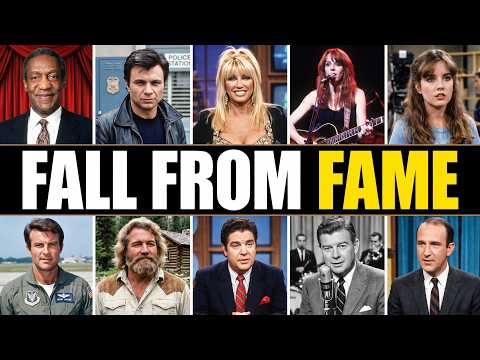
One of these stars was convicted of killing his wife in front of their daughter. Another ruled CBS until he fired a young singer live on the air. These are the documented events behind the downfalls of 12 classic TV stars—stories of ambition, scandal, and the unforgiving spotlight.
For decades, they were welcome guests in our living rooms, their faces synonymous with comfort and trust. But behind the scenes, their lives were anything but scripted. From Bill Cosby’s fall from grace to Arthur Godfrey’s on-air betrayal, the record shows a darker side to television’s golden age.
Consider Bill Cosby, once America’s dad. For 50 years, he was the epitome of trust. But in 2005, a woman named Andrea Constand accused him of assault. The case would take a decade to unfold, with dozens more women coming forward. In 2018, he was convicted of aggravated indecent assault and sentenced to 3 to 10 years in prison. Though the conviction was later overturned, the damage to his legacy was done.
Then there’s Suzanne Somers, who dared to ask for equal pay. In 1980, she was earning $30,000 per episode on Three’s Company while her male co-star made more. When she requested $150,000, she was fired—and her character was reduced to a minute-long scene each week. She sued for $2 million but was awarded only $30,000. The fight cost her the biggest role of her career.
Spade Cooley, the King of Western Swing, had a hit TV show in the early 1950s. But in 1961, his wife, Ella Mae, died at their home. Cooley claimed she fell in the shower. Their 14-year-old daughter testified that she watched her father beat her mother’s head against the floor and stomp on her stomach. Cooley was convicted of first-degree murder and sentenced to life in prison. He died of a heart attack during a prison furlough in 1969.
Dan Haggerty, beloved as Grizzly Adams, was convicted of selling cocaine to an undercover officer in 1985. The family-friendly star’s image was shattered, and he never regained his former fame. Robert Blake, TV’s Baretta, was acquitted of murdering his wife in criminal court but found liable in civil court for $30 million. He filed for bankruptcy and never acted again.
Mackenzie Phillips, who played Julie on One Day at a Time, struggled with addiction from a young age. She was fired from the show twice—first in 1980 and again in 1983 after collapsing on set. Her memoir later revealed a shocking secret: a long-term incestuous relationship with her father, John Phillips. She survived overdoses and eventually became a recovery counselor.
Charles Van Doren became a national sensation on the quiz show Twenty-One in 1956. But the show was rigged. Van Doren admitted to Congress, “I was involved, deeply involved, in a deception.” He lost his job at Columbia University and faded from public life. Robert Conrad, TV’s Wild Wild West star, was convicted of drunk driving in 2003 after a head-on collision that left the other driver seriously injured. The crash ended his acting career.
Jimmy the Greek, a CBS football analyst, was fired in 1988 for racist remarks. He said black athletes were “bred” to be better and that if they took over coaching jobs, there would be nothing left for white people. The network fired him the next day. He never worked in television again.
Dana Plato, who played Kimberly on Diff’rent Strokes, was written out of the show when she became pregnant at 19. She later robbed a video store with a pellet gun and was arrested for forging a prescription. She died of an overdose in 1999 at age 34. Her son took his own life a decade later.
Morton Downey Jr., the loudmouth talk show host, was canceled in 1989 after a series of scandals, including an alleged attack at an airport that many believed was a publicity stunt. Arthur Godfrey, the biggest star in early television, fired singer Julius LaRosa live on the air in 1953 for “lacking humility.” The public turned on him, and his career never recovered.
The pattern is clear: fame is fragile, and the higher you climb, the harder you fall. But these are just the headlines. The details behind each downfall are even more compelling—and sometimes more tragic. Stay tuned as we delve deeper into the lives of these fallen stars, one by one.
Take Dana Plato, for instance. Her story is often reduced to a punchline: the child star who robbed a video store. But the record shows a young woman whose life unraveled in ways she never fully controlled. She was 13 when she became Kimberly Drummond, and by 19, she was written out of the show because of a pregnancy. The network didn’t just end her run—it erased her character, as if Kimberly had never existed.
What followed was a cascade of misfortunes. Her mother died the same week she separated from her husband. An accountant she trusted disappeared with most of her money. She was left with less than $150,000 and a son she would eventually lose custody of. The robbery, the forgery, the jail time—they were desperate acts, not calculated crimes. And when she died of an overdose at 34, it was first ruled an accident, then a suicide. The ambiguity feels fitting for a life that was never given the benefit of the doubt.
Then there’s Morton Downey Jr., a man who built his career on volume and vitriol. His show was a circus, and he was the ringmaster, chain-smoking and shouting down anyone who dared disagree. But the airport incident—the swastika, the shaved head—was the beginning of the end. Police found no evidence, and the reversed swastika suggested he might have drawn it himself in a mirror. Whether it was a publicity stunt or a genuine attack, the public had grown tired of the act. By the time the show was canceled in 1989, it was airing on just 70 stations, with ads for phone sex lines filling the breaks.
Downey filed for bankruptcy, tried a few comebacks, and then lung cancer took part of his right lung. In his later years, he expressed remorse for some of his behavior—the sound man he hit with a boom mic, the guests he humiliated. But remorse doesn’t undo a reputation. He died at 68, remembered more for his bluster than his talent.
And then there’s Arthur Godfrey, the man who ruled CBS with a smile and a ukulele. His firing of Julius LaRosa live on the air is the stuff of television legend. LaRosa had hired a manager, which Godfrey forbade, and so Godfrey humiliated him in front of millions. The explanation—that LaRosa lacked humility—backfired spectacularly. Comedians mocked it, Ed Sullivan booked LaRosa immediately, and the public began to see Godfrey as a petty tyrant rather than a friendly uncle.
The firings continued—more than 20 cast and crew members dismissed in similar ways over the next two years. Godfrey’s own arrogance did the rest. He buzzed an airport control tower in his DC-3 and had his pilot’s license suspended. He blamed the wind. The press that had adored him turned on him, and while his ratings held for a while, the warmth was gone. By 1959, he was diagnosed with cancer and retreated to radio. When he died in 1983, he was remembered as a pioneer—but also as a cautionary tale about the cost of control.
These stories share a thread: the moment when the public persona cracks, and the real person behind it is revealed. For some, like Cosby and Cooley, the crack exposed something monstrous. For others, like Plato and Somers, it exposed a system that was all too willing to discard them. And for men like Godfrey and Downey, it exposed a hubris that could never be satisfied.
But the record doesn’t end there. There are more names on this list—stars whose downfalls were just as dramatic, just as documented. And the details of their stories are even more surprising.
Take Robert Blake, the man who played Tony Baretta. In 2005, a criminal jury acquitted him of murdering his wife, Bonnie Lee Bakley. The district attorney publicly called him a “miserable human being” and the jurors “incredibly stupid.” But a civil jury reached a different conclusion, ordering him to pay $30 million for her wrongful death. He filed for bankruptcy, and the state of California came after him for $1.1 million in unpaid taxes. He never acted again.
His story doesn’t end with the verdict. Blake had been in front of a camera since he was a child in the Our Gang comedies. By the time he was 89, he had outlived almost everyone who remembered his heyday. He died of heart disease in 2023, still insisting he was innocent. The record shows both things are true: he was acquitted, and he was found liable. The law has two sets of scales, and they rarely balance.
Now consider Mackenzie Phillips. Her memoir, High on Arrival, revealed something far darker than addiction. She wrote that her father, John Phillips of The Mamas and the Papas, had initiated a long-term incestuous relationship with her when she was a teenager. The revelation shocked the public, but it also explained the trajectory of her life—the drugs, the firings, the desperate need to escape.
She was 16 when One Day at a Time premiered. She was earning $50,000 a week. By 23, she had been fired from the same show twice. The producers ordered her to take six weeks off, then fired her. They invited her back, then fired her again after she collapsed on set. It was a pattern of grace and punishment that mirrored the chaos at home.
What the record shows is that her recovery, when it came, was hard-won. She went through a nine-month rehabilitation program in 1992. She found steadier work on a Disney Channel series called So Weird. In 2016, she began working as a counselor at a recovery center in West Hollywood. She had survived the thing that killed so many child stars: the belief that they were invincible.
Then there’s Charles Van Doren, the quiz show prodigy who became the face of a national scandal. For three and a half months in 1956 and 1957, he was the smartest man on television. He won $129,000 on Twenty-One, coached the whole time by producers who fed him the answers. When he finally lost, NBC signed him to a $150,000 contract and made him a regular on the Today show.
But the deception didn’t hold. A grand jury was convened. Congress opened hearings. Van Doren disappeared for a month to avoid a subpoena, then appeared in Washington and read a statement on national television. “I was involved, deeply involved, in a deception,” he said. NBC dropped him. Columbia University forced him to resign. He pleaded guilty to second-degree perjury and was given a suspended sentence.
He went to work for Encyclopedia Britannica and stayed until he retired in 1982. For decades, he said almost nothing in public about the scandal. In 2008, he finally wrote about it himself in an essay for The New Yorker called “All the Answers.” He died in 2019 at 93, remembered as a cautionary tale about the cost of being too good to be true.
And then there’s Robert Conrad, the toughest man in the room. In 2003, he was driving his Jaguar on Highway 4 in Northern California when the car went over the center divider and hit a Subaru head-on. His blood alcohol level was 0.22—nearly three times the legal limit. The other driver, a 26-year-old man named Kevin Burnett, was seriously hurt. He died two years later at 28, and his family attributed his death to the long recovery from the collision.
Conrad pleaded no contest and was convicted of drunk driving. He was sentenced to six months of home confinement, alcohol counseling, and five years of probation. The crash left him with severe nerve damage and partial paralysis on the right side of his body. He never acted in a major production again. His last broadcast was in 2019. He died of heart failure in 2020 at 84.
The pattern is clear: fame is fragile, and the higher you climb, the harder you fall. But these are just the headlines. The details behind each downfall are even more compelling—and sometimes more tragic. Stay tuned as we delve deeper into the lives of these fallen stars, one by one.
And then there’s Jimmy the Greek, the oddsmaker who helped invent the modern NFL pregame show. He was a CBS fixture for 12 years—until a single lunch in January 1988 ended it. He told a reporter that black athletes were “bred” to be better, tracing it back to slave owners, and that if they took coaching jobs, there’d be nothing left for white people. CBS fired him the next day. He sued for age discrimination and lost.
Dan Haggerty’s fall was quieter but just as final. The man who played Grizzly Adams—a gentle friend to children and animals—sold cocaine to an undercover officer and was sentenced to 90 days in jail in 1985. No network would touch him after that. He died of spinal cancer in 2016, still beloved by a generation that never knew the headline.
Suzanne Somers never got her $150,000 an episode. She was fired from Three’s Company and replaced, and it took her a decade to star in another network series. She and John Ritter didn’t speak for 20 years. She always called it a fight for equal pay.
Spade Cooley died on a prison furlough, standing ovation still ringing in his ears. Ella Mae never got justice beyond a verdict. Their daughter Melody testified against her father at 14 and lived with it forever.
What do you think—were these downfalls deserved, or was the spotlight simply too unforgiving? Tell us in the comments.
Report this article
Select a reason for reporting:






