My son-in-law kicked my chair out from under me at Christmas dinner, and I hit the floor so hard my hip cracked against the hardwood. For one long second, nobody moved. Then his father burst out laughing—that deep, booming laugh—and his mother followed right behind him, pressing her napkin to her mouth like she was trying to hold it in and failing. My own daughter sat frozen, hands folded in her lap, staring at the tablecloth. She didn’t say a word.
Corbin looked down at me, sprawled on the floor like a dropped coat, and said it loud enough for every person at that table to hear: “I like how he still thinks he belongs here.”
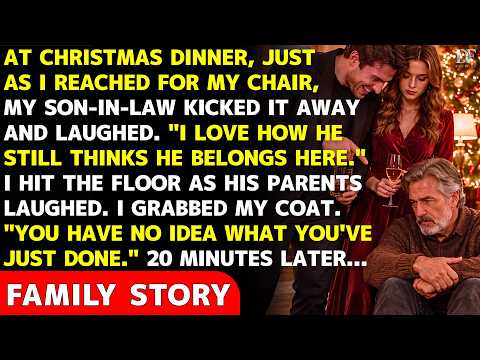
I pressed my palms against the cold floor and pushed myself up. My left knee throbbed. My pride throbbed worse. I brushed off my slacks and walked to the coat rack without looking at anyone else. Behind me, Garrett called out, still grinning: “Come on, Emtt. It was just a chair.”
I turned back around, buttoning my coat with fingers that wouldn’t quite stop shaking, and looked Corbin dead in the eye. “You have absolutely no idea what you just did,” I told him.
“Neither do you, old man,” he shot back, smirking, and Garrett laughed again like I’d told a joke instead of a dead-serious warning.
I picked up my apple pie from the counter and walked out that front door without saying goodbye to a single soul. The porch light caught the snow falling sideways in the wind. I stood there a moment, my chest tight, listening through the window as Garrett’s laughter rolled on like nothing at all had happened.
I got in my truck, gripping the cold wheel so hard my knuckles went white, and thought about all those years of Christmas dinners, all those years of showing up without fail, while my daughter sat frozen, never once rising to help me.
I pulled out of the driveway and didn’t drive straight home. I turned left instead of right at the four-way stop, toward the one empty place I knew I could sit alone before I did something I could never take back.
The gas station lot was empty except for a truck idling near the propane cage and a kid inside sweeping the floor behind the register. Snow kept falling past the streetlight, thick white flakes catching in my headlights before disappearing into the dark. I sat there with the engine running, the heater humming, my thumb hovering over the banking app on my phone.
I thought about every dollar I had handed that family over the years. The down payment on their house. The furnace repair the winter it broke at 2 in the morning. The property taxes when their escrow account came up short. The new roof after that spring hailstorm tore through half the neighborhood. The car lease I co-signed because Corbin swore it would lower the payment. The credit card I had given Karen for emergencies—the one I never once thought to check closely enough.
My chest was still tight from the fall, but something else had settled in underneath it. Something colder and steadier than anger.
I opened the app. I found the backup card first, the one tied to my name that I had given Karen for emergencies. I locked it. Then I scrolled through my recurring payments, cancelling the ones I could stop with a single tap right there in the truck. My thumb moved fast, deliberate, like I had been planning this for years without knowing it.
I set the phone down in the cup holder and just breathed for a minute, watching my own breath fog up the windshield.
It did not take long. Less than 20 minutes after I locked that card, it buzzed against the plastic. A text from the bank. Transaction declined.
I stared at those two words for a long moment before another notification stacked right on top of it. Second transaction declined.
I could picture it clear as day. Corbin standing at some checkout counter, his card getting rejected in front of a cashier and whoever else happened to be in line behind him, his face going red the way it always did when things did not go his way.
My phone lit up. Corbin’s name flashed across the screen, the call ringing through the quiet cab of my truck. I let it ring itself out. Thirty seconds later, it started again. I did not touch it. A third call came in, and this time, I flipped the phone face down against my leg so I would not have to watch his name light up over and over.
When it finally stopped, a voicemail notification popped up instead. I hesitated, then pressed play. Corbin’s voice came through tight and clipped: “Emtt, call me back. Something’s wrong with the bank. I need you to fix this.”
Not one word about the chair. Not one word about the floor.
The gas station kid finished sweeping and disappeared into a back room. Snow kept falling. My hands had finally stopped shaking.
Then my phone buzzed one more time, a text this time, and I turned it back over out of habit before I could stop myself. It was Karen.
Dad, please call me back. Something’s wrong with the card.
I read those words twice. Something’s wrong with the card. Not something’s wrong with what happened tonight. Not I’m sorry about the chair. Dad, are you hurt? Just the card.
That told me everything I needed to know about where her mind had gone first.
My throat tightened and my eyes went hot and stinging right there behind the wheel of my own truck. I pressed the back of my hand against them and let out a breath that shook on its way out.
“Not tonight, Karen,” I said out loud to an empty truck, my voice cracking on her name.
I set the phone back down, screen dark, and I sat there in that gas station lot until my hands felt steady enough to drive. My hip still ached where I had hit the floor. My pride ached worse. All evening I had felt something that was not shame or anger climbing up my throat.
I felt clear.
Ten years I had spent making myself useful to that family, convinced that being needed was the same thing as being loved.
I turned the truck’s heater down and put it in reverse, easing out of the gas station lot onto the empty road home. The porch light was still burning when I pulled into my own driveway, snow drifting sideways past the bulb the way it always did this time of year.
I sat in the truck a moment longer, staring at my dark, quiet house, and I made myself one promise before I ever stepped inside.
“Whatever comes next,” I whispered, my hands finally still on the wheel, “I am done paying for my place at that table.”
I climbed the porch steps, my breath clouding in front of me, my knee aching with every stair. Inside, the house felt colder than the truck, colder than the night itself. It was not until I stood in my own kitchen, coat still on, hands finally steady, that I remembered the statement I had not looked at in months.
Tomorrow morning, I told myself firmly, jaw tight, I was going to open it and read every single line—no matter what it showed me.
Morning light cut through the blinds of my office at Culvin Lawn and Garden, and I sat down at my desk with black coffee going cold beside me and the credit card statement I had been avoiding for months. My hip still ached from the fall—a dull throb that reminded me with every shift in my chair that Christmas dinner had actually happened, that I had not dreamed the whole ugly evening.
I scrolled past the first few charges without much thought, my eyes still tired, my mind still replaying Corbin’s boot connecting with that chair leg. Then my eyes caught on one line, then another, then a third, and my stomach dropped lower with every single one.
A $400 dinner at a steakhouse downtown. $312 at an electronics store. A monthly wine subscription I had never once heard mentioned. A weekend spa charge that alone was more than I spent on groceries in a month.
I kept scrolling and the total kept climbing. By the time I reached the bottom, the number staring back at me was over $9,000. $9,000 I had never approved, never questioned, never once thought to check closely.
My hands were shaking again by the time I picked up my phone and called Karen.
“Dad,” she answered on the second ring, her voice tight with worry. “Is everything okay? Corbin said his card got declined last night, and then this morning ours got flagged, too. I didn’t know what to think.”
“I need to ask you something,” I said, cutting her off gently. “How many times have you used that credit card I gave you? The backup one for emergencies?”
There was a pause on the line before she answered. “Twice, maybe. Once for a prescription and once for part of the water heater repair. Why, Dad? What’s going on?”
“Twice,” I repeated, my throat tightening. “Karen, I’m looking at a statement right now with dozens of charges on it. A steakhouse, an electronics store, a spa, some kind of wine club that bills every single month.”
“But that’s not me,” she said quickly, and I could hear the panic climbing into her voice. “Dad, I swear that’s not me. I would never spend like that without telling you.”
“Then who’s been using it, Karen?” I asked, keeping my voice as level as I could manage. “Because somebody has, every month, for a while now by the looks of it.”
“I don’t know,” she said, her breath catching. “I honestly don’t know, Dad.”
“I want to believe you,” I said, and I meant every word of it.
“You have to believe me,” she said, her voice cracking. “Please, Dad. I don’t even know half those places.”
I read her three more charges off the screen, one by one, my finger tracing down the list. Each time she denied it a little more forcefully than the last, until her breathing on the other end of the line had gone ragged and uneven. Then she went quiet for a long moment, and when she spoke again, her voice had dropped almost to a whisper.
“A few months ago, Corbin borrowed my wallet,” she said slowly. “He said he needed to check something on my insurance card for the SUV. I didn’t think anything of it at the time.”
My chest went tight and cold all at once. “How long did he have it?”
“I don’t know, Dad. Ten minutes, maybe fifteen. I was making dinner. I wasn’t watching the clock.” Her voice broke on the last word. “Dad, please tell me you don’t think Corbin would do something like this.”
I closed my eyes and pressed my thumb against the bridge of my nose, feeling something heavy and sick settle low in my stomach.
“I hope you’re right,” I told her quietly.
“He wouldn’t,” she said again, faster this time, like saying it twice might make it more true. “He wouldn’t do that to us, Dad. There has to be another explanation for all of this.”
“I hope so,” I said again, because I didn’t have the heart to argue with her. Not yet. Not until I had more than a hunch and a stack of strange charges to go on.
“Are you going to call the bank?” she asked, sniffling. “What if they ask me questions, Dad? What do I even say?”
“I’m calling them right after this,” I said. “I want someone to walk me through every single transaction line by line today. And if they ask you anything, you tell them the truth. That’s all any of us can do right now. Okay?”
“Okay,” she said, her voice still shaking badly. “Dad, I’m scared.”
“I know,” I told her softly, my own voice tight. “So am I, sweetheart.”
We hung up a few minutes later, and I sat there quietly at my desk with the statement glowing on my screen, my coffee gone cold, my chest aching with a fear I could not quite name yet. Whatever this was, it felt bigger than one bad night at a Christmas dinner.
I picked the phone back up and dialed the number for my bank’s fraud department, my finger hovering over the call button for one long second before I finally pressed it. My heart pounded harder than it had any right to over a simple phone call.
A recorded voice picked up first, then a hold song, tiny and looping, before a real woman finally came on the line. “Fraud department, this is Denise. How can I help you today?”
“My name’s Emtt Culvin,” I said, reading off my account number from the top of the statement with a shaking hand. “I’m looking at a card statement with thousands of dollars in charges I never made.”
“I’m pulling that up right now, Mr. Culvin,” Denise said, her keyboard clicking on the other end. “Can you confirm the last four digits of the card for me?”
I read them off. She went quiet for a moment, typing, and then her voice changed—sharper, more careful. “Mr. Culvin, I want to flag something for you,” she said. “Earlier this morning, before you called, we had someone contact this office claiming to be you, trying to get the mailing address on this account changed and asking for a replacement card to be sent out.”
My stomach turned over, slow and cold. “That wasn’t me.”
“We didn’t think it was,” Denise said. “The caller couldn’t answer our security questions correctly, so the request was denied and the account got flagged. That’s actually part of why I already had some of this pulled up before you even called in.”
“What time was that call?” I asked, my mind already racing through the morning, trying to place where everyone had been.
“A little after eight this morning,” Denise said. “The caller left a callback number. Since it’s your account, I can read it to you. It ends in 3067.”
I wrote those four digits on the back of the statement. They meant nothing to me yet. Eight in the morning. Corbin usually left for work well before eight. I felt my jaw tighten, but I kept that thought to myself for now, not ready to voice a suspicion I couldn’t yet prove.
“Somebody’s trying to get into my account,” I said, more to myself than to her, my voice hollow in my own ears.
“That’s what it looks like from here,” Denise said. “I’m going to walk you through every transaction on this statement one at a time, and you tell me which ones are yours. Sound good?”
“Sounds good,” I said, and for the next twenty minutes, that’s exactly what we did—line by line, charge by charge, until the true picture sat there, ugly and undeniable, in front of me.
Denise closed the card completely and opened a fraud case, and I spent the next hour watching the pieces slide into place. The midnight key, the eavesdropping, the forged signature, the secret apartment—Corbin hadn’t just wanted my money. He’d wanted the land, the shop, everything Margaret and I built.
Ellen Whitfield filed the police report the next morning. Corbin was charged with forgery, identity theft, and attempted burglary; the district attorney was still weighing what part Garrett and Adelaide had played.
Karen froze her credit, disputed the loan, filed for divorce, and moved into a small rental two streets over. “I’m starting over, Dad,” she told me. “Right here.”
Culvin Lawn and Garden stayed open. Dale stayed on as my right hand. Spring came early that year, and Karen showed up with two cups of coffee, settling onto the stool beside the counter.
“Do you think you’ll ever really forgive him?” she asked quietly.
I thought about the chair, the forged signature, everything that family tried to take. Then I looked at my daughter choosing the truth every time it mattered.
“I used to wake up bracing for the next blow,” I said. “Now I just start my day.”
She smiled small and real. “I think that’s its own kind of forgiveness.”
Maybe she was right. Family isn’t proven by blood—it’s proven by honesty. Looking back, I understand something I wish I’d known years ago: real betrayal never announces itself loudly. It hides behind smiles at the dinner table.
So don’t be like me. Don’t wait for a forged signature before you ask the hard questions. Ask them today, while it costs you nothing.
What would you have done in my place that Christmas night—would you have walked out, or stayed and fought?
Report this article
Select a reason for reporting:






