The Rhine was a ribbon of silver under the March sky, and the Ludendorff Bridge at Remagen was the last thread holding the Western Front together. On the morning of March 7, 1945, eight Junkers 87 Stukas and a lone Messerschmitt Bf 109 swept low up the river valley, their engines a guttural snarl. Below, on the riverbank, the men of Battery D, 482nd Anti-Aircraft Artillery Automatic Weapons Battalion, waited. Their weapon: four .50 caliber Browning machine guns bolted into an open-topped half-track with less armor than a sedan door. The GIs called it the meat chopper. Within minutes, all eight aircraft were flaming wreckage in the fields. Not a single bomb touched the bridge.
But that was the exception. By the summer of 1944, the meat chopper had almost nothing left to shoot at. Allied air supremacy was absolute. Dozens of anti-aircraft battalions sat idle behind the beachhead while the infantry, yards away, bled out in the Norman bocage.
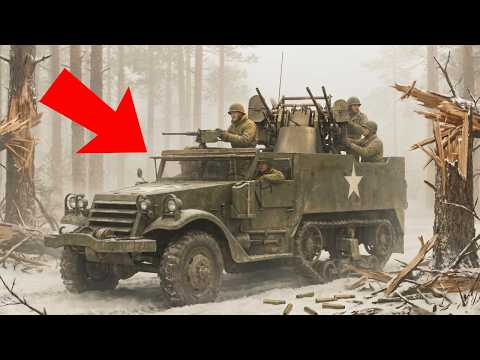
GI rifle companies were dying at 50 to 80 percent casualty rates trying to clear hedgerow lines that had been growing for centuries. Each earthen wall, six feet high and root-bound, was a ready-made fortress. Dug-in MG 42 nests, fortified farmhouses, tree-line snipers the infantry couldn’t suppress with anything they carried. One account captures the moment the equation changed: a rifle squad pinned by sniper fire from a single tree across a Norman field. An M16 half-track rolled forward, traversed its guns onto the tree, and fired for several seconds. The trunk came apart in splinters. The sniper’s position ceased to exist.
By July, AAA battery commanders who had been sitting idle while their attached infantry bled were offering their guns for ground fire. By the Ardennes, it was simply how the M16 was used. The weapon the infantry fell in love with was never meant for them. It was built to kill dive bombers.
The W.L. Maxson Corporation of New York had a contract problem solved and a war to prove it in. Their M45 quad mount, standardized in December 1942, carried four M2 HB Browning heavy machine guns on a single powered turret. Roughly 33 rounds per second—about 2,000 rounds per minute. At that rate, the human ear cannot resolve individual shots. What crews heard was not gunfire. It was a continuous tearing roar like nothing else on the battlefield.
Each gun fed from a 200-round ammunition chest the crews called tombstones. For comparison, the closest German equivalent, the 2 cm Flakvierling 38, fed from 20-round magazines that needed changing every six seconds and required a crew of seven to operate with hand-cranked traverse wheels. The M45 needed three men and a thumb switch.
Mounted in the open rear compartment of a White Motor Company M3 half-track, the whole rig weighed under 10 tons, could make 40 mph on a road, and carried 5,000 rounds of .50 caliber ammunition. The armor, 6 to 13 mm of face-hardened plate, stopped rifle rounds and shell splinters. Nothing else. The infantry had a name for the M3 half-track long before the quad .50 was bolted into it. They called it the Purple Heart Box. And for the two loaders on the side platforms, exposed from the chest up, deafened, showered in a cascade of spent brass, swapping 89-pound ammunition chests while four guns hammered the air out of their lungs, it earned the name.
A single M16 put more raw mass of metal into the air every second than one and a half MG 42s, the most feared machine gun of the war, firing a round more than four times heavier per individual bullet. What happened when that volume of fire was turned not on aircraft, but on unprotected infantry in the open, what the Germans learned to call it, and what it cost the men who crewed it, is coming.
But first, the proof. Mid-December 1944, the Ardennes. Battery D, 482nd Anti-Aircraft Artillery Automatic Weapons Battalion, was attached to the 9th Armored Division when the German offensive broke through the Luxembourg frontier. The 9th Armored’s companies were scattered across a 10,000-yard frontage. Clerks, cooks, mechanics, and anti-aircraft gunners holding a final defensive line against a German division attacking at five-to-one odds. Near the village of Beaufort, Captain Carlton G. “Pappy” Detton ordered his M16s into direct fire positions across snowbound fields.
Red tracer streams in the dark. Four guns per half-track, each spitting lines of burning phosphorus across white ground, the continuous roar echoing off frozen hillsides. Battery D’s quad .50s broke up at least one major infantry assault that night. The men attacking into those tracers, Volksgrenadiers pushing through knee-deep snow, walked into a wall of .50 caliber fire so dense the survivors described it not as being shot at, but as being inside a storm.
Three months later, the same officer forced the same battery to the head of Combat Command B’s column on the afternoon of March 7, 1945. The Ludendorff Bridge at Remagen had been captured intact. Detton’s lead half-track was the 13th vehicle across. His M16s were positioned at the water’s edge, barrels pointed upriver. The next afternoon, three Stukas and a Focke-Wulf 190 came low up the Rhine gorge. Battery D opened fire. All four shot down. The day after, 17 aircraft attacked. 13 destroyed. On March 10, Third Corps anti-aircraft gunners killed 28 of 47 attacking aircraft in a single day.
The geometry at Remagen was perfect, and it reveals the weapon’s one design flaw turned advantage. The M45 had a safety cutout preventing the guns from firing forward over the cab below 5 degrees of elevation, a legacy of the anti-aircraft role that made ground combat awkward. Crews normally compensated by angling the vehicle. At Remagen, positioned at the riverbank looking upriver, the aircraft flew straight into the guns’ optimal arc. The targets came to the weapon.
By the time the bridge collapsed on March 17, the attackers had included Messerschmitt Me 262 jets of Second Group, Kampfgeschwader 51, and Arado Ar 234 B jet bombers of Third Group, Kampfgeschwader 76. Aircraft capable of over 450 mph. The Luftwaffe fired 11 V2 ballistic missiles at the bridgehead. None hit. SS frogmen tried to mine the piers. Machine gun fire and searchlights stopped them. Not a single bomb touched the bridge. It fell to its own structural fatigue, killing 18 American engineers reinforcing the span.
The 482nd AAA Automatic Weapons Battalion claimed 21 aircraft in 10 days and received the Presidential Unit Citation, the only automatic weapons battalion so honored for Remagen. German pilots from the jet units that attacked the bridgehead described low-level approaches to American positions in a single word. “Suicidal.”
Late 1944, German infantry attack doctrine identified American anti-aircraft half-tracks as priority targets on the same list as Sherman tanks and tank destroyers. Their field reports used the clinical term Schwere amerikanische Flak. Heavy American Quadruple Anti-aircraft Gun. No dramatic nickname, just a designation for something they needed destroyed first.
But the legend of the meat chopper obliterating everything in front of it was true only within a narrow set of conditions. Unprotected infantry in the open, light cover, soft vehicles. Against anything else, the math reversed.
A panzerfaust went through the hull like cardboard. Mortar airbursts dropped fragments straight into the open fighting compartment. Sniper fire from an upper-story window could kill a loader who never saw it coming. 5,000 rounds, the entire basic load, disappeared in roughly two minutes of sustained trigger time. During the Bulge, battery histories described dedicated ammunition trucks shuttling back and forth continuously just to keep the guns fed. In the Ardennes cold, the M45’s electric traverse froze solid. Crews cranked the turret by hand.
Post-war assessments were blunt about the crews’ position. The open-topped gun pit, the loaders standing chest up, deafened, handling 89-pound ammunition chests while four Brownings fired, was, in the official language, no place to be in a real ground battle. The vehicle survived because the combination of mobility and volume of fire was irreplaceable. Not because it protected anyone.
The M16 went to Korea and did the same job, ground support against massed infantry, and the open top killed enough loaders that the army finally bolted on the bat-wing gun shields of the M16A1. The M42 Duster replaced it in 1953. But the M45 mount itself outlived the half-track by decades, dropped into the beds of cargo trucks in Vietnam, used by the French at Dien Bien Phu, adapted by the Israelis with 20-mm cannons. The lineage runs through the M163 Vulcan to modern divisional air defense.
What the veterans remembered was never the specifications. It was the sound. That tearing roar that was not gunfire, not anything else they had heard before or since. The brass ankle-deep in the fighting compartment. Red tracers arcing across snow at Beaufort, across the Rhine Gorge at Remagen.
They called it the meat chopper, earned, not given. A name that described exactly what four Browning M2s firing in concert did to anything in front of them. And said nothing at all about what happened to the men standing behind them.
The survivors of Battery D rarely spoke of the noise. They spoke of the silence after—the ringing void when the guns finally stopped, the way a man’s own heartbeat sounded like distant artillery. Loaders who lost their hearing in those open pits would carry the memory of that tearing roar for sixty years, long after the last M16 was scrapped.
Some of them returned to Remagen. They stood on the riverbank where Detton had positioned his half-tracks, and they looked upriver at the quiet water. “The bridge just got tired first,” one veteran said. “We were all tired. But the guns never were.”
The meat chopper was never loved. It was trusted. There is a difference. A soldier trusts a weapon that works when everything else has failed—when the panzerfaust is incoming, when the sniper has your squad pinned, when the jets are screaming down the Rhine gorge. He does not love the thing that deafens him, that leaves his ears bleeding and his hands raw from hauling tombstones. He simply knows that as long as the guns roar, he is still alive.
That is the inheritance of the M45 quad mount. Not glory. Not a monument. Just a sound that men who heard it never forgot, and a name the infantry gave it that said everything about what it did and nothing about what it cost.
They called it the meat chopper. And for the men who stood behind those four Brownings, chest-deep in brass and deafened by their own weapon, the question was never whether it would save them—only whether they would survive the saving.
What would you have done, standing on that riverbank in March 1945, with the Luftwaffe inbound and nothing between you and the bridge but four guns and a thumb switch?
Report this article
Select a reason for reporting:






