The ink was still wet on the documents in Panmunjom when the first shells fell. In a stuffy hut, diplomats passed papers across a table, their pens scratching out the end of a war. Thirty kilometers away, on a scarred hill called The Hook, an Australian machine gunner cleaned his Vickers for the third time that day. He could hear the diplomats in his head. He knew the war was almost over. He also knew what the Chinese had decided to do about it.
Because that night, on ground that would freeze within a week, thousands of men would fight for a hill. And by the time the diplomats signed, most of those men would already be dead.
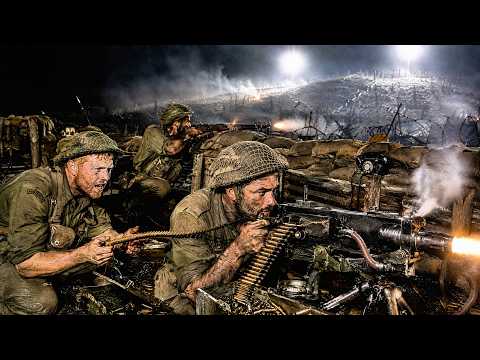
This is the story of the last battle of the Korean War. The story of The Hook. And the story of two hours—one on a wall in Panmunjom, the other in a trench above the Samichon Valley—ticking down to the same second.
To understand what happened, you have to understand the hill itself. The Hook is a crescent-shaped rise jutting out from the main Allied line into the Samichon Valley. From its forward trenches, a man with binoculars could see Chinese positions on Hill Akasak directly. On a clear day, he could see the barbed wire on the opposite slope. On a rainy day, he could see the muzzle flashes.
The Hook is not large. It is not glamorous. It holds no strategic significance in the grand sense of the phrase. But it commands the valley. Whoever holds The Hook can see who moves on the low ground. Whoever holds The Hook can direct artillery onto anything crossing that low ground.
That is why the Chinese People’s Volunteer Army tried to take it three times and failed three times. In the last nine months of the war, the first attempt came in October 1952 when U.S. Marines held The Hook and repelled a night attack. The second came in November when the Black Watch regiment was on the hill, and the Chinese launched a full assault, only to be torn apart by machine gun fire from fixed lines across the valley. The third came in May 1953 when the Duke of Wellington’s Regiment held the hill amid a bombardment of over 20,000 shells in 10 days, 11,000 of them on The Hook in a single night, yet the Chinese could not breach the trenches.
Three times they came. Three times they died on that spur, and each time the ground stayed in Allied hands. That is the hill. That is the piece of Korea that would become the last battlefield of the Korean War.
On July 9, 1953, the men of the 2nd Battalion, Royal Australian Regiment, climbed onto The Hook. They were known simply as “2 RAR.” They had been in Korea since March 17, and for the past four months, they had been patrolling the no-man’s-land of the James Town line sector between the Imjin and Samichon rivers. They were veterans of that exhausting, unglamorous kind of war. The war of night patrols and outposts and mortar duels, the war where you never see the enemy, but you feel him watching you.
They belonged to the 28th Commonwealth Brigade, commanded by Australian Brigadier John Wilton. Their neighbors on the left were the 7th Marine Regiment of the U.S. 1st Marine Division, holding a series of hills including Hill 111 and a point the Americans called “Boulder City.” Their neighbors on the right, across the hill, were “3 RAR,” the 3rd Battalion of their own regiment. Between them and the Chinese, about 200 meters of dead ground at the closest points, a belt of barbed wire, and a number of forward observation posts with names the soldiers used like place names in a country town. “Green Finger,” “Ronson,” the bunker. Those names had already been echoed on the tongues of three who had preceded them in these trenches. Now, these positions belonged to 2 RAR.
The battalion was deployed in a way that would be of great significance in the coming two weeks. D Company held the tip of The Hook, the most advanced and vulnerable position on the hill, where the ground fell away steeply on three sides. C Company held a spur to the west, a feature called Hill 121, where they could direct their fire into the valley that separated them from the Marines on Hill 111. A Company sat in depth behind them, ready to reinforce or counterattack. B Company was in reserve and detached from the battalion, sent to the American positions on Hill 111—a platoon of 2 RAR’s medium machine gun section under a sergeant named Brian Cooper. Cooper’s mission was to stay on that hill with his Vickers guns and sweep the low ground between the Australians and the Marines with fire whenever anything moved at night. He was alone there with the Americans as an Australian gun crew in a Marine trench. That fact would save the Marine line before all this was over.
The men knew these hills had seen savage fighting. They could see it. Every meter of the trench system bore the scars of the May battle. Bunkers had collapsed. Communication trenches had been shelled so flat they were shallow. Entire sections of the overhead cover were missing. On July 13, a photographer named Philip Hobson stood on The Hook to take pictures of the destruction. Later, those who saw the photos would say they looked like “Passchendaele” in 1917.
This is the reality of the hills. And this is what the 2nd Royal Australian Regiment inherited. Since July 9, every hour not spent on observation or patrols was spent on repairs. Bunkers were re-roofed. Trenches were re-dug. Barbed wire was re-laid. Ammunition was stacked. And every night, small groups of Australian infantry advanced into no man’s land to scout what the Chinese were doing on the other side of the valley.
What the Chinese were doing was preparing. That was abundantly clear. Patrol clashes increased through mid-July. On July 22, the Chinese set a precise ambush for an Australian patrol. That in itself was a signal. You don’t set ambushes if you’re waiting out the clock toward peace. You set ambushes if you’re trying to rob the defenders of their eyes and ears.
The Australian war diary during those weeks recorded the same words over and over. Movements, weather, shells falling, shells firing. No casualties, no casualties, no casualties. You could feel the relief in the phrasing. Every day that passed without a friend’s name on the list was a day closer to the end. And this is the point where the two hours begin to turn into one.
Thirty kilometers south in Panmunjom, negotiators were working out the final touches of an armistice that everyone at the table knew would be signed within days. Rumors from the peace talks spread in every direction. On July 23 at 6:15 PM, Brigadier Wilton called his battalion commanders to an urgent meeting at his headquarters. He told them what he had been told. The signing was imminent. From now on, only essential patrols for the security of The Hook would be sent out. In other words, stop taking risks. Don’t lose a man for a piece of ground that would be handed back at the ceasefire. Get through the next forty-eight hours alive.
Word of that meeting spread down from officers to sergeants. Through the smallest, quietest channels to some of the men. Not all of them. Rumors reached the forward trenches only sporadically. And the men on Hill 121 and the tip of The Hook were mostly still preparing for war as if it would never end. This is important. Because in less than 30 hours, the Chinese would launch an attack. And the men who would receive the first shock of that attack would mostly still believe it was just another night in a war that stretched forever in both directions.
The countdown had begun. 72 hours to the armistice. 71, 70… Why did the Chinese come? That is the question people around The Hook ask, and it must be answered before the shells fall, or everything that happens in the next three days will seem like pure madness.
Peace was a known quantity. The signing was days away. Both sides had been fighting a war of fixed lines for two years. A war of trenches and hills and small, vicious patrols. A war where control of the ground had barely changed since 1951. So why attack in the last week? The answer is not madness. The answer is a map.
When the armistice was signed, the line of contact—the line between the armies on the day of signing—would become the demilitarized zone. Any hills you control on the day the guns stop, you keep. Any hills you don’t control, you don’t get. That meant any last-minute gain had geopolitical weight on the peninsula for years to come. Take a hill on July 26 and hold it for 24 hours, and the hill is yours forever. Fail to take it, and it belongs to the enemy on the maps that would be printed for the next seventy years.
So, on the last night, both sides looked at the map, and the Chinese command looked at The Hook. They had tried three times and failed. Three times the hill had held. Maybe this time, with a fresh division, with maximum artillery, and a division-sized attack along the boundary between the Commonwealth Division and the Marines, maybe this time, in the final hours, they could break through and outflank the American position on the Imjin River. If they broke the boundary between the two divisions, they could threaten the entire Marine line.
That was the calculation. It was cold. It was rational. It was made by men in warm command posts by candlelight using rulers and compasses on paper maps, and it would be paid for in the blood of Chinese conscripts, nineteen and twenty-nine years old, in bulk.
48 hours to the armistice. The evening of July 24 descended slowly and warmly over the Samichon Valley. The monsoon season had begun. There was fog in the low ground. At The Hook, the men of D Company stood to before sunset, weapons in hand at every firing platform. C Company on Hill 121 watched the mountain pass toward the Marines. A Company watched the rear. B Company stood ready as reserves on Hill 111. Sergeant Brian Cooper directed his machine gun crews to fire belts of tracer ammunition toward predetermined lanes that would tear the low ground apart the moment anything moved in it. Marine officers walked the trenches and checked the barbed wire. The 7th Marine Regiment was on alert. Behind them, in the gun lines of the 16th Field Regiment of the Royal New Zealand Artillery, the U.S. 11th Marines, and the gunners of the 1st Commonwealth Division, fire plans had been laid for weeks. For every possible Chinese advance, there was a code word. For every code word, a specific fire pattern. Every fire pattern had been rehearsed.
Signallers in the forward company command posts clutched their headsets. Night fell, and everyone on that hill knew that if the attack was coming, it would be tonight.
The attack began at dusk with small movements first. Small groups of Chinese infantry, four or five men, advanced through the folds of the ground below The Hook. They were looking for gaps in the barbed wire, seams between the Australian companies, weak points in the fire plan. They were the probes of the attack, feeling the way ahead. But The Hook had been feeling their presence for a week. Australian observation posts spotted them. Australian standing patrols fixed their direction. Australian mortar shells fell on the identified positions, singly and in pairs, then in torrents. These reconnaissance efforts were shredded before they reached the wire. Small firefights flared in the folds of the valley under the last daylight. Chinese soldiers died in the grass without seeing who shot them.
This went on for about 40 minutes. And at about quarter to nine at night, the second hour—the Panmunjom hour—was completely forgotten, because the Chinese guns began their bombardment.
The bombardment did not begin gradually. It fell on The Hook, Hill 111, and Boulder City at once in a massive, continuous blow, and it did not stop. Medium mortars, heavy artillery, and recoilless rifles fired from the Chinese forward positions on the opposite hill. The pressure of the artillery, as the men in the trenches would later say, is something you feel first in your teeth and then in the bones behind your eyes. The blast pushes the air out of your lungs and back in again when the pressure drops. Dirt fell from the trench walls in layers. The timbers overhead groaned and cracked. The signaller in D Company’s command post gripped the telephone handset with both hands and shouted coordinate corrections while sand fell on his face from the ceiling.
Behind the hills, the New Zealand, American, and British guns began to work according to the fire plan, their shells pouring onto the Chinese assembly areas and approach routes, beginning the counter-fire. And the Chinese fire kept falling. The valley began to glow with that unreal whitish-purple color that only appears when enough high explosives detonate in one place to light up the underside of the clouds.
And at the height of the bombardment—the Chinese way that everyone in these trenches knew—the shells stopped and the infantry advanced. They came in waves. The Australians would later say they came to the sound of bugles and whistles. Illumination flares shot up from the mortar lines behind The Hook and drifted slowly under their parachutes. In that swaying light, the men at the firing platforms saw the low ground in front of the position swarming with rushing bodies. Not a platoon or a company, but a river of men flowing across the valley floor and up the slope by the hundreds.
The main axis of the attack was the valley between Hill 121 and Hill 111, the seam between the Australians and the Marines, the boundary the Chinese had identified after weeks of night patrols. That was the pressure point. There they hoped to achieve a breakthrough. They attacked Hill 121 and Hill 111, and behind them to the left, they threw the weight of their diversionary attack against Boulder City. All of it at once, on a front spanning two battalions.
And in the midst of that attack, the 16th Field Regiment of the Royal New Zealand Artillery poured in the most lethal killing weapon of that night: high-explosive shells with variable time fuses designed to explode not on impact with the ground, but at a fixed height above it in the air. Directly over the heads of the rushing men, so that the fragments scythed down like conical glass, tearing bodies bare of any cover.
The barbed wire in front of C Company on Hill 121 was reached. Chinese soldiers hung in the wire, crawling and trying to free themselves and dying. Behind them, other Chinese soldiers advanced over the bodies of their dead, throwing hand grenades. Machine guns from the Australian bunkers, Bren guns from the firing platforms, and the Vickers section of the medium machine gun platoon were still steady behind their tripods. Everything in the position opened fire. Grenades came in a continuous stream out of the trench. The signaller in the command post shouted map coordinates. Mortar shells from behind the hill dropped their fire to form a curtain that almost touched the barbed wire. Illumination flares kept rising to keep the killing field exposed, and yet the Chinese continued their attack. Wave after wave. Some fell dead at 40 meters. Some at 10 meters. Some at the barbed wire itself. No one got into the trenches. No one got through.
On Hill 111, the Marines faced a worse situation. The main Chinese effort seemed to crash against the American position. Bombardment, wave, bombardment, wave, and several forward Marine trenches were overrun in the first assault. Marines were killed inside their bunkers. Chinese infantry poured densely into part of the main defensive line. The Marines counterattacked with what immediate reserves they had, but the position was on the verge of being lost.
At that moment, Sergeant Brian Cooper, positioned with his Australian section on Hill 111, did something that would have been considered suicide under any other circumstances. He radioed the artillery net and requested a fire mission on his own position, on the top of the hill where he stood, on the trench he was in. He requested variable time fuses, so the shells would explode directly above him. He requested it now and in density on every inch of ground the Chinese had set foot on at the top, because he knew those trenches at that moment were full of the enemy and empty of Marines. The New Zealand and American gunners responded to the request. Shells exploded in the air above Hill 111 while Cooper and his men and the surviving Marines hugged the bottom of their trenches under the overhead cover. The Chinese troops in the open trench above them were hit by fragments raining directly from above. When the shelling stopped, no Chinese soldier remained alive at the top. Thus Hill 111 was saved, by an Australian sergeant who ordered friendly artillery fire onto his own head.
The attacks continued through the night. They lost momentum and coordination, but they did not stop. Small groups continued to push forward. Individual Chinese assault units continued to try to breach the wire. Australian mortar shells continued to reply. The counter-batteries continued to pound assembly areas across the valley. Only in the last dark hour before dawn on July 25 did the firing begin to slacken. The bugles fell silent. The illumination flares stopped rising. In the trenches, the men did not relax. They waited for the attack to return. But it did not return. At least not before daylight.
When the first gray light broke over the Samichon Valley on July 25, the men of the 2nd Royal Australian Regiment looked over their parapets at the ground below Hill 121 and saw for the first time what they had done in the night. It was not a full count. That would come later. But the barbed wire was full. The slope was full. The gully was full. There were Chinese soldiers dead where they had stood to throw grenades, dead where they had fallen while running, dead where they had lain down to change magazines and had not gotten up again. The Australians counted the dead they could see in front of them, then stopped counting. Because you cannot count what will not stop.
Below Hill 111, when Sergeant Cooper looked from his position at dawn, he saw the same thing but worse. Because the ground he was looking at was the ground he had called artillery fire onto. He saw the top covered with the men he had killed to save his trench. There is nothing to say about this. There is not much that can be said about any of this.
In the lines of D Company, a mail orderly brought hot tea to the section leaders. Someone handed out biscuits. Someone in a wounded bunker asked for a stretcher and was told to be patient and wait. This was the morning after the first night. The war was still on. The clock was still ticking. Thirty-six hours to the armistice.
July 25 was not quiet. Chinese artillery fell on The Hook through the afternoon—ranging shots, harrassing fire, testing where the Australians had repaired their wire. Between explosions, word moved down the trenches. “The rumor says it’s done. The rumor says they sign tomorrow.”
Men did the math whether they wanted to or not. “Don’t die tonight. Not for this hill. Not now.”
At dusk, they stood to again. Same wire checked, same guns oiled, same flares stacked. And in the valley below, the Chinese assembly areas filled once more. Same division. Same axis. Same seam between the Australians and the Marines.
The second night came harder. The bombardment was heavier, the infantry more desperate, and this time the Australians knew every lane of death by heart. On Hill 111, Sergeant Cooper again called fire onto his own trench, and again the Marines held. By 3:00 AM on July 26, a Chinese officer across the valley spoke the words that ended the last attack of the Korean War: the assault was cancelled.
Dawn revealed the valley floor carpeted with the dead—thousands of them. The Australians had lost five killed, twenty-four wounded. The Marines, forty-three dead, three hundred sixteen wounded. The hill still stood.
At 10:00 AM on July 27, the documents were signed in Panmunjom. At 10:00 PM that night, the guns stopped. The two clocks became one.
Years later, the men of 2 RAR received a battle honour bearing a single word: Samichon. Five names on a memorial. One silence over a valley.
So here is the question, and it deserves an honest answer: when the war was already lost and won on paper, was holding that hill for two more nights courage—or the last, terrible habit of men who had forgotten how to do anything else?
Report this article
Select a reason for reporting:






