Before dawn on August 26, 1942, Brigadier Arnold Potts hunched over a field telephone at his forward headquarters in Alola, on the Kokoda Track. The report crackling through the line was one he did not want to believe: 400 men held the hills above the village of Isurava—that was all he had on the front line. His scout had spent the night counting the Japanese force now moving against that ridge. They estimated more than 5,000 troops. Nine days. That was how long the hill above Isurava would hold.
In some places, the track was barely wide enough for two soldiers to stand side by side. The battalion dug in there was the 39th, an Australian militia unit. Boys barely 18 years old who had never fired a shot at another human being before that month. They had been sent from Port Moresby with less than three weeks between enlistment and combat. The better-trained soldiers called them, not always kindly, “Chocos.” Chocolate soldiers. The joke was that they would melt in the heat once real fighting started.
But they did not melt. For nine days, four of them under relentless assault, they bled for every yard of the Kokoda Track. By the end, they would achieve something almost no one believed they were capable of. That did not change a thing in the mind of the one man whose opinion mattered most to their careers.
Over 2,000 kilometers south, in a secured building in Brisbane, General Douglas MacArthur read the casualty and situation reports coming in from Papua. The reports told him his forces were outnumbered more than 10 to 1. They told him they were fighting on a single dirt track through some of the worst mountain terrain on earth. No road, no vehicle had ever crossed it. Everything reached those men only on the backs of other men. MacArthur read all of it and reached a different conclusion. That conclusion took shape that week and hardened quickly. The officers leading the track had lost their nerve.
He had been Supreme Commander of the Southwest Pacific Area for less than six months. He had arrived in Australia in March via PT boat and B-17 after leaving the Philippines on President Roosevelt’s direct order. Behind him at Bataan, he had left some 76,000 American and Filipino troops still fighting. They surrendered within a month of his departure. Corregidor held out a little longer. The island fortress fell in early May, about eight weeks after MacArthur left it. Between 11,000 and 13,000 of his men went into Japanese captivity there.
“I came through and I shall return,” he had said to reporters at Terowie railway station in South Australia. Behind his back, some of the men he had left on Corregidor began calling him “Dugout Doug.” The nickname stuck for the rest of the war. He was said to despise it more than almost any criticism ever leveled at him. He needed his return to be a victory entirely of his own making. A stumbling campaign on a jungle track most Australians had never heard of, a retreat in every report that reached his desk—that was not the right shape for the story. Someone would be blamed for it. It would not be him.
Within a month, Douglas MacArthur would begin proceedings to sack two senior Australian commanders. Both men had more combat experience against this specific enemy on this specific ground than anyone on his headquarters staff. The soldiers on the hills above Isurava, the men carrying out the actual withdrawal under Potts’s orders, had two and a half more months of fighting in them. Most of that fighting would be waged after the general they were bleeding for ended the careers of the officers leading them.
What MacArthur never grasped, not that week nor for years afterward, was simple. The retreat he could not forgive them for was the only thing standing between his headquarters and a Japanese army at the gates of Port Moresby. This is the story of how that retreat became the reason Australia kept Papua. It is also the story of two officers Douglas MacArthur wanted gone. The battle he was certain they had lost proved they were right.
He never once walked the ridge line himself. There is a family weight to how Douglas MacArthur judged courage under pressure, and it rarely surfaces in the Kokoda story. His father, Arthur MacArthur, had won the Medal of Honor at Missionary Ridge in the American Civil War. He was an 18-year-old officer at the time. Douglas MacArthur grew up measuring his own conduct against that standard. By the time he reached Papua, he had spent 30 years measuring every officer under his command against it as well. Now, he watched a campaign led by a retreat on the map week after week with those family legends haunting him. A fighting withdrawal would never be interpreted as anything but a failure of will.
The war reached Papua on July 21, 1942. Advance elements of the Japanese South Seas Force landed at Buna and Gona on the north coast. About 2,000 men under Major General Tomitaro Horii. More followed over the ensuing weeks. Horii’s total commitments to the operation would reach nearly 13,000 men, though not all were on the track at once. Their objective had been drawn on a map in Tokyo months earlier: cross the Owen Stanley Range and seize Port Moresby from the land side. The range is a spine of rugged mountains choked by jungle. Most Australian planners had quietly assumed it was impassable for any organized army. From Moresby, Japanese bombers could reach northern Australia. From Moresby, the sea lanes carrying American reinforcements to the Pacific would be under direct threat.
The only way through those mountains was a foot track. Cut by Papuan villages over generations between settlements whose names would become among the most fought-over ground in Australian military history. Kokoda, Isurava, Eora Creek, Templeton’s Crossing, Efogi, Ioribaiwa. In some places, the track climbed a thousand meters in an afternoon and dropped the same distance before dark. No vehicle had ever driven it, and none was needed.
An early skirmish at Kokoda on July 28 and 29 saw the Australians briefly hold the village’s small airstrip. It was the only flat ground for kilometers in any direction, and the only place where supplies could be flown in directly. They lost it, retook it on August 8, and lost it again two days later. Three times control of that same government station changed hands in two weeks. Each time, it cost lives neither side could easily spare.
You do not walk the Kokoda Track. You climb it. Then you drop down the far side into a river valley, then climb again. The heat soaks a shirt through in ten minutes. The cold in the high country at night reaches every man who did not bring a blanket. Malaria, dysentery, and scrub typhus would take more soldiers out of the line on both sides than bullets did throughout this campaign. Every wounded man who could not walk had to be carried out. On a stretcher, by hand, across that same brutal ground.
For the Australians, that job fell mostly to Papuan carriers, several thousand of them over the course of the campaign. The soldiers called them “Fuzzy Wuzzy Angels.” The name has not aged well. Every veteran account from that campaign uses it with genuine gratitude. Without those carriers, the wounded simply did not come out.
The track’s defender at the start was a single Australian militia battalion, the 39th. It had been sent from Port Moresby in July with almost no jungle training. Most of the men had barely fired their rifles outside a range. Their commander, Lieutenant Colonel William Owen, was killed at Kokoda village on July 29. He was shot in the head while defending the position with fewer than 80 men against a Japanese force many times their number. He died believing reinforcements were close. They were coming. They would not arrive for another month.
Neither side had fully factored in one variable. Horii’s troops had to move every round of ammunition, every food ration, every medical supply up the same track his men were now fighting on. Supplies moved on the backs of exhausted soldiers and conscripted Papuan and Korean labor. There was no road behind them. The jungle canopy was so thick that accurate airdrops were nearly impossible. Allied aircraft flew out of Port Moresby whenever the weather over the range allowed. They had already begun hunting the small coastal barges Horii depended on to bring supplies down from Buna. Every kilometer the Australians gave up under pressure was one more kilometer the Japanese now had to feed their growing, sickening army across.
That fact would mean nothing to anyone at General Headquarters for another six weeks. But it would end up mattering more than any single battle in this story.
By mid-August, the survivors of the 39th Battalion dug in on the ridge overlooking the village of Isurava. Combat and disease had whittled them down to a few hundred exhausted men. They had a new commander, Lieutenant Colonel Ralph Honner. Honner had marched his reinforcement company up the track in just two days to arrive in time. That pace was considered nearly impossible over that terrain, and it left the men collapsing on arrival. Behind them, at last, the real reinforcements began to arrive. The 2/14th and 2/16th Battalions of the 21st Brigade under Brigadier Arnold Potts. Veteran soldiers of the Australian Imperial Force from the Syria campaign against Vichy French forces the year before, finally trained troops against a Japanese force that had already cut through everything Potts’s militia could put in front of it.
Potts believed his brigade could hold at Isurava. For three days, it looked as though he might be right. The Japanese attack on Isurava began in earnest on August 26 and did not stop for four days. Horii pushed wave after wave against a defensive line barely a few hundred meters wide at its broadest point. The terrain squeezed the fight into ground where numbers mattered far less than they should. There was no room here to outflank anyone. This was close-quarters jungle fighting at ranges sometimes under ten meters. Grenade-throwing distance. Bayonet distance. Torrential rain turned every trail into a mudslide. On some mornings, visibility dropped to the length of an arm. Mortars were the heaviest weapon either side could realistically move onto that ground. On the Australian side at Isurava, there was no artillery at all. Nothing bigger than a Bren gun and a two-inch mortar against an enemy with mountain guns of his own.
Day one, August 26, was probing action. Japanese patrols tested the Australian line at half a dozen points looking for its gaps. They found none of the gaps they were looking for. On day two, the pressure doubled. On day three, August 28, the pressure became continuous. Mortar fire started at first light. Infantry attacks came in rolling waves, so that a defender who had just thrown back one assault had ninety seconds before the next one reached the forward pits. Ralph Honner led the exhausted 39th through all of it. His men later described fighting on reflexes and stubbornness with nothing else left to draw on. Most were already carrying malaria they had no chance to recover from before the shooting started.
The Australians held grimly, at a cost that climbed every hour on both sides. But they held, and every hour of holding meant Horii’s supply line stretched further behind him across a mountain range with no roads.
On day four, August 29, the Japanese found a gap. A section of the 2/14th Battalion’s line, worn down by 72 hours without real rest, collapsed under a fresh assault. For a few minutes, there was a hole in the Australian position. It was wide enough that a breakthrough could have unraveled the entire defense at once.
Private Bruce Kingsbury, 24 years old, a real estate agent from Melbourne before the war, was among the few men left in reserve. The report recorded at the Australian War Memorial states that he took a Bren light machine gun after its gunner was killed. He charged alone straight into the gap, firing from the hip as he advanced. He cleared ground the Japanese had taken only minutes before. He killed an estimated twelve or more of the enemy during that single-handed attack. A sniper shot him dead moments after the position was retaken. The entire attack lasted less than a minute from start to finish. The line held because of those seconds. Kingsbury was awarded the Victoria Cross posthumously, the first granted for a combat action on Australian soil. Papua in 1942 was administered under Australian law as Australian territory.
That was not the turning point. The fight on that hill did not end with one man’s charge, however much later accounts tried to frame it that way. Isurava fell that same night. The Australians were ordered to withdraw before they could be encircled from both sides. The retreat from the Kokoda Track began within hours of the battle in which one of them had earned a Victoria Cross. It was the retreat that would end two careers within a month.
Veteran Japanese soldiers who fought in the campaign gave their testimony to historians after the war. They described the ridge above Isurava as ground where the enemy seemed to be everywhere and nowhere at once. Three or four riflemen defending a position that should have required a full platoon. They vanished back into shoulder-high kunai grass the moment their position was identified. Then they opened fire again from fifty meters away in a different direction. None of those accounts could explain how so few men held so long against so many. Nor does the official Australian history offer a clean, definitive answer.
What the records of both sides agree on is the arithmetic. More than 5,000 Japanese troops took part in the battle by most estimates. Against a defending force that never numbered more than a few hundred riflemen at any one position. Four days of sustained assault before the line finally broke under a weight it was never designed to stop.
The real turning point in this campaign is a decision. Arnold Potts made it as the wings of his brigade began to crumble at Isurava. No single battle on the track carries the weight of that order. It was the order that would get him sacked within two weeks.
Potts ordered a fighting withdrawal. Most people, when they hear the word retreat, picture men running to the rear. This was a deliberate, staged withdrawal. From Isurava to Eora Creek. From Eora Creek to Templeton’s Crossing. From there to Ioribaiwa. At each position, his exhausted brigade turned and dug in. That forced the Japanese to commit and take casualties to dislodge them. Then it pulled back again before it could be encircled.
It nearly came apart entirely at Mission Ridge above a village called Brigade Hill in the first days of September. The 2/27th Battalion under Lieutenant Colonel Geoffrey Cooper was ordered to hold a position covering the brigade’s withdrawal route. A Japanese force slipped around both flanks in the dark and cut the battalion off. For roughly two days, it was effectively surrounded and out of contact with brigade headquarters. Its wounded could not be evacuated by any normal means. The same sickness and exhaustion draining every unit on that track had already worn the 2/27th down. It managed to break out under Cooper’s leadership by splitting into small groups of no more than a dozen men. They navigated by compass through jungle with no track beneath their feet, carrying what wounded they could and leaving those they could not. Some of those groups did not fully rejoin the brigade for nearly three weeks. The brigade’s casualties over those two days totaled 164 men killed, wounded, and missing. Most were from the 2/27th, the battalion that had been surrounded and bore the lion’s share of the human cost.
All of it happened on a hill most Australians could not name or find on a map. Each position was defended during the withdrawal long enough to bleed the Japanese advance. Then it was abandoned before it could be fully encircled. Then defended again a few kilometers further back by men already spent.
Here the variable that had been present since the start of this story finally began to bite. The supply line Horii’s army had been dragging across a brutal mountain range since July. Every extra day the Australians forced him to spend taking another hill was a day he could not replace his already thin stock of ammunition and food. It was working exactly as any delaying defense is supposed to work. But from more than 2,000 kilometers away, no one saw anything but place names moving south on a map without context. It looked like a retreat that would never stop.
Potts explained the reasoning plainly, in terms his superiors never forgot, in a signal still preserved in the official records. His brigade could not meet a force five or six times its size head-on and expect to survive, let alone complete the rest of the campaign. So he chose to make the enemy pay in time and blood for every kilometer of ground. The alternative was losing his entire command in a position he could not realistically hold. That decision was about to become the most controversial single command decision of the entire Kokoda campaign. Historians would still be arguing about it eighty years later.
In Port Moresby and then in Brisbane, the word in the situation reports through early September was retreat, retreat, retreat. Almost no one at General Headquarters, more than 2,000 kilometers from the mud, read it as a plan.
By the second week of September, General Douglas MacArthur had made up his mind. He sent cables to the US War Department. He spoke to Australian Prime Minister John Curtin. In both cases, he described the Papuan campaign as evidence that Australian troops were not fighting with the aggressiveness the situation demanded. Then he applied direct, sustained pressure on General Sir Thomas Blamey to act on it. Blamey was Commander-in-Chief of Allied Land Forces and MacArthur’s most senior Australian subordinate. According to Blamey’s biographer David Horner, MacArthur did not merely press the case against Rowell. He told Blamey directly and bluntly that Rowell had to go. That left Blamey, by his own later account, with no real room to refuse.
Curtin had his own doubts. He was in no position to act on them. His government’s entire war strategy at that point depended on American support and on MacArthur’s goodwill. Blamey moved. He was under that pressure and facing the prospect of losing MacArthur’s confidence entirely at a time when Australia’s war effort in the Pacific ran through the American general’s headquarters.
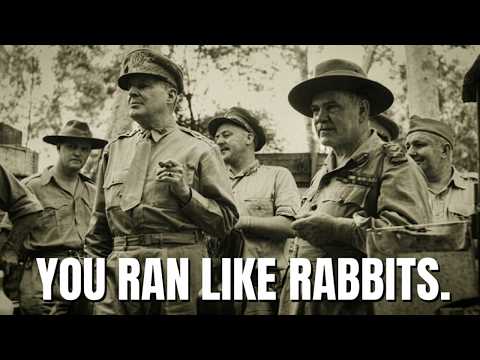
In early September, before any dismissal was finalized, he issued a formal order of the day to the troops in New Guinea. Many of the men who received it read it as a direct accusation of cowardice. It did permanent damage to morale before a single officer had even been relieved.
Brigadier Arnold Potts was relieved of command of the 21st Brigade in the second week of September. It happened days after the fighting withdrawal that had just saved his brigade from annihilation on Brigade Hill. He was replaced by Brigadier Selwyn Porter. The official reason recorded at the time was his lack of offensive spirit in handling the brigade. The men who served under him spent the following decades disputing that judgment in their memoirs and letters to newspapers. Eventually, they gave their testimony to historians who went back through the signals traffic. Those historians concluded the men had been right to object.
Australian Army Minister Frank Ford pressed Blamey throughout early September to go to Port Moresby himself. Ford wanted an assessment of the situation on the ground for the government in Canberra. That pressure leaked through a chain of command already primed by MacArthur’s cables to expect failure. It added political weight to taking further action rather than opposing it. A minister looking for someone to carry the blame for bad headlines rarely demands patience.
It got worse. On September 28, Major General Sydney Rowell was also relieved. He had commanded the New Guinea Force since mid-August, the officer who had ordered Potts’s brigade forward into the fight. His confrontation with Blamey was bitter enough, according to multiple accounts from officers present, that Rowell told Blamey he was no longer welcome at New Guinea Force headquarters. He refused to shake his hand on departure. Two of the officers most directly responsible for the fact that Horii’s army had not yet reached Port Moresby had now been sacked within a single month. The chain of command that did it had been more than 2,000 kilometers from the fighting. It had acted essentially on the word of a supreme commander who never once set foot on the Kokoda Track himself.
Rowell was no unqualified novice called up out of nowhere. He had served as a staff officer through the Middle East campaigns and had been selected specifically to command New Guinea Force because of that experience. Within weeks, he had established a headquarters, a supply chain, and a defensive plan across some of the worst logistical terrain in the entire war. He had done it with almost none of the resources any comparable American command would have taken for granted. That was what the campaign actually demanded of the men fighting it. They were ordered to hold positions against odds of 10 or 12 to 1 by some estimates. They were expected to deliver a decisive victory. Then they were criticized by name and relieved of command when the only tactic that might work, viewed from a map in another city, looked like a rout.
That tactic was trading space for time against an enemy who could not sustain his supply line indefinitely. MacArthur’s pressure on Blamey did not come from nowhere. He treated his own countrymen the same way. Three months later, frustrated by the pace of the American advance against Japanese positions at Buna, he sent his trusted subordinate, Lieutenant General Robert Eichelberger, to the front with an order that was preserved almost verbatim in Eichelberger’s memoirs after the war. “Take Buna or don’t come back alive.” “Relieve any commander who won’t fight.”
This was not a pattern about doubting Australians specifically. It was about a general whose reputation depended entirely on the Pacific campaign moving faster than the terrain itself would allow. He had left the Philippines while his men kept fighting without him. Every stumbling advance anywhere on his front became attributable to someone else’s lack of will, rather than to the ground.
The men who walked off that track never got a parade. They got a speech calling them rabbits. But the record, sifted for eighty years, has finally spoken back. Potts was right. Rowell was right. The withdrawal was the victory.
Horii’s army reached Ioribaiwa in mid-September and could see the coast. Then Tokyo pulled the plug—Guadalcanal had swallowed the reinforcements. The Japanese fell back over the same hills they had bled to take. The Australians followed, retaking Kokoda on November 2.
Potts never led a major command again. Rowell became Chief of the General Staff in 1950—the army’s quiet admission that September 1942 had been wrong. Blamey kept his baton. MacArthur never revised a word.
Four hundred boys held a ridge for nine days against five thousand. The man who sacked their commanders never climbed that hill. History did the climbing for him.
Did a relative of yours serve on the Kokoda Track, at Gallipoli, in Vietnam, or anywhere else? Tell me about them below.
Report this article
Select a reason for reporting:






