Rain lashed the Normandy coast as the first bombs fell, but the real storm was yet to come. Seven weeks after D-Day, the Allies were still trapped in a deadly stalemate, their bridgeheads choked by hedgerows and German steel. Operation Cobra was the gamble that would either break the deadlock or shatter the Allied cause. As American bombers droned overhead on July 25, 1944, no one could predict that this day would mark the beginning of the end for Hitler’s army in France.
The failure of Operation Goodwood just a week earlier had left the British and Canadians reeling, their advance on Caen bogged down in a cauldron of fire. General Bernard Montgomery, the architect of that disastrous offensive, faced fierce criticism from his American counterparts. Omar Bradley, the quiet, unassuming commander of the U.S. First Army, was convinced Montgomery would be sacked. Yet Montgomery held on, and in the midst of this command crisis, Cobra changed everything.
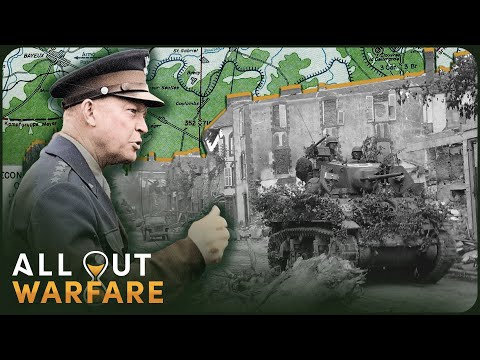
For the Germans, the situation was already desperate. After seven weeks of savage fighting, their divisions in Normandy were hollow shells. They had lost over 96,000 men, with only 5,200 replacements. Tanks were even scarcer—225 destroyed, just 17 replaced. Entire regiments had vanished, and the elite Panzer divisions were reduced to a handful of tanks and a few thousand men. Hitler’s orders were unequivocal: never retreat, never surrender, fight to the last man. But even his most loyal commanders knew the end was near.
In the east, the Russians were advancing relentlessly, and in the south, the Allies had taken Rome. The Japanese were being pushed back across the Pacific. Hitler’s wonder weapons—the V1 and V2—were terror weapons, not war-winning ones. The July 20 assassination attempt had shaken the Führer, and his vengeance was swift and brutal. Hundreds were executed, including some of Germany’s most seasoned commanders. Field Marshal von Kluge, who had taken over from von Rundstedt, knew Hitler’s strategy meant annihilation. He would not survive to see his prediction fulfilled.
As Cobra prepared to unleash hell, the Americans massed their forces. General George S. Patton, the flamboyant, aggressive commander of the Third Army, was finally unleashed. His rival, the methodical Omar Bradley, had crafted a plan that relied on overwhelming air power and a narrow front. The initial bombing was a disaster—short bombs fell on American positions, killing over 100 soldiers. But the German defenses were shattered. The Panzer Lehr Division, once the pride of the Wehrmacht, was virtually wiped out. Its commander, Fritz Bayerlein, later described the scene as a moonscape.
With the German line broken, Patton’s tanks poured through the gap. In just six days, the Americans advanced 60 kilometers—more ground than they had taken in the previous seven weeks. The bocage, that cursed maze of hedgerows, was finally behind them. The roads to Brittany and the heart of France lay open. But the Germans were not finished. Hitler ordered a counterattack at Mortain, aiming to cut the American spearhead. Ultra intercepts warned the Allies, and the German attack was crushed by air power and stubborn defense. Still, the Germans managed to hold key positions, buying time for a retreat.
Montgomery, eager to redeem himself, planned to trap the German army in a pocket between Argentan and Falaise. The Canadians and Poles fought bitterly to close the gap, while Patton’s Third Army raced to seal the southern jaw. But the Allies hesitated, fearing a German breakout. The pocket shrank, but the escape route remained open. Thousands of German soldiers fled through the Falaise Gap, harried by Allied fighter-bombers. The slaughter was immense, but the German army in Normandy was shattered.
By August 21, the gap was closed, but the victory was incomplete. Paris was liberated four days later, and the remnants of the German army streamed back toward the Reich. The battle for Normandy was over, but the war was far from won. The Allies faced a new challenge: the Siegfried Line and a German army that, though battered, refused to die.
Yet the Wehrmacht’s retreat from Normandy was not a rout—it was a fighting withdrawal, conducted with a skill that infuriated Allied commanders. Every bridge, every crossroads, every narrow village lane became a delaying action. German rearguards, often no more than a handful of tanks and a company of grenadiers, would hold just long enough to bleed the pursuers, then vanish into the summer haze before the trap could snap shut.
Patton’s Third Army, racing eastward, found itself fighting for fuel as much as for ground. The supply lines stretched back to the Normandy beaches, and the Red Ball Express—a heroic convoy of trucks running day and night—could barely keep pace. At one point, Patton’s tanks literally ran dry within sight of the German border. The pause gave the enemy exactly what it needed: time.
Time to man the Westwall. The Siegfried Line, that sprawling belt of bunkers, dragon’s teeth, and minefields, had been built in the 1930s and then largely stripped of its guns. Now, Hitler ordered every available artillery piece, every spare machine gun, and every last reserve battalion rushed to the western frontier. Old men of the Volkssturm, boys of the Hitler Youth, and the battered survivors of Normandy dug in side by side.
Eisenhower faced a dilemma. His broad-front strategy required supplies for all Allied armies, but Montgomery demanded priority for a single thrust into the Ruhr—Operation Market Garden. The British field marshal promised it would end the war by Christmas. The Americans were skeptical, but the political pressure was immense. In early September, the first airborne drops were scheduled.
Meanwhile, the Germans were not merely waiting. Field Marshal Model, the new commander in the west, was a master of improvisation. He scraped together battle groups from stragglers, training units, and convalescents. He turned the ancient fortress city of Aachen into a bastion and fortified the banks of the Rhine. And in the east, a new storm was gathering—one that would soon test the Western Allies in ways they had not anticipated.
The first airborne drops of Market Garden began on September 17, 1944, under a sky that seemed almost too clear. Thousands of paratroopers descended on Dutch fields and bridges, confident that the war would be over within weeks. But the Germans, battered as they were, reacted with a speed that stunned the Allied commanders. Model’s improvised battle groups, stiffened by veterans of the Eastern Front, moved to block the airborne corridor almost immediately.
At Arnhem, the British 1st Airborne Division dropped into a lethal trap. The presence of two SS Panzer divisions refitting near the town—a fact Allied intelligence had dismissed—turned the operation into a desperate fight for survival. The paras held the northern end of the road bridge for days, but they could not break through to the main body. Supply drops fell into German hands, and the radios failed. The men of the 1st Airborne fought on, but their position grew more hopeless by the hour.
South of Arnhem, the American 82nd and 101st Airborne had better luck. They seized the bridges at Nijmegen and Eindhoven, but the ground forces of XXX Corps, advancing up a single narrow highway, found themselves under constant attack. The road became a shooting gallery—German anti-tank guns and infantry ambushed the British tanks from every orchard and farmhouse. The advance slowed to a crawl, and the timetable collapsed.
By September 25, the operation was over. The British 1st Airborne had been shattered, losing nearly three-quarters of its men—more than 7,000 killed, wounded, or captured. The bridge at Arnhem remained in German hands, and the war would not end by Christmas. Montgomery blamed the weather and the failure of the Americans to move faster. The Americans blamed Montgomery’s plan. The recriminations would poison Allied relations for the rest of the war.
Yet the Germans had won only a temporary reprieve. Model’s forces were still desperately thin, and the Westwall was a shell of its former self. The line held, but barely. Every division was understrength, every tank irreplaceable. The Wehrmacht was bleeding out, and the Allies, despite their setbacks, had not lost their overwhelming advantage in men, material, and air power.
In Berlin, Hitler saw Market Garden’s failure as proof that the tide could still turn. He began to hoard reserves for a great counteroffensive in the west—a strike through the Ardennes that he believed would split the Allied armies and drive them back to the sea. His generals, veterans of the Eastern Front, were horrified. The resources for such an attack did not exist, and the winter weather would favor the defender. But Hitler would not be dissuaded.
The stage was set for the Battle of the Bulge. In the frozen forests of Belgium and Luxembourg, the last great German offensive of the war would soon be unleashed. But that is a story for another day. For now, the Allies paused at the German border, their supply lines stretched, their armies exhausted. The war had entered its final, most bitter phase.
In the frozen forests of the Ardennes, Hitler’s final gamble would soon be unleashed—but that is a story for another day. For now, the Allies paused at the German border, their supply lines stretched thin, their armies exhausted. The war had entered its final, most bitter phase.
The battle for Normandy was over. Paris was free. The German army in the west had been shattered, its survivors fleeing toward the Reich. Yet the Wehrmacht refused to die. Every mile of the retreat was bought with blood, every crossroads defended with a ferocity that stunned the Allies. The Siegfried Line loomed ahead, not the broken shell of 1939, but a fortified belt manned by old men, boys, and the hardened remnants of the Eastern Front.
Montgomery and Patton still bickered over strategy. Eisenhower still struggled to keep the coalition together. The broad-front advance continued, but the momentum had slowed. The autumn rains turned the fields to mud, and the roads became rivers of sludge. The Red Ball Express trucks could not keep pace with the insatiable demand for fuel and ammunition.
And in Berlin, in the smoky bunker beneath the Chancellery, Adolf Hitler was already planning his next move. The Ardennes offensive would be his last great gamble—a strike through the frozen forests of Belgium aimed at splitting the Allied armies in two. His generals knew it was madness. The fuel reserves were insufficient, the divisions understrength, the weather unpredictable. But the Führer would not be dissuaded.
So the war dragged on. The Allies, victorious in Normandy, faced another winter of fighting. The Germans, beaten but not broken, prepared for one final, desperate stand. The end was coming—but it would not come cheaply.
The battle for France was won. The battle for Germany had just begun.
What do you think—was Montgomery’s cautious strategy at Falaise a mistake, or did the Allies have no choice but to play it safe? Let us know in the comments below.
Report this article
Select a reason for reporting:






