Dr. Rebecca Turner had handled thousands of old photographs, but the moment she pulled print number 17 from the Whitman family archive, something cold crawled up her spine. The image was a standard 1890s studio portrait—a stern couple, two boys in dark suits, and a little girl in a white lace dress seated on her mother’s lap. But the girl’s eyes were closed, her hands folded too neatly, and her skin had an unnatural, waxy smoothness. Rebecca’s breath caught. This wasn’t a sleeping child. This was a post-mortem photograph.
She had seen death portraits before, but this one felt different. The mother’s hands weren’t cradling the child—they were bracing her upright, fingers digging into the tiny waist to keep the corpse from slumping. The boy on the left stared straight ahead, jaw clenched, as if willing himself not to look down. Five people in the frame, and only four of them were alive.
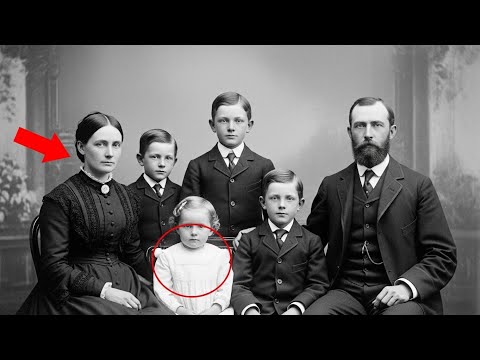
Rebecca zoomed in on the girl’s face. No motion blur—impossible for a living child during a 60-second exposure. The eyelids were flat, held shut with cotton pads or coins, a common Victorian practice. And the hands—folded deliberately on the stomach, fingers interlocked. No sleeping child holds their hands like that.
She cross-referenced the studio: Hastings Photography, Essex Street, Salem. Thomas Hastings advertised “memorial portraiture” as a specialty. The date on the back—October 14, 1893—was likely the session date, not the death date. Families typically waited one to three days after a loss to arrange the shoot.
But who was the girl? Rebecca dug deeper into the archive box and found a small leather journal bound with a brass clasp. The Whitman family record. She flipped to October 1893. There it was: “October 11, 1893. Our beloved daughter Anna Louise Whitman passed into God’s mercy at six years and four months, of diphtheria. She died peacefully at home, surrounded by her mother, father, and brothers Thomas and William.”
The burial was October 13 at Harmony Grove Cemetery. The photograph was taken October 14—one day after the funeral. Rebecca stared at the page, then back at the image. Why would a family exhume their child for a portrait after burial? Or had the date been misrecorded? She turned the journal page, and a loose slip of paper fluttered out—a note in the same precise handwriting, dated October 15, 1893: “For the album. So we never forget her face.”
But something else was tucked behind the note. A second photograph, smaller, creased at the corners. Rebecca’s hands trembled as she turned it over. It showed the same girl—but this time, her eyes were open.
Rebecca’s fingers went numb. She set the smaller photograph down on the archival mat and stared at it under the desk lamp. The same white lace dress. The same careful braids. But the eyes—the eyes were open, and they were not the eyes of a dead child. They were focused, alive, catching the light.
She flipped the photo over. On the back, in the same faded ink: Anna, age 6. June 1893. Four months before her death. A living portrait, taken while she still breathed.
Rebecca’s mind raced. Two photographs. One alive, one dead. The family had kept both. But the archive box had been sealed for over a century—why had no one ever mentioned the second image?
She returned to the leather journal, turning each brittle page with surgical care. The entries after Anna’s death were sparse. The handwriting, once elegant, grew jagged. “October 20, 1893. The house is too quiet. Thomas will not eat. William sleeps in her room.”
Then, a week later: “October 27. Mr. Hastings delivered the memorial portrait. We placed it in the parlor. It is her, and yet it is not. I cannot decide if this brings comfort or torment.”
Rebecca paused. The mother’s handwriting had changed again—the letters slanting differently, as if written in haste or distress. She scanned ahead, searching for any mention of the second photograph.
There it was, buried near the back of the journal, on a page that had been folded and refolded many times: “November 2, 1893. I cannot destroy it. I cannot keep it. The living image is a lie now. She is not there. I have hidden it where no one will find it, and yet I have left it where someone might. God forgive me.”
Rebecca looked from the journal to the two photographs side by side. The mother had hidden the living portrait inside the family record—not destroyed, not displayed. A secret grief, tucked between the pages of births and deaths.
But something still didn’t fit. If the family had buried Anna on October 13, how had they photographed her on October 14? Rebecca pulled up the Harmony Grove Cemetery records on her laptop. The burial entry was clear: Anna Louise Whitman, interred October 13, 1893, plot 44-B.
She cross-checked the date against the local newspaper archives. The Salem Evening News, October 16, 1893: “The funeral of the daughter of Mr. and Mrs. Edward Whitman was held Friday last. The interment was private.”
Private. That was the key. Rebecca dug into the Hastings studio ledger—a separate collection she had catalogued months earlier. Thomas Hastings had recorded every session: date, name, duration, notes. She found October 14, 1893. The entry read: “Whitman, E. Residence call. Child. 45 min. Special arrangement.”
Residence call. Hastings had gone to the Whitman house, not the studio. And “special arrangement”—a phrase he used only for post-mortem work that required unusual preparation.
Rebecca leaned back in her chair. The child had been photographed at home, one day after the funeral. That meant the body had not been in the ground. Which meant Anna Louise Whitman had never been buried on October 13.
She turned the journal page again, her pulse quickening. There, in the margin beside the burial entry, in handwriting so faint she had missed it on the first pass: “The ground was frozen. The sexton delayed until Monday. We kept her in the cold room.”
Monday. October 16. The burial had been postponed by three days. The photograph on October 14 had been taken while Anna still lay in the family’s cold storage room, waiting for the earth to soften.
Rebecca exhaled slowly. The timeline held. The photograph was real. The child had been dead for three days when Hastings arrived with his camera.
But that didn’t explain the open eyes. She picked up the smaller photograph again—the living Anna, June 1893—and placed it beside the memorial portrait. Same dress. Same braids. Same tilt of the head.
Then she saw it. A tiny detail she had missed. In the living portrait, Anna’s right hand rested on her lap, fingers relaxed. In the death portrait, the same hand was folded on her stomach—but the fingers were wrong. The index finger was bent at an unnatural angle, as if it had been broken and reset.
Rebecca grabbed the magnifying loupe and pressed it to the glass. Yes—the joint was swollen, the skin discolored. A post-mortem injury. The kind that happened when a body was moved carelessly, or when rigor mortis had already set in and the hands had to be forced into position.
She set the loupe down. The Whitmans had kept their daughter in a cold room for three days, posed her broken finger for a final portrait, and then buried her in a frozen plot. And still, the mother had written: “So we never forget her face.”
Rebecca reached for her phone to call the head archivist. There was something else she needed to check—a name she had seen in the margin of the journal, half-erased. Dr. Horace Fletcher. The same doctor who had attended the burial. But Fletcher wasn’t just a physician. A quick search revealed he had been investigated in 1894 for illegally supplying bodies to the Harvard Medical School.
Rebecca’s hand hovered over the keyboard. If Fletcher had been involved in body trafficking, then Anna’s death—and her photograph—might be more than a family tragedy.
She pulled up the digitized records of the 1894 Middlesex County investigation. Dr. Horace Fletcher had been accused of certifying false death causes for patients who never existed—and of selling unclaimed corpses to anatomy labs. The case was dropped when the key witness vanished. Rebecca’s eyes narrowed. Fletcher had signed Anna’s death certificate. What if diphtheria wasn’t the true cause?
She returned to the journal, searching for any mention of Fletcher’s visits before October 11. There, on a page from late September: “Dr. Fletcher called again. He says Anna’s weakness is nervous, not physical. He prescribed a tonic. She sleeps too much.”
Sleeps too much. Rebecca’s stomach tightened. Victorian medicine was riddled with sedatives—laudanum, chloral hydrate, morphine. A child given too much could slip away quietly, and a doctor could call it diphtheria without a second glance.
She cross-referenced the Whitmans’ address with the 1893 Salem city directory. Edward Whitman, the father, was listed as a clerk at the Essex County courthouse—no great fortune, but a position with access to legal records. Had Edward discovered something about Fletcher and confronted him? The journal offered no answer. The entries after November grew shorter, then stopped altogether in 1894.
Rebecca turned to the final pages of the leather book. Tucked into the back cover was a folded newspaper clipping, yellowed but legible. The Salem Evening News, March 1894: “Dr. Horace Fletcher has left Salem for the West. His practice will be taken over by Dr. Samuel Greene.” No mention of scandal. No mention of Anna.
She sat back, the two photographs still side by side on the mat. The living Anna smiled faintly, her eyes bright. The dead Anna sat in her mother’s lap, hands folded, finger broken, waiting three days for the ground to thaw.
Rebecca reached for the archive box one more time. At the very bottom, beneath the journal, lay a small envelope sealed with wax. On the front, in the mother’s hand: “For whoever finds her.”
She broke the seal. Inside was a single lock of pale blonde hair tied with white thread—and a note, dated 1910, seventeen years after Anna’s death: “I have told no one what Dr. Fletcher did. I cannot prove it. But I know my daughter did not die of diphtheria. She died because I trusted a man who wanted her body for his science. The portrait was his idea. He said it would ease our grief. I think he wanted to see how she looked after his tonic. God forgive me, I let him.”
Rebecca’s hands were shaking. She read the note twice. The mother had suspected Fletcher of poisoning Anna—perhaps accidentally, perhaps not—and had kept the photograph as evidence, hidden inside the family record for over a century.
She looked at the death portrait again. The broken finger. The flat eyelids. The hands folded too neatly. This was not a memorial. This was a confession.
Rebecca picked up her phone and dialed the head archivist. “You need to see this,” she said, her voice steady. “And I think we need to call the state medical examiner.”
The archivist arrived within the hour. Together they sealed the journal, the two photographs, and the lock of hair in an evidence bag and sent them to the state lab. Rebecca spent the next three weeks chasing Fletcher’s ghost—court filings, medical board minutes, a single letter from a Kansas asylum where he’d died in 1901. No confession. No trial. Just a man who vanished west with his secrets intact.
The lab report came back on a Friday. The hair sample showed elevated levels of chloral hydrate—a sedative, not a cure. Anna Louise Whitman had been slowly poisoned for weeks before her heart stopped.
Rebecca placed the two portraits side by side one last time. The living Anna, bright-eyed, June 1893. The dead Anna, hands folded, October 1893. One hundred and thirty-one years later, a mother’s hidden note had finally found its audience.
The collection was re-catalogued that spring. Print number 17 now hangs in the Massachusetts Historical Society’s public gallery, labeled simply: Anna Louise Whitman, age 6. Photographed three days after her death. Beside it, the living portrait. Both of them, finally, together.
What would you have done, if you were the mother, holding that note and that lock of hair—kept the secret, or spoken?
Report this article
Select a reason for reporting:






