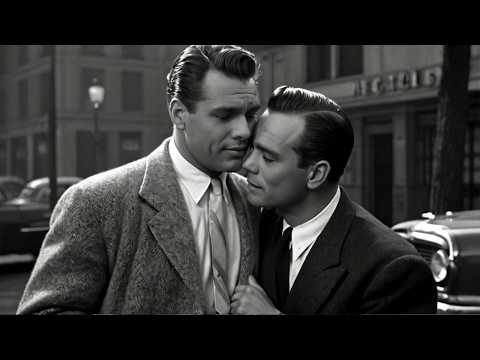
In the glittering world of Golden Age Hollywood, the spotlight illuminated every smile, every romance, every perfectly crafted public image. But behind the dazzling facade, a different story unfolded—one of forbidden love, secret affairs, and the constant fear of exposure. The studio system, with its ironclad morality clauses and relentless publicity machine, demanded conformity. For many of the era’s biggest stars, being gay or bisexual was not just a personal matter; it was a career-ending liability. Yet, despite the immense pressure to maintain a heterosexual public persona, some of the most celebrated actors of the time navigated secret relationships with men, their true selves hidden behind closed doors. From the flamboyant Liberace to the brooding Montgomery Clift, these stars lived double lives, their private passions becoming open secrets among Hollywood insiders while remaining carefully concealed from the adoring public.
The stakes were impossibly high. A single rumor could destroy a career, and the studios went to great lengths to protect their investments—arranging sham marriages, planting fabricated romances with female starlets, and even paying off gossip columnists. But the truth has a way of surfacing, and the stories of these 24 Golden Age actors reveal a complex tapestry of courage, compromise, and the relentless pursuit of authenticity in an industry that demanded nothing less than perfection.
Take Liberace, the flamboyant showman whose dazzling costumes and candelabra-lit performances made him a household name. His sexuality was an open secret in show business circles, yet he vehemently denied it under oath, even suing publications that hinted at the truth. His relationship with Scott Thorson, a young man he hired as a companion, became the subject of a sensational palimony suit that exposed the cracks in his carefully constructed facade. Despite his denials, close friends like Betty White later confirmed what many had long suspected: Liberace was indeed gay, and his managers had used female companions as beards to counter rumors.
Then there was Sir Laurence Olivier, the greatest actor of his generation, whose bisexuality has been the subject of much speculation. Biographers have claimed affairs with men, including actor Danny Kaye, though Olivier’s widow and son have fiercely disputed these claims. In his autobiography, Olivier admitted to being attracted to Kaye but insisted he never acted on those feelings. Yet other accounts suggest a youthful affair with actor Henry Ainley, painting a picture of a man torn between his desires and his public image.
Cary Grant, the epitome of suave sophistication, famously dismissed rumors about his sexuality with a quip: “I don’t care what people say. Hell, I’m not going to go through life with one hand tied behind my back just to please a few people.” But his close relationship with fellow actor Randolph Scott, with whom he shared a Malibu beach house dubbed “Bachelor Hall” for over a decade, fueled endless speculation. The two were inseparable, and photos of them lounging by the pool and cooking together painted a picture of domestic bliss. Studios worked overtime to frame their bond as a bromance, pairing them with female stars to dispel gossip. Grant’s relationship with openly gay costume designer Orry-Kelly, who wrote about their deep romantic bond in his memoir, added further fuel to the fire.
Ramon Novarro, the silent film idol known for his role in Ben-Hur, carefully concealed his relationships with men to protect his career. His sexuality was an open secret among Hollywood insiders, and his tragic murder in 1968—sensationalized by the press—overshadowed his achievements and highlighted the dangers faced by LGBTQ+ individuals of the era.
Charles Laughton’s bisexuality was corroborated by contemporaries, with rumors of his love for Tyrone Power and his later embrace of his homosexuality after his marriage to Elsa Lanchester. James Dean, the rebel without a cause, was rumored to have had relationships with men, including producer Rogers Brackett, who helped advance his career. Rock Hudson, the quintessential leading man, lived a secret life with partner Mark Christian, his homosexuality an open secret in Hollywood until his AIDS diagnosis brought it into the spotlight.
These stories are just a glimpse into the hidden lives of Golden Age stars—a reminder that behind the glamour and the applause, there were real people grappling with their identities in a world that refused to accept them. As we delve deeper into their secrets, we uncover not just scandal, but a profound human struggle for love and authenticity against all odds.
Montgomery Clift was a different kind of secret-keeper—not flamboyant like Liberace, not swaggering like Grant. He was introspective, haunted, and devastatingly private. His romantic life with men unfolded in shadows, whispered about but rarely confirmed. Elizabeth Taylor, his closest confidante, guarded those secrets fiercely. Clift’s struggles with alcohol and prescription drugs have long been linked to the unbearable weight of living a lie in an industry that demanded perfection.
Anthony Perkins, the boyish star of Psycho, navigated a similar duality. Publicly married to photographer Berry Berenson, he privately pursued relationships with men, including a rumored affair with dancer Rudolf Nureyev. Perkins compartmentalized his life so thoroughly that even close colleagues were unaware of the full picture until after his death from AIDS-related complications in 1992.
Marlon Brando, Hollywood’s ultimate rebel, was remarkably candid about his fluid sexuality later in life. His rumored liaison with James Dean has fueled endless speculation—some accounts describe Brando as dominant and emotionally distant, toying with Dean’s affections. Then there was Wally Cox, Brando’s childhood friend and lifelong confidant. When Cox died, Brando kept his ashes in his home, reportedly beside his own bed. Whether their bond crossed into romance remains unconfirmed, but its intensity was undeniable.
Tab Hunter’s story is one of quiet resilience. The blonde, blue-eyed heartthrob of the 1950s was gay, and his relationship with figure skater Ronnie Robertson was well known in Hollywood’s inner circles. He also shared a romantic relationship with Anthony Perkins in the 1950s, kept under wraps by the studio system. In 1955, Confidential magazine threatened to expose Hunter’s sexuality, and Warner Brothers intervened—orchestrating publicity dates with actresses and tightly controlling his private life. It wasn’t until his 2005 memoir, Tab Hunter Confidential, that he finally embraced his truth.
Randolph Scott remains one of Hollywood’s most tantalizing mysteries. His decade-long cohabitation with Cary Grant at their Malibu beach house—dubbed “Bachelor Hall”—sparked whispers that never quite died. Studio executives worked overtime to suppress the rumors, and Scott married twice, perhaps to keep up appearances. At a Hollywood party, the two were reportedly spotted spending an unusual amount of time away from the crowd, deep in conversation, lost in their own world. The host joked about them sneaking off, fueling more gossip. Whether Scott was gay remains a mystery, but his bond with Grant has made him a fascinating figure in Hollywood history—a story as much about what’s unsaid as what’s known.
Sal Mineo’s story is one of tragedy and quiet bravery. Best known as Plato in Rebel Without a Cause, Mineo was described by peers as sensitive and introspective. In a rare 1972 interview, he discussed his bisexuality—an admission almost unheard of for a Hollywood actor of his era. He directed and starred in Fortune and Men’s Eyes, a play about homosexuality and prison life, and played a bisexual character in P.S. Your Cat Is Dead. His murder in 1976 became a flashpoint for cruel speculation, the media framing his death as a byproduct of his sexuality rather than a tragic crime. Those close to him remembered him differently: a trailblazer who embraced his identity despite societal pressures.
Farley Granger, renowned for his roles in Hitchcock’s Rope and Strangers on a Train, was candid about his bisexuality in his memoir, Include Me Out. He detailed romantic involvements with playwright Arthur Laurents and a brief affair with composer Leonard Bernstein during the filming of Sideshow in 1949. His most enduring relationship was with television producer Robert Calhoun, a partnership spanning over three decades until Calhoun’s death in 2008. Granger maintained discretion throughout his career—a necessity in an era when open acknowledgment could jeopardize everything—but in later years he reflected on his experiences without shame or regret.
Clifton Webb never directly told anyone he was homosexual, but he never really hid it either. He wasn’t ashamed of who he was and never regretted it. Though he played a gossip columnist on screen, he couldn’t prevent conversations about his sexuality from constantly being had in real life. He never married and was never seen on dates; everyone associated him with his love for his mother, who was his date to parties and premieres. Webb was not afraid to act outside the strictly enforced gender roles of the 1940s and 1950s, and his coworker Robert Wagner later confirmed that he knew Webb was gay. When Webb passed away in the 1960s, the Stonewall riots were still years away—being openly gay was not exactly an option, regardless of staying closeted.
Dirk Bogarde lived with his manager Anthony Forwood for nearly forty years, their partnership an open secret in the industry but never publicly acknowledged. In 1961, he starred in Victim, the first British film to use the word “homosexual,” risking his career to tell a story that mirrored his own hidden life. He never came out, but his quiet courage spoke volumes.
Richard Chamberlain kept his homosexuality secret for most of his career, fearing it would cost him his romantic leading man status. He was involved with actor Wesley Eure in the 1970s before beginning a long-term relationship with Martin Rabbett. “I can talk about it now because I’m not afraid anymore,” he said after coming out in his 2003 memoir. His relief was palpable—and heartbreakingly late.
Sir John Gielgud faced public humiliation in 1953 when arrested for “importuning for immoral purposes.” Yet the theater community rallied, giving him a standing ovation at his next performance. His long-term partner Martin Hensler remained by his side until death. Tyrone Power, Van Johnson, Roddy McDowall, James Whale, Michael Redgrave, George Nader—each navigated the same treacherous waters, some with sham marriages, others with discreet partnerships.
Their stories are not just about scandal—they are about survival. About love forced into shadows. About talent that flourished despite the constant threat of exposure. These 24 actors remind us that authenticity is not a luxury but a human necessity, and that the price of hiding it can be measured in lost years, broken relationships, and silent suffering.
Today, as we look back at their glittering images, we see more than stars—we see people who loved, lost, and fought to be themselves in a world that refused to let them. Their legacy is not just in their films, but in the quiet courage they showed behind the scenes.
So, the next time you watch a classic film, remember: the person on screen may have been playing a role, but the person behind it was fighting a battle we can only imagine. What would you have done in their place?
Report this article
Select a reason for reporting:






