In 1946, inside a Polish courtroom, the air was thick with the weight of unspeakable crimes. The trials of Stutthof concentration camp guards had begun, and the world demanded justice for thousands of tortured souls. But among the dozens of defendants, one figure drew every eye—not for her remorse, but for her chilling indifference.
She was Jenny Barkman, a 24-year-old blonde with the face of an angel. Witnesses called her “Crazy Jenny” and “the Beautiful Specter.” As prosecutors detailed her atrocities—whippings that shredded flesh, dogs unleashed on prisoners, mothers torn from children—she simply fixed her hair and smiled at the guards. When the death sentence fell, she uttered words that froze the room: “Life is a pleasure, and like all pleasure, it does not last long.”
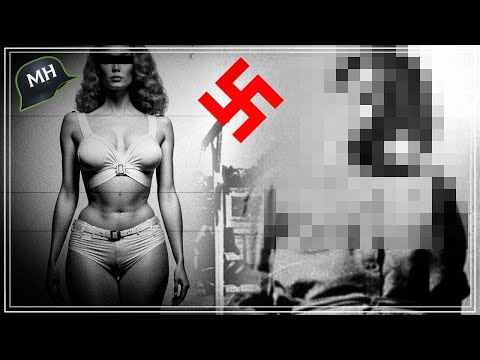
How does a young woman go from posing for fashion magazines to becoming one of the most sadistic torturers of the Third Reich? Jenny’s story begins in Hamburg, 1922. Born into a humble family, she grew up in the turbulent days of the Weimar Republic. With her blonde hair and blue eyes, she perfectly fit the Nazi ideal of the Aryan race—a fact that would later shape her dark path.
After high school, Jenny pursued modeling and acting, hungry for fame and glamour. She had a natural talent before the camera, and soon her suggestive photos were circulating among German soldiers on the front lines, offering a fleeting escape from the horrors of war. By 1944, at just 22, she seemed on the brink of international stardom.
Then, without warning, she abandoned it all. Jenny gave up modeling and applied for a job as a guard at Stutthof concentration camp in Poland. Was it the high salary? A twisted desire for power? Or a perverse patriotism as the Reich crumbled? No one knows for sure.
What is certain is that Stutthof was a hell on earth—isolated, surrounded by electrified barbed wire, where prisoners starved, froze, and died in gas chambers. But Jenny didn’t just follow orders. She reveled in cruelty, inventing new tortures with a smile. Her favorite was the leather whip, lashing victims until they bled to death—or leaving them paralyzed by tearing the flesh from their heels.
She separated mothers from their children, watching gleefully as the little ones were led to the gas chamber. Hundreds are suspected to have died by her hand. And yet, when the Red Army advanced in 1945, Jenny fled—only to be recognized at a train station four months later.
Now, as she awaits execution, her enigmatic smile never fades. But what truly happened in those final moments before the rope tightened? The answer lies in the twisted journey of a woman who turned beauty into a weapon of horror.
The courtroom testimony that sealed Jenny’s fate came not from generals or judges, but from the hollow-eyed survivors who had once scrubbed her boots and endured her whims. One by one, they shuffled to the witness stand, their voices trembling as they described the beautiful specter who haunted their nightmares. “She would choose the strongest men,” whispered a former prisoner, “and whip them until the bone showed. Then she would laugh and move to the next.”
Another survivor, a woman whose child had been torn from her arms, pointed a shaking finger at Jenny. “You smiled,” she said. “You smiled as they took my son.” Jenny tilted her head, as if recalling a pleasant afternoon, and offered no defense.
Her calm was more terrifying than any outburst. While other defendants wept or denied everything, Jenny sat with her ankles crossed, occasionally touching her hair as though checking her reflection. The prosecutors called it arrogance. The guards called it madness. But some whispered it was something far stranger—a woman who had never believed she could lose.
When the verdict was read, the courtroom fell into a silence so deep that the rustle of paper sounded like thunder. Death by hanging. Jenny rose gracefully, smoothed her skirt, and delivered her final public words without a tremor. “Life is a pleasure, and like all pleasure, it does not last long.”
The judges exchanged uneasy glances. The reporters scribbled furiously. And Jenny was led away, her heels clicking against the stone floor like a metronome counting down her remaining days.
In her cell, she refused visits from a priest. She ate her meals with delicate precision, arranged her hair each morning with the same care she had once given to photo shoots, and reportedly hummed melodies from old German cabaret songs. A guard later testified that she seemed less like a condemned prisoner and more like a woman waiting for a train—patient, composed, and entirely untroubled by where it might take her.
But the story of Jenny Barkman does not end in that cell. It ends on a hill in Gdansk, where the morning of July 4th, 1946, dawned gray and humid. And it is there—among the crowd of two hundred spectators, the trucks, the ropes, and the final, gasping moments—that the true nature of her eerie calm would finally be revealed.
The execution site was a sloping field just outside the city, chosen because the uneven ground made the trucks easy to position. Unlike the gallows used for military executions, there was no platform, no hood, no last words. The condemned were simply lined up beside one another, a row of eleven men and women in prison gray, their hands bound behind their backs.
Jenny stood third from the left. Her hair had grown out in the months since her arrest, and a guard had tied it back with a strip of cloth. Even now, witnesses said, she held her chin high, scanning the crowd as though searching for a familiar face.
The first rope was fitted around the neck of a former SS officer. The truck lurched forward, the rope snapped taut, and the crowd gasped. Then came the second. Then Jenny’s turn.
According to a Polish journalist who covered the execution, Jenny did not resist as the rope was looped over her head. She did not close her eyes. Instead, she turned her head slightly toward the line of remaining prisoners and said something that no one in the crowd could hear.
One of the guards later claimed she said, “See? I told you it wouldn’t last long.” Another insisted her lips never moved at all. The discrepancy was never resolved, and the truth of her final words died with the men who heard them.
The truck rolled forward. Jenny’s body dropped, swung, and twisted in the humid air. The crowd watched in silence as her face darkened and her feet kicked against nothing. It took several minutes for her to go still.
When it was over, the bodies were cut down and taken away for burial in an unmarked grave. No family claimed Jenny Barkman. No flowers were left. The hill in Gdansk returned to being an ordinary field, and the world moved on to the next trial, the next atrocity, the next name in an endless ledger of wartime horrors.
But the question of why she did it lingered. In the decades that followed, historians would return again and again to the puzzle of the model who became a torturer. Some argued she was a true believer, seduced by Nazi ideology. Others insisted she was simply a sadist who found in the camp a perfect stage for her cruelty.
And still others pointed to a stranger possibility—that Jenny Barkman had never cared about politics, money, or power at all. That she had joined Stutthof for the same reason she had posed for photographs: because she wanted to be watched.
If that was true, then her final performance was her masterpiece. The composed defendant. The enigmatic smile. The words about pleasure that did not last. She had turned her own death into a spectacle, and the two hundred spectators on that hill had given her exactly what she craved—their undivided attention.
Yet the story does not quite end there. For among the papers recovered from Stutthof after the war, investigators found a single photograph that had never been published. It showed Jenny in her guard uniform, standing beside a barbed wire fence, her head tilted at the same angle she had once used for fashion shoots.
On the back, in neat handwriting, someone had written a date and four words in German. The date was 1944. The words were translated years later by a historian who could hardly believe what he was reading.
They read: “For my mother. With love.”
The photograph raised more questions than it answered. Investigators searched for Jenny’s mother, but records showed she had died in 1943—a year before her daughter ever set foot in Stutthof. So who was the photo meant for? And why would a woman who never showed remorse leave behind such a tender inscription?
Some historians dismissed it as a macabre joke. Others wondered if Jenny had written the words with a different meaning entirely—not love as affection, but love as a kind of twisted pride. “Perhaps she wanted her mother to see what she had become,” one researcher suggested. “Not a model. Not a pretty face. Something the Reich would remember.”
The theory was never proven. The photograph itself vanished from the archives in the 1960s, and only a black-and-white copy survives in a Warsaw museum. Visitors often pause before it, studying the smiling guard with the tilted head, trying to see the monster beneath the beauty.
Decades later, a survivor named Halina Wójcik returned to the site of Stutthof for a memorial service. She was ninety-two years old, her hands gnarled by arthritis, her voice a whisper. A young journalist asked if she remembered Jenny Barkman.
Halina was silent for a long moment. Then she nodded. “She was the prettiest thing I ever saw,” she said. “And the worst. I used to think the two things couldn’t exist in the same person. Now I know better.”
The journalist asked what she meant. Halina looked toward the field where the camp once stood, now overgrown with grass and wildflowers. “Evil doesn’t always look ugly,” she said. “Sometimes it looks just like a girl from a magazine. That’s what makes it so hard to see coming.”
She walked away then, leaning on her cane, and the journalist was left standing alone with the weight of those words. The story of Jenny Barkman had ended on a hill in Gdansk, but its shadow stretched across generations—a warning, a puzzle, and a question that refused to die.
Because in the end, Jenny never explained herself. She never confessed, never repented, never offered the world a reason it could understand. She simply smiled, said her enigmatic words, and let the rope do its work.
And perhaps that was her final cruelty—leaving us to wonder forever what, if anything, had ever been real behind those blue eyes.
What do you think—was Jenny Barkman a true believer, a born sadist, or simply a woman addicted to being watched? Share your thoughts in the comments below.
Report this article
Select a reason for reporting:






