March 1945. Berlin was dying. The city that had once thundered with parade boots and triumphant speeches now trembled under Allied bombardment. Buildings that had stood for centuries collapsed into rubble. The grand boulevards where Hitler had once rolled in motorcades were now obstacle courses of shattered concrete and twisted metal. And in the basements and bunkers beneath this crumbling empire, Germany was preparing its final, most desperate gamble. It was sending its children to war.
Dietrich Weber stood in a dim cellar beneath a destroyed school in the Charlottenburg district, staring at the rifle being thrust into his 15-year-old hands. The weapon felt impossibly heavy, cold metal against his palms. Around him, two dozen other boys ranging from 12 to 17 years old received their own rifles, their faces pale in the flickering light of oil lamps. Most of them had been his classmates just months earlier, before the schools closed, before everything fell apart.
The officer distributing the weapons was Hauptmann Gerhard Steiner, a skeletal man in his 50s who had been pulled from retirement to train this final generation of defenders. His Iron Cross from the First War hung crooked on his threadbare uniform. When he spoke, his voice carried none of the martial enthusiasm that had once defined the Reich’s military instruction. Instead, there was only exhaustion and something that looked unsettlingly like pity.
“You are soldiers of the fatherland now,” he told them. But the words rang hollow in the underground space. “The Führer calls upon Germany’s youth to defend the homeland against the Bolshevik and Anglo-American invaders who wish to enslave our people. Your duty is clear. Your sacrifice will be remembered forever.”
Dietrich had heard similar speeches a thousand times in Hitler Youth meetings, but they had always been delivered in sunlit squares with flags snapping in the wind and crowds cheering. Now the words fell flat against concrete walls that shook with each distant explosion. Forever seemed like a promise that Germany could no longer keep.
Beside him, a smaller boy whose name Dietrich didn’t yet know struggled to hold his rifle upright. The child couldn’t have been more than 13, with blond hair that stuck up in uneven tufts and eyes that were too large for his thin face. His hands shook visibly as he tried to mimic the older boys’ stances. Dietrich noticed that someone had stuffed newspaper into the boy’s boots to make them fit better, and the sleeves of his uniform jacket had been rolled up multiple times.
Outside, air raid sirens began their familiar wail. The boys flinched collectively, but Hauptmann Steiner merely raised his voice to be heard over the growing thunder. “Tomorrow, you will be assigned to defensive positions. Tonight, you will learn to clean and load your weapons. Remember that the enemy shows no mercy. They will not care that you are young. They see only German soldiers, and they will kill you without hesitation.”
Dietrich looked down at the rifle in his hands and wondered if he would live to see his 16th birthday in two months. Deep down, in a place he was afraid to examine too closely, he already knew the answer.
The village had no name that mattered anymore. By April 1945, it was simply a collection of shattered buildings along a road the Americans wanted. Dietrich and his unit of boy soldiers had been positioned there three days earlier with orders to hold the crossing at any cost. Their commanding officer, Lieutenant Bauer, had disappeared during the first artillery barrage, leaving the children to fight a war they couldn’t possibly win.
Dietrich crouched behind the remains of a stone wall, his rifle pressed against his shoulder, trying to remember everything he’d been taught in those few frantic training sessions. Around him, the other boys from that Berlin cellar had become his squad, though none of them had chosen this brotherhood. They’d been thrown together by circumstance and desperation, bound by shared terror and the fading dream of the thousand-year Reich.
13-year-old Oskar Lang huddled in the rubble nearby, his oversized helmet slipping down over his eyes every few minutes. He’d been crying quietly since dawn, trying to hide it from the older boys. His rifle lay across his lap, and Dietrich wasn’t certain the child even knew how to fire it properly. Before the war consumed everything, Oskar had been a student at a gymnasium in Hamburg, studying Latin and dreaming of becoming a doctor. Now, he clutched a weapon and waited for death.
16-year-old Rudolf Keller was different. He paced along their defensive position with the rigid bearing of a true believer, his jaw set in determination. Rudolf had been a squad leader in Hitler Youth, one of those boys who had memorized every speech, every slogan, every promise of German supremacy. Even now, with the Reich collapsing around them, he spoke of secret weapons and inevitable victory. “The Führer has a plan,” he insisted whenever doubt crept into conversations. “We must hold until reinforcements arrive.”
14-year-old Leonhard Brandt said little. He was a thin boy with careful hands who’d spent most of his life drawing and painting. Even here in this destroyed village, Dietrich had seen him sketching in a small notebook he kept hidden in his jacket. Leonhard drew what he saw: the shattered buildings, the frightened faces, the truth that propaganda posters had never shown. His silence felt more honest than Rudolf’s speeches or Oskar’s tears.
The fifth member of their group was 14-year-old Alois Fischer, a farmer’s son from Bavaria who’d watched American bombs kill his entire family during a raid on Munich. He spoke rarely, moved mechanically, and seemed to have retreated somewhere deep inside himself where the war couldn’t follow. When he did speak, his voice carried no emotion, just flat statements of fact. That made the other boys uncomfortable.
The sound of engines in the distance brought them all to attention. Rudolf gripped his rifle tighter. Oskar’s crying stopped. Leonhard closed his notebook. Alois simply stared toward the sound with empty eyes.
“This is it,” Rudolf whispered, his voice carrying forced confidence. “Remember your training. Remember your duty to the fatherland.”
Dietrich checked his rifle one more time and wondered which of them would still be alive by nightfall.
The Americans came at midday with overwhelming force. Tanks rolled down the village’s main road while infantry moved methodically through the ruins. Dietrich fired his rifle twice before realizing how utterly futile their resistance was. The Americans weren’t the savage barbarians of propaganda films. They were professional soldiers executing a military operation with practiced efficiency, and five terrified boys with rifles were nothing more than a minor obstacle to be eliminated or bypassed.
Rudolf kept shouting orders that no one followed, his voice growing more desperate with each passing minute. “Fall back to the church! Suppressing fire on the left flank!” He’d learned the terminology from training manuals and war films, but the words meant nothing in the chaos of actual combat. A tank shell exploded fifty meters from their position, and Rudolf’s commands dissolved into incoherent screaming.
Oskar had stopped even pretending to fight. He sat with his back against a wall, arms wrapped around his knees, rocking slowly back and forth. His rifle lay forgotten in the dirt beside him. Dietrich crawled over to check on him, expecting to find the boy wounded, but Oskar was physically unharmed. He’d simply retreated into some interior space where the battle couldn’t reach him. His lips moved in silent prayer or perhaps just repeated fragments of childhood rhymes. His mother had probably taught him those songs before the bombs and the conscription and the end of everything normal.
Leonhard had taken up a position in what remained of a second-story room—not to shoot, but to observe. Through the gaps in the destroyed wall, he watched the American advance with the same careful attention he’d once given to still-life arrangements in art class. Later, Dietrich would learn that Leonhard had been drawing even then, sketching the tanks and soldiers with quick, precise lines, documenting reality while Rudolf screamed about glory.
Alois fired his rifle methodically, without apparent fear or excitement. He aimed, squeezed the trigger, worked the bolt, aimed again. Whether he hit anything was unclear and seemed unimportant. He was simply performing the action he’d been instructed to perform, moving through the motions like a farmer working a field. The detachment in his movements was more disturbing than Oskar’s breakdown or Rudolf’s hysteria.
By early afternoon, their position had become untenable. The Americans had surrounded the village center, and sporadic gunfire from desperate boy soldiers wasn’t going to change the outcome. An older German sergeant from a regular army unit stumbled into their position, blood streaming from a head wound. He looked at the five boys, and something like horror crossed his face.
“Get out of here,” he gasped. “Fall back east. Find your families. This war is over.” Then he was gone, limping away through the rubble, and the boys were alone again with their impossible orders to hold a position that no longer mattered.
Rudolf refused to retreat. “We hold here. Those are our orders. We hold until relieved.” But there would be no relief, no reinforcements, no secret weapons—just five children playing soldier while an empire died around them.
The end came quickly once it began. American soldiers appeared in their defensive position before Dietrich fully registered they’d been flanked. One moment he was checking his remaining ammunition; the next, a massive figure in an olive drab uniform was standing three meters away with a rifle pointed directly at his chest. The soldier’s face was hidden behind combat gear, but his voice carried a strange accent that Dietrich’s limited English couldn’t immediately place.
“Drop it, kid. Drop the weapon now.”
Dietrich’s rifle clattered to the ground. Around him, the other boys were being similarly disarmed. Oskar didn’t resist, simply raised his hands high above his head, tears streaming openly down his dirt-smeared face. Leonhard carefully set his weapon down and stepped away from it with deliberate slowness, as if trying not to startle a dangerous animal. Alois showed no reaction at all, letting the Americans take his rifle without acknowledgment.
Rudolf was the problem. The 16-year-old backed against a wall, rifle raised, screaming in German about duty and honor, fighting to the last bullet. His voice cracked with adolescent rage and terror. The American soldiers didn’t shoot him. Instead, they surrounded him carefully, speaking in low, calm voices that Dietrich couldn’t fully understand but whose tone was unmistakable. They were trying not to hurt him.
One soldier stepped forward, hands raised in a placating gesture. His face was visible now, weathered and sunburned, with kind eyes that seemed deeply out of place on a battlefield. He was perhaps thirty years old, with the build of someone who’d worked farms before he’d worked wars. The name stenciled on his uniform read PRITCHARD.
Sergeant Elwood Pritchard approached Rudolf the way someone might approach a frightened dog. He spoke in broken German, his accent terrible, but his meaning clear. “Krieg ist vorbei. War is over. Du bist Kind. You are child. Nicht sterben heute. Not die today.”
Rudolf’s rifle wavered. His face contorted with confusion and betrayed conviction. Everything he’d been taught said these Americans would torture and murder him. Yet here they stood, clearly capable of killing him instantly, instead pleading with him to surrender safely. The cognitive dissonance was too much. His rifle dropped, and he collapsed to his knees, sobbing with a violence that shook his entire body.
Captain Harold Brennan arrived minutes later, surveying the captured boys with an expression Dietrich would remember for the rest of his life. It wasn’t triumph or satisfaction. It was profound sadness mixed with anger, though the anger seemed directed elsewhere—at the system that had put rifles in children’s hands. The captain was perhaps forty, with graying hair and a face that suggested he’d seen too much of this war already.
“Jesus Christ,” he muttered in English, then louder to his men, “Get them water. Check for wounds, and somebody find out how old these kids actually are.”
Dietrich stood among his captured squad, hands zip-tied in front of him, and waited for the execution he’d been promised would come. The propaganda films had been very clear about what happened to German soldiers who surrendered.
They walked in single file along a muddy road, flanked by American soldiers who kept their weapons lowered but ready. Dietrich counted fifteen guards for five boys, which seemed excessive until he considered that these Americans had no way of knowing whether their young prisoners were fanatics who might try something suicidal. Rudolf’s earlier resistance had probably convinced them that German indoctrination ran deep, even in children.
The April afternoon was unnaturally warm, and sweat soaked through Dietrich’s ragged uniform. His wrists ached from the plastic restraints, and his boots had developed holes that let in mud with each step. Behind him, Oskar struggled to keep pace, his shorter legs working double time. Sergeant Pritchard noticed and slowed the entire column without comment, letting the youngest boy catch his breath.
They passed through countryside that showed the war’s fingerprints everywhere. Burned-out vehicles littered the roadside. Abandoned equipment lay scattered in fields. A farmhouse stood roofless, its walls pockmarked with bullet holes. In a different life, Dietrich might have found this landscape beautiful. Rolling hills stretched toward distant forests, and wildflowers were beginning to bloom despite the devastation. Nature didn’t care about empires falling.
Leonhard kept his head up, eyes moving constantly, as if memorizing every detail of this journey. Dietrich wondered if the artist was already composing sketches in his mind, turning trauma into something he could process later through drawing. Alois walked with the same mechanical emptiness he’d shown during combat, present in body but absent in spirit. Rudolf had gone silent after his breakdown, his face set in rigid shame.
The prisoner-of-war camp appeared after two hours of walking. It wasn’t the massive facility Dietrich had imagined from propaganda descriptions. Instead, it was a modest compound of perhaps twenty wooden buildings surrounded by wire fencing and guard towers. American flags hung limp in the still air. Soldiers moved about their duties with a casual efficiency that spoke of routine rather than wartime urgency.
Captain Brennan led them through the main gate. Other prisoners—older German soldiers—watched from behind wire with expressions ranging from curiosity to pity. One veteran, gray-haired and missing an arm, shook his head slowly when he saw the boys. His lips formed words Dietrich couldn’t hear but could easily imagine. Children. They’re sending children now.
The processing area smelled of disinfectant and sweat. American clerks with typewriters recorded information while medical personnel stood ready. Captain Brennan spoke with another officer, their conversation conducted in low tones with frequent glances toward the five boys. Dietrich caught fragments of English words he’d learned in school. Children. Orders. What the hell were they thinking?
They were separated then, each boy taken to a different area for medical examination and delousing. Dietrich wanted to protest, to keep his makeshift squad together, but exhaustion and confusion had stolen his voice. The last thing he saw before being led away was Oskar’s terrified face looking back at him, silently begging not to be left alone.
A soldier guided Dietrich into a small room with a table and two chairs. The door closed behind him with a sound like finality. This was where interrogation would begin, where the Americans would extract information before the execution. Dietrich sat down and prepared himself to die with whatever dignity a fifteen-year-old could manage.
Morning came with unexpected gentleness. Dietrich had spent the night in a barracks with the other four boys, all of them issued thin blankets and given access to real bunks with mattresses. No one had tortured them. No one had even questioned them beyond basic information. Name, age, hometown, unit. The Americans had seemed more concerned with their medical condition than military intelligence, which made no sense according to everything Dietrich had been taught.
Corporal Vernon Tucker, the camp medic, had examined each boy with professional thoroughness. He’d cleaned their wounds, treated their malnutrition, and provided vitamin supplements while shaking his head at their condition. The corporal was perhaps twenty-five, with steady hands and a face that suggested he’d seen too many broken bodies. He worked in silence mostly, but Dietrich heard him mutter under his breath when he discovered the extent of Oskar’s frostbite scars. “Just kids. They’re just goddamn kids.”
After breakfast—watery oatmeal that was still the best meal Dietrich had eaten in weeks—they were assembled outside. Captain Brennan stood with Sergeant Pritchard and several other soldiers, their faces grave.
“This is it,” Rudolf whispered. “This is when it happens. They fed us so we’d be easier to manage.”
The boys were led to an open area behind the barracks. Fresh-cut grass dampened their threadbare boots. The morning sun cast long shadows across the compound. Guard towers loomed above them, soldiers visible in silhouette against the brightening sky. Everything about the moment felt ceremonial, final.
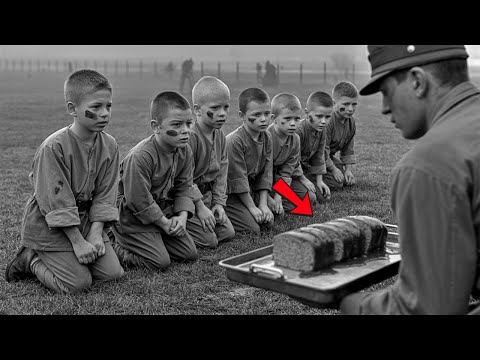
“Kneel,” Captain Brennan ordered through a translator.
Dietrich’s legs moved automatically. Muscle memory from years of Hitler Youth drills and military training. He knelt in the grass with his four companions forming a line beside him. Oskar was crying again, silent tears that dripped onto his folded hands. Leonhard’s face had gone pale but remained composed, as if he was studying this moment for future reference. Alois showed no emotion whatsoever. Rudolf kept his chin raised in defiant pride, determined to die as a soldier.
Dietrich fixed his eyes on the grass in front of him. Individual blades came into sharp focus, each one distinct and perfect. A small beetle crawled between the stems, oblivious to the drama unfolding above it. Dietrich found himself envying that beetle’s ignorance, its simple existence unmarred by ideology or war. He thought of his mother in Berlin, if she was still alive. He thought of his father, who died at Stalingrad three years earlier. He thought of his younger sister Eva, who’d been evacuated to the countryside and whose fate remained unknown. Would they ever learn what happened to him? Would anyone remember that Dietrich Weber had existed?
The sound of boots on grass made him flinch. Someone was approaching from behind—multiple someones. This was the execution squad taking position. Dietrich closed his eyes and tried to remember a prayer from childhood, but the words wouldn’t come. His mind had gone blank with terror.
Then he smelled something completely unexpected. Food. Hot food. Meat and bread and something sweet that made his empty stomach clench with sudden, desperate hunger. His eyes opened in confusion.
Private Salvatore Lombardi stood before them carrying a metal tray loaded with thick slices of meatloaf, fresh bread, and what appeared to be actual butter. Steam rose from the food in the cool morning air. The Italian-American cook was perhaps thirty years old, built like someone who’d spent his life in kitchens, with flour still dusting his uniform sleeves. His face showed confusion at the scene before him—five boys kneeling in grass as if awaiting execution.
“Captain, what the hell is this?” Lombardi’s accent carried Brooklyn’s working-class neighborhoods. “I thought you said feed the new prisoners. Why are they kneeling like that?”
Captain Brennan’s expression shifted from grave solemnity to sudden understanding, then to something approaching horror. He stepped forward quickly, hands raised in a calming gesture.
“Stand up. All of you stand up right now. You’re not being executed. Jesus Christ, is that what you thought was happening?”
None of the boys moved. The cognitive dissonance was too severe. Executions they understood. Firing squads made sense within their worldview. But food, kindness—these contradictions couldn’t be processed.
Rudolf actually laughed, a high, desperate sound that bordered on hysteria. “Psychological torture,” he announced in German. “They’ll feed us and then shoot us. Make us grateful before the end.”
Sergeant Pritchard knelt down to their level, his weathered face showing genuine distress. He spoke in his broken German, supplemented with hand gestures. “Nicht schießen. Not shoot. Essen. Food. Für euch. For you.” He pointed at the meatloaf, then at the boys, then at his own mouth. “Verstehen? Understand?”
Oskar was the first to break. His thirteen-year-old body, pushed beyond its limits by malnutrition and terror, simply couldn’t sustain resistance when confronted with the smell of real food. He reached toward the tray with trembling hands, then stopped, looking to Dietrich for permission or guidance.
Dietrich found himself in an impossible position. As the oldest and the de facto leader, the other boys looked to him for direction. But what was the right choice? Accept the food and potentially walk into some elaborate trap? Refuse and starve while clinging to pride? His training said never trust the enemy. His stomach said he was dying of hunger.
Sergeant Pritchard solved the dilemma by taking a piece of meatloaf from the tray and eating it himself. He chewed slowly, swallowed, then smiled. “See, good food. Safe food. Same food I eat.” He cut another piece and held it out to Oskar. “Bitte. Please.”
The youngest boy took it with both hands as if receiving something sacred. He bit into the meatloaf, and his eyes widened. The taste of seasoned meat, of fat and salt and herbs, was overwhelming after months of near-starvation rations. He made a sound between a sob and a laugh, then devoured the rest in desperate bites.
That broke the remaining resistance. Leonhard accepted food next, then Alois, then even Rudolf. Dietrich was last, taking a slice of meatloaf that was still warm from the kitchen. The first bite hit his tongue, and he understood why Oskar had cried. The meatloaf was simple food, the kind that American families ate on weeknight dinners without thinking twice. Ground beef mixed with breadcrumbs and eggs, seasoned with onions and a touch of paprika, baked until the edges caramelized slightly. Nothing fancy, nothing elaborate. But to five German boys who’d survived on moldy bread and watery soup for months, it was a revelation.
Dietrich chewed slowly, trying to make each bite last. The meat was rich and fatty in a way he’d almost forgotten food could be. The texture was soft enough that his damaged teeth didn’t ache with each bite. The seasoning was subtle but present, proof that somewhere in this American camp, someone cared enough to make food taste good rather than just sustain life. This wasn’t survival rations. This was someone’s care made edible.
Oskar ate with both hands, grease running down his chin, no longer caring about dignity or appearances. Between bites, he made small, grateful sounds that were almost animal in their intensity. The bread was soft and white, nothing like the hard black bread of German military rations. When Sergeant Pritchard offered him butter—actual yellow butter—the boy spread it so thick that it squished out the sides when he bit down.
Leonhard ate more carefully, but his hands shook as he brought each piece to his mouth. Dietrich watched tears run silently down the artist’s face while he chewed. Later, Leonhard would try to explain that the tears weren’t just about hunger satisfied. They were about the shock of kindness, the complete inversion of everything he’d been taught. The Americans were supposed to be monsters. Monsters didn’t make meatloaf with such obvious care.
Even Alois showed signs of returning to himself. The mechanical emptiness that had characterized his movements since his family’s death flickered slightly. He ate with the same methodical efficiency he’d shown loading his rifle, but something in his eyes suggested awareness returning. Food could do that sometimes—pull people back from the edge of complete dissociation, remind them that physical existence still mattered.
Rudolf struggled visibly with the experience. His ideology demanded that he refuse this gift, that he remain defiant and pure in his loyalty to the fallen Reich. But his fifteen-year-old body had different priorities. He ate while tears of frustration ran down his face, hating himself for accepting enemy charity, unable to stop his hands from reaching for more.
Private Lombardi watched them with an expression that combined satisfaction and deep sadness. He’d cooked for his family’s restaurant in Brooklyn before the war, knew how food could communicate care in ways words never could. But watching these starving children devour simple meatloaf seemed to break something in him. He turned away, shoulders shaking, and Dietrich realized the cook was crying.
Captain Brennan stood nearby with Sergeant Pritchard, both men silent. Finally, the captain spoke in English that Dietrich only partially understood. “How do we send them back after this? How do we tell them they’ll be repatriated to a country that has nothing left to give them?”
Sergeant Pritchard had no answer. Neither did anyone else.
When the food was gone, the five boys sat in the grass, their stomachs full for the first time in recent memory, their entire worldview shattered by the simple act of being fed by those they’d been taught to hate.
Dietrich set down his fork and looked around the table at the men who had once been his captors. “You know,” he said, his voice thick with emotion, “I spent years trying to understand why you didn’t shoot us that morning. And then I realized—you didn’t see enemies. You saw hungry children.” He paused, letting the words settle. “That’s the America I try to teach my students about.”
He raised his glass. “To Private Lombardi’s meatloaf—the first lesson in humanity I ever truly understood.” The room echoed with applause and laughter, but beneath it ran a current of something deeper: the quiet knowledge that a single act of kindness, offered without calculation, can echo through decades.
As the evening wound down, Dietrich stepped outside into the cool November air. He thought of Oscar, now a pediatrician in Ohio, of Leonhard’s paintings hanging in galleries, of Rudolf’s sermons about grace. Five boys had walked into that camp expecting death and walked out carrying the seeds of redemption.
He looked up at the stars and whispered a prayer of thanks—for meatloaf, for mercy, for the mysterious ways that enemies become brothers.
What simple act of kindness has ever changed your life?
Report this article
Select a reason for reporting:






