My mother smiled when she said it. “We only kept you for the benefits. Now you’re not useful anymore.” The words landed like a slap, but I didn’t flinch. My father slid the paperwork across the tablecloth—a clean, legal cut. Twenty-five years of my life reduced to a line item that had expired.
They had no idea what I was holding under my napkin. Or who was sitting three tables behind my mother’s chair.
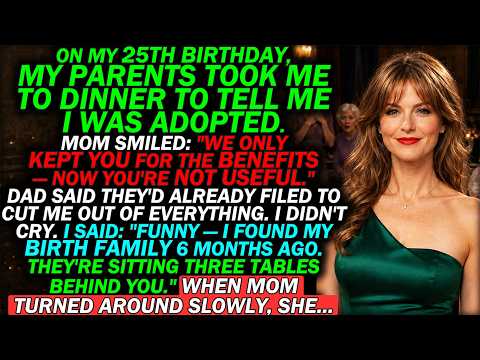
My name is Paige Mercer, and that night at the restaurant Vantair, I was supposed to be the broken girl in their carefully rehearsed scene. But six months earlier, I’d found my birth family. And I had invited them to my birthday dinner.
My mother wore her funeral cashmere. My father booked the table under her name, not mine. There was no cake, no balloon—just the cold politeness of people about to read a verdict.
I knew the difference between a dinner and a deposition. This had the temperature of a deposition.
I grew up on one candle pressed into a grocery-store cupcake. My cousin Brett got bounce houses and caterers because he was blood. I got the math: a child who asks for less is cheaper. By nine, I stopped asking for cake because it made the arithmetic easier for everyone at the table.
I left at eighteen with two duffel bags and a community college acceptance I’d filled out myself. Nobody drove me. I worked nights, took classes in the morning, and by twenty-five, I was a paralegal at a trusts and estates firm. I could read a trust the way some people read a face.
The only person who ever called was my grandmother, Nana Ruth. Every Sunday at four. She was the one who told me, “You were chosen, sweetheart, not collected.” She died when I was twenty-three. And within a month, my parents moved into the larger house on Lynden Road—the one connected to Nana’s name in ways I understood better than they realized.
The year before that dinner, my family went quiet. My aunt Renee started using a word in the group chat she’d never bothered with before: blood. Blood-only weekends. Blood-only cabins. I didn’t have the documents yet to know why the temperature had dropped on a schedule.
Then my mother called. “We’d like to take you out to celebrate twenty-five properly,” she said, and I felt the cold click of a lock turning somewhere I couldn’t see. When Diane gets generous, it’s because a spreadsheet has told her the generosity will pay for itself.
So I said yes. And then I made a few calls of my own. Quiet ones. The kind you make when you’ve decided you’re not going to be ambushed—you’re going to be ready.
I won’t tell you yet who I called. But I’ll tell you the rule I live by, the one Nana never said out loud but taught me anyway: when my mother is sweet, someone at the table is about to lose something. I just made sure this time it wouldn’t be me.
I walked into Vantair with a manila folder under my arm, the calm of a woman who has read the last page of a book everyone else thinks is still being written. I wasn’t going to a disownment. I was going to a goodbye I’d already chosen.
They just didn’t know it yet.
We ordered drinks before anyone said a true thing. My mother praised the wine list. My father told a story about parking he’d already told in the car. Then, between the bread and the entrees nobody would eat, Diane folded her hands and shifted into the voice—the one she used when she returned a Christmas gift in front of me and explained why it hadn’t been practical.
“We’ve always done our very best for you,” she began. Wesley nodded a half second behind her, the way he’d nodded behind her for thirty years.
I rested one hand flat on the manila folder beside my plate. The tab had a typed label, just four letters showing above my fingers. My father’s eyes flicked down to it and away. I covered the rest with my thumb—not to hide it, just to let him wonder. And I watched the wondering start to work on him.
My mother kept going about sacrifices, about how a child should understand the cost of being raised. I thought about a sweating cupcake and one candle, and I said nothing.
Then she paused, took a small sip, and set the glass down with the precision of a woman reaching a slide she’d practiced.
“There’s something, Paige, that you should have been told a very long time ago.”
“You’re adopted,” my mother said. She said it the way you’d announce a change to a dinner reservation. “We adopted you when you were an infant. You were never biologically ours.”
She watched my face while she said it, and I understood she was waiting for the collapse. This was the moment she’d built the whole evening around—the corner table, the cashmere, the practiced pauses. All of it engineered to land right here, on the second when her adopted daughter learned she’d been a stranger all along and broke into pieces she could sweep up and walk away from.
I’d love to tell you it didn’t land. It landed. Some part of a person always braces for the floor to be there, and mine had just been told there was no floor. But I’d had six months to learn this already, and the only thing my mother actually revealed that night was how little she knew about me.
She leaned in, almost gentle, and delivered the sentence I will hear in waiting rooms and quiet kitchens for the rest of my life.
“We only kept you for the benefits.”
She smiled when she said it. That was the detail that freed me in the end—not the cruelty. I’d been raised on the cruelty. The smile. A woman does not smile delivering the worst news of your life unless she has rehearsed it enough times to enjoy the choreography.
And in her smile, I finally saw the whole shape of it. I hadn’t been a daughter who disappointed them. I’d been an asset that had finished depreciating.
My father, to his discredit, tried to explain it like an accountant defending a tax position. “There were assistance payments in the early years,” Wesley said, not meeting my eyes. “The adoption came with a small monthly subsidy when you were little, but that ran out a long time ago. There were tax considerations after that. And there was your grandmother, of course.”
He said Nana had certain expectations about family—that adopting me had helped them meet those expectations, and that meeting them had turned out to be, in his careful accountant’s word, worthwhile for a good many years.
I sat very still and let the arithmetic of my childhood rearrange itself into its true equation. The one cupcake. The hand-me-downs from Brett that came with the tags from Renee’s returns still on them. The way the heat got turned down in my room first.
They hadn’t been poor. They’d been pocketing the difference between what a child costs and what a child generates.
And I had been the generator.
“We invested in you,” Wesley said, as if that settled it. As if a child were a rental property with a depreciation curve.
Then my mother, impatient with his bookkeeping, cut to the line underneath all the others—the one the whole evening had been built to deliver.
“The subsidy has been gone since you were a child, Paige. And what came after it ends today. You’re twenty-five now. There’s simply nothing further that keeping you does for us.”
She said it almost regretfully, the way you’d note that a coupon had expired. “Now you’re not useful.”
Two sentences, and they’d reduced a quarter century of being their daughter to a line that had stopped producing income.
I reached for my water. My hand did not shake. I noticed that it didn’t, and I filed it away as a small, surprising gift.
Then my father did the thing he’d come to do. He reached into the leather portfolio he’d brought—the one I’d assumed held a birthday card—and slid a thin sheath of papers across the tablecloth until it touched my plate.
“We’ve already filed,” he said, “to formalize things. You won’t be in the will. You won’t be a beneficiary on anything of ours. We wanted to do this cleanly, in person, so there’d be no confusion later.”
He’d rehearsed cleanly. I could hear the lawyer who’d coached him in it.
And here is the part I have never been able to make my family understand—the part that turned the whole night for me without my saying a word. I read the caption on the first page in about four seconds, the way I’d read a thousand of them, and I saw immediately what they had done.
They had filed against the wrong instrument.
They’d spent good money cutting me out of an estate that was almost beside the point, while leaving entirely untouched the document that actually decided everything. They didn’t know what I knew. They thought the power in this room ran through their own modest will, and so that’s where they’d aimed their expensive little knife.
I didn’t correct them. You don’t tell the other side they’ve sued the wrong defendant. You let them finish.
So I slid the papers an inch back toward the center of the table, neither accepting nor refusing. And I let them keep believing they’d won.
Across the table, my aunt Renee’s voice crackled from my mother’s purse on speakerphone, because of course Renee was listening. “Blood looks after blood, Paige,” she said, warm as a knife in soup. “You’ve always understood that.”
I didn’t cry. I took a slow sip of water and set the glass down without a sound. And I watched something cross my mother’s face I had never seen there before—disappointment, not at me, but at the performance. She’d written this scene with a sobbing girl in the lead, and the girl wasn’t sobbing.
“Aren’t you going to say anything?” she asked, brittle now. Then she made the mistake people like her always make. She reached for the line that had worked the first time, expecting it to work again. “We only kept you for the benefits,” she repeated, slower, leaning on each word, trying to draw blood she could see.
But a sentence loses its teeth the second time you hear it from the same mouth. The first time it was a revelation. The second time, it was just a confession—and not about me.
I smoothed my napkin once and let her watch me not break. Behind her, at table nine, a woman with my exact chin turned her head toward us and went still.
I turned the folder so it faced them and laid three pages out on the white cloth, side by side. The retainer letter. The distribution schedule of the Ruth Mercer Family Trust. And my original birth certificate, with Susan Hale’s name where my mother had assumed her own belonged.
I watched Diane read the words shall terminate upon the beneficiary’s twenty-fifth birthday, whereupon the remainder shall pass to my granddaughter, Paige. I watched the color leave her face from the top down, like a window shade being drawn.
“Mom,” I said gently, because I could afford to be gentle now. “You filed against the wrong family. The one you cut me out of was always the smaller one.”
Her face rearranged itself, the cold draining out and a terrible warmth flooding in. She reached across the table for my hand. “We’re still your parents. Whatever’s in those papers, that doesn’t change what we are. We’re family.”
I looked at her hand and did not take it. I gathered the pages back into the folder, unhurried, and kept the pen they’d brought for my surrender, setting it neatly beside her plate. Then I stood.
“Sit down, Paige,” she said, the soft mask slipping, the old cold control snapping back like a bone setting. “Where on earth do you think you’re going?”
I held the folder against my chest and told her in the plainest words I owned. “My birth family is sitting three tables behind you.”
I watched my words land. I watched my mother begin, very slowly, to turn around in her seat—the way you turn when some part of you already knows and is begging the rest of you to be wrong.
There at table nine, beneath the warm low light, were Susan and Pearl and Danny, who had been there the entire time. Susan met my mother’s eyes and didn’t glare. She just looked at the woman who had raised her daughter on one candle and a calculator. Then she looked at me, and her whole face opened like a window in spring.
All three of them stood—not to make a scene, just to be on their feet when I crossed the room, the way you stand for someone arriving at a gate after a long flight.
I walked past my mother, still half turned in her chair. Past Renee, whose mouth had finally run out of the word blood. Past my father, who lifted his eyes to me as I passed, then dropped them again, choosing comfort one last time.
Fifteen feet. Three tables. Twenty-five years.
When I reached them, Pearl took my face in both her hands, the way Nana used to. Susan pulled out the empty chair beside her own—the fourth chair, the one they’d asked the host to set even though their reservation was for three.
“We saved you a seat,” she said. “We always did.”
I heard my mother’s chair scrape behind me, heard her voice rise and crack. “After everything we paid for—” It carried across the dining room. But I noticed she said paid, not loved. Even now, the word love would not come, because it had never been in the inventory.
I didn’t stand to match her. I didn’t raise my voice. Susan’s hand found mine under the table, and I just held it and let my mother be loud, because the loudness was doing my work for me.
Pearl had ordered me a slice of chocolate cake while I was gone, and Danny had stuck a single candle in it, lit. For one second, the symmetry of it caught in my throat.
“Blow it out, sweetheart,” Susan said. “Make the wish.”
And I realized I didn’t have one. I already had it.
The trust did exactly what my grandmother built it to do. The remainder passed to me through the bank trustee, untouched by the will my parents had spent good money revising—because you cannot disinherit someone from a trust you don’t control. Their waiver, unsigned, was worth what it was always worth.
I didn’t sue anyone. I didn’t post anything. I simply stopped answering, and I let the silence be the boundary—which is the only kind that ever holds.
My father texted me once, weeks later. Three words: I am sorry. No name signed, no follow-up. When I didn’t reply, I never replied. He was, as ever, a year too late, saying it to the wrong room, when it cost him nothing and changed nothing.
I have spent every birthday since at a table that wanted me before they knew if I’d ever come. Being useful was all my parents ever wanted from me. Being wanted was the one thing I’d never had.
It took me twenty-five years and one terrible dinner to learn that anyone who only keeps you for the benefits has already told you, in the plainest language there is, that they were never your family at all.
So here’s my question for you: if someone in your life only values you when you’re useful—what would it take for you to finally pull out the chair that’s been waiting for you all along?
Report this article
Select a reason for reporting:






