In the late summer of 1897, under the stone floor of a small room at Pueblo Bonito, a Navajo excavation crew found a step. Not a natural ledge, but a cut block of sandstone, worn hollow in the middle. Beneath it, sixty-two more steps plunged into darkness. At the bottom, a round chamber the size of a church held a fluted copper machine four men tall, its point aimed straight up. The oldest man on the crew stopped at the top of the stairway and refused to go down. “The Navajo know this,” he said. “It was left behind.”
The leader of the dig, Richard Wetherill, heard that sentence. The field director, George Pepper, wrote the measurements into his notebook. But that chamber never appeared in any published report. One autumn morning, the stairway was filled with sand again. This is where the case begins.
Chaco Canyon is a shallow cut in a dry tableland in northwestern New Mexico. Nine miles long, no trees, no firewood, winter nights below zero, summer afternoons past a hundred. It looks like the last place on earth anyone would build a city. And yet, nine hundred years ago, the largest stone buildings in North America rose inside it. The greatest of them, Pueblo Bonito, was a half-moon of four floors and more than six hundred rooms, raised over generations from thin, finely dressed sandstone.
Behind it looms a slab of rock weighing thirty thousand tons. Later arrivals named it Threatening Rock. The builders knew the danger. They braced it with walls and built there anyway. Around 1150, the canyon emptied. The people moved north and south. Their descendants live today in the Hopi, Zuni, and Rio Grande Pueblos. Then another people came: the Navajo. They grazed their sheep on the tablelands but never went inside the great houses. In Navajo tradition, the houses and the dead of the old people are not disturbed. What stays there, stays there.
In 1896, a rancher from Colorado named Richard Wetherill secured funding from two New York brothers, Talbot and Fred Hyde, whose fortune came from soap. The Hyde Exploring Expedition was born. Everything it found was to go to the American Museum of Natural History. The museum wanted a scientist in charge. Harvard sent one of its own, George Hubbard Pepper, twenty-three years old, from Staten Island, seeing the desert for the first time. The digging was done by Navajo workmen, eleven of them that summer, hired by the day. They worked inside the great house on their own terms. When a bone came out of a room, they put down their picks and walked away until the next morning.
By the end of July 1897, the crew had opened more than a hundred rooms. They found cylinder jars, turquoise necklaces, macaw feathers, seashells, and a few small copper bells carried north from Mexico. That was all the copper there was at Chaco. A handful of bells, the largest of which would have fit inside a closed fist.
Then they reached the back row on the north side, in the shadow of Threatening Rock. Room 104 was small, thirteen by ten, its roof fallen in, full of sand. The crew emptied it in two days. Beneath was a floor of thin sandstone slabs. The next morning, the oldest man on the crew, a man of about sixty from the Escavada Wash, was clearing the joints between the slabs when he struck the floor with the handle of his pick. It sounded hollow. He struck again. Hollow. One slab was lifted. There was no earth beneath it. There was clean, fine, yellow river sand, as if sifted by hand. Not one stone, not one fleck of charcoal, not one broken sherd. Pepper wrote, “The sand did not form here. It was brought here.”
Beneath two feet of that sand, cut into bedrock, a square opening appeared, four feet by three. From its edge, the first step went down. The step was cut from a single block of sandstone, eight inches high, eleven deep, its middle hollowed out like a threshold worn down by centuries of feet. Pepper measured the first step, then the second, then the other sixty-one. Sixty-three steps. The stairway ran straight north, turned sharply left at the thirty-first step, then ran straight again. The ceiling was low. A man could go down only stooping. In the walls, at shoulder height, handholds had been cut into the rock. Twenty-nine on the right, twenty-nine on the left. The walls were smooth, no chisel marks. The vertical depth of the descent, by Pepper’s own reckoning, was forty-one feet. No known room, no known kiva at Pueblo Bonito went that deep.
At the foot of the stairway, the air changed. It was dry and cold. It had no smell. After the August heat of the canyon, it was like going down into winter. Three men made the descent: Wetherill, Pepper, and the crew’s interpreter, a Navajo man of about twenty who had learned his English at Fort Defiance. Each carried a kerosene lantern. At the foot of the last step, the lantern light reached out ahead of them and touched nothing. Wetherill set his lantern down. For a while, he said nothing. Then, according to Pepper’s entry, he said only this: “We did not find this. Someone left it for us.”
Pepper did not go back to camp that night. He sat in the doorway of room 104 under a kerosene lamp and wrote nine pages into field book C. Those nine pages are the only detailed description we have of the chamber and of what stood inside it.
First, he wrote down the chamber. It was a perfect circle. He measured it twice, north to south and east to west. Both measurements came out at seventy-eight feet. The largest kiva in Pueblo Bonito was half that size. The ceiling was flat, not a dome. It had been cut level out of the bedrock in one piece, thirty-one feet above the floor. No supporting column, no beam. Thirty-one feet overhead, a span of rock seventy-eight feet across, held itself up against nothing.
At the foot of the wall, a low bench ran around the entire chamber. Two feet high, three feet deep. In Pueblo kivas, benches like this are made for sitting, but Pueblo benches are built of laid stone. This bench had been cut out of the rock together with the wall. Above the bench, a row of niches had been cut into the wall. Pepper counted them. Fourteen niches, all the same size, all evenly spaced, fourteen inches wide, eighteen high, a foot deep. Every one of them four feet above the floor. Every one of them empty.
Pepper looked closely at the top of the bench as well. In the kivas of Pueblo Bonito, the benches are worn. Sat upon for centuries, their edges rounded, patched here and there. The edge of this bench was sharp, not one sign of wear, not one scratch. No one had ever sat here. But the steps of the stairway were worn hollow in the middle. Someone had gone down and come back up those steps many, many times. And once they were inside the chamber, they did not sit.
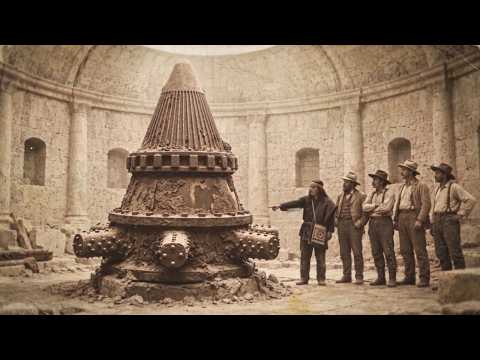
The floor was laid in rings that narrowed toward the center, nine rings. The slabs of each ring a little smaller than the ring before. At the center of the rings was a low, round platform. And on the platform, the machine.
Pepper described it from the bottom up. The platform was a round slab, fourteen feet across. On it sat a broad collar that ringed the base of the machine, like a millstone. The collar was twelve feet across with thirty-six round bosses along its rim. Pepper called them rivet heads. Four arms came out of the base, short, thick, square at the ends. Each one five feet long and two feet four inches thick. Their faces were covered in rows of round studs.
Above the collar rose the body, swollen, heavy, narrowing as it climbed. The lower half of the body was coated in a dry, hard, reddish clay. The clay had set into a crust and had flaked away in places. Where it had fallen away, dark metal showed beneath. Pepper broke off a piece of the clay and crumbled it between his fingers. The ground in the canyon is a fine yellow sand. This clay was red, dense, almost greasy. Nowhere in the chamber, nowhere on the stairway, nowhere in the building above, was there any other trace of it. And the crust was not random. It ended at exactly the same height all the way around the body, just below the second collar, in a dead straight line. Below the line, crust. Above it, bare metal. Like the line left on the rocks at the edge of a lake when the water has gone down. At some point, the machine had been buried in clay up to that line, and someone had dug it back out.
Ten feet above the floor, a second collar wrapped the body. Around this collar, set like the teeth of a gear, were square blocks. Twenty-four square blocks. And above the second collar, the cone began. Eleven feet high, narrowing to its tip, fluted from top to bottom with vertical ribs. Pepper spent an hour counting them. Seventy-two ribs. The tip of the cone was not sharp. It was blunt and rounded, about the size of a fist. From base to tip, twenty-three feet. Four men standing on each other’s shoulders.
Then Pepper tested the metal. From a corner of the body where the clay had fallen away, he scraped a small shaving with his pocketknife. Back at camp, in a porcelain dish, he let a single drop of nitric acid fall on the shaving. The liquid turned green. He added ammonia. The liquid turned a deep, clear blue. It was the simplest test a field archaeologist knew in 1897. And the result meant only one thing. Copper.
Pepper worked out the weight. He treated the body as a rough cone set on a cylinder and assumed it was solid. He multiplied by the weight of copper. The answer was somewhere around sixty tons. Sixty tons of copper. Put every copper bell ever found at Chaco on one scale, and they would not weigh two pounds.
But there was a stranger line in Pepper’s notebook than the weight. That night he climbed out and sighted on the North Star to fix true north. The next morning he went back down, stretched a cord along each of the arms, and measured the angles. The four arms pointed to the four directions. North, south, east, west. By Pepper’s measurement, within half a degree.
And last of all, he looked up. Directly above the blunt tip of the cone in the ceiling, there was a round hole. Three feet across. The hole was not open. It was stopped with a thick round disc of sandstone that sat perfectly in its seat. The disc was flush with the ceiling. In the lantern light, it showed only as a thin flawless circle. Pepper drew the hole. Beside it, he drew a question mark. And that question mark was never answered anywhere else in Fieldbook C.
There was dust on the chamber floor, fine, even, untouched. On that first descent, Pepper saw no prints but their own. From the foot of the stairway to the machine, across forty feet of dust, there was not a single mark made before them.
Pepper tried to photograph the chamber, too. The expedition had a camera and a box of glass plates. He brought magnesium powder down into the chamber and fired it four times. With each flash, the chamber filled for an instant with white light, and then the smoke rolled up toward the ceiling. The four plates were developed in camp the next day. All four came out black. The smoke that kept the light from ever reaching the machine. So, there is no photograph of the machine. There are only three views drawn by a young man on gridded paper, from the front, from the side, from above.
Could all of this be a mistake? Could the measurements have been exaggerated? The test misread? The question has to be asked. Because there is a reasonable explanation that can account for this excavation, and for this chamber, too.
The first part of that explanation is Chaco itself. The people of Chaco were masters of round rooms. The canyon holds what archaeologists call great kivas, sunken ceremonial chambers forty to sixty feet across. Over the centuries, some of them were deepened and some were built one on top of another. An unusually deep great kiva, cut down into bedrock, does not fall outside Chaco’s own architectural language.
The second part is the copper. Metalworking was known in Western Mexico from about the seventh century. Smiths there melted copper and cast it by the lost-wax method. The bells that reached Chaco were their work. Centuries, macaws, cacao, shells, and bells moved between Chaco and the South. A remarkable prestige object from far away sits inside the known limits of that trade.
The third part is Pepper himself. He was twenty-four. It was his first major excavation. Nine pages written in one night by lamplight in a state of excitement. One shaving and one drop of acid. It would be easy to understand a young man overstating the weight of his first great find.
This account may be correct, but it does not explain everything. The largest work of the Western Mexican metalsmiths to survive to our time is an axe weighing a few pounds, not sixty tons, not even a hundred pounds. There is no known copper deposit in the San Juan Basin. The nearest large copper country lies hundreds of miles to the south in Arizona and Southern New Mexico. And one measurement is too simple to be blamed on Pepper’s excitement. The mouth of the stairway was four feet by three. The collar at the base of the machine was twelve feet across. The machine was not carried down that stairway. It could not have been. Either the chamber was cut around it or it was there before the chamber.
Pepper wrote down neither possibility, but up above, the old man waiting in the doorway of the room said he knew which one it was.
That evening, Wetherill walked to the old digger’s hogan. The interpreter followed. The old man spoke of a stairway already there when the builders came, a chamber already there, and a thing below already there. “They built their houses over it, to guard it,” he said. Only a few ever went down, always from the same family, always in the same season. They did not go to sit. They went to do something. The thing below has four arms that face four ways, and it is taken hold of by its arms. Wetherill asked what for. The old man turned his hands slowly, as if turning something very heavy. “To close it,” he said. “Close what?” “The world beneath.”
Pepper wrote it all down, then added one line: “The account does not come from one man alone. The crew knows it and confirms it.” The next morning, two men put down their picks and did not return. A third said only, “The old man knows. What he says is true. Do not ask more than that.”
So the records agree: a chamber cut around a machine, a stone above its head that must not be touched, and a door that was never meant to be opened again. And yet the question remains—if that round stone in the ceiling were lifted today, would we find only ten feet of rock, or something still waiting, still holding the door shut? What do you think?
Report this article
Select a reason for reporting:






