Major Dick Winters had faced death before, but nothing prepared him for the frozen hell of Bastogne. In December 1944, the men of Easy Company were looking forward to a quiet Christmas at Camp Mourmelon, France—a break from the horrors of war. Instead, they were thrust into the bloodiest battle in US Army history: the Battle of the Bulge. “Little did we realize that we were heading straight into the biggest, bloodiest battle in the history of the US Army,” Winters later wrote.
The Ardennes region was gripped by the coldest winter in 30 years. Temperatures plunged to -20°F, and wind chill made it feel like -40°. The men were ill-equipped: no winter clothing, insufficient ammo, and dwindling supplies. “You can’t describe it,” Winters recalled. Frostbite, trench foot, and hypothermia claimed over 15,000 American casualties—20% of all US losses in the battle.
But it wasn’t just the cold that broke them. The relentless German artillery barrages were worse. “Artillery doesn’t only kill, it maims and tears the body apart sending limbs in every direction,” Winters wrote. In the episode “The Breaking Point,” viewers watched in horror as Joe Toye and Bill Guarnere lost their legs to shelling, and Skip Muck and Alex Penkala were killed. For those who survived, the psychological wounds would never heal.
After the war, many men tried to bury their memories. Don Malarkey, another Easy Company veteran, couldn’t concentrate in college. “I still shiver because of the Battle of the Bulge,” he said decades later. “Like a lot of other guys in Easy Company, I tried to drink away the memories. There wasn’t a glass of scotch I brought to my lips that I wasn’t back in Bastogne.” The nightmares never stopped.
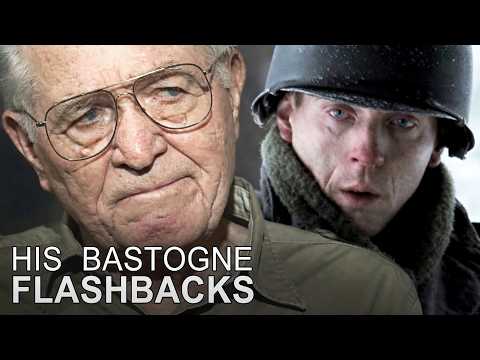
Dick Winters was no different. In a revealing interview from the early 2000s, he was asked how he adjusted to civilian life. “Do you think this guy you’re looking at today has adjusted to this day?” he replied. “It’s a slow process. You relive this with flashbacks.” Even six decades later, the memories were as vivid as ever. The date January 9—the day of the heaviest shelling—was seared into his mind. “You live this every day,” he said. “You don’t live the whole thing every day, but there are segments that will pop up every day.”
For Winters and his men, Bastogne was more than a battle—it was a wound that never fully healed. The true cost of war isn’t just measured in lives lost, but in the invisible scars carried by those who survived. As Winters put it, “I am not sure anyone who lived through Bastogne doesn’t carry the scars of that ferocious campaign.”
But Winters’ story is just one of hundreds of thousands. The Battle of the Bulge involved over 500,000 American soldiers, with 75,000 casualties. Each survivor returned home to become a mailman, a teacher, a factory worker—ordinary people leading extraordinary lives, forever haunted by the past. Their sacrifices secured our freedom, and their silent battles remind us of the heavy price of war.
Yet the story of Bastogne did not end with the men who fought there. It echoed forward into the lives they built afterward—the families they raised, the jobs they held, the quiet moments when a sudden sound or a winter chill would pull them back. For many, the war never truly ended; it simply changed battlegrounds.
Don Malarkey’s daughter once recalled how her father would sometimes stare out the window on cold mornings, his coffee growing cold in his hands. He never spoke of Bastogne to his children until they were grown. “He carried it alone,” she said. “He thought he was protecting us.” It was only in his final years, when he began speaking at schools and veteran gatherings, that the dam finally broke.
Dick Winters, too, found a measure of peace in sharing his story. He wrote his memoir, built a quiet life in Pennsylvania, and became a reluctant spokesman for his generation. But even as he spoke to audiences about leadership and sacrifice, the memories remained close to the surface. “There are segments that will pop up every day,” he admitted. “You’re not going around talking about it. You’re keeping it to yourself.”
What makes Bastogne unique in the American memory is not just its scale, but its timing. It came at the end of the war, when victory seemed certain. The men of Easy Company had already survived Normandy, Holland, and the bitter fighting of Market Garden. They believed the worst was behind them. Bastogne proved them wrong.
The siege lasted eight days. Surrounded, outnumbered, and outgunned, the men of the 101st Airborne held the crossroads town against overwhelming odds. When German commanders demanded their surrender, Brigadier General Anthony McAuliffe famously replied with a single word: “Nuts!” That defiance became legend. But for the soldiers in the foxholes, it was not about legend. It was about survival.
Years later, historians would analyze the tactical decisions, the troop movements, the strategic importance of Bastogne’s road network. But the veterans remembered different things. They remembered the frozen ground they could not dig into. They remembered the sound of shells screaming overhead. They remembered the faces of friends who never came home.
As Winters put it in his memoir, “If you live through it, you will never forget it, nor will you ever be the same.” That truth applied not just to Bastogne, but to the entire war. The men who returned were not the same men who had left. They had seen too much, lost too much, and carried too much.
And yet they went on. They married, raised families, built careers. They became the backbone of postwar America—the Greatest Generation, as they would later be called. But the title, however deserved, masked the private struggles that continued long after the parades and the medals. The Greatest Generation was also the generation that suffered in silence.
In the years that followed, Winters rarely spoke of Bastogne unless asked directly. He preferred to talk about leadership, about the lessons of teamwork and perseverance that he believed had made the men of Easy Company who they were. But when the cameras were off and the crowds had gone home, the memories remained. “There are things you carry with you,” he once told a close friend. “They don’t go away. You just learn to live with them.”
Other veterans found their own ways of coping. Some found solace in faith, others in family, and a few in the quiet camaraderie of reunions where no explanations were needed. At those gatherings, a single glance between men who had shared a foxhole was worth more than a thousand words. They didn’t need to describe the cold, the fear, or the sound of artillery. They had lived it together.
But not all of them made it back whole. Some struggled with alcoholism, others with depression, and many with a quiet rage that could flare without warning. “The war took something from all of us,” Malarkey reflected. “Some of us just hid it better than others.” The men who had stormed Normandy and held the line at Bastogne were not immune to the invisible wounds of combat.
What the men of Easy Company experienced at Bastogne was not unique to them. Across the frozen forests of the Ardennes, hundreds of thousands of American soldiers fought in conditions that defied imagination. They were boys from small towns and big cities, farmers and factory workers, who found themselves thrust into a battle that would define their generation. Each one of them carried a story that deserved to be told.
And yet, for decades, many of those stories went untold. The men came home, hung up their uniforms, and got on with their lives. They didn’t talk about the war, not because they had forgotten, but because they couldn’t explain it to those who hadn’t been there. How do you describe the sound of a shell that kills your friend standing three feet away? How do you explain the feeling of being surrounded, outnumbered, and told to surrender—and choosing to fight anyway?
It was only in their later years, as the ranks of the veterans thinned and the world began to recognize the magnitude of their sacrifice, that many of them finally opened up. Books were written, documentaries were filmed, and their stories reached new generations. Band of Brothers brought their experiences to millions, but it was the veterans themselves who gave the story its soul.
Winters understood this better than most. He knew that the series had done something remarkable—it had shown the world what Bastogne had been like. But he also knew that no film could capture everything. “The picture speaks for itself,” he said in that interview. “It does a very good job in having you share the feelings of that time.” Yet the feelings were not something you could watch on a screen. They were something you carried in your bones.
For the men who survived Bastogne, the battle never truly ended. It lived on in the flashbacks that came without warning, in the cold sweats of a winter night, in the sudden silence that fell over a room when someone mentioned the Ardennes. It lived on in the friendships forged under fire and in the grief for those who never came home.
And it lived on in the lives they built afterward—lives that were, in their own way, a victory. They had stared into the abyss and come back. They had seen the worst of humanity and chosen to build the best of it. That was their legacy, and it was one that no amount of time could diminish.
Winters passed away in 2011, but his words still echo. “I am not sure anyone who lived through Bastogne doesn’t carry the scars of that ferocious campaign,” he wrote. Those scars were invisible, yet they shaped the lives of every man who came home. The Greatest Generation was also the generation that suffered in silence.
Today, the frozen forests of the Ardennes have grown quiet. But the stories remain—in memoirs, in interviews, in the faces of aging veterans. Each one is a reminder that freedom is never free. It is paid for in blood, in frostbite, in sleepless nights that stretch across decades.
So when you see a mailman, a teacher, a factory worker—remember. They may have fought at Bastogne. They may still fight every day. Their silent battles secured our freedom. We must never take their sacrifice for granted.
What will you do to honor their memory?
Report this article
Select a reason for reporting:






