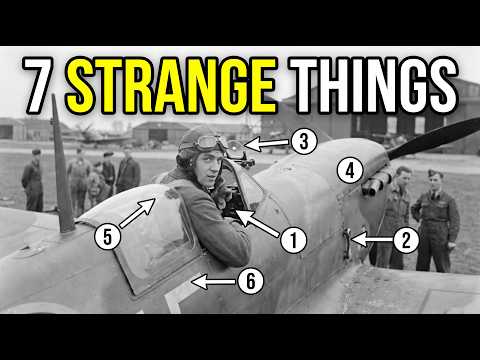
August 1940. At a German test airfield called Rechlin, one of the Luftwaffe’s best fighter pilots climbs into the cockpit of a captured Spitfire. He flies it hard, then writes an evaluation that mixes praise with warning. Superb in control, but flawed as a weapon. Push its nose down and the engine will quit. Its propeller belongs to another decade. He was right. He was also wrong. By the time his report was printed, half of it was already obsolete. And within weeks, the most famous fighter commander in Germany would look Hermann Göring in the eye and ask for Spitfires. That is the strange thing about the Spitfire. The men who knew the Bf 109 best kept finding things about it that made no sense. Some were real defects. Some had already been fixed while they weren’t looking. Some had nothing to do with the aircraft at all. They were about pride.
So let’s go through them. Seven things the Bf 109 world found strange about the Spitfire. And to understand any of them, we must start with the man in that cockpit at Rechlin. His name was Werner Mölders. If the Luftwaffe had a fighter pilot’s brain, it was this man. In Spain, he helped develop the flexible combat pair; two aircraft, one to hunt and one to guard the tail, a tactic every air force on Earth would copy. By the summer of 1940, he was commanding a full fighter wing. And here’s a detail most people skip. Just two months before that test flight, his aircraft was shot down over France and he was taken prisoner. The fall of France is what released him. So this is not a man who thinks the enemy is a joke. He had tasted defeat in aerial combat.
Now, Rechlin, the Luftwaffe’s main test center, had something rare. A Spitfire Mark I and a Hurricane, both captured, both flyable. The Germans ran flight tests against their Bf 109 E and Bf 110 to find out exactly what they were facing. Mölders flew both British fighters. His verdict on the Hurricane was harsh. It was decent and forgiving, but clearly worse than his 109. But the Spitfire was different. He wrote that it was superior by a whole class. And that is the first strange thing.
The Spitfire was a gentle aircraft. To a 109 pilot, that was almost suspicious. The 109 was small, narrow, and demanding. It was built around the idea of putting the most powerful engine possible into the smallest, lightest airframe that could carry it. That gave it speed and climb, but it came at a cost. The cockpit was cramped. The narrow landing gear made takeoffs and landings a real gamble. And the Luftwaffe lost many 109s without an enemy anywhere near. The Spitfire seemed to represent a completely opposite philosophy. Its wing was large for an aircraft of its size. Spread the same weight over a larger wing area, and each square foot has less work to do. Quite simply, the Spitfire could fly slower without falling out of the sky, and it could turn tighter before it started to shake. Years later, German test pilots who flew the captured Spitfire attributed its smooth control to exactly that: low wing loading.
But being gentle didn’t mean it was perfect, and early Spitfires had some quirks a 109 pilot would never expect in a frontline fighter. The earliest Mark Is had no automatic landing gear. After takeoff, the pilot had to switch hands on the stick and pump a lever repeatedly to raise the wheels. And as his arm moved up and down, the control stick tended to move with it. New pilots would wander off the runway, gently swaying from side to side. The RAF called it the Spitfire swing. That was a peacetime aircraft showing its roots, and the Rechlin test team found more of these things.
When the Germans put the aircraft side by side, the official result was clear. The Bf 109 E outperformed every foreign fighter they tested. In one climb test, the 109 reached the target altitude in about four and a half minutes. The Spitfire needed five. The Hurricane needed over five and a half. So why was the Spitfire’s control so superb and its climb so poor? The answer lay just ahead of the cockpit. That is the second strange thing: the propeller.
Think of riding a bicycle with only two gears. One is excellent for starting up a slope. The other is excellent for moving on flat roads. Anything in between means you’re either spinning your legs madly or pressing the pedals uselessly. That’s what the Germans found in the captured Spitfire. The de Havilland propeller had two pitch settings, one fine for takeoff and one coarse for normal cruise. The Rechlin report spelled out the consequences. In fine pitch, the engine over-revved. In coarse pitch, it couldn’t use its full power. Mölders’ report put it in combat context. In a battle that changed second by second, the Merlin engine was either screaming past its limits or not giving everything it had. The 109 didn’t suffer from this problem. Its propeller adjusted its pitch continuously. To a German pilot, flying the Spitfire was like driving a racing car with a gearbox taken from a delivery truck. It was an accurate observation, but it was already outdated.
Here’s what Rechlin didn’t know. In June, on the other side of the Channel, the RAF was facing the same problem. And the man who forced the solution was not a minister or an air marshal. He was a squadron leader named Desmond Cooke, commanding No. 65 Squadron at Hornchurch. De Havilland already had a constant-speed unit, a governor that allowed the propeller to adjust its angle automatically, like a gearbox with infinite gears. Some Spitfires already had constant-speed propellers. But most did not. So on Sunday, June 9, 1940, one of Cooke’s officers picked up the phone and called de Havilland directly. Four days later, a team of de Havilland specialists began converting a Spitfire. They worked for 36 hours straight. On June 15, the modified fighter landed at Hornchurch. The difference was immediate. It took off in a shorter distance. It climbed much faster. And its ceiling increased by about 7,000 feet. Cooke didn’t wait for official paperwork. On June 20, he had his own Spitfire converted. Two days later, on June 22, the Air Ministry ordered every Spitfire, Hurricane, and Defiant converted to constant-speed propellers. That was the same day France signed its armistice with Germany. De Havilland began building conversion units without waiting for an official contract. By June 25, their engineers were working at 12 Spitfire bases. And by August 16, the job was done. Over a thousand fighters converted in the field, in the middle of a war, in about seven weeks. Desmond Cooke didn’t see the work completed. Less than three weeks after his own aircraft was modified, he was shot down and killed.
Now look again at Mölders in the cockpit at Rechlin. He is evaluating a two-gear Spitfire. But the Spitfires waiting for him over Kent had a lot more than that. And what about that slow climb in the German test? That was for an aircraft the RAF was in the process of phasing out. But the next strange thing was not obsolete. It was very real, and 109 pilots used it to stay alive.
That is the third strange thing. Push the stick forward hard, and the Spitfire’s engine will cough and quit. To understand why, you need to know one difference between the engines. The Daimler-Benz in the 109 used direct fuel injection. Fuel was sprayed directly into the cylinders under pressure, so it didn’t matter which way gravity was pulling. The Merlin used a carburetor with a float chamber. Imagine a small bowl of fuel with a float on top, like the valve inside a toilet tank. When the aircraft flies normally, gravity keeps the fuel in the right place. But push the nose down suddenly, and everything inside becomes weightless for a moment. The pilot rises against his straps, and the fuel in the bowl sloshes the wrong way. The engine floods with an overly rich mixture and begins to sputter or quit entirely. The German test report said it plainly: “sudden forward movement of the stick causes the carburetor to cut out.” Now imagine that in a dogfight. A Spitfire is chasing a 109 and closing. The German pilot simply pushes the stick forward and drops into a steep dive. His direct-injection engine keeps running strong. If the Spitfire pilot tries to follow the same way, his engine stumbles. He loses a second or more, and the 109 is gone.
RAF pilots learned a workaround. Instead of pushing forward, they would roll the Spitfire upside down and then pull the stick to dive. That kept positive G on the aircraft and kept the fuel in place. The solution worked, but it took time. And in a fight between two closely matched aircraft, time was everything. So who fixed this problem? Not Rolls-Royce, not the RAF. A woman named Beatrice Shilling, an engineer at the Royal Aircraft Establishment at Farnborough. Before the war, she raced motorcycles. She understood engines the way mechanics do, with her hands. The real fix, a new pressure carburetor, would take time to design and manufacture. Shilling found a solution that could be implemented immediately. A small brass thimble with a hole in the middle, later simplified to a flat washer. It restricted the maximum fuel flow just enough to prevent the engine from flooding during negative G. It could be installed without taking the aircraft out of service. In early 1941, Shilling and a small team visited RAF fighter bases to install it on every engine. She traveled between airfields on her old racing motorcycle. By March 1941, it was in all Merlin engines in Fighter Command. The pilots loved it and gave it a nickname too rude to mention in official papers. Miss Shilling’s orifice. But look at that date again, March 1941. The Battle of Britain was over. All that summer, every Spitfire pilot flew with this weakness, and every 109 pilot knew how to exploit it. So far, the Germans had the edge in the matchup. Better climb in their tests, and a real trick to escape in combat. But the next strange thing was different, and it’s where test reports and the real sky begin to diverge.
That is the fourth strange thing. The Spitfire would turn inside you. Remember that big wing? In tight turns, the Spitfire could hold a tighter circle than the 109 without stalling. And the British tested this directly. They had a captured Bf 109 E, one that had lost its way and landed in France in late 1939. The French handed it to the British in May 1940. In July, test pilot George Stenforth flew comparative trials. His conclusion was that the Spitfire out-turned the 109 almost as easily as the Hurricane did. So the Spitfire wins turning fights, right? Not so fast. Because when the British ran mock combat, something embarrassing happened. Their report admitted that the 109 often stayed right behind the Spitfire’s tail despite the Spitfire’s superior turning performance. Why? Because many Spitfire pilots didn’t pull the aircraft into the turn hard enough. That’s the hidden obstacle. The 109 had automatic slats on the leading edge of its wings. As the aircraft approached the stall, they slid forward and allowed the wing to keep biting the air. The airframe would shake and shudder, and to the pilot, that felt like danger. Experienced German pilots learned to fly through it without fear. Meanwhile, the young Spitfire pilot would feel his aircraft begin to shake and often ease off. The better-turning aircraft only wins if the pilot believes in it enough to keep pulling.
And here the picture becomes a mirror. The Germans criticized the Spitfire’s rudder and elevator in their report, but British testers found the 109 had a nasty surprise of its own. At high speed, its elevator became extremely heavy. A 109 pilot chasing a Spitfire or Hurricane toward the ground might find he simply couldn’t pull up in time. The British wrote that on several occasions, a 109 followed an RAF fighter down and flew straight into the ground without firing a shot. Each side found the other’s controls strange. Each side was right, and pilots on both sides died learning where the limits were.
So which aircraft was better? Test pilots kept producing numbers. Combat produced a messier answer. And part of that answer was about weapons. That is the fifth strange thing. The Spitfire would hit you again and again, and yet you could still fly home to your base. The early Spitfire carried eight Browning machine guns, four in each wing. Each fired a rifle-caliber bullet, .303 inches. Eight guns sounds like a lot, and when the specification was written in the 1930s, it was. The idea was to throw a huge cloud of lead at a fast target during a one- or two-second firing pass. The aircraft’s total ammunition gave the pilot only about 15 seconds of firing. The Bf 109 E dealt with the same problem differently. It carried two machine guns above the engine, and in most 1940 versions, a 20 mm cannon in each wing. Fewer shots, but each cannon shell exploded. One threw more bullets, the other threw fewer, harder punches. And by 1940, the German aircraft being shot at had changed. Armor behind the crews, and self-sealing fuel tanks lined with rubber that expanded to close a bullet hole before fuel could leak. So German aircraft, especially bombers, kept limping back to France full of bullet holes but still flying. A Spitfire pilot could hit a target hard and watch it keep going. The RAF realized it needed cannons. And here’s the irony. They already had cannon-armed Spitfires in the fight. In June 1940, No. 19 Squadron began receiving Spitfires armed with two 20 mm Hispano cannons instead of the eight machine guns. The Spitfire’s thin wing was so narrow that the drum-fed cannon had to be mounted on its side. It was a disaster. The cannons jammed constantly, sometimes after only a few shots. Imagine finally getting behind a bomber, opening fire, and hearing your cannons go silent. The pilots complained so bitterly that the squadron asked to swap its new cannon fighters for old machine-gun Spitfires from a training unit. In September 1940, at the height of the battle, that actually happened. By late 1940, engineers had developed an efficient cannon installation. Two cannons and four machine guns. And from then on, the Spitfire’s firepower increased with almost every new version. But in the most important summer, the Spitfire fought with weapons designed for a war that had already moved on.
So now you have a list of problems. A two-speed propeller, an engine that quits under negative G, a turning advantage that depended on the pilot’s nerves, and cannons that often failed to finish the job. Which raises an obvious question. If the Spitfire had all these problems, why were German pilots obsessed with it? That is the sixth strange thing, and it has nothing to do with the aircraft at all. German pilots saw Spitfires everywhere. The story most people know goes like this. The Spitfire was the RAF’s best fighter, the one the Germans feared, the aircraft that won the Battle of Britain. And you can understand why that story stuck. It was fast, beautiful, and easy to remember in any language. The British public adored it. But here’s the fact that doesn’t fit that story. During the Battle of Britain, Hurricanes made up about 63% of Fighter Command’s strength and were responsible for roughly 61% of total Luftwaffe losses. The aircraft Mölders described as inferior shot down more Germans than the one he preferred. Now look at the German side. RAF records repeatedly showed that German pilots claimed fights with Spitfires at times and places where no Spitfires were flying. The aircraft actually shooting at them was the Hawker Hurricane. Some German pilots who were shot down even insisted to the Hurricane pilots who downed them that it was definitely a Spitfire. Historians later gave it a name: Spitfire snobbery. Why would a professional pilot do that? Think about it from his point of view without guessing anyone’s thoughts. If the best fighter in the world beats you, that’s a hard day. But if the aircraft your own test center rated as second-rate beats you, that’s humiliating. But there was also a real reason they felt the Spitfire was bigger than it was. When possible, the RAF tried to send Hurricanes against bombers and Spitfires against the escort fighters. So the real opponent for 109 pilots, the aircraft attacking them, was most often the Spitfire. The Hurricanes were busy diving on Heinkels and Dorniers below. And neither British fighter was fighting alone. Behind them was a system the Germans badly underestimated. Radar stations on the coast, a network of observers inland, and control rooms that tracked every raid and fed squadrons already airborne the right altitude and position. A 109 pilot faced Spitfires in the sky. He didn’t see the hundreds of people who put those Spitfires exactly where they would meet him. The Spitfire became a symbol to the enemy. And that leads us to the strangest thing of all.
In late summer 1940, Hermann Göring visited his fighter commanders on the Channel coast. His bomber losses were mounting and he blamed the fighters. He ordered them to stay close to the bombers. No more free chase, no more diving from high altitude and climbing away. They were to fly alongside the bombers, slowly, tied down, waiting to be attacked. In one meeting, according to Adolf Galland’s memoirs, Göring asked his fighter commanders what they needed. Galland was a wing commander, usually with a cigar in his mouth, and one of the Luftwaffe’s most successful pilots. He later wrote that Mölders asked for 109s with more powerful engines. Galland answered differently. He said he would like a squadron of Spitfires for his wings. That is the seventh strange thing. Some of the best 109 pilots in the world wanted one. Except that wasn’t exactly what Galland meant. And here the famous story often gets bent out of shape. He was not admitting the Spitfire was the better fighter. By his own account, he believed the 109 was the better aircraft for attack. His point was about the mission Göring had just given him. If you were going to tie fighters to slow bombers, forcing them to defend instead of hunt, you needed an aircraft that could turn tightly in a defensive fight. The Spitfire’s big, flexible wing was suited to that job. The 109’s speed and dive were wasted in that role. It was an insult wrapped in a tactical argument, and Göring did not take it well. But think about what that moment shows. The Spitfire had become the benchmark. Even when the Germans believed their aircraft was better, they argued with each other by comparing it to the Spitfire. And that obsession didn’t end in 1940.
Two years later, the Germans finally got their chance to find out what a Spitfire would be like with a German heart. On November 18, 1942, a Free French pilot named Bernard Scheidhauer was flying a Spitfire VB with No. 131 Squadron on a low-level raid over Normandy. His fighter, serial number EN830, was hit by anti-aircraft fire. Damaged and disoriented, he landed in a field at Le Fief on the island of Jersey in the German-occupied Channel Islands. According to most accounts, he thought he had landed on the Isle of Wight. The Spitfire was almost intact. The Germans had captured Spitfires before. They had even talked, in 1941, about fitting a German engine into one so they could compare it directly with the 109. Now they had a good airframe to do it. The aircraft EN830 went to Rechlin, the same test center where Mölders had flown a Spitfire Mark I, then moved to the Daimler-Benz flight test unit at Echterdingen, near Stuttgart. It was painted dark green and pale blue with large black crosses and bright yellow markings. Engineers removed the Rolls-Royce Merlin. They built a new engine mount and installed a Daimler-Benz DB 605A, the same engine used in the Bf 109G. They added the 109G’s propeller and its air intake. They even replaced the British 12-volt electrical system with the Luftwaffe’s 24-volt system. Think about what that means. The engine was fuel-injected, so it wouldn’t quit under negative G, and the propeller adjusted itself continuously. Two of the things that had seemed strange in 1940 had simply disappeared. What remained was the Spitfire airframe and that big wing. It began flying in early 1944 and the result was almost funny. The test group reported that the DB 605 gave it better performance than the Merlin it replaced. The pilot said visibility from the cockpit had improved. The aircraft, EN830, became an official engine test bed and was popular with Daimler-Benz pilots for work and for play. German test pilots were flying a Spitfire just for fun. In a way, Galland got his wish. Germany had its own squadron of Spitfires. A squadron of one, in German colors, that came too late.
The aircraft did not survive the war. On August 14, 1944, American bombers raided Echterdingen. The bombers destroyed Junkers transports, several 109s, prototypes, and the German-engined Spitfire. What was left was cut up for scrap. And the man who flew it to Jersey never saw any of this. Bernard Scheidhauer was sent to Stalag Luft III, a prisoner-of-war camp in Silesia. In March 1944, he took part in the mass escape known as the Great Escape, working with its organizer, Roger Bushell. They reached the Saarbrücken railway station disguised as French workers, and there they were caught. Both were among the fifty escapees recaptured and executed by the Gestapo on Hitler’s orders. A piece of his aircraft’s wooden propeller and his flying helmet remain in Jersey today. And the rest of the men in this story went their separate ways too. Werner Mölders, the pilot who wrote that the Spitfire was a class better, became the first fighter pilot in history to score one hundred victories. In November 1941, he died as a passenger when the transport aircraft carrying him to a funeral crashed in bad weather. Adolf Galland survived the war, finished his service flying jet aircraft, and later became friends with the men who had fought him over England. The RAF hero Robert Stanford Tuck became a godfather to his son. Beatrice Shilling continued working at Farnborough for decades. The fix that kept Spitfire engines running over England was, in the end, just a metal ring with a hole in it.
So let’s go back to that cockpit at Rechlin in the summer of 1940. One of the sharpest minds in the Luftwaffe is flying the enemy’s best fighter and taking notes. And almost every note was accurate. The propeller was obsolete, but British pilots and de Havilland engineers had already replaced it in a thousand aircraft while Rechlin was still writing its report. The engine did quit, but a motorcycle-racing engineer fixed it with a simple brass fitting. The Spitfire did turn tighter, but only for pilots brave enough to keep flying through the shudder. Its cannons did fail to finish the job until the cannon finally worked. And the aircraft the Germans saw everywhere was often a Hurricane, guided by a radar and control system they never fully understood. That is what 109 pilots found truly strange about the Spitfire. Not that it was perfect, for clearly it was not. It was that every flaw they found seemed to vanish before they could exploit it, and every advantage they thought they held in theory seemed to shrink in the real sky. They measured it. They mocked it. They hunted it. One of them asked his boss for it. And when Germany finally got a Spitfire of its own, its engineers didn’t take it apart to prove it was worse. They fitted it with a German engine and their test pilots flew it for fun.
And that is the strangest thing of all. The Spitfire was never the flawless machine of legend, nor the overrated beauty of German contempt. It was a living thing, constantly being remade in the middle of a war by engineers, racers, and pilots who refused to wait for permission.
Every flaw the Germans catalogued was real. Every flaw was also being fixed while they wrote. That is why the men of the 109 could never quite catch it, and why they never quite stopped thinking about it.
So here is the question that remains, long after the engines have gone quiet. If you had to climb into that cockpit at Rechlin in 1940, knowing everything you know now, would you have written the same report, or would you have asked for a Spitfire of your own?
Report this article
Select a reason for reporting:






