On the morning of January 31, 1968, the city of Huế awoke to the roar of rockets and mortars. Within hours, the ancient Imperial City was overrun by thousands of North Vietnamese and Viet Cong troops, and the Battle of Huế—the longest and bloodiest single battle of the Vietnam War—had begun.
For the young men fighting, it was a nightmare they had never imagined. The streets of one of Vietnam’s most beautiful and historic cities became a labyrinth of death, where every alley hid an enemy and every wall could be a tomb.
But how did it come to this? Only months earlier, American commanders believed the war was all but won. General William Westmoreland had promised that attrition would force the Communists to the peace table. Yet in Hanoi, Ho Chi Minh and his generals saw an opportunity. They devised a plan for a massive offensive—the Tet Offensive—that would strike at the heart of South Vietnam, spark the general uprising they believed was imminent, and shatter American resolve.
Huế was central to that plan. The city was a symbol of Vietnamese culture and history, and its capture would be a devastating blow to the South Vietnamese government. The Communists moved with stealth, using the Tet ceasefire as cover. They smuggled weapons into the city and positioned thousands of troops. Meanwhile, half of the South Vietnamese 1st Division had been given leave for the holiday, and the city’s defenses were dangerously thin.
When the attack came, it was swift and brutal. The North Vietnamese quickly seized most of the Citadel—the massive fortress that housed the Imperial Palace—and raised their flag over the ancient walls. Only a small contingent of South Vietnamese troops and a handful of American advisors held out in the MACV compound south of the Perfume River. They were surrounded, outnumbered, and fighting for their lives.
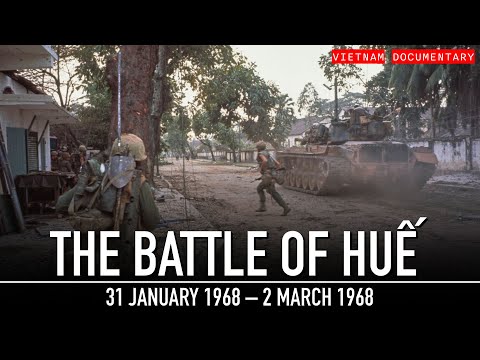
The relief effort was immediate but costly. US Marines from Phu Bai were sent to break through, but they met fierce resistance at the bridge over the Phu Cam Canal. Tanks were called in, and the Marines fought house to house, inch by inch. By the time they reached the compound, they had suffered heavy casualties, and the battle was far from over.
As the fighting raged, the world watched. What no one knew yet was that a massacre was unfolding inside the Citadel. Communist troops had been given lists of “enemies of the people”—government officials, teachers, religious leaders, and foreigners. They were rounded up and executed in what would become known as the Huế Massacre. The true scale of the horror would only be revealed in the weeks and months to come.
The battle for Huế was just beginning, and it would test the courage and endurance of everyone involved. The Marines and South Vietnamese soldiers knew they had to retake the city, no matter the cost. But the enemy was entrenched, the weather was turning, and the ancient Citadel was a fortress that would not fall easily.
The Marines who crossed the Perfume River on February 11th quickly learned that the Citadel was unlike anything they had trained for. The 30-foot walls, the narrow lanes, the centuries-old stone—it all favored the defenders. Progress was measured in buildings, sometimes in rooms. A squad might spend an entire morning fighting for a single courtyard, only to be pushed back by a counterattack before dusk.
Rain fell relentlessly, turning rubble into mud and soaking the Marines to the bone. Snipers haunted the rooftops, and NVA sappers crept through the tunnels the Japanese had dug decades earlier. Every corner was a potential ambush, every doorway a possible grave. Lieutenant Colonel Ernie Cheatham’s men pushed north toward the treasury building, but the advance was agonizingly slow.
Chong’s Black Panthers, meanwhile, fought with a ferocity born of desperation. They knew the city better than anyone, and they used that knowledge to deadly effect. Yet even they were stunned by the enemy’s discipline and determination. The Communists had dug in deep, and they were not going to give up the Citadel without a fight to the last man.
Back in Saigon, the news from Huế was grim, and it was about to get worse. The Tet Offensive had erupted across the entire country. Even the US Embassy in Saigon had been breached by Viet Cong commandos. Americans at home, who had been told the war was nearly won, watched in disbelief as their television screens filled with images of chaos and carnage.
For the men fighting inside the Citadel, the political storm back home was a distant concern. They had more immediate problems. Supplies were running low, the wounded were piling up, and the enemy showed no sign of breaking. The Marines called in artillery and air strikes, but the thick walls of the Citadel absorbed much of the punishment, and the Communists fought on from the rubble.
Then, on February 14th, a stroke of luck. A Marine radio operator intercepted an NVA broadcast ordering reinforcements through the western gate. US artillery was waiting for them. The barrage caught the Communist column in the open, and the reinforcements never arrived. It was a turning point, though no one knew it yet.
The fighting continued, day after day, block after block. The Marines and South Vietnamese troops pressed forward, tightening the noose around the enemy’s last strongholds in the southwest corner of the Citadel. The Imperial Palace, once a symbol of Vietnamese grandeur, was now a killing ground. The end was coming—but the cost would be terrible.
On February 21st, the Marines finally secured the western sector, and the remaining NVA and Viet Cong were trapped in the southwest corner around the Imperial Palace. They fought for every inch, but they were slowly being strangled. The end was now only a matter of time.
For political reasons, it was decided that South Vietnamese troops should retake the palace itself. On February 24th, the South Vietnamese flag was raised over the Citadel once again. The last Communist troops not already killed or captured slipped away into the jungle, desperate to reach the Ho Chi Minh Trail and fight another day.
On March 2nd, 1968, the battle was formally declared a victory in both Washington and Saigon. It had cost the ARVN 385 men and the US Marine Corps another 147, while over 5,000 Communist troops were killed. It was, at that point, the longest single infantry battle of the Vietnam conflict.
But the true horror was yet to be fully revealed. In the weeks that followed, mass graves were discovered—the bodies of thousands who had been rounded up and executed in what became known as the Huế Massacre. Estimates put the death toll at around 4,000, though historians still debate the exact number. Witnesses described an orgy of murder that spared no one, not even entire families.
In an ironic twist, despite its strategic failure, the Tet Offensive accelerated calls in the US for withdrawal. The following year, US troops began to be drawn down under President Nixon’s policy of Vietnamization. That policy failed, and in 1975, Vietnam was united under the Communist banner.
The Battle of Huế left scars that never fully healed—on the city, on the men who fought there, and on a nation that would spend decades coming to terms with the war. For the young Marines who survived the Citadel, the memories of those weeks would never fade. The ancient walls still stand today, silent witnesses to the courage and the horror that unfolded within them.
What do you think—was Huế a victory that came at too high a cost, or a turning point that sealed America’s fate in Vietnam? Share your thoughts in the comments below.
Report this article
Select a reason for reporting:






