May 1945. The war in Europe was over, but for 2,400 German women prisoners, the real shock was just beginning. At a British textile factory in Wales, three words stopped them dead: “Tea time, ladies.” They stared in disbelief. Tea? During work hours? It had to be a trap.
These women had been raised on Nazi propaganda. They believed the British were cruel and weak. They had worked 12-hour shifts in German munitions factories with no breaks, no mercy, and constant fear. Now their captors were telling them to sit down and rest. Something was very wrong. Or maybe something was very right.
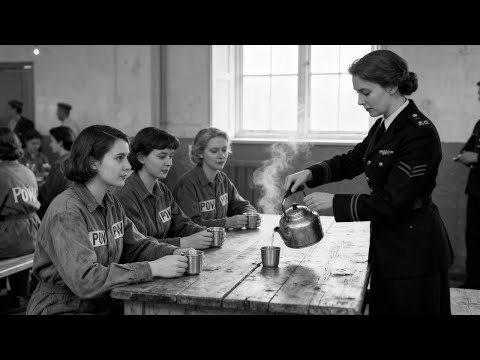
Inger was 24, a loyal member of the Nazi League for German Girls. She had believed every lie. When she arrived at Camp 186 in Bridgen, Wales, she braced for horror. Instead, she saw low fences, a small garden, and a British woman speaking broken German: “Welcome to camp 186. You will receive ration cards. Tomorrow you begin work assignments.”
The ration card listed 2,800 calories per day—more food than she had eaten in the last year of the war. The orientation continued: “You will work 8-hour shifts. There will be a break at 10 a.m. for tea. There will be a break at 3 p.m. for tea. Sundays are rest days.” Inger felt her stomach twist. Eight hours? Breaks? Rest days? This was impossible. This was a trick.
That first night, she could not sleep. The mattress was too soft. The blanket too warm. Outside, she heard no screaming, no gunshots—just the wind through the Welsh hills. Something was deeply wrong with this place. Or maybe, just maybe, everything she had been taught was the lie.
The first morning at the textile mill arrived too soon. The machines roared to life at 7 a.m. Inger fell into the familiar rhythm: thread through the shuttle, watch the tension, keep the pace. Her back ached, but she ignored it. Then the clock hit 10:00. Suddenly, the looms powered down. Silence.
Mr. Davies, the foreman, pulled out a thermos. “Right then, tea time,” he called cheerfully. He poured a cup and bit into a biscuit. Other British workers sat on stools, chatting and laughing. The German women stood frozen like statues. This had to be a test. Any second now, the screaming would start.
Mr. Davies looked over and chuckled. “You’re allowed to sit, love. Union rules. 15 minutes twice a day.” He gestured to empty stools. Inger did not move. A younger British woman walked over. Her face was hard. Inger braced for a slap. Instead, the woman pointed to a stool. “Sit,” she said in broken German. “Sit. Tea. 15 minutes.”
Slowly, like a frightened animal, Inger moved toward the stool. She sat down. Her legs felt weak. Nobody screamed. Nobody threatened. The clock ticked. At exactly 10:15, Mr. Davies stood up. “Right, back to work.” The machines powered up again. The work continued as if nothing had happened.
But something had happened. Inger’s world had cracked just a little bit.
Lunch was the next shock. At noon the machines stopped for thirty minutes, and the workers filed into a canteen that smelled of hot food—real food. A woman behind the counter handed Inger a plate: meat pie, boiled potatoes, carrots, a slice of bread with butter, and a small pudding with custard.
She sat down and stared. One woman wept. Another ate so fast she nearly choked. Inger ate slowly, each bite tasting like a dream. In Germany during the last year of the war, she had eaten potato peels and bread so hard it hurt her teeth. This one meal was probably more calories than she used to get in two days.
The weeks piled up contrast after contrast. Every Sunday there was no work, and Inger spent the first one waiting for the trick. Nothing happened. Guards played football. Prisoners wrote letters home. On the second Sunday, a church group arrived with 300 wool blankets. A white-haired British woman pressed one into Inger’s hands. “Stay warm, dear,” she said through the translator.
Inger took the blanket and felt tears sting her eyes. Her country had bombed their cities. Her country had killed their sons. Why were they giving her a blanket?
At the factory, a British woman caught her hand in a machine. Production stopped at once. A doctor was called. She was sent home to heal on full pay. In Germany, Inger had watched women lose fingers and be forced back to work the same day.
One afternoon a new pattern baffled her. The woman at the next loom—older, maybe fifty, a black mourning armband on her sleeve—walked over. Inger braced for anger. Instead the woman pointed at the instructions and spoke slowly, using her hands. Loop the thread this way. Pull it through here. Watch the tension like this. She stayed ten minutes, until it made sense, then nodded and returned to her loom.
That night Inger wrote in her diary. Today I broke a machine spindle. I waited for the beating. Instead the supervisor said, “Accidents happen. Let’s fix it together.” I don’t understand these people. If the British are weak like we were taught, why does everything work so well?
December came cold and gray, the damp Welsh wind cutting through everything. Inger had stopped waiting for the trap. The camp offered English lessons twice a week, and she attended every one. Learning the language felt like opening a door—she could understand the foreman now, read the factory notices, say please and thank you.
Then Christmas arrived. The dining hall had been transformed: real plates, real forks, paper chains strung across the ceiling, and a smell of roasting meat that made her mouth water. Plates were set down before them—roast chicken with crackling skin, Brussels sprouts in butter, mashed potatoes and gravy, glazed carrots, herbed stuffing.
Inger stared. Around her, women cried and prayed. Then came dessert: plum pudding with thick custard. She took a bite and closed her eyes. She had forgotten what sugar tasted like. A woman walked the aisles with a pot of real coffee, and the steam rose up carrying that beautiful bitter smell.
The commandant stood. “You are prisoners. Yes, that is the reality of war. But you are also human beings. Today we remember that mercy is not weakness. It is strength.”
Inger broke. The tears poured down her face and onto her plate, her whole body shaking. The woman beside her reached over and held her hand. They were all crying—because this was more humanity than their own leaders had ever shown them.
They give us tea breaks. They give us Sundays off. They give us Christmas dinner. We were told the British were our enemies, weak and cruel. But they treat us better than our own Führer ever did.
That night she read the newspapers in the camp library. Bergen-Belsen. Auschwitz. Dachau. The photos made her sick. She wrote in her diary with shaking hands: If the camps were only labor camps, why did those prisoners get no tea breaks, no calories, no doctors, no blankets? What kind of strength murders children? I believed in monsters and called them heroes.
June 1948. The repatriation train carried her home to Hamburg—and to rubble. Whole streets flattened, children begging for food, her old apartment occupied by strangers. “This is everyone’s story,” the old woman said. “Find somewhere else.”
She found work at a textile mill, twelve-hour shifts, no breaks, a supervisor who shook a girl who stumbled from exhaustion. Inger could not stay quiet. “In England we had tea breaks. Eight-hour shifts. And we produced more.” She was fired on the spot—but the other women had stopped working to listen.
She kept telling the story for decades. By the 1960s, mandated breaks and eight-hour days became law in West Germany. “I was captured by the British, but I was freed by a cup of tea,” she told her grandchildren. “Real strength knows when to rest.”
So here is the question for you: if kindness proved stronger than cruelty, why do so many leaders still choose the whip over the teacup?
Report this article
Select a reason for reporting:






