In the late summer of 1940, as Nazi Germany basked in the glow of its stunning victory over France, Adolf Hitler turned his gaze eastward—toward the Soviet Union. The mere mention of this new target sent shockwaves through the German High Command. Most generals were stunned, but one man, Field Marshal Wilhelm Keitel, was outright horrified. He had seen the Soviet military machine up close during a visit in 1931 and had come away deeply impressed. Now, as Hitler pushed for a preemptive strike, Keitel knew he had to act. What followed was a dramatic confrontation that would test the limits of loyalty and reshape the fate of millions.
Keitel’s first reaction to the plan was one of fierce rejection. In August 1940, he drafted a memorandum outlining why an attack on the Soviet Union was foolhardy. He argued that German forces were stretched thin across conquered territories, that Great Britain remained undefeated, and that the non-aggression pact with Stalin had to be honored. “Launching an attack in 1941 is too hasty,” he warned, urging Hitler to wait. But Hitler would have none of it.
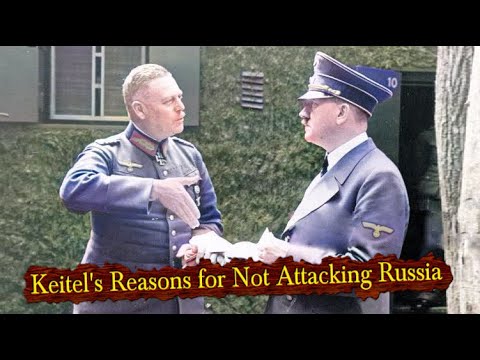
Hitler dismantled Keitel’s arguments with cold precision. He insisted that the clash with the Soviet Union was inevitable and that time was on Stalin’s side. “The longer we wait, the more prepared the Soviets will be,” Hitler snapped. He pointed to Stalin’s purges of the army as a sign of weakness and argued that Soviet industry was still fragile. As for the non-aggression pact, Hitler scoffed: “Stalin signed it only to grab his share of Poland and to watch us bleed against the West. Once we’re weakened, he’ll stab us in the back.”
Keitel was deeply stung by the rebuke. His pride wounded, he did something extraordinary: he submitted his resignation. He asked to be replaced by someone with better strategic judgment and requested a combat command. “I no longer feel I enjoy your trust,” he told Hitler. But Hitler refused, furious that any general would dare question his authority. The confrontation left their relationship badly damaged.
Yet as the months wore on and Operation Barbarossa neared, Keitel’s stance shifted. Once the invasion began, he wholeheartedly agreed with Hitler, even claiming that the Soviets had been on the verge of attacking themselves. But the damage to their rapport was done, and the consequences would echo through the war.
What Keitel could not foresee was how the campaign would unravel—and how he would later blame Italy for Germany’s failures in the East. In his memoirs, written just before his execution in 1946, he lamented the wasted weeks in the Balkans, wondering what might have been if Germany had struck earlier. But as we will see, history has a way of complicating such simple regrets.
To understand Keitel’s later bitterness, one must return to the autumn of 1940, when the Balkans suddenly demanded Germany’s attention. Mussolini, without consulting Berlin, had launched a disastrous invasion of Greece from Albania. The Italian army bogged down, and Britain rushed troops to Crete and mainland Greece. Hitler was furious—not only at the strategic distraction but at the threat to the Ploiești oil fields, Germany’s vital fuel source.
Keitel watched the crisis unfold with growing alarm. “Italy is a burden that grows heavier with every month,” he confided to a fellow officer. He saw the Balkan campaign as an unnecessary detour, one that would drain men, tanks, and above all time from the coming Russian operation. When Hitler ordered the invasion of Yugoslavia and Greece in April 1941, Keitel did not protest—he simply noted the calendar with a sinking feeling.
The operation was swift and successful. Yugoslavia capitulated in eleven days; Greece fell within three weeks. But the victory came at a cost. Elite divisions were diverted, transport aircraft were wrecked in the airborne assault on Crete, and the start date for Barbarossa slipped from mid-May to late June. “Those two months,” Keitel would later write, “might have been the difference between a siege of Moscow and a frozen grave.”
Yet modern historians have challenged Keitel’s neat arithmetic. The spring of 1941 was unusually wet, and the rivers of eastern Poland and Belarus—the Bug, the Narew, the Berezina—remained swollen and impassable well into May. Roads turned to mud that swallowed trucks and horses alike. Even if Hitler had insisted on a May attack, the panzers would have churned to a halt before reaching Minsk.
There was another, subtler consequence of the Balkan diversion. Stalin, watching German troops pour into Yugoslavia and Greece, grew less suspicious of an imminent strike to the east. The concentration of Wehrmacht forces in the Balkans seemed to confirm his belief that Hitler was still focused on the West and the Mediterranean. “The Soviet generals relaxed,” one historian noted. “They saw the German army engaged elsewhere and concluded they had more time.”
That complacency proved catastrophic—but not in the way Keitel imagined. When the German blow finally fell on June 22, the Red Army was caught off balance, yet the delay had also allowed the Soviets to complete defensive preparations they might otherwise have abandoned. The end result, as we now know, was neither a quick victory nor a May triumph—it was a war of attrition that Germany could not win.
Keitel’s memoir, scribbled in the shadow of the gallows, reveals a man still wrestling with ghosts. He blamed Italy, he blamed the weather, he blamed the Balkans—but he never blamed Hitler. That silence, perhaps, says more about the field marshal than any of his carefully argued memoranda.
In the end, Keitel’s memoir was less a strategic analysis than a confession of a broken man. He had spent the war years as Hitler’s chief of staff, a position that required absolute obedience—and he had given it, even when his own judgment screamed otherwise. “I was a soldier,” he wrote, “and a soldier does not question orders.” But the world would question them for him.
At Nuremberg, the Allies placed Keitel’s signature on dozens of orders—the Commissar Order, the Night and Fog Decree, the execution of captured commandos. His defense was always the same: he had merely passed along the Führer’s commands. The tribunal rejected it. “A soldier’s duty is not a shield for crimes against humanity,” the prosecution declared. On October 16, 1946, Keitel was hanged.
But long before the gallows, there was another moment—one that haunted him more than any battlefield defeat. In December 1941, as the German army froze before Moscow, Keitel telephoned Hitler to suggest a withdrawal. Hitler’s response was a scream so loud that Keitel held the receiver away from his ear. “I will not retreat! Not one step!” The order was absolute, and thousands of German soldiers paid for it with their lives.
Keitel never forgave himself for not resigning then. In his cell, he admitted to a chaplain that he had drafted a second resignation letter that winter but never sent it. “I was afraid,” he confessed. “Not of death—of what he would do to my family, to my name.” That fear, he realized too late, had cost far more than his honor.
Yet the story of Barbarossa’s failure cannot be laid solely at Keitel’s feet. The German intelligence apparatus had grossly underestimated Soviet reserves—they expected 200 divisions, not 360. The logistics plan assumed the campaign would be over in six weeks; the troops were issued summer uniforms and told to expect a quick victory. When the autumn rains came, the tanks sank to their axles in mud.
And then there was the Soviet response. The Red Army, though battered, refused to collapse. Factories were dismantled and shipped east beyond the Urals; new divisions appeared from the Siberian steppes. “We had no idea,” Keitel admitted, “that they could replace losses so quickly.” The German generals had planned for a battle of annihilation; instead, they got a war of production—and they were losing it.
By the time Keitel wrote his memoirs, he knew the truth: the invasion had failed not because of two wasted months in the Balkans, but because Germany had attacked a country it could not defeat. The Soviet Union was too vast, too populous, too ruthless in its sacrifice. “We were like a man who strikes a bear,” he wrote, “and then finds that the bear does not fall.”
In his final weeks, Keitel received a letter from a former staff officer asking whether he regretted anything. His reply was brief: “I regret that I did not speak louder when I had the chance.” It was the closest he ever came to admitting that his loyalty to Hitler had been a fatal error—not just for Germany, but for himself.
The letter from the former staff officer arrived in early October 1946, just days before the verdict. Keitel read it by the dim light of his cell, then set it aside without answering for a long while. When he finally picked up his pen, the reply was short and uncharacteristically candid: “I regret that I did not speak louder when I had the chance.” It was the closest he ever came to admitting that his loyalty to Hitler had been a fatal error—not just for Germany, but for himself.
Those words echoed the bitter irony of his career. He had once warned against the invasion, had drafted memoranda and even offered his resignation. Yet when Hitler overruled him, Keitel did not resist—he obeyed. And once the war turned, he clung to the Führer’s promises even as the Eastern Front collapsed. “A soldier does not question orders,” he had written in his memoir. But in the end, he questioned everything except the man who gave them.
On October 16, 1946, Wilhelm Keitel walked to the gallows at Nuremberg. His last words were for Germany, not for Hitler: “I call on God Almighty to have mercy on the German people. More than two million German soldiers died for the Fatherland. I go to meet my fate with a clear conscience.” Whether that conscience was truly clear, only he and history could judge.
His memoir, smuggled out of his cell, became a strange legacy—part apology, part rationalization. He blamed Italy, the weather, the Balkans, the Soviets. He blamed everyone but the man whose orders he had signed without flinching. And yet, in that final confession to a chaplain—“I was afraid. Not of death—of what he would do to my family, to my name”—there was a flicker of the truth he could never fully speak aloud.
So the story of Operation Barbarossa ends not with a bang but with a whisper of regret. The invasion failed because Germany attacked a country it could not defeat, and because men like Keitel chose obedience over conscience. The two wasted months in the Balkans mattered less than the two million lives lost in the snow. “We were like a man who strikes a bear,” Keitel wrote, “and then finds that the bear does not fall.” The bear did not fall—and the man who struck it paid the price.
Now it is your turn to weigh the evidence. Do you agree with Keitel’s belated regret, or was his silence the real crime? Should Barbarossa have been delayed to 1942—or abandoned altogether? And if you had stood in his boots, would you have spoken louder when you had the chance? Share your thoughts in the comments below.
Report this article
Select a reason for reporting:






