Dr. Sarah Mitchell had seen thousands of antique photographs in her career as a social historian at Cambridge, but the moment her eyes landed on the 1920 studio portrait tucked between dusty volumes in a Canterbury antiques shop, something cold slithered down her spine. The family posed stiffly—a stern father, a solemn mother—but it was the little girl in the center, with her dark ringlets and white pinafore, who made Sarah’s breath catch. The child was smiling. Not the stiff, formal smile of a long-exposure portrait, but a knowing, calculating curve of the lips that seemed far too mature for a nine-year-old. It was a smile that didn’t reach her eyes.
Sarah couldn’t look away. The shopkeeper’s voice made her jump. “Interesting piece, that one,” said elderly Mr. Peton, appearing beside her. He explained it was the Ashford family—Herbert, a wealthy shipping owner, his wife Constance, and their daughter Millisent. But his next words turned Sarah’s blood to ice: the family had met a tragic end shortly after the photograph was taken. Herbert died suddenly of a heart attack, Constance was institutionalized, and young Millisent vanished in 1922, never to be found.
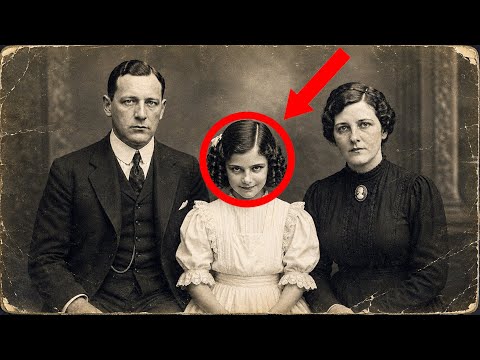
Back in her Cambridge office, Sarah couldn’t shake the girl’s unsettling expression. She pulled out a magnifying glass and studied the photograph again. That smile—it was predatory, as if Millisent knew something her parents didn’t. Sarah dove into the university archives, desperate to learn more. What she found made her stomach clench. Herbert Ashford had died just five days after the portrait was taken. And a medical journal from 1921 described a case of “acute delusional disorder” in a woman who claimed her daughter had undergone a terrifying personality change—cruelty to animals, inappropriate social responses, and a smile that never reached her eyes. The woman was Constance Ashford.
Determined to uncover the truth, Sarah visited the photography studio that had taken the portrait. Mrs. Henderson, the current owner, retrieved a leather-bound ledger from 1920. The notes from her great-grandfather were chilling: the Ashfords had appeared nervous, almost frightened, while the child was “remarkably composed.” She smiled constantly, but it was “not the natural smile of a happy child.” Herbert had been sweating and complaining of chest pains, yet insisted the portrait be completed that day. “We may not have another opportunity,” he had said.
Sarah’s next stop was the county archives, where she found Herbert’s death certificate and a coroner’s report that had never been made public. The attending physician had noted symptoms consistent with severe poisoning—dilated pupils, excessive sweating, gastrointestinal distress—but no obvious source. The patient’s wife reported that Herbert’s symptoms always followed meals prepared by their daughter. Millisent had developed a sudden interest in cooking, gathering herbs and plants from the garden. The doctor’s final observation was the most disturbing: when he questioned the child about her father’s symptoms, she described them with clinical precision far beyond her years, and smiled as if enjoying a private joke.
Sarah sat in stunned silence. The pieces were falling into place, but she needed more. She drove to the Kent Police Museum, where she discovered the private journal of Constable William Thornton, who had investigated Herbert’s death. His notes were damning: Millisent had shown no grief, only that same unsettling smile. She had been collecting toxic plants—foxglove, nightshade, yew berries—and experimenting on animals. “I am convinced that young Millisent Ashford was systematically poisoning her father,” Thornton wrote, but the investigation was closed due to lack of evidence and the family’s social standing. No one wanted to believe a nine-year-old could be a calculated murderer.
But Sarah was beginning to believe it. And she was about to discover that Millisent’s story was far from over.
Sarah pushed her chair back from the desk and rubbed her eyes. The museum’s fluorescent lights hummed overhead, and somewhere in the building a door clicked shut. She had been reading for hours, and the image of that smiling child had burned itself into her mind. There was a gap in the record, she realized—a missing decade between Millisent’s disappearance from Yorkshire in 1922 and the first confirmed sighting of the “Smiling Woman” in 1930. Eight years of silence. Eight years in which a child with a taste for poison had grown into something far more dangerous.
She returned to the North Yorkshire Archives the following morning, this time requesting the complete file on the Weatherbe household rather than just the correspondence with the solicitor. The archivist, a thin young man named Colin, brought her a cardboard box tied with string. “You’re not the first to ask about this one,” he said, hesitating. “A gentleman came through about fifteen years ago. Said he was writing a book. Never heard from him again.” Sarah asked for his name, but Colin shook his head—the request slips from that era had long since been discarded.
Inside the box she found something the earlier correspondence had not mentioned: a small bundle of letters in a child’s careful script, tied with faded ribbon. They had been addressed to Constance Ashford at the Mosley Hospital but never posted. Sarah untied the ribbon with trembling fingers.
The first letter was dated October 1922, a month after Millisent’s disappearance. Dear Mother, it read. I am sorry Aunt Penelope was so unkind about my experiments. She did not understand that I was only trying to learn what Father’s books taught me. I have found a new place to stay, with a widow who has no children and a very large garden. She says I am a blessing. I will write again when I have learned more. The letter was signed with a single looping initial: M.
Sarah’s hands went cold. She read the remaining letters in a daze. Each one was dated from a different village, each described a new “kind lady” or “lonely gentleman” who had taken the child in, and each ended with the same chilling refrain—that Millisent was learning, that she was grateful for the opportunity, and that she would write again soon. The final letter, dated March 1923, was shorter than the rest. Dear Mother, it said. The constables are asking questions again. I think it is time I stopped being a little girl. Do not worry. I have learned how to be whatever people need me to be.
There were no more letters. Sarah sat back, the paper trembling in her hand. She had just read a confession, written by a child, of murders that had never been solved. And she had read something else—a promise of transformation, made by an eleven-year-old who understood, with terrible clarity, that survival meant becoming someone else.
She thought of the photograph again. That smile. It wasn’t the smile of a child who had done something wrong and gotten away with it. It was the smile of a child who had looked at the world and understood exactly how it worked—that no one suspects a little girl, that grief buys sympathy, that a pretty face and a soft voice open every door.
Colin appeared at her elbow. “Professor Mitchell? There’s a phone call for you. A Detective Inspector from Scotland Yard. He says it’s about the Ashford file.”
Sarah looked up, her heart hammering. She had not told anyone at Scotland Yard that she was researching the case. She had only requested the file. “Did he give a name?” she asked.
Colin glanced at his note. “He said his name was Morrison. Detective Chief Inspector Robert Morrison. He said to tell you he’s been waiting a very long time for someone to ask the right questions.”
Sarah’s mouth went dry. Morrison had compiled the Smiling Woman file in the 1940s—and if he was calling her now, then either the file had been reopened, or the man had left something out. Something he had been carrying for decades, waiting for someone to find.
She took the call in the archivist’s cramped office, the receiver cold against her ear. The voice on the other end was old and dry, like leaves turning to dust. “Professor Mitchell. I’ve been expecting your call for some time—though I confess I’d hoped it would come sooner.”
Sarah gripped the receiver. “You’re Robert Morrison? The Morrison who compiled the Smiling Woman file?”
A long pause. “I am. Or what’s left of him. I’m eighty-nine years old, Professor, and I’ve spent the better part of my life waiting for someone to prove me right.” He coughed, a rattling sound. “I read about your request in the archive logs. They still notify me, you see. An old man’s vanity.”
“The file said the case went cold after 1947. That Millisent vanished.”
“The file said what I was permitted to write.” His voice sharpened. “What it did not say was that in 1948 I received a letter. Posted from Southampton, three days before a woman calling herself Margaret Mills boarded a ship to Australia.”
Sarah’s skin prickled. “A letter from Millisent?”
“From Millisent.” Morrison paused, and she heard him shifting, perhaps reaching for something. “I have carried it for forty-seven years. She wrote that she had read of my investigation in the newspapers and wished to thank me. She said I was the only one who had ever understood her—that the others had all been fools who preferred comfortable lies to uncomfortable truths.”
“Why are you telling me this now?”
“Because the letter was not the last thing she sent.” His voice dropped. “Two months ago, a parcel arrived at my home. No return address. Inside was a single photograph, taken this year, and a note in that same careful hand. It said: ‘Still watching, Inspector. Still smiling.'”
Sarah’s blood turned to water. “That’s impossible. Margaret Ashworth died in 1995. The nursing home records—”
“Were forged.” Morrison cut her off. “I never believed she died. A woman who spent seventy years perfecting the art of becoming someone else does not simply expire in a Surrey nursing home and leave a paper trail for historians to follow. She left that trail deliberately, Professor. She wanted to be found. She wanted an audience.“
Sarah thought of the antiques shop, the portrait tucked between dusty volumes, the way it had seemed to call to her. “The photograph in Canterbury. The estate sale. It was placed there for someone to find.”
“Yes.” Morrison’s voice was barely a whisper. “And you found it. Which means she knows your name, Professor Mitchell. She knows where you work. And she is, I suspect, rather looking forward to meeting you.”
The line clicked. Sarah stood motionless, the dead receiver still pressed to her ear, as Colin hovered in the doorway with a question on his face that she could not begin to answer.
Sarah set the receiver down slowly, her fingers numb. “He’s gone,” she said, though Colin hadn’t asked. She gathered her notes with shaking hands and drove back to Cambridge through a grey afternoon that seemed to press against the windscreen.
That evening she spread everything across her desk—the portrait, the letters, the coroner’s report, Morrison’s file—and forced herself to look at the child’s smile one last time. It was not evil, she realized. It was patience. The smile of someone who had outlived every person who ever tried to understand her.
She locked the photograph in her office safe and, just before midnight, wrote a single line in her research journal: Millisent Ashford is still alive. Then she turned off the lamp and sat in the dark, listening to the old building settle around her.
Somewhere out there, a woman of a hundred and fourteen years was smiling at a new audience. And Sarah had just been given the role of a lifetime.
What would you do if the monster you were researching knew your name—and wanted to be found?
Report this article
Select a reason for reporting:






