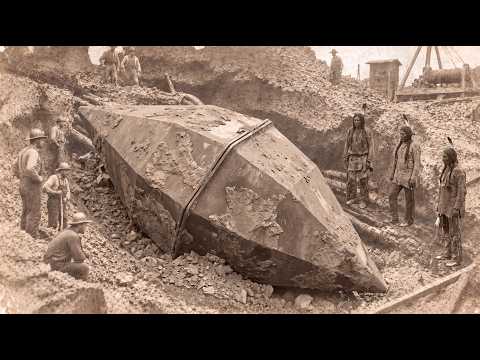
In the autumn of 1904, deep inside the Oquirrh Mountains of Utah, a copper mining crew drove a pickaxe into the ore at the end of a tunnel 900 feet into the mountain—and struck something that was not metal, not rock, not copper, and not a mineral vein. It was a dark, octagonal body with pointed ends, standing upright from the heart of the mountain, balanced perfectly on one tip without swaying. It stood seven feet four inches tall—taller than a man. A thin line encircled its middle. The shift supervisor measured it and wrote the number in his notebook, then added another line: when he pressed his palm hard against its eastern face for a long moment, the upper half rotated in silence.
Five years later, on the other side of the mountain, an elderly man of the Ute tribe—born east of Utah Lake—described this thing to a university researcher. He had never seen it, but he knew where it stood. He knew how it stood. The Ute said it was left there, and what is left there should not be touched. That is where this story begins.
Before we can understand what was found at the end of that tunnel, we need to understand that mountain—because Bingham Canyon was no ordinary mining gulch. The Oquirrh Mountains are a rugged, barren range running north to south along the western edge of the Salt Lake Valley. Bingham Canyon is a narrow gorge carved into the eastern slope of that range. The two brothers who first settled the place in 1848, Thomas and Sanford Bingham, gave the canyon their name. At first they cut timber and raised cattle. The ore came later.
Silver and lead were discovered in the 1860s, copper in the 1890s. Wooden houses, saloons, churches, and stores lined the canyon floor. The town was so narrow that two horse-drawn wagons could not pass side by side on some streets. In 1903, two men—Daniel Jackling and Enos Wall—founded the Utah Copper Company. Jackling was a 34-year-old mining engineer who believed in something others considered worthless: the low-grade copper spread through the entire mountain mass. Two percent copper—just forty pounds of metal per ton of rock. But the mountain was so vast that, if mined the right way, that small amount could become a fortune.
In 1904, he chose that way: not from the inside, but from the outside, as an open-pit mine. But before the pit could be opened, the company had to understand what was inside the mountain. So they drove exploratory tunnels—long horizontal passages pushed into the rock to learn how much copper it held. The Utah Copper Company’s lower development tunnel was one of those passages.
In 1904, a few thousand people lived in Bingham Canyon, the town stretching along the valley floor as one long street. A branch of the Denver & Rio Grande Railroad reached the mouth of the canyon. From there, ore cars descended into the valley. The workers had come from all over the world—Swedes, Finns, Welsh, Irish, Greeks, Italians, Japanese. Each group had its own boarding house, its own saloon, its own neighborhood. Some neighborhoods on the canyon slopes could only be reached by stairs. The men who worked the mine came from this diverse crowd. Most did not speak each other’s language fluently, but they all knew one rule: anything a man sees inside the mountain, he reports to the shift boss, and the rest is the shift boss’s responsibility.
But this mountain had an older history, too. The name “Oquirrh” does not come from miners—it comes from the language of the Goshute people. These mountains mark the eastern boundary of Goshute territory; the Goshute lived in the desert valleys to the west. Directly east of the mountains, along the shores of Utah Lake, lived the Timpanogos Ute. The lake provided them fish, the reeds along the shore provided shelter, and the surrounding mountains provided game. The two peoples knew each other. They knew each other’s mountains and streams, and the stories that described what lay inside those mountains.
In the 1860s, most of the Ute were removed from the lake and resettled on a reservation in the Uinta Valley to the east. Their descendants still live there today, and the stories did not stay at the lake. They went with them. The company records do not mention these stories. The Ute accounts do not mention the Utah Copper Company. This is the story of an ancient machine found in a Utah copper mine in 1904, and of what the Ute said about it. They said this: it was left there.
This is not a campfire tale, and it is not a newspaper hoax. The first record of this story is a gray notebook that was in the pocket of a shift boss. The shift boss’s name was Evan Pritchard. He was forty-four years old, born among the coal mines of Carmarthenshire in Wales. He went underground at the age of twelve and came to America at twenty-six. He had been in Bingham since 1893. In town, they called him “Evan the Bookkeeper”—because he carried a small, cloth-bound gray notebook in the inside pocket of his coat every shift, bought for ten cents from a local store. In eleven years, he filled twenty-six of them with details like the number of cars that came out, the ore grade, which support timber had cracked, and who was on the sick list. According to Pritchard, a supervisor who doesn’t take notes is a supervisor who eventually remembers things wrong. And remembering things wrong costs money.
The page dated October 10, 1904, looks ordinary. The lower development tunnel had reached a depth of 900 feet. The ore was running two and a half percent copper—better than the previous week. The timber crew was two hours late. One miner’s wrist had swollen. The page dated October 11 is different. It is longer, and it contains words Pritchard never used in any of his twenty-six notebooks. The page begins as usual—the date, the shift, the temperature at the collar. Then comes a short sentence: “Miner Olaf Lindquist, Swede, twenty-nine years old, came back from the end of the tunnel at a speed that was impossible under normal conditions.” Pritchard describes his face as that of a man who could not decide whether to drop what he was carrying or not.
Pritchard took a second lantern and walked with Lindquist, and in his notebook he wrote one sentence about what he saw at the end of the tunnel. Not ore. Two words in a notebook full of talk about ore. Lindquist also wrote down what he saw that morning in his own words. Four years later, in 1908, he left Bingham and returned to Sweden, and sent a letter to his brother from his village in Värmland. The letter stayed with the family. In one paragraph, he describes the strangest thing he saw underground in America. He sums it up in a single phrase: “Iron standing upright inside the mountain.”
Pritchard knew every form copper took in this mountain. Oxidized green surfaces, dark blue crusts, glittering veins of raw copper inside the rock. He had spent twenty years examining ore, and he knew what was ore and what was not. And at the end of the tunnel, four feet above the floor, what was visible through the freshly broken rock was not ore. At first, only a corner showed—a sharp, flat, dark surface, and a perfectly straight edge where two faces met. Pritchard traced the edge with his lantern. It ran downward into the rock in one straight line. He told Lindquist to set the pickaxe aside, then waited. The first opening was nine by fourteen inches, and Pritchard wrote that down, too. A surface inside the broken rock, surrounded by ore on three sides, with the fourth side exposed where the pickaxe had struck it.
It did not look like copper. It did not look like any ore he knew. Pritchard tried to describe it several times, crossed out two attempts, and finally wrote: “Dark as wet slate, but it does not absorb light the way slate does.” There were four people in the tunnel that morning: Pritchard, Lindquist, a loader, and a boy of fifteen. Pritchard sent the boy with a short message from the tunnel mouth to the company office. The message contained only one sentence. We know what that sentence was from the reply that came from the office the next day. Until the reply arrived, no one touched that surface again.
Pritchard set the lamp aside, called his men back, and stood before the surface for forty minutes in a long silence that men who measure time underground by work cannot measure. He wrote this in his notebook. The more he looked at it, the less ordinary it seemed. In the margin of the notebook, there is another small note written that day, but it looks as if it was added later. Pritchard writes that he touched the edge with his bare hand, and that the surface he touched was not cold—the way everything inside the mountain is cold. Nor was it very cold. He did not dwell on that detail then, but a few pages later he returned to it.
The reply from the office arrived the next morning, carried by the same boy. Pritchard had placed it inside the back cover of his notebook. The paper was folded, its edges worn, and it contained three short sentences and three initials. Do not touch it. Do not blast it. I will come down tomorrow. D.C.J. Daniel Cowan Jackling. The second entry in this story does not come from a supervisor. It comes from the general manager of the company himself.
Jackling descended into the mine the next morning, October 12, 1904. He was thirty-five years old, a man who had graduated from a mining school in Missouri, built mills in Colorado and Utah, and founded the Utah Copper Company from nothing. General managers rarely went underground, but Pritchard’s note had been a single sentence, and once Jackling read it, he went down himself carrying his lamp. He stood before the object for a long time without saying a word. Pritchard writes this about him: he was the type who spoke only after deciding what he would say.
Finally, Jackling said one thing. The object must be removed carefully, and there will be no blasting. Pritchard had underlined the word carefully. It is the only place in his notebooks where he underlined a word. Not using explosives would stretch the work for weeks, but it was Jackling’s decision. The men worked with hand tools. They crumbled the ore piece by piece, widening the area around the object. And as the opening grew, something appeared that none of the engineers could explain.
The object was embedded entirely within the ore. There was no crack above it and none below. On both sides, there were no fissures, no water channels, no sign of a collapse through which it could have entered later. The ore had wrapped around its surfaces, just as it had wrapped around everything inside the mountain. Without seams, without interruption. There were six hundred feet of solid rock above it. Jackling wrote a two-page examination report in his own hand, in the precise language an engineer uses when documenting something he cannot explain. He wrote that there were no traces in the ore touching the object to suggest it had been inserted later. And he recorded his professional opinion in one sentence: The object settled into its place at the same time the surrounding ore formed, as part of the same event. Of the same age.
According to geologists, Bingham’s copper formed millions of years ago when hot, mineral-laden fluids seeped through the mountain’s rocks and cooled there. Millions of years. It took three days to remove the object because it would not fit in the vertical shaft. Carpenters built a cradle of heavy beams around it inside the tunnel. It was secured there in an upright position, wedged tightly with planks and pegs. Then the men rolled it, still standing, onto a rail platform all the way to the tunnel mouth. According to Pritchard’s notebook, none of the men suggested laying it flat. And no one explained why they didn’t.
And only there, in daylight, was it seen in full for the first time. It had eight faces, and both ends terminated in a pointed tip. Its widest point was exactly in the middle—three feet and one inch. Its length, measured with Pritchard’s steel ruler, was seven feet four inches. A single thin line encircled its center, fine as a hair, yet deep enough to catch a fingernail. Its surface was covered in a rough, flaking crust, as if it were an artifact pulled from deep within the earth. Wherever the crust flaked away, a dark, dull metal appeared beneath. Not all of it.
The hoist scale read 3,900 pounds. Jackling measured the seam with a feeler gauge from his bag—thin steel strips engineers use to measure gaps between two surfaces. A blade two-thousandths of an inch thick slid into the seam. A blade three-thousandths of an inch thick did not, and this gap was identical on all eight faces he measured around the object’s circumference. A casting mold does not leave such a seam. Not even a blacksmith’s weld. The faces were measured too, and each was fourteen inches wide at the seam. Eight faces, eight equal widths, and each face tapered toward the pointed tips at both ends without any curvature.
Then Pritchard wrote that sentence, which he had scratched out and rewritten several times in his notebook. When he pressed his palm against the eastern face with a long, deliberate pressure, the upper half of the object rotated along the seam in silence by one-eighth of a turn. And in the gap that opened along the seam, in the lantern light, something appeared inside. Thin, toothed, interlocking rings, like the inner workings of a pocket watch, but finer than any watch he had ever opened. When Pritchard withdrew his hand, the upper half slowly returned to its place and the seam closed.
Jackling tried the same experiment himself. According to his notes, the upper half did not budge with a single touch. Only when he threw his full weight onto his palm deliberately for several seconds did it rotate. It rotated without sound, without creaking. In the gap, by lantern light, he could count at least five interlocking rings, each thinner than the one before. Each ring turned on its axis, and when he withdrew his hand, it took forty seconds, as he measured with his pocket watch, for the upper half to return to its original position. Jackling added one sentence to his note. On any of the rings, where the teeth met, his lens could find no trace of wear. In a mechanism that came from rock millions of years old. There was no wear at all.
There is an official explanation for this story, and it deserves a fair hearing first. An internal memorandum from the Utah Copper Company, dated November 3, 1904, exists in the company records. According to the correspondence, the mass found in the tunnel was assessed as a discarded cast piece that had fallen from an old operation dating to the 1870s. Mining had been going on in Bingham Canyon since the 1860s. The canyon once had small smelters, broken machinery, and abandoned boilers. Such a piece could have fallen from an old tunnel and later been covered with ore dust. The memo notes that the matter was closed from the company’s point of view. From their perspective, this is a perfectly reasonable explanation, but it does not explain Jackling’s own note. The general manager had written in his own hand that there were no traces in the surrounding ore indicating later entry. There was no old tunnel and no fissure. And a cast piece does not rotate along a seam, nor carry rings finer than a watch movement inside it, nor stand on its lower tip without toppling. The correspondence does not address these two points.
There is also a third piece of evidence. During those years, the United States Geological Survey was conducting a detailed survey of the Bingham area. The geologist in charge was John Mason Boutwell. Throughout 1903 and 1904, he entered the mines in the canyon, mapped the rocks, and measured the ore bodies. His work was published in 1905 as USGS Professional Paper 38, and it remains one of the primary sources on Bingham’s geology to this day. There is not a single word about the object in the published report. But at the bottom of a page in Boutwell’s field notebooks, dated October 1904, there is one line: “An unusual metal mass was reported. The lower tunnel. The company refused access.” The government geologist was there, and he wanted to see the mass. He was not allowed to see it.
Yet the analysis was conducted inside the company. Martin Oldroyd, the assayer at the Pilot Mill in Copper Cliff, took scraped samples from the object’s crust and the raw metal beneath it. The first two pages of his three-page report describe his methodology. Acids, flame tests, comparison samples. The third page is full of the most honest sentences an assayer can write. There were traces of copper in the crust, as expected from a surface that had lingered in a copper-rich environment. Inside, there was a component resembling tin, but not actually tin. Oldroyd described the majority of the mass in one phrase: an unknown alloy with no commercial counterpart. The mass did not react to any of the standard acids. It responded partially to a magnet, but in a way that did not match any iron-group metal he knew.
Oldroyd performed another calculation. He computed the object’s volume based on Pritchard’s measurements and divided it into the weight recorded on the hoist scale. The resulting density was greater than copper’s, but less than lead’s. So the bulk of the object was made of a material heavier than copper but lighter than lead. Oldroyd was a Lancashire man who had been in the field since 1896 and had weighed hundreds of samples. He did not know any metal that fell within that range and looked like this. Nothing. Oldroyd sealed his report with the following sentence: “Further analysis would require instruments not available at this station or, to his knowledge, at any assay office in the region.” The explanation was reasonable. The report was honest. And the two did not describe the same thing.
The third account in this story does not come from a mine, nor from a company. It comes from a page in a notebook written in pencil by a university researcher on the porch of an Indian agency. The researcher’s name was Ralph Vary Chamberlin. He was born in Salt Lake City in 1879. He was a biologist, a precise scientist who classified plants and animals. But in his late twenties, he began recording the names Native peoples of Utah gave to plants, animals, and places. That work was real, and it was published. In 1909, an article on Ute plant names in the American Anthropologist. In 1911, an expanded study of Goshute plant knowledge. In 1913, place names and personal names of the Goshute. None of these publications mentioned a machine.
But one of the field notebooks Chamberlin kept during his work on Ute plant names at the White Rocks Agency in the Uinta Valley during the summer of 1909 contains a page that never made it into the published article. The page is dated at the top August 1909. Below that are the usual lines where Chamberlin recorded plant names. Then, in the same hand, something else. Chamberlin’s informant was an elderly man of the Timpanogos Ute; Chamberlin did not write his name on this page. He wrote only this. The man was about seventy-five years old, had spent his childhood on the shores of Utah Lake, and was among the last people to see the lake before settlers’ farms filled its shores. The interview was conducted with the help of a translator. According to Chamberlin’s note, the translator was a young Ute man who had studied at the White Rocks boarding school.
The old man spoke slowly. At the end of each sentence, he waited for the translator to catch up. Sometimes he repeated the same sentence a second time using different words. He spoke first about the lake. He described how he had lived his childhood on the lake shore among the reeds. He said: “In the spring, schools of a fish found only in that lake came to the shore.” That fish was dried and stored for winter. This fish is real. Today, biologists call it the June sucker, and it lives only in Utah Lake. The old man, according to Chamberlin’s account, mentioned that there was a way to teach children to look toward the western side of the lake. In the evening, the adults would seat the children on the shore, and as the sun set, they would point to the mountains. Which mountain had game, which mountain had water, which mountain to avoid.
The old man also explained how they found that mountain. At the beginning of summer, on the evening of the longest day, his grandmother would take him to the shore. That evening, the sun set in a specific notch on the peak of the mountains northwest of the lake. His grandmother would point to that notch and say it was there. Chamberlin wrote this sentence, but added nothing to it. Looking from the shore of Utah Lake, the sun sets in the northwest on the summer solstice. In that direction, beyond the lake, lies the northern part of the Oquirrh Mountains—the area where Bingham Canyon is located. Chamberlin never calculated this. To our knowledge, no one had before.
Chamberlin had asked him about the plants that grew in the mountains west of the lake. The old man listed the plant names, then according to Chamberlin’s account, fell silent for a while, and told a story unrelated to plants. He said the mountains west of the lake are Goshute mountains. The Ute went there to hunt, but deep in those mountains, in the green stone, there was something standing upright. No one went there. Chamberlin asked what it was, and the old man answered with his hands. According to Chamberlin’s note, he curved his palms toward each other, brought his fingertips together, then repeated the same shape while pointing downward. One end pointing up, one end pointing down. Chamberlin wrote this on the page: like a spinning top, it has two ends. One points to the ground, the other to the sky.
“Who made it?” Chamberlin asked. The answer on the page was brief. It was left behind by them, and those who left it were not of the Ute or Goshute tribes. They came before them. He wondered why no one went there. Chamberlin put the old man’s answer in quotation marks. “What is left is not touched. When it is touched, it turns once.” Chamberlin asked another question. “Has anyone touched it before?” According to the notes, the old man said that long ago, in the time of his grandmother’s grandmother, someone had touched it. He also specified where it was touched. The translator conveyed this to Chamberlin: “From the side where the sun rises.” Chamberlin recorded this detail in the margin in small letters, without knowing why it mattered.
The Ute said it has two ends. The Ute said it stands upright. The Ute said it was left there, but they were not the ones who left it, and it turns once when touched. It turns once. Chamberlin wrote no note beside this sentence, but at the bottom of the page he tried to write the name the old man gave to that thing. First, he wrote the Ute word as it sounded to him, then crossed it out. The only thing he left at the bottom is his own translation of the word’s meaning: “The one who stands waiting.”
We are not debating whether this story is true. That is not the goal of this video, but we must say this. A name can be misspelled in a county record. But it cannot be lost from the mouth of a living person. The old man did not learn this story from a book. He heard it beside the lake as a child from someone who lived before him. And there was something Chamberlin did not know. In 1909, when he wrote this page, he did not know what the Utah Copper Company had found five years earlier at the end of a tunnel in Bingham. He could not have known. None of it had appeared in any newspaper. Pritchard’s notebook was still in his pocket. Jackling’s note was in the company safe, and Boutwell’s single line was in a government field notebook. The old man had not seen them. No one had.
Now we have two records that never crossed. The first consists of documents from a company and from the government. A supervisor’s notebook, a general manager’s inspection note, an assayer’s report, and a single line from a geologist. None of their authors cared about Ute tales. The second is a people’s memory, a story heard beside a lake and retold fifty years later on an agency porch. None of those who passed it down had ever seen the vault of the Utah Copper Company. Let us place these two records side by side without adding anything.
The notebook says: “It stood upright on its lower tip.” The oral account says: “Something standing upright.” The notebook says: “It had two pointed ends and eight faces.” The oral account says: “Like a spinning top, it has two ends. One faces the ground, the other faces the sky.” The company record says: “In the mountain range west of the lake, in the heart of the green copper ore.” The oral account says: “In the mountains on the western side of the lake, inside the green stone.” And now the last line. Pritchard’s notebook says: “When he pressed his palm against the eastern face, the upper half rotated once, then returned.” The old man says: “It turns once when touched.”
But there is an additional line. In his notebook, Pritchard had written which side of the object he pressed his palm against to make the upper half rotate—the eastern face. The tunnel ran west into the mountain. The side of the object facing the tunnel, the direction the miners came from, was east. In Chamberlin’s notebook, five years later, in a translator’s words: from the side where the sun rises. Pritchard’s notebook was never published, nor was that page of Chamberlin’s notebook.
We have to stop here. Because in Pritchard’s notebook, there is another line written that day, but no one read it for months. That evening, after the object was brought into daylight and the men had dispersed, Pritchard remained alone with it at the tunnel mouth. He placed his palm over the seam. He did not press down. He just placed it there, and wrote in his notebook that he felt a very faint, very regular vibration beneath his palm inside the seam—not like a machine running, but like something waiting. On the first day he had written that the surface was not cold the way everything inside the mountain is cold. We will not say what that means.
The convergence of these two records is not proof, and it may be mere coincidence. It may also be one story that overlapped with another over time. In a moment we will explain why this might be the case in the strongest possible terms. But we must also say this: coincidences usually converge on a single word. These two accounts intersect in five details: position, shape, location, movement, and direction. One of these details—the rotation—never appeared in any newspaper. Pritchard also noted the rhythm of the vibration. Every few seconds, slow and steady, slower than a heartbeat and faster than breaths.
The next morning, the body was transported to Copperton. Pritchard did not go with it. In the spring of 1905, Pritchard left the Utah Copper Company and moved to a silver mine in Park City. He carried with him a letter of recommendation from the company. The letter was well-meaning and full of praise, but its final paragraph contained a condition. Pritchard was not to speak to anyone about the lower tunnel at his former workplace—not to workers, not to journalists, not to visitors. Pritchard did not speak, but he did not stop writing.
The fourth entry in this story was written eight years after the object was removed from the mountain, and that entry describes a void, not an object. In 1906, the Utah Copper Company began implementing the decision Jackling had made two years earlier. Steam shovels descended on the slope of Bingham Canyon. Tracks were laid behind the shovels, and all the cars rolled along those tracks down the mountain face. The mountain was no longer mined from the inside, but from the outside, step by step. By 1912, Bingham was known as the largest industrial mining complex in the world. The mountain was coming apart piece by piece. And as the terraces were cut, the old tunnels appeared one after another in daylight. The shovels tore through the roofs of tunnels where miners had once walked by lamplight, revealing their interiors.
In August 1912, a shovel was working on a bench near the old level of the 1904 lower development tunnel. The shovel was a Bucyrus model manufactured in Ohio, a massive steam-powered machine that moved on rails. Its arm devoured several tons of rock at a time. Its operator was a young Greek named Nikos Papas. He had come to Bingham two years earlier, first as a loader, then as a shovel assistant. That morning, at the edge of the bench, he lowered another bucket into the ore. The shovel’s bucket plunged into the ore, then fell into emptiness.
The assistant engineer in charge of the bench was Harold Beasley. He was thirty-one years old, born in Salt Lake City, and a recent engineering graduate from the University of Utah. He stopped the shovel. He climbed down to where the bucket had struck. And inside the ore, behind the surface the bucket had broken, he found a cavity with smooth walls. The cavity was empty, but it took the shape of an eight-faced form tapering to a sharp point, with walls as smooth as the inside of a mold. Beasley measured it and recorded his measurements on a survey card that is still preserved in the company archive today. Depth: seven feet four inches. Widest point: three feet one inch. Exactly like the measurements in Pritchard’s notebook.
But there is something stranger on Beasley’s card than the measurements themselves. On the inner wall of the cavity, exactly in the middle at the widest point, there was a thin line running all the way around it. It looked as if it had been pressed into the wall. Beasley described it as a circular mark inside a mold, the trace of a mating edge. Beasley also looked at the bottom of the cavity, where the sharp point would rest, and there was a small, smooth depression in the rock, the size of a fingertip. It looked as though something had been resting on that single point and rotating for a very long time. Beasley never saw Pritchard’s notebook, nor Jackling’s note. He knew nothing about what had happened in the tunnel in 1904. He was still in college that year, but he wrote on the back of the card, below the measurements, a question in his own hand: “A mold of what?”
There is a number in the corner of the card: 1912 B117. In the same file, there are hundreds of cards from the same year, recording excavation measurements, shovel breakdowns, and blasting tests. Number 117 is indistinguishable from the others. Same paper, same ink, same letterhead. Only the question is different. It never received an answer, because work at Bingham stopped a month later. In September 1912, the majority of Utah Copper Company miners went on strike. A large proportion of the strikers were Greek immigrants. The reasons were wages, work contracts, and the commissions taken by employment agencies. Armed strikers took positions on the canyon hills. The company brought in strikebreakers and the state sent in the militia. The strike lasted for weeks and the shovels stopped working. When the shovels returned to work, the excavation site had been removed. The cavity went with the ore into the cars and on to the mill.
Nikos Papas was one of those who stayed on the hills throughout the strike. When the strike ended, he did not return to Bingham. Someone else took his place on the shovel. Beasley left the Utah Copper Company in 1914 and moved to a copper mine in Nevada. He did not take his card with him. It remained in the company’s survey files alongside hundreds of other cards from that year. Without a single mark on it. And today, all that remains of it is Beasley’s card with two measurements and a question. And at some point, someone knew exactly what was standing in that cavity.
The fifth record does not come from Bingham nor from the Ute. It comes from the other side of the mountain, from the true owners of Oquirrh. In 1913, Ralph Chamberlin published his study of Goshute place names and personal names in the journal of the American Philosophical Society. The study lists the names the Goshute gave to the mountains, springs, and valleys in their territory, along with their meanings. It remains one of the primary sources consulted today for understanding Goshute geography. The published list includes many names from the eastern slope of the Oquirrh Mountains. But in Chamberlin’s field notes for this study, there is another name that was not included in the published text. Chamberlin wrote its meaning in his own hand: the place of the standing thing. He did not specify which canyon it was. And directly below that name, there are two more unpublished lines. The Goshute informant told Chamberlin that no human foot had ever trodden that place. And when asked why no one had set foot there, the answer was summarized in the same answer a Ute had given him four years earlier at White Rocks. That place was left.
Chamberlin’s Goshute informants were mostly from Deep Creek, today’s Ibapah, the valley on the Utah-Nevada border, more than a hundred miles from the Oquirrh Mountains. Those men knew nothing of the Utah Copper Company, the houses of Bingham, or what happened in the mine in 1904. But they knew a place on the eastern edge of their mountains where no human foot had ever trodden. And they gave that place a name in their language after something that stood upright.
Chamberlin’s family donated his field notebooks after his death, and they are now preserved in boxes in the special collections of the University of Utah library. Plant names, animal names, place names—hundreds of pages. These two pages bear no mark distinguishing them from those hundreds of pages. To find them, a person who knows what he is looking for must turn every page one by one. Two peoples, two distinct languages. Two separate years, and the same mountain.
We need to draw a line here. Because stories like this can easily extend to other places, other continents, and other peoples. We will not do that. The Uinta region has a rich archaeological history. On the shores of Utah Lake and in the surrounding valleys lived a people archaeologists call the Fremont culture. They lived roughly between 700 and 1300 AD. They grew corn, made clay figurines, lived in pit houses, and painted images on rocks. Fremont settlements are still being excavated throughout Utah today. The Fremont did not work copper. No cast metal ingots or gear-like parts have ever been found at any Fremont site. The Fremont culture does not explain what was found at the end of the tunnel. And we will not claim to explain it.
But the Fremont left something else behind. In the rocky areas west of Utah Lake at the foot of the Oquirrh Mountains, there is a collection of rock art documented by archaeologists. Most of the motifs are familiar—mountain goats, human figures, spirals. The only known record of this collection is a field card filled out during one of the federal archaeological surveys conducted in Utah in the 1930s. The card lists the rock site, sketches, and a brief note. The field agent who filled out the card classified the collection as Fremont style. He drew one motif separately because he could not find it in any list. In one of them, an upright form with two pointed ends. There is no figure around it—no human, no animal, just that shape. And below it, the trace of a small palm facing toward it.
The sixth and final file traces the object itself, and this trace ends in a place stranger than anything else in this story. After 1904, the object remained in the warehouse of the Pilot Mill in Copperton. In company ledgers, it was mentioned for three years with a single line: “tunnel find.” During storage, in 1906, the Guggenheim Exploration Company became a major partner in the Utah Copper Company. At that time, the Guggenheims controlled one of the largest smelting and mining groups in America. With the partnership, records, warehouses, and inventories were reorganized. In March 1907, the Copperton warehouse was cleared. There is an entry in the shipping record: heavy crate, mine specimen, of scientific importance, shipped from Salt Lake City to New York to the office of the Guggenheim Exploration Company by express mail. The weight listed in the shipping record, including the crate, is 4,150 pounds. Add the weight of a heavy wooden crate to the 3,900 pounds recorded on the hoist scale in 1904, and the two numbers match within a few pounds. Within a few pounds.
The crate traveled east from Salt Lake City in an express freight car with two transfers along the way. The text of the label affixed to the crate was copied into the shipping record as well: mine specimen, of scientific importance, to be kept upright. The last two words were underlined. For a crate weighing 4,000 pounds that had sat in a warehouse for three years and crossed the continent by express freight train, someone considered this warning necessary. There is no receipt indicating the crate was received in New York. But at the end of that same year, there is a card in the accessions records of the American Museum of Natural History in New York indicating a donation. The name of the mining company is listed as the donor. The description reads: “metal concretion, Bingham, Nevada.” Nevada. Bingham Canyon is not in Nevada. It is in Utah.
The card matches an entry in the museum’s bound accession ledger for 1907. Next to that entry in the ledger are the initials of the employee who received the donation and a shelf code. The shelf code refers to the vault of the museum’s mineral storage facility in those years. The dimensions field on the card reads seven inches, not seven feet seven inches. One evening, an employee made two small errors while transferring the label on the crate to the ledger in haste. He misspelled the name of the state. He wrote the unit of measurement incorrectly. And these two small errors turned an eight-sided object weighing 3,900 pounds into a seven-inch rock from Nevada in the museum’s records. No one hid it. No one tracked it. The card also contains an accession number, a seven-digit number from that year’s donation series. The numbers preceding and following it in the same series belong to rocks that are still in the museum’s mineral collection today. This number, however, stands alone in the series.
In the 1990s, a researcher found this card and wrote to the museum. The reply was polite and brief. The registration number existed in the system, but the object associated with that number could not be located in the shelf inventory. The museum explained that some old donations had been transferred to other institutions over the years. Some had been moved between storage facilities and some records could not be matched to a physical object. The researcher who found the card was a retired mining historian living in Salt Lake City. He was combing through the Utah Copper Company’s shipping records for a book about the company’s early years and wondered where that heavy crate from 1907 in New York had gone. He wrote to the museum in the spring of 1994 and the reply came that autumn. Two paragraphs, polite and vague. He wrote again and this time no reply came. The book was never published. The researcher’s notes were donated to a local historical society after his death. The only place where the 1907 shipping records exist alongside the museum accession card is a single file within those notes. This is not a cover-up of the truth. It is the ordinary bureaucracy of a large museum. But somewhere within that ordinary bureaucracy, there may be a seven-inch rock from Nevada registered, pointed at both ends, eight-faced, with a body that turns once along its seam, or used to.
There is another account of this story, where everything fits neatly into comfortable categories, and to be honest, this account is much simpler. Skeptics, quite rightly, turn first to the company correspondence of 1904. Mining had been going on in Bingham Canyon since the 1860s. The first claim in the canyon was staked in September 1863 by soldiers from Fort Douglas under Colonel Patrick Connor, and after the railroad reached the canyon in 1873, dozens of small operations opened, failed, and left their iron behind. The canyon was full of small smelters, broken boilers, and abandoned machine parts. A large mass of cast metal, after falling from an old tunnel, could over time be covered with ore dust and mud, appearing at the end of a mining passage as if it were inside the ore. This explanation is convincing.
Second, nature sometimes produces astonishing shapes. In copper deposits, one finds giant crystals, well-formed metal masses, and metamorphic rocks that have taken the shape of another mineral. An eight-faced mass with two pointed ends could be an unusual but natural crystalline formation. Third, the notebooks. The shift boss’s pocket notebook is not an official document. What Pritchard called “rotation” may have been a slipping of crust, a mass settling in its cradle, or an illusion of a tired eye at the end of a long shift. Fourth, the oral tradition. This is not a diminishment of respect for oral tradition. It is a natural consequence of how oral tradition survives. Between 1904 and 1909, miners in Bingham, saloons in Salt Lake City, and the roads leading to the Uinta Valley may have carried the same rumors. The old man may have heard that rumor from a trader or an agency employee.
Fifth, Chamberlin’s unpublished notes. These are field notebooks, pages torn from their context and full of crossed-out words. Their dates are partly illegible. It may be unfair to give them too much weight. Sixth, Jackling’s note. That note was never published. As we know it today, it consists of two handwritten pages retrieved years later from company files. Jackling’s handwriting was narrow and slanted. A phrase saying “no trace” could simply mean something else. Placing too much weight on every word in a note written by an engineer in haste may burden it with more than it can bear.
And finally, Boutwell. The single line in the USGS geologist’s notebook: “unusual metal mass.” It could simply refer to any old machine part found in one of Bingham’s passages. In those years, old iron was constantly being pulled from the canyon’s tunnels. The only thing connecting Boutwell’s line to this story is the date and the name of the tunnel. All these explanations are logical, and all of them remain within the known world. And we have no intention of diminishing any of them. But each one explains only part of the story.
How did an old cast piece end up inside ore that Jackling described as showing no signs of later intervention? Do natural crystals contain gear rings inside them? Where did the rumor get the detail of “turning once”—a detail never published in any newspaper? And in 1912, why did an engineer who had never seen Pritchard’s notebook find an empty mold with exactly the same dimensions? No one asked these questions. The company closed the matter, the museum recorded the records incorrectly, and the government geologist was not allowed in. No one hid it. It’s just that no one followed up. This is not the story’s weakness. It is the story itself.
In Bingham Canyon today, there is no mountain. There is a pit. The Bingham Canyon Mine is one of the largest man-made excavations in the world, over two and a half miles wide and three-quarters of a mile deep. It is said it can be seen from space. The 1904 lower development tunnel—that 900-foot passage in Pritchard’s notebook—vanished long ago inside the mine, lost amid billions of tons of rock that were dug and sent to the mill. The tunnel has disappeared. And the town of Bingham has disappeared too. Its narrow streets, saloons, and churches emptied one by one as the pit swallowed the slopes. In 1971, the town was officially dissolved. Today, the site of the old town lies under waste rock at the edge of the mine.
On April 10, 2013, the northeast wall of the mine collapsed. The Manefay landslide became one of the largest landslides recorded in the history of mining in North America. More than 100 million tons of rock slid into the bottom of the pit in less than two minutes. Everything the mountain held in 1904 was either processed through the mill or buried under that rock. The mine is still operating today. The Kennecott Utah Copper Company, operated by Rio Tinto, continues to extract copper, gold, and molybdenum from the pit. There is a visitor center at the edge of the pit. From there, visitors look into the void where a mountain once stood. The signs tell the story of the 1906 steam shovels, Jackling’s decision to switch to open-pit mining, and the mine’s history spanning more than a century. That story mentions nothing about a discovery in one of the mine’s tunnels.
The Bingham Canyon Mine was designated a National Historic Landmark in 1966. It is recognized as the most productive copper mine in history, and the copper extracted from it over more than a century exceeds the total production of any other mine in the world. Every ton of ore contained the two percent copper Jackling believed in in 1904. Copper scattered throughout the mountain, which was once thought worthless. And at some point, deep within that mass, there was something that was not copper.
But the mountain’s memory has not entirely faded. The Ute Indian Tribe still lives today on the Uinta and Ouray reservation. The descendants of the descendants of the elders who were born on the lake shore go to school in the Uinta Valley and still speak the names of plants in their native language. West of the Oquirrh Mountains, in the Skull Valley and Ibapah, Goshute communities still live on their ancestors’ lands. We do not know where Pritchard’s notebook is. Jackling’s note never left the company archive, Beasley’s card exists, and in the records of the American Museum of Natural History, a number is searching for a rock from Nevada.
In the autumn of 1904, inside a copper mine in Utah, a man’s pickaxe struck something behind the ore. It was not rock. A company weighed it. An assayer could not name it. A clerk recorded it as a seven-inch rock from Nevada. And five years later, an old man remembered a story he had heard beside the lake, about the one who stands waiting, who was left behind by them, and who turns once when touched. If that faint vibration beneath Pritchard’s palm meant that something was waiting, what was it waiting for?
If you want this channel to continue highlighting buried records, subscribe and tell us in the comments—who do you think the Ute were remembering when they said it was left behind by them?
Report this article
Select a reason for reporting:






