The order came through the headset, cold and final: “Target acquired. Engage.” But for the F-35 pilot, those words felt like a punch to the gut. Below, an F-14 Tomcat—the iconic fighter that had once ruled the skies—was now in the crosshairs. A relic of a bygone era, yes, but to the pilot, it was a symbol of everything they had ever loved about flying.
Memories flooded back: the first time they saw an F-14 at an airshow, the deafening roar of its twin engines, the way it seemed to dance across the sky. Now, they were being asked to destroy it. “Oh, no. No,” they whispered, the words barely audible over the hum of the cockpit. A bitter laugh escaped their lips—a laugh of disbelief, of sorrow, of helplessness.
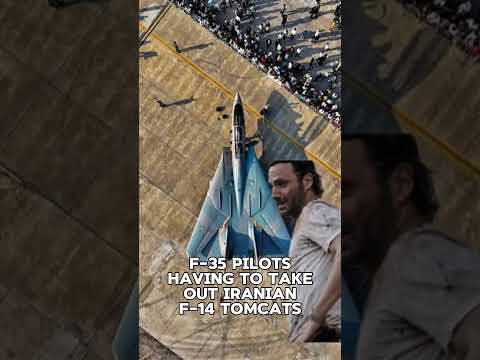
The F-35, a marvel of modern technology, felt like a betrayer. Its stealth and precision were unmatched, but in this moment, it was a weapon aimed at the heart of aviation history. The pilot’s hands trembled on the controls. How could they do this? The F-14 was more than just a plane; it was a legend. And legends, they thought, should never be shot down.
But the mission was clear. The F-14, now in enemy hands, posed a threat. The pilot had trained for years to follow orders without question, to suppress emotion and execute. Yet, as they lined up the shot, something inside them cracked.
“This is Viper One-One, requesting confirmation,” they said, voice steady despite the storm inside. The response was immediate: “Confirmed. Take the shot.” There was no room for sentiment in war. The pilot took a deep breath, their finger hovering over the trigger. The F-14 loomed in the targeting display, its silhouette unmistakable.
In that split second, they saw not an enemy, but a ghost—a reminder of the pilot they once dreamed of becoming. The F-14 had inspired them to join the Air Force, to push beyond limits, to soar. And now, they were about to extinguish that inspiration forever.
“I’m sorry,” they murmured, and pressed the trigger.
The missile left the rail with a hiss that seemed to suck the air from the cockpit. Viper One-One watched it streak downward, a thin white thread stitching the sky to the ground. For three seconds, nobody breathed—not the pilot, not the controller, not the F-14 crew below.
Then the Tomcat did something no one expected. It banked hard, wings sweeping forward as it rolled into a dive so steep the targeting computer flashed red with lost lock. “What the—” the pilot started, but the words died in their throat. The F-14 wasn’t running. It was charging, nose pointed straight at the incoming missile like a bull accepting the matador’s blade.
The controller’s voice crackled, sharp now: “Viper, the target’s gone defensive—do you have a second solution?” But there was no second solution. The missile was already past the point of no return, and so, it seemed, was the Tomcat.
Then the impossible happened. The F-14’s canopy flashed—not with fire, but with light. A mirror signal, old as aviation itself. Two flashes. Then three. Then a pattern the pilot recognized from a training manual written before they were born: I am friend. Do not fire.
“Abort!” Viper One-One shouted, thumb slamming the self-destruct command. The missile detonated a thousand feet short, a harmless bloom of smoke that the Tomcat flew straight through, emerging on the other side like a ghost refusing to die.
The controller was furious. “What the hell are you doing up there? That bird’s been flagged hostile for a week!” But the pilot wasn’t listening. They were staring at the F-14, which had leveled out and was now rocking its wings—the universal signal for follow me.
“Viper One-One to base,” the pilot said, voice impossibly calm. “I’m going to need you to pull the threat file on that Tomcat. All of it. Because either I just committed treason, or somebody down there is flying a museum piece with a message.”
There was a long pause. Then, quietly: “Stand by, Viper. We’re checking.”
The F-14 climbed, lazy and confident, turning north toward the mountains. The pilot eased the stick forward and followed, heart hammering against their ribs. Whatever waited in those hills, it had just survived a missile and asked for an escort. And against every instinct, every order, every ounce of training—they were giving it one.
The radio stayed silent for what felt like an eternity. Viper One-One kept their eyes glued to the Tomcat ahead, its twin exhausts glowing faintly against the darkening sky. Every instinct screamed to break off, to climb, to put distance between themselves and whatever this was. Instead, they eased the throttle forward and held formation.
Then the controller came back, and their voice had changed. It wasn’t angry anymore. It was careful—the way people talk when they’re reading something they don’t quite believe. “Viper, the threat file on that Tomcat was flagged by a clerk who’s been dead for six years. The signatures are forged. That bird’s not hostile.”
A pause. “It’s listed as missing in action. Forty-two years ago. Pilot: Commander Elias Vance.”
The name hit like turbulence. Vance. The Vance. The man who’d flown the last Tomcat out of a collapsing airbase, who’d been declared lost when his wingman never made it home. Every pilot in the squadron had heard the story—the legend they told cadets to teach them about loyalty.
“Base, that’s impossible,” Viper said. “Vance would be—” They did the math and stopped. “He’d be in his seventies.”
“We know,” the controller replied. “Which is why we’re not calling this a rescue. We’re calling it a rendezvous. He’s requesting you land at the old strip in the valley. He says he’s been waiting for someone who wouldn’t take the shot.“
The F-14 dipped its wings again, dipping toward a narrow pass between two ridges. Viper followed, the F-35’s sensors painting nothing but rock and snow—no airfield, no runway, nothing but a ghost on their radar that kept flickering in and out like a heartbeat.
“He’s leading me into a box canyon,” Viper muttered. “This is how they trap you in the sims.”
“Then it’s a good thing you’re not in a sim,” the controller said. “Viper—whatever he wants to tell you, hear him out. Command’s already asking questions we can’t answer. We need to know why a dead man is flying a plane that shouldn’t exist.“
The canyon opened. And there, carved into the valley floor like a scar, was a runway—cracked, overgrown, but unmistakable. The Tomcat’s gear dropped, and it settled onto the strip with the grace of something that had done it a thousand times before.
Viper One-One touched down behind it, brakes squealing, dust billowing. When the canopy hissed open, the air smelled of pine and hot metal. And there, climbing down from the F-14 with the slow, deliberate care of a man who’d earned every one of his years, was Commander Elias Vance.
He looked up at the F-35 and smiled—a tired, knowing smile. “You took your time,” he called across the tarmac. “I’ve been sending that signal for forty-two years.”
Viper One-One dropped to the tarmac, legs unsteady. “Sir, they told me you were dead.” Vance chuckled, patting the Tomcat’s fuselage. “Reports of my death were… exaggerated. But the plane—she’s real enough.” He gestured toward the mountains. “I’ve been hiding her, waiting for someone who’d listen.”
“Why now?” Viper asked. “Why not come home?” Vance’s smile faded. “Because the threat file wasn’t the only thing forged. Someone wanted me gone—and they’re still in the system.” He pulled a worn logbook from his flight suit. “Names. Dates. Proof.”
Viper took it, hands trembling. “What do you want me to do?” “Finish the mission I started,” Vance said. “Not the one they gave you. The real one.” He pointed at the F-35. “You’ve got the tech. I’ve got the truth. Together, we can clear my name and expose the ones who buried it.”
“And if I say no?” Viper asked. Vance shrugged. “Then you fly home, tell them you lost me. But you’ll always wonder.” He turned toward the old hangar. “I’ve got coffee. It’s terrible. But it’s hot.”
Viper looked at the F-35, then at the F-14, then at the logbook. “One cup,” they said. “Then we talk.” Vance nodded, and together they walked into the shadows—two pilots, two eras, one last chance to set things right.
What would you have done in Viper’s shoes—followed orders or followed the ghost?
Report this article
Select a reason for reporting:






