The rain didn’t just fall—it judged. In the sweltering heat of Vietnam, 1969, a group of American soldiers watched in disbelief as Australian SAS troops calmly sliced open their own boots. To the Americans, it was madness. To the Australians, it was survival. What happened next would rewrite everything they thought they knew about war.
Lieutenant Clark had always believed in the power of procedure. His men were spotless, their gear immaculate, their boots polished to a mirror shine. But as the first drops of rain hit the red clay, that confidence began to dissolve. The jungle didn’t care about regulations. It only remembered the ones who bled.
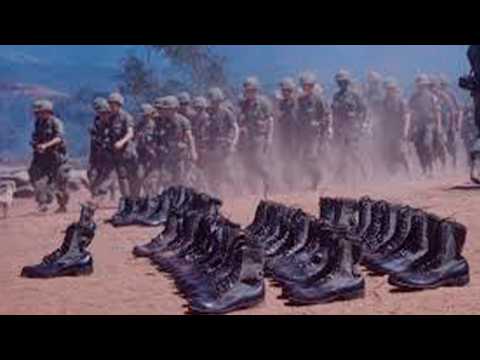
The Australians moved like ghosts, their torn boots flapping silently, water draining with every step. The Americans, weighed down by waterlogged leather, stumbled and cursed. “Better a blade through leather than rot through skin,” one Australian muttered, not bothering to explain. It was a philosophy written in scars, not manuals.
As the storm intensified, the jungle became a living enemy. Boots filled with water, feet blistered, and pride crumbled. “We’re not fighting the rain,” Clark realized. “We’re fighting ourselves.” The Australians didn’t fight the jungle—they listened to it. And in that moment, Clark understood the brutal truth: survival wasn’t about control. It was about adaptation.
That night, under the dim glow of a dying flare, Clark’s men did the unthinkable. One by one, they sliced their own boots open, just as the Australians had. The sound of tearing leather was a quiet rebellion, a surrender to necessity. Every cut was a confession, every torn thread a prayer. And as the rain resumed its relentless drumming, Clark finally understood: the jungle wasn’t an enemy to conquer. It was a teacher, and the lesson had only just begun.
Dawn broke pale and uncertain, the kind of light that seemed to apologize for arriving at all. Clark stood at the edge of the clearing, watching his men sleep in the mud-caked hollows they had carved for themselves. Their boots lay beside them like shed skins—torn, ruined, and utterly indispensable. No one had given the order. No one needed to.
He crouched and pressed two fingers to the earth, feeling the soft give of it, the way it held water like a sponge. For years he had been taught to read maps. Now he was learning to read ground. The realization settled in his chest with a weight that was almost peaceful.
One of the Australians appeared beside him without a sound, squatting on his heels, chewing something that might have been biscuit or might have been bark. He followed Clark’s gaze across the sleeping men and grunted.
“They’ll do,” he said, and it was the closest thing to a medal anyone had offered all week.
Clark almost laughed. “Three days ago they couldn’t walk ten meters without falling.”
The Australian spat into the mud and wiped his mouth with the back of his wrist. “Three days ago they were still fighting the wrong war.” He stood, stretched until his spine cracked, and nodded toward the tree line. “Jungle’s got more to say. Best we hear it before the radio does.”
They moved out an hour later, but the formation had changed. No longer two columns pretending to be one—now a single organism, fluid and quiet. The Americans had stopped checking their straps every hundred meters. They had stopped glancing at their compasses as if the needles might betray them. Instead, they watched the Australians, and the Australians, without ever seeming to notice, watched the trees.
It was in the third hour that the jungle offered its next lesson.
A young private—Hollis, barely nineteen, with a face that still held the softness of a schoolyard—stopped dead on the trail and pointed. “Sir. There’s no sound.”
Clark froze. The private was right. The cicadas had gone silent. The birds had vanished. Even the drip of water from the canopy seemed to have paused, as though the forest itself were holding its breath.
The Australian scout at the head of the column raised one hand, fingers spread. Every man dropped without a word, rifles coming up, eyes scanning the green wall ahead. Clark’s heart hammered against his ribs, and for the first time in days, he felt the old fear—the clean, sharp fear of an enemy that could shoot back.
Then the scout’s hand closed into a fist, and he turned his head just enough to catch Clark’s eye. “Not men,” he breathed. “Tiger. Maybe two hundred meters. Moving parallel.”
The words traveled down the line in whispers, and Clark watched something remarkable happen. His men—his polished, manual-trained, checklist soldiers—did not panic. They did not ask for orders. They simply held their ground, breathing slow and shallow, becoming part of the silence the tiger was reading.
Minutes passed like hours. Then, somewhere deep in the green, a branch snapped, and the cicadas erupted back into song.
The scout rose first, brushing mud from his knees. “Gone,” he said. “Didn’t like what it smelled.”
Hollis let out a breath that was almost a sob. “What did it smell?”
The Australian looked at him for a long moment, then at Clark, and the corner of his mouth twitched. “Something that learned to listen.”
They moved on, and the jungle swallowed the lesson whole, already preparing the next one.
The tiger’s passing left a strange gift in its wake: a new kind of quiet. Not the silence of fear, but of attention. Every man walked differently now, feet placed with care, eyes lifted from the mud to the green cathedral above.
By midday, the trail opened onto a shallow ravine where a stream ran brown and quick over stones. The Australians stopped without signal, and within moments the whole column had dissolved into the shadows, drinking, refilling, watching the water for what it might carry.
Clark knelt beside the scout who had spoken at dawn, the one with the ancient rifle and the rough-cut stock. Up close, the man’s face was a map of its own—sun-cracked, patient, with eyes that seemed to look through rather than at things.
“You’ve done this before,” Clark said. It wasn’t a question.
The scout drank, wiped his mouth, and considered the stream. “Everyone’s done it before,” he said. “Most just don’t survive to remember.”
He reached into his webbing and pulled out a small tin, dented and blackened, and offered it. Clark opened it. Inside, wrapped in oiled cloth, were strips of dried meat and a handful of pale roots, cut thin and dark at the edges.
“What is it?”
“Lunch.” The Australian smiled for the first time—a quick, crooked thing that vanished almost before it formed. “Root’s bitter. Chew it slow. Keeps the cramps off when the water’s bad.”
Clark chewed. It was bitter, and it was good, and he realized with a small pang that he had learned more about survival in this one exchange than in four years of officer training.
That evening, as the light went gold and then grey, the scout sat beside him and drew something in the dirt with a stick. A curve, a fork, a series of small circles.
“Tomorrow the ground changes,” he said. “Limestone. Water goes down instead of across. Boots stay dry but the rock cuts. You’ll want to wrap your feet—cloth, not tape. Tape holds the wet.”
Clark studied the crude map. “How do you know what’s ahead? You’ve never been here.”
The scout tapped the stick against the circles. “The trees know. Look at what grows. Look at what doesn’t. The ground tells you where it’s going before your feet ever get there.”
He stood, stretched, and melted back into the dark without another word. Clark sat with the map in the dirt until the rain began again, soft and steady, and the marks dissolved into mud.
But he didn’t need them anymore. He had already memorized the shape.
In the morning, the Americans wrapped their feet in strips of torn shirt, and when the limestone came—white and jagged and cruel under the thin soil—they crossed it without a single cut.
The limestone gave way to a valley choked with elephant grass, taller than a man and sharp as a bayonet. The Australians moved through it without a whisper, parting the blades with their rifle barrels, reading the bent stalks like a page. Clark followed, and behind him his men followed him, and the whole column slid through the green like a single held breath.
It was Hollis who found the wire. Not with his eyes—with his boot, the torn leather catching on something that sang a thin metallic note. He froze, one leg lifted like a heron, and whispered the word every soldier feared.
“Mine.”
The column stopped. The scout was beside him in three seconds, crouched low, eyes tracing the grass. He held up two fingers, then pointed—left, right, ahead. A tripwire, strung low and rusty, running between two stakes. Old. Careless. But still lethal.
“Back the way you came,” the scout breathed. “Slow. Same steps. The ground remembers.”
Hollis reversed, inch by inch, sweat running into his eyes, until the wire no longer hummed against his boot. Then the scout drew his knife and cut the tripwire with a single clean stroke, and the whole column exhaled together.
Clark found his hands were shaking. “You knew where it was.”
The scout shrugged. “Grass was bent wrong. Something had walked here before us and stopped.” He sheathed the knife. “The jungle keeps a record. You just have to learn to read it.”
They moved on, and Clark noticed that his men now watched the grass the way they had once watched their compasses—not trusting, but reading. The lesson had sunk deeper than any order could have driven it.
That night, camped in a dry hollow beneath a shelf of rock, the two units sat together for the first time. No rank, no nation—just men passing a canteen and a tin of the bitter roots. Someone told a joke, and someone else laughed, and the sound was strange and good in the dark.
Clark sat apart, writing in his notebook by the last of the light. Not a report. Something else. A list, he realized, of everything the jungle had taught him that no manual ever would. He read it back and found it was short enough to fit on a matchbook.
Listen before you move. Read the ground. Cut what traps you. Trust the ones who bleed beside you.
He closed the notebook and looked at the men around the fire—American and Australian, indistinguishable in the flickering dark—and understood that the war would end someday, but this would not. This would go home with them, buried in their bones, passed down without words to whoever came after.
At dawn the scout shook him awake with a hand on his shoulder. “Time,” he said. “Base is a day out. You’ll want to walk in first.”
Clark sat up. “Why?”
The scout smiled that quick crooked smile. “Because the ones who laugh loudest have the most to learn. Let them see your boots before they see your medals.”
They walked out of the jungle as they had walked into it—but not the same men. The base gate rose from the mist, clean and bright and impossibly loud. Officers with clipboards stared. Fresh recruits in polished boots gawked. And Clark walked past all of it, his torn boots flapping softly against the concrete, and said nothing at all.
Behind him, his men did the same. Not one of them looked back at the jungle. They didn’t need to. It was already inside them.
And somewhere in the green, the rain began again—patient, indifferent, eternal—already teaching the next lesson to whoever was foolish enough to listen.
What would you have done, standing at that gate in torn boots while the polished world laughed—would you have explained, or simply walked on?
Report this article
Select a reason for reporting:






