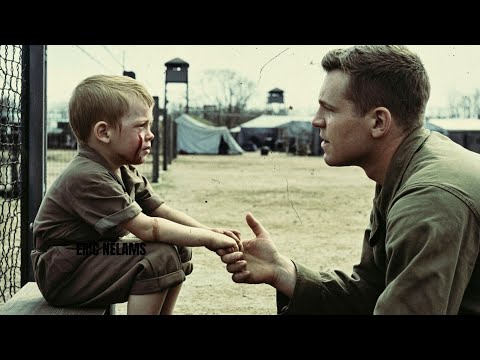
December 1944. The snow fell like ash over the broken streets of Hamburg, blanketing piles of brick and twisted metal where homes once stood. Inside a damaged school basement, 15-year-old Hans Mueller sat with forty other boys, their brown uniforms and red armbands a stark contrast to the fear in their eyes. The Hitler Youth leader paced before them, his voice echoing off the concrete walls: “The Americans are animals who eat their own dead. When they capture German soldiers, they cut off their fingers one by one. They laugh while German boys scream for their mothers.” Hans felt his stomach twist. He looked at the faces around him—some boys were only thirteen, others with thin mustaches trying to grow. All of them looked scared.
Hans thought of his mother, working sixteen hours a day in a factory making bullets, giving him half her bread ration even as she grew thinner each week. He had not seen her smile in months. The leader’s voice droned on: “You will die fighting before you let an American touch you.” The boys nodded, but their hands shook.
Three hundred miles south, in the rolling hills of Bavaria, sixteen-year-old Klaus Hoffman helped his grandfather load turnips into a wooden cart. The farm that had fed their family for five generations now produced barely enough to keep them alive. “The Americans will be here soon,” his grandfather said, coughing into a dirty cloth. “They will burn our fields and steal what little we have left. That is what Americans do. They take everything and give nothing back.” Klaus had heard these stories his whole life—teachers showed pictures of American soldiers with devil horns, said they lived like savages and killed prisoners for sport. But Klaus wondered: if Americans were so stupid and weak, why were they winning the war?
Near Berlin, fourteen-year-old Dier Schulz crouched behind sandbags on a bridge over the Oder River. His rifle was almost as tall as he was. His hands were so cold he could barely feel the trigger. The older boys talked of fighting to the last bullet, of never surrendering. “Better to die than be captured by monsters who drink German blood from cups made of German skulls.” Dier did not want to die. He wanted to go home to his mother and little sister—but home was a pile of rubble now, hit by an American bomb two weeks ago. His mother and sister were buried somewhere under the stones.
All across Germany, the same scenes played out. Boys who should have been playing soccer learned to load artillery shells and throw grenades. They slept in cold bunkers and ate soup made from potato peels. They were told that dying for Germany was the greatest honor a boy could have. The propaganda machine worked day and night—radio broadcasts told of American soldiers eating German children, newspapers printed pictures of American tanks crushing German churches, movie theaters showed films of Americans dancing while German cities burned.
But the truth was different. In America, teenage boys their same age were also far from home, also scared, also missing their families. They carried pictures of girlfriends and wrote letters to mothers. They shared candy bars and complained about army food. They played cards and told jokes to forget how frightened they were. The German boys knew none of this. They only knew what they had been taught: that Americans were devils in human skin.
On December 15th, 1944, Hans heard the air raid sirens begin their terrible wail. He ran to his gun position on the roof of a tall building. The sky was full of silver planes, more than he had ever seen. The sound of their engines was like thunder that never stopped. His hands shook as he loaded the shells. The gun was bigger than him, and the noise when it fired made his ears ring. Around him, other boys fired at the endless stream of American bombers.
Then Hans saw something that made his blood freeze. Three American fighter planes were diving straight toward his building. Their guns flashed like angry stars. Bullets hit the concrete around him, sending chips of stone flying. One of the other boys screamed and fell. Hans saw blood spreading across his brown uniform. He wanted to run, but his legs would not move. The American planes roared overhead so low he could see the pilots’ faces in their cockpits. For just a moment, one pilot looked right at him. Hans expected to see the face of a monster. Instead, he saw a young man, maybe only a few years older than himself. The pilot’s eyes were not filled with hate. They looked almost sad. Then the moment passed. The planes were gone. Hans knelt beside his wounded friend, not knowing that in three days, everything he believed about Americans would change forever.
Three days later, Hans woke up in a place that could not be real. The ceiling above him was white and clean. The bed he lay in had soft sheets that smelled like soap. Warm air came from metal boxes on the walls. Through a window, he could see green grass and trees with all their leaves. This had to be a dream. Or maybe he was dead. A man in a white coat walked over to his bed. The man had kind eyes behind wire glasses. He spoke German with a strange accent. “Good morning, Hans. I am Dr. Williams. You are in an American field hospital. You were hurt when your building was hit. Do you remember?” Hans tried to speak, but his throat felt like sand. The doctor held a glass of water to his lips. The water was cold and clean. Better than any water Hans had tasted in months.
“Where are the others?” Hans whispered. “Your friends are safe. Klaus is in the bed next to you. Dier is down the hall. All three of you are going to be fine.” Hans turned his head and saw Klaus lying in the next bed, staring at the ceiling with wide eyes. Klaus looked as confused as Hans felt. A woman in a white dress came over with a metal tray. She had yellow hair and a warm smile. She spoke English to the doctor, then looked at Hans. “Breakfast,” she said in broken German. Hans looked at the tray and could not believe what he saw. There were two pieces of bread with butter. Real butter, not the gray paste they ate in Germany. There was a bowl of soup that smelled like chicken. There was an orange, round and bright as the sun. Hans had not seen an orange in two years.
“This is too much,” Hans said. “I cannot eat all this.” The nurse laughed and said something in English. The doctor smiled. “She says you are too thin. She wants you to eat everything. In America, we believe sick people need good food to get better.” Hans took a small bite of the bread. The butter melted on his tongue. It tasted like happiness felt. He wanted to eat it slowly to make it last. But he was so hungry that he finished both pieces in minutes.
Klaus sat up in his bed and pointed out the window. “Hans, look.” Outside, a green truck was backing up to the hospital. American soldiers were unloading wooden boxes. One soldier dropped a box and white packages fell out all over the ground. The soldier picked them up, brushed them off, and threw three of them in a trash can. “They threw away food,” Klaus whispered. “Good food.” Hans watched two more soldiers walk by eating from small bags. They finished eating and threw the bags away. In Germany, people would fight over those empty bags, hoping to find crumbs inside.
Later that day, an American soldier came to visit them. He was young, maybe twenty years old. He had red hair and freckles like the boy who used to sit behind Hans in school. The soldier carried a brown bag. “Hello,” the soldier said in careful German. “My name is Jimmy. I brought you something.” He reached into the bag and pulled out three small bottles. They were dark brown and had red writing Hans could not read. Jimmy twisted the cap off one bottle and handed it to Hans. Hans sniffed it. It smelled sweet and strange. He looked at Jimmy, not sure what to do. Jimmy pretended to drink from his own bottle and made a happy face. “Coca-Cola,” he said. “American drink. Very good.” Hans took a tiny sip. Bubbles danced on his tongue. The taste was like nothing he had ever experienced. It was sweet and sharp at the same time. It made his nose tingle. Klaus laughed out loud when he tasted his. It was the first time Hans had heard his friend laugh in months.
Jimmy sat down in a chair between their beds. He pulled a small book from his pocket and showed them pictures. There was a woman with dark hair holding a baby. There was a big house with white walls and a green yard. There were cows in a field that looked just like the cows on Klaus’s farm before the war. “My wife,” Jimmy said, pointing to the woman, “my baby son. My farm in Iowa.” Hans stared at the pictures. This American soldier had a family just like they did. He lived on a farm just like Klaus. The baby in the picture looked exactly like Hans’s little cousin. Jimmy pulled out another picture. It showed a boy about Hans’s age wearing a blue uniform and holding a baseball bat. The boy had Jimmy’s same red hair and freckles. “My brother,” Jimmy said, “sixteen years old like you.” Hans felt something crack inside his chest. This American soldier’s brother was the same age as Hans. Maybe he played games and worried about school tests and missed his family when he was away. Maybe he was not so different from Hans after all.
Over the next few days, more impossible things happened. An American cook brought them extra food when they said they were still hungry. A chaplain sat with Dier when the young boy cried for his mother. A doctor spent an hour cleaning Klaus’s infected foot, even though Klaus was the enemy. Every day, trucks arrived with more supplies than Hans thought existed in the whole world. Trucks full of bandages and medicine. Trucks full of food in metal cans, trucks full of blankets and clothes. The Americans threw away more in one day than Hans’s family had owned in a year. But the strangest thing was how the American soldiers acted. They laughed and told jokes. They played music on small radios. They showed pictures of their girlfriends and talked about home. They did not seem like monsters at all. They seemed like boys, just like Hans and his friends.
On their fifth day in the hospital, Hans asked Dr. Williams a question that had been burning inside him. “Why are you being kind to us? We are your enemies.” Dr. Williams was quiet for a long moment. Then he said, “You are not my enemies. You are children who got caught in a war made by old men. In America, we believe that children deserve to be protected, no matter which side they come from.” Hans lay awake that night, staring at the clean white ceiling. Everything he had been taught was wrong. The Americans were not monsters. They were people just like Germans. Maybe better than Germans because they were kind to their enemies. For the first time since the war began, Hans wondered if Germany was fighting on the wrong side.
The next morning brought even more surprises. A group of American soldiers came into the hospital carrying strange wooden sticks and a white ball. They set up chairs in the main room and started hitting the ball back and forth. The sound echoed through the halls like gunshots, but the soldiers were laughing. “Baseball,” Jimmy explained when he saw the boys watching. “American game. Want to try?” Dier had been moved to their room the day before. He was the youngest and still jumped at loud noises. But when Jimmy held out the wooden stick, something changed in the boy’s eyes. He took the stick with both hands. It was heavy and smooth. Jimmy threw the ball gently toward Dier. The boy swung and missed. The American soldiers clapped anyway. They cheered like Dier had done something wonderful. Jimmy threw the ball again. This time, Dier hit it. The ball rolled across the floor, and all the Americans whooped and hollered. Hans watched Dier’s face light up. For a moment, the fourteen-year-old boy looked like a child again instead of a soldier. Klaus whispered to Hans. “They are playing with us, with their enemies. Why would they do that?” Hans had no answer. In Germany, adults did not play games with children. Adults gave orders. Children obeyed. Fun was something that happened before the war in a world Hans barely remembered.
That afternoon, a different kind of truck arrived. This one was painted white and had a picture of a smiling man on the side. Music played from speakers on top of the truck. American soldiers came running from all directions, holding coins and laughing like little boys. “Ice cream truck,” Jimmy said, grinning. He helped Hans walk to the window to see better. The truck driver opened a window in the side of his vehicle. Inside, Hans could see dozens of wrapped treats in bright colors. Steam came out like fog. American soldiers lined up talking and joking with each other. Jimmy came back a few minutes later carrying three wrapped bars on sticks. “Ice cream,” he said. “Cold candy. Very popular in America.” Hans unwrapped his bar carefully. It was covered in chocolate, but when he bit into it, the inside was cold and sweet and creamy. It melted on his tongue and made his teeth ache in a good way. He had never tasted anything so wonderful. “Every day?” Klaus asked, pointing to the truck. “Every day,” Jimmy nodded. “Sometimes twice a day.” Hans tried to imagine having so much food that you could eat cold candy twice a day. In Germany, ice was something you found in puddles in winter. Candy was something rich children ate before the war. The boys ate their ice cream slowly, making each bite last as long as possible. Around them, American soldiers bought three or four bars each, eating them quickly and throwing the sticks on the ground without thinking. “They waste so much,” Dier whispered in German. “Maybe they have so much they do not need to save it,” Klaus replied.
That evening, Jimmy brought more visitors. Three American soldiers about his age sat around the boys’ beds. One had dark skin, which Hans had never seen before, except in propaganda pictures that showed dark-skinned people as evil. But this soldier smiled warmly and shared photographs of his family back in Chicago. Another soldier was short and had the same black hair as Hans’s uncle. He spoke a few words of German and made everyone laugh when he tried to say “good evening” but said “good horse” instead. The third soldier was quiet and serious. He pulled out a harmonica and played soft songs that sounded like lullabies. The music made Hans think of his mother singing to him when he was small. “We are all far from home,” the serious soldier said in careful German. “We all miss our families. War makes us the same.”
As the days passed, Hans began to see patterns. American soldiers shared everything. If one man got a package from home, he opened it and passed around the cookies or candy inside. If someone was sad, others sat with him and told jokes until he smiled. They also worked together in ways Hans had never seen. German soldiers followed orders without question. American soldiers seemed to discuss everything. They argued about the best way to do jobs, but they did not get angry. They listened to each other’s ideas. One morning, Hans watched a group of Americans fixing a broken truck. When they could not figure out the problem, they called over other soldiers to help. Soon ten men were working together, each one contributing something different. In Germany, one man would be in charge and the others would just follow orders. “They treat each other like brothers,” Klaus observed. “Like family,” Hans agreed.
The medical care continued to amaze them. German doctors had done their best, but they had no supplies. They reused bandages and gave the same needle to different patients. American doctors threw away bandages after using them once. They had different needles for each person. They had medicines Hans had never heard of. When Dier developed a fever, three doctors examined him. They took his temperature every hour. They brought him cool cloths and extra blankets. They stayed awake all night watching him even though he was just a German prisoner. “Why do they care so much?” Dier asked when his fever broke. “I think,” Hans said slowly, “they see us as people, not as enemies.”
Hans started paying attention to how Americans talked about the war. German officers spoke about glory and victory and dying for the fatherland. American soldiers talked about going home. They showed pictures of their girlfriends and counted days on calendars. They wanted the war to end so they could return to normal life. “We fight to win,” one American sergeant told Hans, “but we do not fight because we hate you. We fight because we want to go home to our families.” Hans thought about this for a long time. He had been taught that dying in battle was the highest honor. Americans seemed to think that living in peace was the highest honor.
Late one night when the hospital was quiet, Hans lay awake thinking about everything he had seen. The abundance of food, the waste that came from having too much. The kindness shown to enemies, the way Americans treated each other like equals, the medical care given freely to anyone who needed it. Everything he had been told about America was backward. They were not savages living in huts. They were not weak or stupid. They were not cruel or heartless. They were rich beyond anything Hans could imagine. They were organized and efficient. They were kind to their enemies and generous with their friends. They had built a society where even the lowest soldier ate better than German officers. Hans realized that Germany had not just lost the war. Germany had been wrong about everything from the very beginning. The Americans were not the enemy of civilization. They might be civilization itself.
December 24th arrived with snow falling softly outside the hospital windows. Hans had been counting the days since his capture. Fifteen days of having his entire world turned upside down. Fifteen days of kindness from people he was taught to hate. Fifteen days of questioning everything he had ever believed. He woke that morning to the sound of singing. Not the hard marching songs of the German army, but something gentle and warm. American voices drifted down the hallway, singing words he did not understand, but melodies that made his heart feel strange. Jimmy appeared in the doorway with his usual smile. But today he looked different. He wore a clean uniform instead of his work clothes, and his red hair was combed neatly to one side. “Merry Christmas,” Jimmy said in German. The words sounded funny in his American accent, but Hans understood. Christmas. Klaus sat up in his bed. “Today is Christmas.” Hans had lost track of the days. In Germany, Christmas had become another workday. The Hitler Youth leader said Christmas was a weak holiday that made soldiers soft. They were supposed to celebrate the winter solstice instead with ceremonies about German strength and purity.
“Come,” Jimmy said. “We have surprise for you.” The boys put on their hospital robes and slippers. Jimmy helped Dier, who still walked slowly because of his injured leg. They followed him down the hall toward the main room of the hospital. Hans stopped in the doorway and stared. The room had been transformed into something from a fairy tale. A pine tree stood in the corner, taller than any man. It was covered with small lights that twinkled like stars. Colored balls hung from every branch. At the top sat a golden angel with wings spread wide. Tables along the walls groaned under the weight of more food than Hans had ever seen in one place. There were whole chickens, golden brown and still steaming. There were bowls of white potatoes with butter melting on top. There were green beans and orange carrots and bread rolls that smelled like heaven. There was a cake as big as a wagon wheel covered in white frosting with red decorations.
But the most amazing thing was the people. American soldiers sat next to German prisoners. They were talking and laughing together like old friends. Some Americans were teaching Germans card games. Others shared photographs from home. At one table, a German officer was showing an American sergeant how to fold paper into the shape of a bird. “How is this possible?” Hans whispered. “Christmas,” Jimmy said simply. “Today we remember that we are all children of God. Today there are no enemies.” Dr. Williams came over to them carrying three wrapped packages. “These are for you,” he said. “From the soldiers in this hospital. They wanted you to have Christmas presents.” Hans took his package with shaking hands. The paper was bright red with green ribbons. He had never owned anything so beautiful just for the wrapping. He opened it carefully, trying not to tear the pretty paper. Inside was a wooden toy soldier painted in bright colors. But this soldier was not holding a gun. He was holding a small American flag in one hand and a German flag in the other. At the bottom, someone had carved words in English and German: “Friends, not enemies.”
Klaus opened his package and found a photograph in a wooden frame. It showed Jimmy’s farm in Iowa with green fields stretching to the horizon. On the back, Jimmy had written, “For Klaus, your new home in America, when the war is over.” Dier’s gift was a small stuffed bear, soft and brown, with a red ribbon around its neck. Attached was a note: “For the youngest and bravest, from your American brothers.” Hans felt tears burning his eyes. These were not the tears of sadness he had cried so many times during the war. These were different tears, warm and clean. He did not understand what they meant.
An American chaplain stood up and began to speak. His voice was gentle, like Hans’s grandfather reading bedtime stories. He spoke in German so everyone could understand. “Tonight we remember a story about a baby born in a stable. His parents were far from home and there was no room for them anywhere, but kind strangers took them in and cared for them. That baby grew up to teach the world that love is stronger than hate, that forgiveness is stronger than revenge. That we must care for our enemies as we care for our friends.” Hans listened and felt something breaking apart inside his chest. All his life he had been taught that Germans were special, that they were better than other people, that they had the right to rule the world because they were stronger and smarter. But sitting in this room surrounded by Americans who treated him like a beloved little brother, Hans realized how wrong that was. These Americans were not weaker than Germans. They were stronger in ways that mattered more than armies and tanks. They were strong enough to be kind to their enemies. They were strong enough to share their food with people who had tried to kill them. They were strong enough to give Christmas presents to boys who had been shooting at their airplanes just weeks before.
A young American soldier sat down next to Hans. He looked about eighteen years old with blonde hair and blue eyes that could have been German. “My name is Robert,” the soldier said in perfect German. “I learned your language in school. I always wanted to visit Germany before the war.” “Why?” Hans asked. “Because my grandmother came from Germany,” Robert said. “She told me stories about beautiful castles and forests and music. She said German people were good people who loved their families and worked hard and cared about their neighbors.” Hans stared at this American boy who looked like he could be Hans’s own brother. “Your grandmother was German?” “Yes. She came to America when she was sixteen, about your age. She married my grandfather and raised five children. She always said that America was wonderful because it was made up of people from everywhere. Germans and Irish and Italians and people from Africa and Asia, all living together and helping each other.” Hans thought about the dark-skinned soldier who had shown him family pictures. He thought about the short soldier with black hair who spoke broken German. He thought about Jimmy from Iowa and Robert whose grandmother was German. “America is not one people,” Hans said slowly, understanding something new. “No,” Robert smiled. “America is all people. That is what makes us strong. We do not fight because we hate you. We fight because we believe everyone deserves to live free and safe and happy. Even Germans. Especially German children like you.”
Later that evening, when the celebration was winding down, Hans found himself alone with Dr. Williams. The doctor was writing in a notebook, recording the day’s events. “Doctor,” Hans said quietly, “may I ask you something?” “Of course.” “Everything I was taught about Americans was wrong. You are not savage or weak or stupid. You are the opposite of everything they told us. Why did our leaders lie to us?” Dr. Williams set down his pen and looked at Hans for a long time. “Because the truth would have made it impossible for them to start this war. If German people knew that Americans were just ordinary people who loved their families and wanted peace, they never would have agreed to fight us. So your leaders had to make you hate us first. They had to make you afraid of us. They had to convince you that we were monsters who wanted to destroy everything good in the world.” “But we are the ones who started the war,” Hans said, the words coming out like a confession. “We are the ones who invaded other countries. We are the ones who built camps to hurt people. We are the monsters.” Dr. Williams reached over and put his hand on Hans’s shoulder. “You are not a monster, Hans. You are a fifteen-year-old boy who was lied to by evil men. You had no choice in what you were taught, but now you have a choice in what you believe.”
That night, Hans lay in his clean bed, staring at the toy soldier on his bedside table. The little wooden figure held both flags, German and American, like they belonged together, like the people of both countries belonged together. Hans understood now that the war was not about making Germany great. It was about making a few German men powerful. Those men had used boys like Hans as weapons, filling their heads with lies and sending them to die for nothing. But the Americans had shown him something different. They had shown him what strength really looked like. Real strength was being kind when you could be cruel. Real strength was helping when you could harm. Real strength was seeing enemies as human beings who deserved compassion.
Hans pulled out a piece of paper and began to write, forming the words carefully in the dim light. “My name is Hans Mueller and I am fifteen years old. For my whole life, I believed things that were not true. I believed Americans were evil people who wanted to hurt Germans. I believed Germany was fighting a holy war to save the world. I believed dying for my country was the most important thing I could do with my life. Now I know that the most important thing I can do is live for peace. The Americans have taught me that enemies can become friends. They have taught me that different people can live together and help each other. They have taught me that the world is big enough for everyone to be happy. When I go home to Germany, I will tell everyone what I learned here. I will tell them that Americans are not monsters. I will tell them that war only brings suffering, but kindness brings hope. I will tell them that we were wrong. And it is not too late to choose a better way.”
Hans folded the paper and put it under his pillow. Tomorrow, he would be moved to a prisoner of war camp. Eventually, he would go home to a Germany that no longer existed. But he would carry this lesson with him for the rest of his life. In the darkness, Hans whispered a prayer he had learned that day from the American chaplain. It was not a prayer for victory in war. It was a prayer for peace on earth and goodwill toward all people. For the first time since the war began, Hans felt hope.
The next morning brought a visitor that changed everything once more. Hans was finishing his breakfast when Jimmy appeared with a tall, thin man in a different uniform. This man had gray hair and kind eyes behind wire glasses, but his shoulders carried the weight of someone very important. “Hans,” Jimmy said. “This is Colonel Patterson. He runs this hospital.” Hans tried to sit up straighter, expecting to be scolded or punished. In Germany, when important officers visited, someone was always in trouble. But Colonel Patterson pulled up a chair and sat down like he had all the time in the world. “Hans, I heard about what you wrote last night. Dr. Williams showed me your letter. Would you mind if we talked about it?” Hans nodded, his throat suddenly dry. “You wrote that you want to tell people in Germany about what you learned here. That is a very brave thing to want to do. But I need you to understand something important. When you go home, some people will not want to hear these things. Some people will call you a traitor for saying good things about Americans.” Hans had already thought about this. “I know, sir, but I cannot go back to believing lies.” Colonel Patterson smiled. “That is exactly what I hoped you would say. Hans, how would you feel about helping us with something very important? We are going to start schools in Germany after the war. Schools that teach the truth about what happened. Schools that teach German children about democracy and freedom and how different peoples can live together in peace. We need young Germans who understand these ideas to help us.” Hans felt his heart beating faster. “You would trust me to do that, even though I was your enemy?” “Especially because you were our enemy,” the colonel said. “You know what it feels like to believe the lies. You know what it feels like to hate people you have never met. And now you know what it feels like to learn the truth. That makes you the perfect person to teach other German children.”
Klaus had been listening from his bed. “Sir,” he said quietly, “could I help, too? I want to go back to my farm, but I also want other boys to know what we learned here.” Dier sat up in his bed, his young face serious. “Me, too. I do not want any more children to grow up hating people they do not know.” Colonel Patterson looked at each boy carefully. “This will not be easy work. There will be Germans who call you cowards and traitors. There will be Americans who do not trust you because you were Nazi soldiers. You will be caught between two worlds, belonging fully to neither one.” “But it is the right thing to do,” Hans said. It was not a question. “Yes,” the colonel nodded. “It is the right thing to do.”
That afternoon, the three boys were moved to a different part of the hospital. This section housed German prisoners who were being prepared to go home. But these were not ordinary prisoners. These were men and boys who had asked to learn about democracy and American values. Hans met Heinrich, a twenty-year-old tank driver from Berlin who had been captured in France. Heinrich spoke perfect English and had been working with American teachers to write new textbooks for German schools. “The hardest part,” Heinrich told Hans, “is not learning that Americans are good people. The hardest part is accepting that we Germans did terrible things. Not just fighting a war, but really terrible things to innocent people.” Hans had heard whispers about camps where bad things happened to Jewish people and others the Nazis did not like, but he had never known the details. Heinrich told him stories that made Hans feel sick to his stomach. “I did not know,” Hans whispered. “None of us knew the worst of it,” Heinrich said. “But we all knew something was wrong. We chose not to ask questions. We chose to believe the lies because they made us feel important and special. That is what we have to live with now.”
Over the next week, Hans attended classes taught by American officers and German prisoners who had been there longer. They learned about how democracy worked in America. They learned about the Constitution and the Bill of Rights. They learned about how Americans chose their leaders and how those leaders could be removed if they did bad things. But most importantly, they learned about taking responsibility for their actions. “In a democracy,” explained Captain Morrison, an American teacher from Ohio, “every citizen has the power to choose what their country does. But that also means every citizen has the responsibility for what their country does. You cannot just follow orders and say it was not your fault.” Hans thought about this idea for days. In Germany, he had been taught that his job was to obey without question. Thinking for yourself was dangerous. Asking questions was treason. “But how do you know if your leaders are telling the truth?” Klaus asked during one class. “You ask questions,” Captain Morrison said. “You read different newspapers. You talk to different people. You travel to other countries and see how they live. Most importantly, you remember that any leader who tells you to hate people you have never met is probably lying to you.”
The boys also learned practical skills. They learned to read and write English. They learned about American farming methods that Klaus could take back to his family’s land. They learned about American medicine and engineering. But the most important lessons came from simply living alongside Americans every day. Hans watched how American soldiers treated each other. When someone made a mistake, they helped him fix it instead of punishing him. When someone was sad or scared, others sat with him and listened. When there was work to do, everyone pitched in together. “They are not perfect,” Hans wrote in his journal one evening. “I have seen American soldiers get angry and say mean things. I have seen them make mistakes and be selfish sometimes. But when they do these things, other Americans tell them they are wrong. They do not just follow bad examples. They try to make each other better.”
On New Year’s Eve, the hospital held another celebration. This time, German prisoners and American soldiers worked together to prepare the food and decorations. Hans found himself standing next to Jimmy hanging paper streamers from the ceiling. “Jimmy,” Hans said, “when I go home, I will miss you.” Jimmy smiled, but his eyes looked sad. “I will miss you, too, Hans. You have become like a little brother to me.” “Will I ever see you again?” “I hope so. After the war, when things are normal again, maybe you can come visit my farm in Iowa. Maybe I can come see your city in Germany when it is rebuilt.” Hans tried to imagine a world where Germans and Americans visited each other as friends. A world where former enemies worked together to build something better. It seemed impossible, but then again, everything that had happened in the past month had seemed impossible. “Jimmy,” Hans said, “thank you for showing me that enemies can become family.”
That night, as 1945 began, Hans lay in his bed thinking about the year ahead. Soon, he would leave this place that had changed his life forever. He would travel to a prisoner camp, then eventually home to a Germany that would be different from the one he left. But he would not go home empty-handed. He would carry with him a new understanding of what it meant to be human. He would carry the knowledge that differences in language and culture and politics did not have to mean hatred and war. He would carry the memory of Americans who chose kindness over cruelty, forgiveness over revenge. Most importantly, he would carry the responsibility to share what he had learned. Not everyone would want to hear it. Not everyone would believe it. But Hans knew that even if he could change just one mind, just help one German child see Americans as human beings instead of monsters, it would be worth any price he had to pay. The boy who had once been willing to die for Hitler’s lies was now ready to live for a much more difficult truth. That peace was harder than war, but infinitely more valuable.
Spring came to the hospital in slow, green waves. One morning Jimmy appeared with a canvas bag and a grin. “Your papers are ready. You go home tomorrow, Hans.” Hans felt joy and grief collide in his chest. Home meant his mother—but also a ruined city full of people who might call him traitor.
That night, Jimmy handed him a folded map of Iowa. On the back he had written an address. “Write to me. When you are old enough, come. My door is always open.” Klaus and Dier exchanged addresses too, promising to meet again when Germany was rebuilt.
Years later, a young man stepped off a ship in New York harbor, clutching a worn wooden soldier with two flags. On a farm in Iowa, an older man with red hair and freckles dropped his pitchfork and ran.
Hans had come to keep his promise. Peace, he had learned, was harder than war—but it began with one hand extended across the ruins.
What would you have done, standing in that hospital doorway on Christmas Eve?
Report this article
Select a reason for reporting:






