The rain lashed against the windows of Harrison’s Auction House as Dr. Amelia Grant sifted through a collection of Civil War-era photographs. She had seen thousands like them—stiff portraits of wealthy families, frozen in silver and glass. But then her fingers stopped on one image. Three young Black women in silk gowns, their posture impeccable, their expressions calm. Yet something about the way they held their hands made Amelia’s breath catch. Each sister’s fingers were positioned in a distinct, deliberate pattern. This was no ordinary portrait.
Amelia turned the photograph over. Faded handwriting read: “The Kingsley sisters, Charleston, 1863.” In 1863, Charleston was the heart of the Confederacy. Three Black women in such finery—it was almost impossible. Unless the image was never meant to be seen as it appeared.
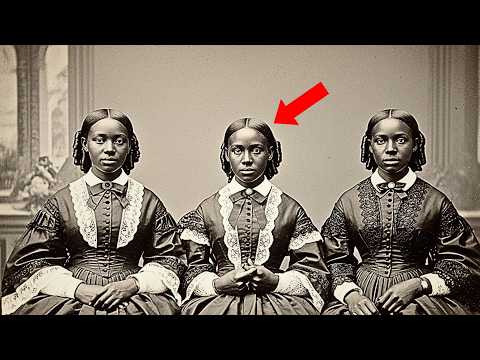
She purchased the entire collection on the spot. Back at Howard University, Amelia pinned the photograph to her research board. “It’s like they didn’t exist,” she muttered after days of searching census records. No Kingsley family appeared anywhere. Her graduate assistant, David, suggested, “Maybe Kingsley wasn’t their real name.” The thought lingered. Why would three Black women need to hide their identity in a photograph?
Under magnification, Amelia found a tiny embossed seal: J.R. Whitmore, Charleston. Whitmore was a white photographer from a prominent Confederate family. But after the war, he had moved north and donated heavily to Freedmen’s schools. “He changed sides,” Amelia whispered. “Or maybe he was never on the side we assumed.”
In Charleston, archivist Dorothy led Amelia to a restricted archive. She retrieved a small leather journal—Whitmore’s diary, donated anonymously in 1952. Amelia opened it carefully. An entry dated March 1863 read: “The three sisters sat for their portrait today. The message is embedded. If our friends in the north understand the code, the next passage will proceed as planned.” Her hands trembled. He was using photographs to send coded messages.
Dorothy nodded slowly. “The Underground Railroad didn’t end when the war began. It transformed. And Whitmore was part of it.” The sisters, Whitmore wrote, were not named Kingsley at all. Their real names were Clara, Ruth, and Viola. They had escaped from a Georgia plantation three years earlier and had been living under assumed identities in Charleston, working as seamstresses. But they weren’t just survivors. They were conductors.
Amelia spent the next week tracing every reference. The hand positions in the photographs weren’t random. They were a language. According to Whitmore’s notes, the sisters had created a visual code based on hand placements, finger positions, and the arrangement of objects in the frame. Each combination conveyed specific information: safe houses, dangerous routes, times of passage, names of allies and enemies. The photographs were distributed through a network of abolitionists disguised as art collectors and traveling merchants. The images passed through checkpoints without suspicion because they looked like nothing more than ordinary portraits.
David asked over a video call, “How many photographs are we talking about?” Amelia checked her notes. “Whitmore’s journal mentions at least forty portraits taken between 1862 and 1865. Most featured the sisters, but some included other members of the network.” She looked at the photograph pinned to her board. According to the journal entry from March 1863, this image confirmed that the Combahee River route was safe for passage. Three months later, Harriet Tubman led the Combahee River Raid, freeing over 750 enslaved people.
“Are you saying the sisters helped plan the raid?” David asked. “I’m saying their photograph might have been part of the intelligence that made it possible.” Amelia’s research led her to Helen, the great-great-granddaughter of the White family who had sheltered the sisters. Helen was reluctant at first, but she eventually shared a worn booklet—her ancestor Elizabeth’s cipher guide. “The dresses in Whitmore’s portraits weren’t just beautiful,” Helen explained. “They were messages. The pattern of lace on a collar, the number of buttons on a sleeve, the arrangement of ribbons—everything meant something.”
Amelia decoded the March 1863 photograph layer by layer. Clara’s hand position indicated a date range: the first week of June. Ruth’s clasped hands with crossed thumbs specified a location: the Combahee River ferry crossing. Viola’s flat palm and curved fingers communicated a number: approximately 700. The dress patterns added detail—Union gunboats would provide cover, local guides had been secured, and the operation’s leader was a woman known by the code Moses. Harriet Tubman.
Amelia sat back, overwhelmed. “They were spies,” she whispered. “The most effective spies of the Civil War—and history forgot them completely.” But the question haunted her: What happened to Clara, Ruth, and Viola after the war? Whitmore’s journal ended in 1865. Elizabeth’s records made no mention of them after Richmond fell. Amelia began searching Freedmen’s Bureau records, and after weeks, she found a reference that made her heart stop. A registration document from Savannah, Georgia, dated November 1865, listed three sisters applying for marriage licenses on the same day: Clara, Ruth, and Viola. All three were formerly of Charleston and worked as teachers.
Teachers. Amelia traced them to a Freedmen’s school in Savannah. Clara had taught reading and writing to adults who had been forbidden to learn during slavery. Ruth had specialized in mathematics and accounting. Viola had taught music—and according to one report, had an extraordinary gift for codes and ciphers, which she employed in teaching children to read. The sisters had continued their work, transforming from spies into educators.
Amelia also found a letter Clara had written in 1867: “We were never named in the histories of the war. We were not generals or politicians. We were seamstresses and photographer’s subjects. But we knew that freedom required more than battles. It required intelligence, patience, and the courage to hide in plain sight. We do not seek recognition. We seek only to ensure that those who come after us will never be invisible again.”
Amelia’s research eventually led her to living descendants. Michael, a retired postal worker in Chicago, was descended from Ruth. Patricia, a school principal in Detroit, was descended from Clara. James, a musician in Atlanta, was descended from Viola. “She taught codes through music,” Amelia explained to James. “Songs that contained hidden messages, rhythms that encoded information. She turned resistance into art.” James was silent for a long time. Then he picked up his guitar and began to play a melody his grandmother had taught him as a child—a melody passed down through generations without explanation. “I always wondered where this song came from,” he said quietly. “Now I know.”
The descendants gathered for the first time in Charleston, near the site where Whitmore’s studio had once stood. They stood in a circle holding copies of the photograph, connected by a history that had nearly been erased. Amelia published her findings, and the Smithsonian’s National Museum of African American History and Culture agreed to create an exhibit: Hidden in Plain Sight: The Secret War of the Seamstress Spies. On opening night, Patricia spoke for the group: “For over 150 years, our grandmothers were invisible. History recorded the generals and the politicians, the battles and the treaties, but it forgot the women who sewed messages into dresses, who posed for photographs that carried secrets, who risked everything to help others find freedom. Tonight, they are invisible no more.”
Amelia returned to Charleston a year later. She stood at the corner where Whitmore’s studio had once been, now marked by a small plaque. She thought about all the other photographs from that era sitting in archives and attics, dismissed as ordinary portraits. How many of them contained messages that had never been decoded? How many other stories were waiting to be discovered? She pulled out her phone and took a photograph of the plaque, the river, the sky. Then she sent it to the descendants with a simple message: “They are remembered. They will not be forgotten again.”
But the story did not end with Amelia’s discovery. Six months after the exhibit opened, a package arrived at her office in Washington. It had no return address, only a postmark from Beaufort, South Carolina. Inside was a second photograph—another portrait of three women, this one dated 1864, and the same embossed seal in the corner: J.R. Whitmore, Charleston.
Amelia’s hands shook as she unwrapped it. These women were older, their dresses plainer, their faces lined with a weariness the first portrait had not shown. But their hands—their hands were unmistakable. The same coded positions, the same silent language. A note was tucked behind the frame, written in a cramped, unfamiliar hand: “You found the first. Now find the rest. They are not all sisters by blood.”
She called David immediately. “There’s a second network,” she said, her voice tight. “Or a second layer of the same one. Whitmore wasn’t working alone, and neither were Clara, Ruth, and Viola.” David was quiet for a moment. “Then the forty portraits in his journal—some of them might still be out there.”
Amelia pulled up her scans of Whitmore’s diary and began reading again, this time with different eyes. She had focused on the sisters because they were the ones in the photograph she had found. But Whitmore had documented other subjects too—a woman identified only as “M.,” a man called “the Deacon,” a girl whose name was never written down at all. Forty portraits. Forty messages. And she had decoded only one.
She flew back to Charleston and tracked down Dorothy at the county library. The archivist listened, then led Amelia to a cabinet she had never opened before. “These came in with Whitmore’s journal back in 1952,” Dorothy said, unlocking it. “The donor left no instructions. We assumed they were family photographs, nothing more.” Inside were eleven more portraits, each with the same embossed seal.
Amelia spread them across the table. Different women, different ages, different settings—a parlor, a garden, a church pew, a porch. But every single one of them held her hands in a deliberate position. Every single one was a message. She recognized a few of the faces from her earlier research: seamstresses who had worked for Elizabeth White, a free woman of color who had run a boarding house near the wharves.
She decoded the first one that night. The hand positions pointed to a safe house in Beaufort, still standing, now a private residence. The dress pattern named a ship—the Planter—and a date in May 1862. Amelia sat back, stunned. The Planter was the Confederate transport ship that Robert Smalls had commandeered to freedom. The sisters’ network had known about it before it happened.
She called Michael, Ruth’s descendant, and told him what she had found. He was silent for a long moment. “So they weren’t just part of one raid,” he said slowly. “They were part of everything.” Amelia looked at the eleven photographs spread before her, each one waiting to be read. “Yes,” she said. “And I think we’ve only just begun to understand how much.”
Amelia spent the next three years decoding the remaining portraits. Each one revealed a thread in a web stretching from Savannah to Richmond, from the Sea Islands to the mountains of Tennessee. The women in those photographs had tracked troop movements, smuggled medicine, and guided fugitives through swamps at night. Some were seamstresses. Some were cooks. One was a laundress who washed Confederate uniforms and memorized every stain and tear that hinted at battle plans.
She published a second book, The Unseen Thread, and this time the descendants were listed as co-authors. Michael wrote the foreword. Patricia designed the cover. James composed a score for the audiobook, weaving in the melody his grandmother had hummed without knowing why. “We’re not just remembering them,” Patricia said at the launch. “We’re finishing their work.”
The final photograph arrived on a cold morning in January. No return address, just a Beaufort postmark and a single line on the back: “Now you know where to look.” Amelia held it to the light. Three women she had never seen, hands folded in a code she now read like a familiar language. She smiled and pinned it to her board.
Some stories, she realized, are never truly finished. They simply wait for the next pair of hands willing to look closely enough. How many other quiet acts of courage are still hiding in plain sight, waiting for someone to finally see them?
Report this article
Select a reason for reporting:






