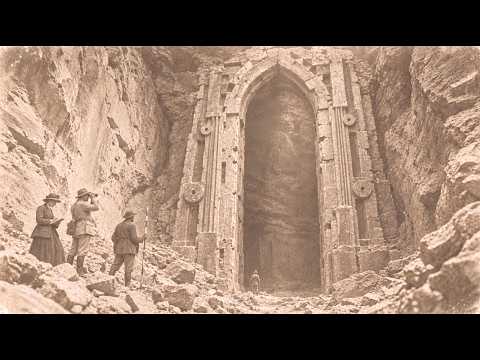
In the autumn of 1900, deep inside a gold mine in northern Georgia, a crew heard a hollow ring behind the rock face. They set a small charge, expecting a cave. Instead, the dust settled on a corridor—walls dressed smooth as a church front, joints finer than a hair. At its end stood a true half-circle archway, sixteen feet high, with a keystone at the crown and round stone discs set into either side. Nobody builds a sixteen-foot doorway for a man.
The surveyor, Nathaniel Pel, lowered himself through the hole with a lantern. His boots touched stone. For a long minute, he said nothing. Then: “Send down another lantern.” The light was coming back off a wall of cut stone—stone that did not belong to that mountain. The sill beneath the arch, a single nine-ton block, was worn into a shallow hollow at its center. Two and a half inches deep. Not by water, Pel wrote. By feet.
Nine years earlier, six hundred miles west in Oklahoma, an eighty-five-year-old Cherokee man named James Wafford had told an ethnologist a story his elders passed down from 1824. At the head of Yahula Creek, above Delonaga, there was a door. Its threshold was worn by the feet of those who came and went. The door had not been made to their measure. The ethnologist, James Mooney, drew a small pencil sketch in his notebook margin—a half circle, with two rings on either side. Then he filed it away and never published it.
For seventy years, the two records sat in separate archives, each unaware the other existed. Pel’s field book, with its inch-perfect measurement—“Arch true half round, keystone inside height 16 ft 0 in”—and Wafford’s spoken testimony, carried through exile and translation. Two men, two worlds, one impossible shape.
The mine itself was born of gold and tears. In 1829, twenty years before California, gold turned up in these Georgia streams. Tens of thousands poured in. The Cherokee, who had lived in these mountains for centuries, were driven out on the Trail of Tears. By 1899, a company with five million dollars in capital had returned to Delonaga, driving tunnels into ridges laced with quartz veins. It was in one of those tunnels—the number four adit, 310 feet from the portal—that the hammer struck wrong.
Pel spent four days measuring. The corridor ran twenty-four feet to the arch, six feet eight inches wide, nine feet high. The arch was eleven feet wide inside, sixteen feet to the underside of the keystone. The joints were so tight his iron rod would not enter. No chisel marks. No mortar. The stone was pale gray, fine-grained—nothing like the dark schist of the mountain. He could not find a single broken piece anywhere.
On the jams, two round discs per side, each three feet across, with a raised boss pierced through the center. Between them, narrow niches seven feet tall, two feet deep. Empty. Their floors smooth as the walls. Beyond the arch, the floor dropped away into darkness. Warm air rose from below—140 feet underground, in October. Pel wrote it down and left it there.
When the superintendent asked if there was gold in it, Pel said no. Within a week, the company sealed the hole with heavy planks and waste rock. No archaeological examination was ever requested. The arch was forgotten—except by the men who had seen it.
Thirty-five years later, in 1935, a mining engineer named Roy Leadford reopened the tunnel. The corridor was exactly as Pel had left it. Not a stone had fallen. Leadford measured everything and matched Pel’s figures inch for inch. He brought a thermometer: the corridor read 56 degrees, the sill 64. Ten degrees warmer than the tunnel, with no fire anywhere.
Then he crossed the threshold. Seven steps of the same pale gray stone led downward, each twenty-two inches high—nearly three times a comfortable stair. The center of every step was hollowed, just like the sill. The top step most of all. Below, a wide floor stretched into darkness, lined with the same round discs. Leadford counted eleven before his lamp gave out. He went no further.
Before he left, he built a concrete wall across the opening and scratched 1935 into the mortar with a nail. His daughter later recalled one sentence he said at supper, for no reason at all: “Those steps weren’t made for going down. They were made for coming up.”
In 1936, a local reporter found the old shift foreman, Wy Chastain, who had been there in 1900. For the first time in thirty-six years, Chastain told the story—Pel’s silence, the warm sill. When asked why he had never spoken, he said, “A man who told a thing like that would never get hired in a mine again.”
The interview ran half a column on an inside page. The headline read: Old Miner Recalls Stone Room. But the mountain kept its secret. And the question that would consume the next generation of seekers was already forming: whose feet wore that threshold down—and which way were they going?
Francis Hail found the interview on microfilm in 1968, and for three years she traced every name in it. She was not an archaeologist—she said so at every opportunity—but her gift was for finding a thing inside the records and testing whether it agreed with another record. In the spring of 1971, she went to Atlanta, to the basement of the Department of Mines, Mining, and Geology, where the folders were being reviewed to decide which to throw away. She found the Lumpkin County Old Workings folder inside a carton. It carried an inventory number that matched no catalog. She photocopied every page and put the folder back.
But it would take her eight more years to find the other half. In 1979, Hail wrote to the National Anthropological Archives at the Smithsonian, asking for every page in Mooney’s notes where the name Yahula appeared. The answer came a year later: a photocopy of one page, filed not with Mooney’s Cherokee Myths but in a folder labeled Western Cherokee, geographic names, miscellaneous, among notes on pronunciation. For ninety years, it had been cataloged as a vocabulary sheet.
On the back, in Mooney’s hand, only a date and three initials: Taloqua, April 1891. JDW. James D. Wafford. Hail laid the photocopy on her desk beside a copy of Pel’s second drawing, dated 1900—a half circle, two rings on either side. The sentence she wrote in the margin of her notes that day can still be read: “The same hand could not have drawn both. The same thing could have made two hands draw it.”
There is a version of this story in which everything settles into comfortable categories. Pel’s field book is lost; the words we have come from a typed copy made by a clerk twenty-four years later. Copies make mistakes. The stone could be marble from Tate, forty miles west—pale gray, fine-grained, faint veins running in a single direction. A wealthy gold rush company might have lined a water passage or a storeroom with it. The heat? Sulfide minerals oxidize when air reaches them, giving off warmth. The wear? Water running the same path for centuries hollows stone too. Pel wrote not water, but Pel was a surveyor, not a geologist.
Wafford’s words do not reach us in his own language; they come through Mooney’s pen in English, sixty-seven years after he heard them in 1824. The stone enclosure could be an ordinary stock pen. Mooney’s margin sketch could be any doodle. Chastain’s account is a memory from thirty-six years after the fact, and memory turns into story with time. Leadford worked for a small partnership that needed investors; a report of something extraordinary could have made money easier to raise.
All of this is reasonable, and any one explanation on its own could be true. But they all have to be true at the same time. A marble-lined water passage built 140 feet underground with no way in from outside. A passage with no way in that somehow needed a sixteen-foot arch, four discs, two empty niches, and steps twenty-two inches high. A copying error that matches Leadford’s independent measurements to the inch. A pronunciation doodle that matches Pel’s drawing ring for ring.
The weak links in this story really are weak: a lost field book, an empty envelope, the memories of two old men. But that is not a weakness in the story. It is the story—because every record vanished just as it was about to become strong. No institution ever closed these questions. None ever opened them either. The files were not suppressed. They were simply never followed up.
Today, the portal of the number four adit cannot be seen. In 1983, Hail wrote to the owner of the ridge—an Atlanta family that had bought the land in 1958 as a hunting tract—asking permission to go into the tunnel. The family’s attorney replied courteously: old mine workings were unsafe, and the family’s insurance did not permit anyone to go underground.
In the autumn of 1988, at seventy-two, Hail went one last time. She did not ask permission. She stopped at the edge of the county road, unfolded Pel’s old map, and took photographs. Those photographs are among her papers: a steep slope above the Yahula, overgrown with laurel and vine, a fan of fallen rock. No portal, no rails, no rusted ore car—nothing but the slope and the sound of the creek below. On the back of one photograph, Hail wrote: “The mountain and the archive keep the same thing the same way—by forgetting.”
But she did one more thing that year. At home, with a ruler, she laid Pel’s compass bearing—22 degrees west of north—across a topographic map. Starting at the tunnel and running through the body of the mountain, the line followed the upper valley of Yahula Creek and reached the head of the creek within half a mile of the spot where Mooney’s elders had placed the stone enclosure. In 1900, Mooney wrote that it was all so long ago now that even the stone house might have been destroyed.
North of Delonaga, Yahula Creek now lies behind a dam. Construction began in 2001 and ended in 2003, and the valley became a lake that holds the town’s drinking water. Part of the path where Yahula sang at night along the creek now lies under the water.
Hail died in 1991. Her unfinished manuscript was never published. Nine boxes today sit in the library of the University of North Georgia, the successor to North Georgia College. Puit’s four typed pages, Pel’s letter and three drawings, Mooney’s single page, and a photocopy of the empty envelope—all in the same box.
On the other side of town, a section of the Consolidated’s old tunnels has been open to visitors since 1991. Every day, people walk past quartz veins by lamplight a hundred feet underground. A few miles away, inside a ridge, behind a concrete wall with 1935 scratched into its mortar by the point of a nail, a corridor and an arch are waiting. And the sill lies where Pel left it, hollowed in the middle.
In the autumn of 1900, when Ant Satfield struck the face with his hammer, the sound came back wrong. There was an empty space behind the stone. One hundred and twenty-five years later, there still is. Pel gave it a measurement—16 ft 0 in. Wafford gave it a name—Yahulai, the place of the man who crossed the threshold and did not come back. Leadford gave it a temperature—64 degrees, with no fire anywhere. None of them gave it an answer.
Doors are not made to be used once. A threshold wears down because it is crossed again and again—going and coming back. If you know these mountains, if you have seen the stone enclosure at the head of the Yahula or heard a story told on these ridges about a threshold, tell it in the comments. Half the record of this story is still in the mouths of living people.
And one question remains: whose feet wore that threshold down two and a half inches—and the last time they crossed it, which way were they going?
Report this article
Select a reason for reporting:






