On the afternoon of April 30th, 1945, deep beneath the shattered garden of the Reich Chancellery in Berlin, a man you’ve heard of pressed a Walther pistol to his temple and squeezed the trigger. A woman beside him, barely his wife for 40 hours, bit down on a glass ampule of cyanide. The Soviet artillery overhead was so close that the walls of the bunker trembled with each shell. Within hours, their bodies would be dragged up a flight of stairs, doused in petrol, and set alight in a shallow bomb crater. The thousand-year Reich had lasted 12 years, 3 months, and 8 days.
But here’s the strange, uncomfortable question that history rarely answers in full: Hitler did not die alone down there. He was surrounded by secretaries, bodyguards, cooks, doctors, pilots, generals, telephone operators, and the children of Joseph Goebbels. More than two dozen people were still inside that bunker when the shot was fired. Some of them lived until 2013. Some of them escaped into the chaos of a dying city and were never seen again. Some of them spent a decade in Soviet labor camps being tortured for information about a corpse. One of them married a British officer and moved to Cambridge. One of them tried to rebuild the Nazi party and nearly got away with it.
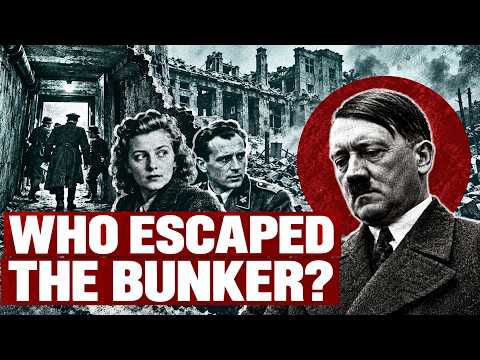
So what actually happened to the people in Hitler’s bunker after their world ended? Who got out? Who got caught? And who spent the rest of their lives insisting that the man who ordered the deaths of millions had been, in their words, a wonderful boss?
To understand what unfolded in the hours and years after Hitler’s suicide, you have to picture the place itself. The Führerbunker was not a palace. It was two levels of damp, airless concrete rooms strung along narrow corridors lit by flickering bulbs that dimmed every time the generator above ground was hit by Soviet shellfire. The ventilation stank of diesel, sweat, and burnt wiring. The toilets overflowed. By late April 1945, around 20 people were sleeping on cots and benches in the lower level with another 30 or so above in the Führerbunker and in the cellars of the Reich Chancellery hospital.
The city above them was no longer a city. The Red Army had encircled Berlin on April 25th. By April 29th, Soviet troops were fighting street by street less than 500 meters from Hitler’s quarters. Inside, the atmosphere was something between a wake and a hostage situation. Hitler, by all accounts of the people who were there, had become a shaking, gray-faced old man at 56, his left arm trembling uncontrollably, his skin the color of ash. The SS physician, Ernst Günther Schenck, summoned to the bunker on April 21st to help organize emergency food supplies, later described him as a living corpse. The staff drank. They smoked openly, which Hitler had always forbidden.
Hermann Fegelein, Himmler’s representative in the bunker and the brother-in-law of Eva Braun, had already been executed in the Chancellery Garden on April 29th after being caught trying to desert. The marriage of Hitler and Eva Braun just after midnight on the 29th was followed within hours by the writing of his last will and testament, typed by his youngest secretary, a 25-year-old woman named Traudl Junge.
Not everyone had stayed to the end. Two of Hitler’s older personal secretaries, Johanna Wolf and Christa Schroeder, had been personally ordered out of Berlin on April 22nd and flown south to Bavaria by Hitler’s own insistence. He told them, almost tenderly by the accounts of both women, that it was no longer safe for them. Both would survive the war in the western zone of occupation. Schroeder was interrogated at length by the Americans and wrote a book about her years with Hitler that was published after her death in 1984. Wolf, who had worked for Hitler the longest of any of them, from 1929 until the collapse, refused for the rest of her life to speak publicly about her time in the inner circle, maintaining a complete silence that she carried to her grave in 1985. Their early departure in late April had, in effect, saved them.
The ones who stayed through to the very end were the younger women and the men who could not or would not leave their posts. The last supper, if you can call it that, took place around 1:00 in the afternoon on April 30th. Hitler ate a plate of spaghetti and tossed salad prepared by Constanze Manziarly, who had cooked for him since 1943. Present were his two youngest secretaries, Traudl Junge and Gerda Christian, and the cook herself. Eva Braun did not attend. She was already dressed for her own death in a black taffeta dress with a bouquet of pink flowers, a cyanide ampule tucked into her palm.
The conversation at the table, Junge later recalled, was almost unbearably banal. Hitler spoke of nothing in particular. Then, he stood up, shook hands with each of them in turn, and walked back toward his private study. Shortly after, Hitler’s beloved German Shepherd Blondie was taken to another room and killed with a cyanide capsule tested on her by Dr. Werner Haase to confirm that the batch of poison supplied by Himmler was genuine. Her puppies were shot in the garden by a bunker guard. The animal deaths, several survivors later said, hit the staff harder emotionally than the human ones that followed.
When the shots came on the afternoon of April 30th, somewhere around half past 3:00, almost nobody in the bunker heard them. Rochus Misch, the SS telephone operator sitting at the switchboard a few corridors away, said later that he was busy connecting a call. Otto Günsche, Hitler’s SS adjutant, was standing guard outside the study door. He had been given a single specific order by Hitler himself just hours earlier: “Make sure the body is burned. Make sure nothing is left for the Russians to parade through Moscow.”
Günsche opened the door with the valet Heinz Linge at his side and Martin Bormann behind them. What they found became one of the most mythologized scenes of the 20th century. The two bodies were wrapped in blankets, carried up the four flights of stairs to the Chancellery Garden, laid in a shallow crater soaked with roughly 200 liters of petrol scavenged from vehicles above, and set alight. The small knot of men who stood just inside the bunker doorway and raised their arms in a final salute as the flames caught included Linge, Günsche, Bormann, Goebbels, Hitler’s driver Erich Kempka, and several SS officers whose names you will never remember. All of them, every single one, would be dead or in a Soviet cell within 72 hours.
For the next 24 hours, the bunker became a death house in its most literal sense. Joseph Goebbels, who had been appointed Chancellor in Hitler’s will, dictated his own political testament, and then, on the evening of May 1st, carried out what he had always said he would do. His wife Magda first drugged their six children with morphine in the Führerbunker above. Then, one by one, she crushed cyanide ampules in their mouths. The eldest, Helga, was 12 years old. The youngest, Heidrun, was four. There is evidence that Helga fought. Her autopsy showed bruising on her face. Within an hour of their deaths, Joseph and Magda walked up to the garden themselves, where he shot her and then himself.
The remaining people in the bunker now had one decision left to make: stay and die, or try to break out. The breakout began on the night of May 1st into May 2nd, 1945, and it was organized, more or less, by the SS general in charge of the Chancellery defenses, Wilhelm Mohnke. Mohnke divided the survivors into 10 small groups and sent them out at staggered intervals through a subway tunnel entrance. The plan was to filter northward through the ruined U-Bahn system toward the Weidendammer Bridge over the River Spree, and from there, somehow, reach the German lines or the Western Allies. The plan was almost suicidal in its optimism. The Red Army was everywhere. The city was burning. Civilians were being shot at random. German soldiers who tried to surrender were sometimes killed on the spot.
What happened to each of those groups is the real story of the bunker’s afterlife, and it splinters into dozens of different fates. The first group included four of the women who had been closest to Hitler in his final weeks. Traudl Junge, the young secretary who had typed his will, Gerda Christian, another secretary married to a Luftwaffe officer, Elisabeth Krueger, Martin Bormann’s personal secretary from Hamburg, and Constanze Manziarly, the Austrian dietitian who had been cooking Hitler’s vegetarian meals since 1943. They were accompanied by Dr. Schenck and a few SS officers. The group pushed northward through the underground tunnels and across the half-destroyed streets, scrambling over rubble, hiding in cellars, trying to blend in with the terrified civilians.
Traudl Junge made it. She was 25 years old. For the first few days, she wandered the shattered city, swapping her uniform-like clothing for ordinary dress, until she was eventually picked up and arrested in June 1945. Both the Soviets and the Americans interrogated her. Her importance was obvious. She had been in the room with the dictator in his final hours. She had typed the words of his political testament, the document that was supposed to live forever as the final declaration of the thousand-year Reich. After various rounds of imprisonment and questioning, she was released and spent the next five decades working quietly as a secretary and later as a magazine editor in Munich.
For most of her life, she said very little publicly about what she had seen. She was, by her own later admission, hollowed out by shame. In 2002, days before she died of cancer at 81, she gave the extraordinary documentary interview that became Blind Spot: Hitler’s Secretary, and published her memoir Until the Final Hour. Her last recorded words to a journalist were devastating in their simplicity. Now that she had told her story, she said, she could let go of her life. She died on February 10th, 2002.
Gerda Christian survived, too. She slipped out of Berlin, made her way to Bavaria, and in 1946, filed for divorce from her husband Eckhard, who had left the bunker on April 22nd to take up a Luftwaffe staff post elsewhere. She never forgave him for not staying with her to the end. She lived another half a century in post-war West Germany, keeping almost entirely out of public view, and died of cancer in Düsseldorf on April 14th, 1997, aged 83.
Else Krüger’s post-war life is one of the strangest in the whole story. Bormann’s personal secretary, and by some accounts his mistress, slipped away from the breakout group somewhere in central Berlin. She was eventually detained by the British, interrogated at the famous CSDIC center, and used as a witness at the preparatory interviews before the Nuremberg trials. There, she met a British intelligence officer named Leslie James. She married him, took the name Else James, and moved to Cambridge, England, where she lived the rest of her life as a quiet suburban housewife. Her neighbors had almost no idea who she had been. She resurfaced in the press only once, in 1979, when a journalist tracked her down in connection with a new book about the bunker. She died in Cambridge on August 18th, 1995, aged 79, and left strict instructions that she wished to be remembered not as Bormann’s secretary, but simply as Else James.
Constanze Manziarly was less lucky. The young Austrian cook with the plump cheeks, nicknamed Fräulein Marzipan by the bunker staff, made it as far as the U-Bahn tunnels before her group fragmented. According to Traudl Junge, who was the last person to see her alive, Manziarly was pulled aside by two Soviet soldiers who claimed they wanted to check her papers. She called back cheerfully to the others that it would be all right. She was never seen again. She vanished on May 2nd, 1945, aged 25. Her presumed fate is one of the thousands of silent horrors that unfolded in Berlin that week.
And then, there was Martin Bormann, the second most powerful man in the Nazi state, the gatekeeper to Hitler, the shadow who controlled who got in to see the Führer and when. Bormann was in a different breakout group with the SS surgeon Ludwig Stumpfegger. They moved northward along the railway line toward the Lehrter Bahnhof. What happened to Bormann in the hours that followed became one of the great unsolved mysteries of the 20th century. For decades, rumors placed him in Argentina, in Paraguay, in a Jesuit monastery in Spain, in a secret Soviet apartment in Moscow.
The International Military Tribunal at Nuremberg tried him in absentia in October 1946 and sentenced him to death without ever being certain he was alive to receive the sentence. The truth, as it turned out, was prosaic and brutal. In December 1972, construction workers digging near the Lehrter Bahnhof uncovered two skeletons. Dental records matched them to Bormann and Stumpfegger. In 1998, DNA testing using samples from Bormann’s son Martin Jr. confirmed the identification beyond any doubt. Bormann had bitten down on a cyanide capsule to avoid Soviet capture, probably in the early hours of May 2nd, 1945, within a few hundred meters of where he had last been seen alive. His remains were cremated in 1999 and his son, who had become a Roman Catholic priest, scattered the ashes in the Baltic Sea.
Not everyone in the breakout tried to escape through the tunnels. A separate group, led by Wilhelm Mohnke himself, pushed northward and was discovered and arrested by Soviet troops on May 2nd. Mohnke, who had commanded the Leibstandarte SS Adolf Hitler and been responsible for the defense of the Chancellery, was flown to Moscow and spent the next 10 years in Soviet prisons and camps. He was never put on trial. He was released in 1955 under the agreement negotiated by West German Chancellor Konrad Adenauer, which brought thousands of German prisoners of war home from the Soviet Union. He settled in Hamburg, went into business, and lived another 46 years. The British investigators who had spent years trying to prove his responsibility for the Wormhoudt massacre of 1940, in which SS troops killed around 80 British and French prisoners of war, were never able to bring him to trial. He died in Hamburg on August 6th, 2001, aged 90, a wealthy and comfortable man.
The two men who had actually carried Hitler’s body up the stairs and burned it, Heinz Linge, the valet, and Otto Günsche, the adjutant, fared very differently. Both were captured by the Red Army within days of leaving the bunker. Both were transported to Moscow. Both were thrown into the notorious Lubyanka prison, interrogated for months on end, subjected to beatings, kept in solitary confinement, and told repeatedly that the only way they would ever see Germany again was by telling the Russians exactly what had happened to Hitler’s body. Stalin, it turned out, was obsessed with the question. He refused to believe at first that Hitler had actually died. He suspected a trick, an escape, a double. He wanted certainty.
So, between 1945 and 1949, Linge and Günsche were interrogated hundreds of times. Their accounts cross-checked against each other, their memories picked apart in brutal detail. The result was a confidential dossier prepared in a single copy for Stalin personally that became known decades later as The Hitler Book. It is the most comprehensive eyewitness account of Hitler’s inner life ever compiled, and it exists only because two SS men were tortured into producing it over the course of four years in a Soviet cell. Linge spent 10 years in captivity before being released in 1955. He returned to West Germany, lived in Bremen, published a memoir, and died on March 9th, 1980, aged 66. Günsche was transferred to Bautzen prison in East Germany in 1955 and released on May 2nd, 1956, exactly 11 years to the day after his capture. He went to work in West German industry, kept almost entirely silent about his past, and died of heart failure in Lohmar on October 2nd, 2003, aged 86.
Hans Baur, Hitler’s personal pilot since 1932, had been given one last order by his boss: “Fly Martin Bormann out of Berlin.” Baur, who worshipped Hitler, tried to carry it out. He found the improvised airstrip in the Tiergarten too damaged for use and was shot and captured by Soviet troops with multiple wounds. The Russians were convinced at first that he had flown Hitler to safety before the collapse. For a decade, they interrogated him on exactly that point. He lost a leg to his wounds. He was finally released in October 1955, briefly re-imprisoned by the French when he returned to the Western Zone, and freed again in 1957. He went home to Bavaria, wrote his memoirs, and lived another 36 years in unrepentant admiration of the man he had served. He died on February 17th, 1993, aged 95.
The two doctors who worked in the Chancellery emergency hospital through the final weeks had very different endings. Werner Haase, who had been one of Hitler’s personal physicians, and who, by his own later account to the Soviets, instructed Hitler on the most reliable method of suicide, was already dying of tuberculosis when he was captured by the Red Army. He was interrogated repeatedly in Moscow and died in Soviet custody on November 30th, 1950, aged 50. Ernst Günther Schenck, the SS Colonel Doctor who had performed hundreds of operations alongside Haase in the final week, was also captured and sent to the Soviet Union. He spent 10 years in various camps and prisons, was released in 1955, and returned to West Germany, where he had been stripped of his medical license over earlier wartime nutritional experiments on concentration camp prisoners. He lived another 43 years and died in Aachen on December 21st, 1998, aged 94.
The nurse who had worked alongside both doctors in the Chancellery emergency ward, Erna Flegel, stayed in the bunker complex until it was overrun. The Red Army captured her, but after a few weeks of questioning, let her go. She lived quietly in Germany for decades, working as a nurse, almost completely forgotten, until an American interrogation report of her from 1945 was declassified in 2005, which briefly put her back in the news. By then, she was already in her 90s. She died in 2006.
And then there is the strangest survivor of all, the mechanic Johannes Hentschel, who had been in charge of the generators, the ventilation, and the water supply for the bunker from the very beginning. Hentschel refused to leave. When the breakout groups departed on the night of May 1st, he stayed behind to keep the water pumping for the wounded still in the Chancellery hospital above. He was alone in the bunker when the first Soviet soldiers walked down the stairs on the morning of May 2nd, 1945. He surrendered without resistance, was taken into Soviet custody, and spent the next eight years in various camps. He returned to Germany in 1953, lived a quiet life, and died in 1982. He is often cited as the last man to leave the Führerbunker alive, in the sense that he was still at his post when it fell.
Not every survivor was captured. One of them, remarkably, slipped through the Soviet net entirely and set about trying to resurrect the Nazi Party. Artur Axmann, the head of the Hitler Youth, had been in the bunker with Hitler through the final week. He had organized, catastrophically, the deployment of 14- and 15-year-old boys with anti-tank weapons against Soviet armor on the streets of Berlin, a slaughter from which most of them never came home. According to the Soviet-held testimony of Hitler’s head of security, Hans Rattenhuber, Axmann took the Walther pistol with which Hitler had killed himself out of the study, saying he would hide it for better times. Axmann slipped out of the bunker with Bormann’s breakout group and witnessed Bormann’s death, or at least Bormann’s corpse, lying beside the railway line.
He then doubled back, went into hiding, and vanished. For several months, Artur Axmann lived in the Bavarian Alps under the false name Erich Seevet. He was not simply hiding, he was actively trying to build what American counterintelligence officers would later describe as the nucleus of a fourth Reich. He had access to looted party funds, contacts in a trucking company staffed by former Hitler Youth cadres, and a network of true believers scattered across occupied Germany. The United States Army Counterintelligence Corps caught up with him in December 1945. The scheme never got anywhere near its stated ambitions, but the Americans took it seriously enough to break it up methodically, arresting dozens of his co-conspirators over the following months. Axmann himself was held, denazified, and in August 1958 fined 35,000 marks, roughly half the value of his assets in Berlin. He went into business, worked with mixed success as an entrepreneur, and died in Berlin on October 24th, 1996, aged 83.
Two other senior army officers who had been in the bunker in the final hours chose a different exit. General Hans Krebs, the chief of the Army General Staff, who had been sent out on May 1st to try to negotiate a surrender with the Soviet General Chuikov, returned empty-handed and shot himself in the bunker that night. General Wilhelm Burgdorf, Hitler’s chief Wehrmacht adjutant, did the same. Both were 50 years old.
SS General Hans Rattenhuber, the chief of Hitler’s personal security detail, chose to try to escape, was shot and wounded during the breakout, and was captured by the Red Army. He spent 10 years in Soviet captivity, was released in 1955, and died in Munich in 1957. Franz Schädle, the commander of the Führerbegleitkommando bodyguard unit and Rochus Misch’s immediate superior, had been badly wounded in the leg. Unable to walk, he shot himself in the bunker in the early hours of May 2nd.
Which brings us, finally, to the last man standing. Rochus Misch was 27 years old when he fled the bunker on the morning of May 2nd, 1945. After the Goebbels suicides, after the breakout groups had already departed, after the surrender was effectively complete. He had been at the switchboard for nearly five years. He had answered Hitler’s phone, taken calls from field marshals and foreign ministers, overheard conversations that no outsider was ever supposed to hear. He had seen the Goebbels children walk past him on their way to be killed by their mother. He had seen Hitler’s body wrapped in a blanket. He slipped out of the bunker, was captured by Soviet troops within hours, and spent the next nine years in Soviet labor camps. He was tortured, interrogated, and eventually, by his own account, worked in a coal mine.
He returned to his family in Berlin on New Year’s Eve, 1953, moved back into the modest house in the working-class Rudow district that he had bought before the war, and set up as an interior decorator and art dealer. His wife, Gerda, whom he had married in 1942, waited for him. She died in 1998. Rochus Misch spent the rest of his long life giving interviews, writing a memoir called Der letzte Zeuge, The Last Witness, and defending the memory of the man he always called the boss. He never apologized. He never recanted. He admitted to knowing about Dachau, insisted he had never known the real scale of the Holocaust, and spoke of Hitler almost tenderly as a kind, considerate employer.
In 2003, when Otto Günsche died, Misch became the last person on Earth who had been in that bunker when Hitler died. He outlived everyone. He was the last witness to the drama of April 30th, 1945, and he carried that status for a full decade. He died in Berlin on September 5th, 2013, aged 96. With his death, direct human memory of the final hours of the Führerbunker ended.
Now, step back for a moment and look at the shape of all of this. Of roughly 30 to 40 people who were in the Führerbunker in its final hours, something remarkable emerges. Almost all of the women survived. All of the secretaries survived. The cook was presumed killed. The male soldiers and officials fared much worse. Several shot themselves. A handful were killed in the breakout. The majority of those who were captured were taken not by the Western Allies, but by the Soviets, which meant years and often a full decade in prisons and labor camps, interrogation about things they often did not know, and the methodical extraction of a story that Stalin personally wanted to possess.
Here is the quiet, uncomfortable truth about post-war justice for the bunker crowd. Almost nobody was ever prosecuted for a specific crime. Mohnke was never tried. Günsche was never tried. Bormann was never tried. Schenck lost his medical license, but served no criminal sentence. Axmann received a fine. Linge, whose job it had been to burn Hitler’s body, served Soviet time rather than a sentence from a court of law. The denazification tribunals treated most of them as minor offenders, Mitläufer, fellow travelers, people who had followed rather than led. The real sentence was Soviet captivity, and that was imposed not by courts, but by circumstance, by whoever happened to be standing in the ruins of a given street when a Red Army patrol came around the corner.
The bunker itself was blown up in stages by the Soviets. The upper structures were demolished in 1947 and 1949. The lower chambers survived in a damaged state and were finally dismantled with great difficulty because of the thickness of the concrete during the construction of apartments in East Berlin in 1988 and 1989. Today, the site in the heart of modern Berlin is a car park. A single small information board, placed there in 2006, is all that marks the exact spot where the regime ended. The German authorities have been deliberately careful never to make it a landmark, in order to avoid giving neo-Nazi pilgrims a shrine. Winston Churchill visited the ruined bunker in July 1945, posed for photographs sitting on a chair that had been dragged up from Hitler’s study, and left. The chair itself vanished.
What do we make, in the end, of the people who were down there? They are not villains in any simple sense, with the exceptions of the hard committed Nazis like Bormann and Goebbels. Many of them were young. Several of them were apolitical. Traudl Junge was 22 when she went to work for Hitler. Constanze Manziarly was a trained dietitian from Innsbruck, who had taken a cooking job without really grasping what she was walking into. Rochus Misch was a working-class orphan who got the posting because his commanding officer thought he was quiet and reliable. These were, in many cases, young Germans who had been handed the most consequential job of their lives at an age when most of us are still figuring out what we want for breakfast.
That does not excuse them. Junge herself, in her final years, was adamant that it did not. She tortured herself endlessly over the fact that another young German woman, Sophie Scholl of the White Rose resistance group, had been executed in 1943 at exactly the same age Junge had been when she was taking dictation from Hitler. One of them had seen the regime for what it was and died opposing it. The other had typed its final words. Junge said she could never forgive herself for the gap between those two choices. That is maybe the most honest sentence any of the survivors ever uttered.
The others mostly chose silence, or denial, or quiet continuity. Mohnke ran a successful trailer truck import business in Hamburg. Günsche worked as an industrial manager in West Germany. Linge made a modest living from his memoir. Baur rebuilt his life in Bavaria. Axmann became a West Berlin businessman. Else Krüger quietly became an English housewife. Christian lived unnoticed in Düsseldorf. Misch gave his tours of memory to any journalist who turned up at his door and insisted until the end that the boss had been misunderstood.
What all of this means really depends on what you take history to be. If history is a courtroom, then the bunker survivors are a mass failure of justice. A group of people who were in some of the closest personal proximity to the most catastrophic political project of the 20th century and who almost all walked away with their skins and most of their lives intact. If history is a laboratory for understanding how ordinary people end up inside extraordinary evil, then the bunker survivors are the single best case study we have because they are the ones who kept writing it down, kept giving interviews, kept being asked, and kept, in their different ways, trying to answer. If history is simply the slow accumulation of what we know, then the fact that Linge and Günsche were tortured into producing the single most detailed portrait of Hitler’s inner life we will ever have is itself a sort of monument, a dossier produced in a basement cell in Moscow because Josef Stalin wanted to understand his enemy.
The last of them is gone now. Rochus Misch died in 2013. There is no one left who heard the shot or thought they heard it or sat at the switchboard while a man a few corridors away reshaped the century with a Walther pistol. The bunker survivors have become what everyone eventually becomes: paper, interviews, memoirs on library shelves, a set of names and dates in a Wikipedia list. The last human link to the inside of the Third Reich at the moment it ended has been severed, which means that from now on everything we know about those final hours is second-hand, mediated, filtered through pages. The witnesses have become the record.
And that is maybe the strangest fate of all. Not death in a bomb crater, not a Soviet gulag, not a quiet Hamburg office or a Cambridge living room. The strangest fate of the bunker survivors is that they lived long enough to tell us in their own words what the end of the world had looked like from the inside. And then, one by one, over nearly seven decades, they faded into the silence that always wins in the end.
If you made it to the end of this one, I want you to leave a candle emoji in the comments so I know you stayed with the whole story. And if this is the kind of history you want more of, go ahead and subscribe to the channel so I can keep bringing these stories to you. We are getting close to a milestone and your support genuinely means a lot. Thanks for watching and I will see you in the next one.
Report this article
Select a reason for reporting:






