You’ve seen the viral posts. Gerda Bormann, they say, was a sadistic guard who unleashed her German Shepherd on emaciated prisoners, who watched medical experiments with cold detachment, who documented executions with a bureaucrat’s precision. The videos rack up millions of views. The comments seethe with outrage. There’s just one problem: almost none of it is true.
The woman they’re describing was Johanna Bormann—a concentration camp guard at Auschwitz and Bergen-Belsen, convicted of war crimes and hanged in December 1945. The real Gerda Bormann never set foot in a camp. She never pulled a trigger or stood over a mass grave. But here’s what makes her story more disturbing, not less: her crimes didn’t require any of that.
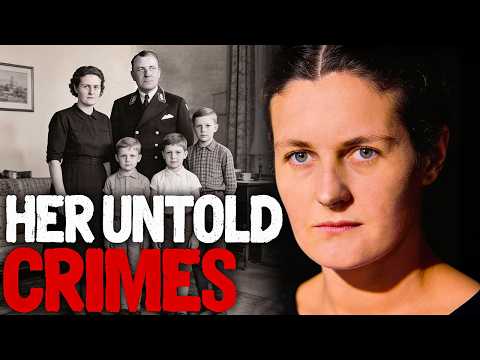
Gerda Bormann tried to redesign human reproduction itself. She didn’t need to watch prisoners die to contribute to the Nazi horror. She tried to legalize polygamy to breed a master race—and she started by offering to share her own husband.
Born Gerda Buch on October 23, 1909, in Constance, Germany, she grew up inside the movement. Her father was chairman of the Nazi Party’s Supreme Court, the body that enforced ideological purity among members. Dinner table conversations weren’t about ordinary politics. They were about racial destiny and the reshaping of German society from its foundations.
By 19, she had caught the attention of Martin Bormann—ambitious, ruthless, already indispensable to the Nazi leadership. They married on September 2, 1929. Adolf Hitler served as a witness. So did Rudolf Hess. This wasn’t just a wedding; it was a ceremony binding two families deeper into the Nazi inner circle.
Over the next 14 years, Gerda bore 10 children. She was either pregnant or recovering from pregnancy almost continuously. The regime awarded her the Cross of Honor of the German Mother—a medal for women who produced large families for the fatherland. On paper, she was everything the Nazi state wanted: devoted, fertile, obedient, the model German wife raising the next generation of Aryans.
But behind this facade, her marriage was a nightmare. Martin Bormann terrorized his family. Hitler’s own valet later testified that everybody knew Bormann terrorized his family. He had affairs openly, flaunting them in ways that humiliated Gerda publicly. He was violent. He was controlling.
Most women in that situation would have been broken by it—trapped, abused, with no way out. Gerda did something nobody expected.
In the early 1940s, Martin took a mistress: Manja Behrens, a young actress, exactly the kind of woman a powerful Nazi would pursue. Affairs among the Nazi elite were common enough. What happened next was not.
Any normal wife would have protested, demanded it stop, threatened to leave, or withdrawn into bitter silence. Gerda did none of these things. Instead, she wrote to her husband encouraging the relationship. Not tolerating it. Not resigning herself to it. Actively encouraging it.
The letters that survived are unlike anything historians had seen from Nazi wives. Gerda offered to share household duties with the mistress. She proposed drawing up legal documents to formalize the arrangement, making Manja a kind of official second wife with recognized status. She wrote warmly about the other woman, suggesting they could all live together, raising children as one extended family unit.
This wasn’t weakness. It wasn’t resignation. It wasn’t a broken woman accepting her fate. This was ideology taken to its horrifying conclusion.
Gerda had internalized Nazi racial doctrine so completely that she saw her own marriage not as a personal relationship but as a breeding arrangement. Her husband’s infidelity wasn’t a betrayal—it was an opportunity. If Martin could father more Aryan children with another racially pure woman, then jealousy was a selfish emotion she needed to overcome for the good of the race.
She actually believed this. And she was just getting started.
She called it Völkische Notgemeinschaft—racial emergency marriage. Her proposal was systematic and detailed. Any racially pure German man should be legally entitled to multiple wives simultaneously, not as some informal arrangement, but as a formal institution with state sanction. Younger women would rotate through pregnancy cycles while others managed the household and childcare.
The entire domestic structure of German society would be reorganized around maximizing Aryan births. Gerda drafted the legal language herself. She offered to sign formal acknowledgements that could serve as templates for other German wives. She argued in her letters that a healthy Aryan man had a biological imperative to father as many children as possible. Monogamy, she wrote, was holding back the race. Marriage, as it existed, was a relic of Christian morality that no longer served Germany’s interests.
The specificity is what makes it so disturbing. This wasn’t vague ideological rambling. She had thought through the logistics: how property would be divided, how children would be registered, how the law would need to change to accommodate multiple simultaneous marriages. She was proposing to dismantle the institution of the family and rebuild it as a breeding program.
And the Nazi leadership took her seriously. This wasn’t the rambling of one deranged housewife writing letters nobody read. Gerda Bormann’s proposal circulated among the Nazi elite because it addressed a real problem they faced—and it offered a solution more radical than anything they had publicly proposed.
By 1943, Germany had suffered catastrophic military losses. The Eastern Front alone had consumed hundreds of thousands of young men. Millions of German women would be left without partners after the war. If the regime wanted to replenish its population with racially pure children, where would the fathers come from?
The Nazis had already created Lebensborn—a program encouraging SS officers to father children with unmarried women deemed racially valuable. Pregnant women stayed in special homes, gave birth, and the children were raised as wards of the state or adopted by approved families. It was eugenics dressed up as social welfare.
But Gerda’s proposal went further. Lebensborn still operated in the shadows, never officially acknowledged for what it was. Völkische Notgemeinschaft would bring the same logic into the open. It would dismantle marriage, family law, and religious morality entirely—all in service of racial biological objectives. It would make every German wife complicit in sharing her husband, reframing jealousy and possessiveness as anti-state sentiments.
Heinrich Himmler himself had discussed similar ideas. The notion that traditional marriage was inadequate for producing enough children had circulated in Nazi ideological circles for years. What Gerda contributed was a wife’s perspective—a woman volunteering to be the test case, offering her own marriage as the prototype for what German families could become.
The war ended before any of it could be implemented. But the proposal’s existence reveals how far Nazi ideology had penetrated into private life, reshaping how believers understood love, family, and intimacy itself.
Now return to the confusion that started this story, because understanding why people conflated these two women reveals something important about how we remember Nazi evil. Johanna Bormann was born in 1893, making her sixteen years older than Gerda. She worked as a concentration camp guard first at Auschwitz-Birkenau and later at Bergen-Belsen. Survivors remembered her with terror. She was known for her sadism, for the German Shepherd she kept that she would set loose on prisoners too weak to work. Witnesses at her trial described her watching the dog attack emaciated men and women while she stood by, sometimes laughing.
When British forces liberated Bergen-Belsen in April 1945, they found Johanna Bormann among the captured guards. She was tried alongside others in what became known as the Belsen trial. The evidence was overwhelming. She was convicted of war crimes and hanged on December 13, 1945.
The two women shared nothing but a surname. Gerda was a Nazi wife in Munich and at the Berghof. Johanna was a camp guard in occupied Poland and Germany. They never met. They moved in entirely different circles. But when the internet discovered both names, the stories merged. Posts about Gerda started including Johanna’s crimes. Videos mixed photographs of both women. The camp guard’s atrocities became attributed to the secretary’s wife.
Clarifying this doesn’t exonerate Gerda. It reveals something more troubling about how Nazi evil actually functioned—and why the quiet ideologues might matter as much as the uniformed killers.
The Holocaust required both the Johannas and the Gerdas. This is the uncomfortable truth that gets lost when we focus only on the most visible perpetrators—the guards, the executioners, the commanders who signed deportation orders. Johanna Bormann pulled triggers, released dogs, watched people die at her feet. Her crimes are visceral, immediate, impossible to minimize. When we think of Nazi evil, we imagine her: someone in uniform, weapon in hand, standing over victims.
But the machinery of genocide also needed people like Gerda Bormann. True believers who never had to witness the camps because they had already internalized the worldview that made them possible. People who sat in comfortable homes, raised children, and wrote letters proposing that German society reorganize its most intimate relationships around racial breeding. They provided the ideological foundation that made the guard’s work seem logical, even necessary.
Gerda never killed anyone. She raised ten children, wrote letters to her husband, and drafted policy proposals that would have reshaped German families for generations. She represents a different category of complicity: the architect who never visits the construction site. The theorist whose ideas become someone else’s actions.
This is why the conflation matters. When we collapse Gerda into Johanna, we lose the distinction between different kinds of evil. We imagine that Nazi crimes required monsters—people fundamentally unlike us, recognizable by their cruelty. But Gerda looked like a devoted mother, received medals for her fertility, wrote warmly about sharing her husband with another woman. The horror wasn’t in her actions. It was in her beliefs—and in how completely those beliefs had replaced normal human feeling.
May 1945. The Reich is collapsing. Allied forces are closing on Berlin from every direction. In Hitler’s bunker, the remaining Nazi leadership prepares for the end. Martin Bormann was there until the last hours. On May 2nd, he attempted to escape the bunker as Soviet forces surrounded the Chancellery. He was never seen alive again.
For decades, his fate remained one of the war’s great mysteries. Had he escaped to South America? Been captured by the Soviets? His remains weren’t positively identified until 1998, when DNA testing confirmed that a skeleton found near the Lehrter Bahnhof in 1972 was his. He had died trying to flee Berlin—killed either by Soviet fire or by suicide as capture became inevitable.
Gerda never learned what happened to her husband.
As Berlin fell, she fled south with her surviving children to Merano, a town in South Tyrol that had been annexed from Italy. American forces eventually found her there. They interrogated her about her husband’s activities, about what she knew, about the inner workings of Hitler’s court. But they didn’t prosecute her. Unlike other Nazi wives who faced denazification tribunals and prison sentences, Gerda was left alone.
It wouldn’t have mattered anyway. She was already dying.
Doctors diagnosed uterine cancer. Perhaps the grim irony of a woman who had devoted her body to producing children for the Reich, now consumed by disease in those same organs. She died on March 23, 1946, at thirty-six years old. No trial, no public accounting, no moment where she faced what her ideology had enabled.
Her children were eventually adopted by a Catholic priest who worked to raise them outside the shadow of their parents’ legacy. Some rejected their Nazi heritage entirely when they came of age. Others remained conflicted, caught between love for the parents they remembered and horror at what those parents had believed and done. The woman who proposed dismantling the traditional family to serve racial breeding saw her own family scattered to strangers. There’s no evidence she ever recognized the irony.
The questions that remain about Gerda Bormann are the kind historians may never answer. What was in the full correspondence that didn’t survive the war? Did she write more explicitly about the Final Solution? Did she ever understand where the ideology she championed was actually leading? Why wasn’t she prosecuted when other Nazi wives faced tribunals? The answers died with her in that South Tyrolean town in March 1946.
What survived was a proposal for restructuring human intimacy itself—for turning marriage into a breeding program and wives into willing participants in their own degradation, all for the glory of a racial utopia that existed only in the fevered imaginations of true believers. Gerda Bormann reminds us that totalitarian evil doesn’t always wear a uniform. Sometimes it writes letters from comfortable homes, proposes policies over family dinners, and volunteers to sacrifice jealousy and possessiveness for the good of the race.
Sometimes the most dangerous believers never see a single body because they’ve already accepted a worldview where bodies are just material for building a better future. That’s what makes her story worth telling correctly—not to exonerate her by separating her from Johanna Bormann’s crimes, but to understand that she committed her own. They just don’t photograph as well.
So here’s the question: if the quiet architects of genocide look like devoted mothers and write letters from comfortable homes, how many of us would recognize them—or ourselves—in that mirror?
Report this article
Select a reason for reporting:






