On the 18th of March, 1918, a soldier from the 10th Battalion of the Australian Imperial Force made his way to London from Sutton Veny Camp in Wiltshire. He had turned 38 just five days earlier. For six weeks, he had been waiting for a second committee to see a model that had been built for him in Melbourne. The first committee had examined it without him present. He was not allowed to appear with the model.
In London, he found the model in the basement of a government department, its paperwork languishing in a mail slot. It never reached the second committee. Within a week, he was ordered back to camp—the Germans had launched their spring offensive in France.
The model was of a machine he had first sketched in Western Australia years before the war. Other Australians in that war made things no one had issued them. Men at Gallipoli and in France built periscopes from shaving mirrors and bombs from jam tins. A rifle that could be aimed from below the parapet. A rifle that kept firing after everyone had left.
Much of it survives. A biscuit with a postcard stitched to it. A periscope made from two shards of mirror. A clock from shell casings. A supply parachute. And that model—all held in the collection of the Australian War Memorial. Many more live in the pages of the official history.
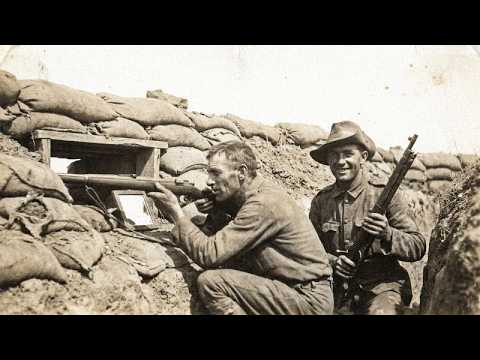
Here are 12 of them, counting down from the one a gunner mailed to his brother, to the one that stayed in that basement. “Anzac” meant Australia and New Zealand. New Zealand engineers stood at the same benches on the beach. British sailors worked there too. A British squadron flew one of these ideas into battle. Another began with a French device and relied on a British corporal’s microphone; a Canadian company delivered one of the tunnels. Many of the twelve were invented elsewhere first, and where that was the case, this video makes it clear.
Most were made from what lay scattered in the trenches, and the British Army and Royal Air Force adopted every one.
If your grandfather or great-grandfather served at Gallipoli or in France, tell us his name and battalion in the comments. And if the family still keeps a piece of trench art on a shelf, tell us what it is. One line is enough.
Number 12: The biscuit you could post. The army biscuit at Gallipoli was called the “Anzac wafer” or “Anzac tile,” and the War Memorial describes it as extremely hard. Men broke their teeth on them, and in the early days there were no dentists in the army to fix them. So they grated them into water and ate them as porridge, or ground them to thicken tinned beef stew and onions, or soaked them, spread them with jam, and baked them over the fire in what they called jam tarts.
Driver Percy Hindy of the 6th Battery, 2nd Field Artillery Brigade—a trainee carpenter from Malvern in Melbourne—found another use. He stitched an official field service postcard onto a piece of biscuit and mailed it from Gallipoli to his brother, Mr. James Hindy, at Gordon Grove, Malvern. It was postmarked the 8th of November, 1915. He signed it “George,” and no one at the War Memorial knows why. It is on display there today.
Paper was scarce. Sapper John Hawes, a signaller with the 3rd Light Horse Brigade, wrote home that June in indelible pencil, and some men wrote on toilet paper. The sweet oat biscuit Australians bake now for Anzac Day was never in the ration issue.
And one of the twelve things in this video was shown to the War Office in London before the war began, by a man the army later rejected twice when he tried to enlist.
Number 11: Periscopes from shaving mirrors. Royal Marines had brought a few periscopes ashore at Anzac, and some officers had their own binoculars, but they were nowhere near enough. So Australians made them from mirrors sent to the beach from transports and from their own shaving mirrors—two pieces of glass set at an angle in a wooden strip. A periscope factory was set up on the beach, and by the end of May 1915 it had produced 3,000. Since then, it began making periscope rifles too.
One of those handmade ones, with the two mirror pieces fixed in wood, was found in 1919 and is now at the War Memorial.
Put yourself at Quinn’s Post at the head of Monash Valley. The Turkish trench is less than 50 meters away. You raise a periscope over the sandbags and you have a few seconds, because the men who spent the longest time here learned not to leave it up for more than that. The light horse periscopes were smashed by enemy fire as soon as they were raised. The entire issue of the 16th Battalion’s periscopes was destroyed on the spot. By late July, Bean noted that in the 1st Division’s sector of the line alone, about 30 periscopes were being broken every day.
Number 10: The periscope rifle. On the 19th of May, 1915, Major Thomas Blamey was inspecting the front trench in the “Pimple” area on 400 Plateau when he found two men of the 2nd Battalion bent over a frame of broken boxwood and wire fixed to a rifle. One explained it was a way to hit the target without exposing himself to injury. A periscope was fixed so that its top glass looked straight along the line of sight, while the shooter looked into the bottom glass from below the parapet.
The man credited with the invention is Corporal William Beech, a building supervisor from Sydney born in Shropshire. Blamey thought the invention might be valuable. Beech was taken to headquarters to fit the periscope to other rifles. By the 26th of May, there was a factory on the beach making them. The first of those rifles entered Quinn’s the day before, carried by a man who said he was tired of fighting Turks and would play cricket with them instead.
According to Bean’s account, the rifle was accurate at 200 or 300 yards, though the War Memorial’s encyclopedia considers it less effective than a standard rifle. At Quinn’s, where the garrison could hardly fire a single shot during the day, these rifles helped the snipers curb Turkish fire until, as the official history says, the Australians eventually had the upper hand.
Soon the Turks were the ones forced to use periscopes, and whenever one of their periscopes appeared, it was smashed by fire. By about the 20th of August, they had a periscope rifle of their own. A number of Australian rifles were sent to the British at Helles and later at Suvla, where they were not much used. There was a competing claim. In August, a soldier of the 10th Battalion, George Tostee, offered his commander a periscope rifle he had invented. The War Memorial says the credit usually goes to Beech.
Number nine: The jam tin bomb. In the first weeks at Anzac, there were almost no hand grenades. Regular supplies did not begin until the end of the first week of May, and even then only of the most primitive kind. On the 7th, Major Quinn—the officer the post was named for—approached Lieutenant Little at his position on the line carrying two bombs and told him not to throw them needlessly because supplies were very scarce.
The Turks, on orders from their German commander Liman von Sanders, had trained to throw a well-made bomb shaped like a cricket ball, and one of those is also at the War Memorial, collected from Quinn’s and made in the Kalafat Yeri foundries in Constantinople. The Australians learned to throw them back. A sergeant of the 13th Battalion named Scott, a train guard from Wollsend, returned one directly. Others smothered them under their coats.
The bombs the Australians threw on the beach were made at headquarters by several sections of Australian and New Zealand engineers working with some British sailors. Shrapnel from Turkish shells and enemy barbed wire, cut into short lengths, were packed inside old jam tins around a small bag of ammonal. The fuse was lit with a match. At first, the fuses were cut too long, giving the Turks time to throw the bombs back.
By June, the factory just above the beach was producing more than 200 bombs a day. A New Zealand engineer later said he never saw a manufactured bomb at Anzac until August. Bean photographed the factory in Anzac Valley on the 17th of December, three days before the last soldiers left.
In June 1915, the Royal Navy took the problem seriously. A proper hand grenade was designed aboard the battleship Cornwallis and a prototype made. The War Memorial holds it. Its record notes that the troops continued to use the primitive jam tin bombs, and that this model was the only one ever made. A British design, the Garland mortar, also fired bombs, and on the 1st of June Bean photographed one leaving the mortar at Quinn’s, trailing a tail of white calico.
One Navy bomb against 200 tins a day from a table on the beach. On the 7th of August, the bomb factory’s stock ran out. The Australians were holding the trenches they had taken at Lone Pine the night before, facing successive counter-attacks. By 10:08 a.m., the factory near the beach had sent every bomb it had in stock. Work continued with 54 men. By 7:10 that evening, Bean estimated it had met the most urgent demands.
Two days later at Lone Pine itself, Captain Alfred Shout lit three bombs at once to throw them. The third exploded in his hand. He lost his life on the 11th of August and was awarded the Victoria Cross. That same day, two corporals, Webb and Wright, were assigned a single task: to catch enemy bombs and throw them back. Neither returned home.
Number eight: The newspaper against rumor. By June 1915, the Anzac bridgehead was full of spy fever and rumor, the kind that grows in trench warfare. The soldiers had a word for that kind of story, “furphy,” and the War Memorial’s explanation traces it to the water carts marked “J. Furphy & Sons,” where men gathered to exchange gossip, rumors, and exaggerated tales. Bean noted in his diary on the 7th of June that Major Blamey wanted a “Furphy’s Gazette” to counter rumors. On the 11th, the company quartermaster sergeant, Frank Noonan of the 6th Battalion, sat with Bean in his dugout, and together they wrote the first issue of “The Dinkum Oil.” Noonan had already been running his own paper called “The Snipers’ Shots.”
Eight editions appeared within about a month, and copies reached families and appeared in newspapers in Australia. Bean wrote that he could not say he helped Noonan, and that all he did was hold the pen and write clearly. Five months later, he tried to write a book. In November, he asked the men in the trenches to send their stories, poems, and drawings, and he edited them on the island of Imbros, and in 1916 Cassell in London published it as “The Anzac Book.” With an introduction by General Birdwood, at two shillings and sixpence a copy, with the money going to the national funds. David Barker of the 5th Field Ambulance drew many of them. One was titled “The Dawn of Despair.” Another was about the flies.
Number seven: The rifle that fired itself. It begins with silence. At 6 p.m. on the 24th of November, 1915, on orders from Anzac headquarters, every rifle and gun along the Anzac front stopped firing. It was supposed to last two days. It was extended to a third. The men called it “the silent stunt.”
On the other side of no man’s land, the Turks did not know how to interpret it. At Quinn’s, they came out and pulled down and removed two sections of the wire netting protecting the trench from bombs. At Holly Ridge, about 50 of them advanced and were fired on, and Bean wrote that the Turkish staff was baffled. In the end, the Turkish staff decided that the Anzac forces wanted to complete winter work in peace. The silence ended at midnight on the 27th.
Three weeks later, the Anzacs were already leaving, and the problem was reversed. The last men in the line had to make the empty trenches look full. Corporal William Scurry of the 7th Battalion, who had been an architectural model maker before the war, first tried using sand, to pour like an hourglass. When he stopped for lack of water, an old schoolmate in the battalion, Private Alfred Lawrence, gave him a full quarter-gallon. Their version used two kerosene tins, one above the other. Water dripped through a hole in the top tin into the bottom tin. When the bottom tin became heavy enough, it pulled a string tied to the trigger. The delay depended on the size of the hole, and usually took about 20 minutes.
Rifles fitted this way were placed in the trenches on the 19th and 20th of December. Other units used candles or fuses or strips of cloth. The German general commanding the Turkish Fifth Army, Liman von Sanders, later wrote that the departure plan was not known to his side until the last moment and that it was prepared with extreme care. He wrote that by the time his advance troops reached the beach, “the Anzac soldiers had gone.”
Scurry, born in Carlton in 1895, was 20 years old when he made it, and was awarded the Distinguished Conduct Medal for that rifle. He received a commission the following year, and was commanding a light mortar battery in France when he was wounded on the 3rd of September, 1916, at Pozières while examining a new type of fuse in an unexploded German bomb. Metal fragments cost him the sight of his right eye and crushed the index finger of his right hand, which was later amputated. He was awarded the Military Cross for his work with the battery. His left eye began to fail in 1920, and he spent the rest of his life with a fraction of his sight. In 1923, he left modeling and became an orchardist at Silvan in the hills east of Melbourne. In the Second World War, he returned to military service with the 17th Garrison Battalion and then as commander of the internment camp at Tatura. He died in December 1963.
Alfred Lawrence, the carpenter who gave him the water, was 18 when he sailed. In October 1917, he was severely wounded by shrapnel, and the fragment lodged so close to the aorta that it could not be removed. He returned home in April 1918, went into business in Bendigo, and lived to be 89.
Number six: What they made between the shells. On the Western Front, empty shell casings were everywhere, and legally they still belonged to the government. Most trench art was made away from the front line to pass the time. Sapper Stanley Pearl of the 5th Field Engineer Company, who volunteered at Ulverstone in Tasmania in November 1915, made a clock in Ypres in March 1918 from two 4.5-inch shell casings he picked up on Christmas Day 1917 from the Australian batteries at Le Bizet.
In January 1918 at Armentières, he made a napkin ring from a piece of a 6-inch shell that had not exploded, and added bases made from 18-pounder shrapnel balls that fell near him. He made his vase after the Armistice at Tilloy-lès-Conty in Belgium, and it took a lot of nerve. Pearl made it from a French 75mm shell casing he obtained as a souvenir from a French battery south of Villers-Bretonneux, and fitted it with handles from one-inch copper steam pipes, which he had sawed off a German locomotive at night with a hacksaw despite a guard being present.
After the war, he worked as a carpenter at the War Memorial, where the clock, ring, and vase remain. Other men made games. A “draughts” board cut from a wooden box was found at Quinn’s Post when Bean’s historical mission returned to Gallipoli in February 1919. A soldier of the 7th Brigade headquarters made another board in France from the ruins of a church and monastery at Péronne. He used oak from the organ and inlaid squares from part of a nun’s wardrobe, and carved the names of eight battles around its edge. Armentières, Fleurbaix, Albert, Pozières, Péronne, Bullecourt, Messines, Ypres.
Number five: The light beneath the Western Front. Below the front line, tunnelers and men in deep dugouts needed pumps, fans, and electric light. Along the front from south of Arras to Nieuwpoort on the Belgian coast, much of this work fell to a small Australian unit with a name no one could say in one breath. It was the Australian Mining and Mechanical and Electrical Company, sometimes jokingly called “the Alphabet Company.”
Formed in France in 1916 from the Mining Corps of the Australian Imperial Force, it numbered—according to the War Memorial’s count—fewer than 300 men, led by Major Richard Morse, a mechanical and electrical engineer from Rozelle in Sydney. The company installed lighting systems, power stations, pumps, and fans in the areas of two British armies, and its generators were often placed only 300 yards from the front line. Their own workshop, in an old fittings factory on Rue de Bois in Hazebrouck, ran on a captured 12-horsepower engine.
According to one account, one of its tasks was a dugout beneath “Hill 63” near Messines, called “Wallangarra,” which the company equipped with 450 lamps, and which General Sir Herbert Plumer opened on the 1st of November 1916. A British staff officer, inspecting tunnels for General Headquarters, wrote in his diary that the commander of a British tunneling company praised Morse and his men highly, and that the Australians kept working no matter how late the hour until the water receded.
After the war, the chief engineer of the British armies in France wrote to the company that the army had come to rely on it as a habit whenever it needed quick results. The Mining Corps also supplied the army with a drill. Captain Stanley Hunter, a mining geologist born in London who was in his fifties when he went to war, designed a drilling machine known as the “Wombat,” and the British Army adopted it. He was mentioned in dispatches and returned to Australia in March 1918. A photograph at the War Memorial, taken on the 30th of January 1918, shows Lieutenant Robertson and Private Jolley of the 3rd Australian Tunnelling Company using the machine to drill a ventilation shaft for a shelter.
Pumps mattered everywhere underground. At Hill 60, which the 1st Australian Tunnelling Company took over from a Canadian company on the 9th of November 1916, one electric pump saved the efforts of 60 men who had been working the army’s manual pumps. At 10:03 on the morning of the 7th of June, 1917, Captain Oliver Woodward closed the switch that fired the mines beneath the hill, and his hand touched the terminals and he received a severe shock.
Number four: The Australian who listened to the guns. Lawrence Bragg was born in Adelaide in 1890 and commissioned in 1914 as a British officer in the Royal Horse Artillery. In July 1915, he was sent to the map section at British General Headquarters to work on locating enemy guns by the sound they made when firing. In September, he was in the Vosges mountains with another physicist, Harold Robinson, studying the devices the French were already using. In October, he moved to Flanders. In November 1915, his section located the position of the first German gun by sound.
That same month, a letter arrived from his father. The prize had been announced on the 12th of November. Lawrence Bragg was staying at a vicarage in Flanders when he read that both of them, father and son, had won the Nobel Prize in Physics. He was 25, still the youngest winner of the Physics prize ever. The vicar offered him a bottle of Lacrima Christi to celebrate. About 10 weeks earlier, his brother Robert, an artillery officer with the British at Suvla, had been hit by a shell on the 1st of September. He lost his life the next day aboard the hospital ship Nevasa and was buried at sea.
Bragg’s quarters that winter were a farm at La Clytte, and the microphone that made the sound-ranging technique work came from a British corporal in his section on Kemmel Hill, named William Tucker, from Imperial College in London. A fine platinum wire heated by an electric current cools for a moment when the air wave from a gunshot reaches it, and the change shows on a galvanometer. The first one was mounted inside a rum jar. Place a row of them at the front, record the time each one jumps, and the gun’s position can be fixed on a map.
By June 1916, there were 16 sound-ranging sections along the British front. During the British offensive at Passchendaele in 1917, Bragg’s sound experts located 190 German guns in the first 20 days. He ended the war with the Military Cross, the Order of the British Empire, and was mentioned in dispatches three times.
Number three: A fighting style with a borrowed name. Before the war, British newspapers and politicians had a term for the way Germany was said to be winning an empire without having to fight. Simply by expanding its trade. They called it peaceful penetration. In the spring of 1918, Australians adopted the term to describe their own style of fighting, where they quietly wiped out German positions a few men at a time, nibbling away at the lines.
Bean says the name first appeared in the records of the Australian Imperial Force in the orders of the 46th Battalion dated the 30th of April. Near Hamel, a corporal of the 58th Battalion named Sayers managed to trap a German patrol of about 30 men. A year earlier at Messines, this kind of work had been known by a different name, “stunting.” In 1918, patrols usually went out with a Lewis machine gun mounted at the rear to cover them. This went on through May and June.
By the 8th of July, the War Memorial records that this kind of patrolling and the capture of German soldiers batch after batch added nearly 3 miles to the Australian front, with a thousand German soldiers taken prisoner. On the 5th of May, there was a man writing from an advanced German position who had his own description for it. He wrote that the Australian patrols “crept about at night like cats.”
Number two: Ammunition from the sky. At the end of June 1918, General John Monash was planning an attack at Hamel, east of Amiens, with four companies of the US 33rd Division alongside his Australian troops. One of his problems was old and well known. Machine gunners advancing to a newly captured line run out of ammunition, and carrying it to them across open ground cost men’s lives.
The army’s plan was to drop ammunition from the air by parachute at specific points, and wherever a machine-gun crew placed a large white V on the crops. V stood for Vickers. The task of making this work was given to Captain Lawrence Wackett of No. 3 Squadron, Australian Flying Corps, a Duntroon graduate who had learned to fly in 1915. The first trial box crashed and nearly hit the wing commander and the squadron commander. Major Blake suggested changing the bomb racks. Wackett did so, and on the 24th of June he won the approval of the army commander, General Rawlinson.
Standard bomb racks and release mechanisms were modified to carry two ammunition boxes with parachutes. The squadron spent 10 days in a hangar making more than a hundred parachutes, and Blake later gave credit also to the workshop mechanics led by Sergeant Nicholson. The parachutes were brown, and each carried one box containing 1,200 rounds. Wackett ended the war with the Distinguished Flying Cross. On a reconnaissance mission in September 1918, 80 bullet holes were counted in his aircraft.
No. 3 Squadron had many other tasks on the 4th of July, so on the morning of the battle, 12 aircraft of No. 9 Squadron, Royal Air Force, flew at a thousand feet or lower, each carrying two parachutes. According to the official records, they dropped 93 boxes, or 111,600 rounds. Monash estimated the number at a hundred thousand at least, and wrote that it resulted in a clear saving of lives and a reduction in casualties. One box fell ten feet from a machine-gun position. The wind swept two boxes into German territory and they hung in the trees of the Accroche wood. The majority fell far from where they were planned.
One British aircraft was brought down by one of its own supply parachutes, which caught on the plane, while a second was shot down by German fire. The other solution that morning came on tracked vehicles. Monash had four supply tanks, a design originally meant to carry a gun but which proved more efficient at carrying supplies, and each carried a non-commissioned officer and four infantrymen to load and unload. One reached the 13th Battalion’s dump loaded with 133 coils of barbed wire, 180 long screw pickets and 270 short ones, 45 sheets of corrugated iron, 50 fuel tins filled with water, 150 mortar bombs, 10,000 rounds of ammunition, and 20 boxes of hand grenades. By the time the battalion commander arrived, it had unloaded and gone back.
In Bean’s account, the four tanks delivered loads that would have required working parties of 1,200 men. He wrote that some of the infantry believed this was the most notable lesson of the battle. Was the airdrop the first of its kind? The War Memorial’s exhibition on 1918 says it was the first time on the Western Front that aircraft were used this way in battle. The memorial’s historian, Aaron Pegram, wrote that the German air force had done it in May 1918. Bean’s official history says the idea reached General Rawlinson in a captured German report. Monash wrote that this method became common in the following months, and the official historian of the Australian Flying Corps, Frederick Cutlack, noted that it was adopted throughout the Royal Air Force.
In August, the British General Staff issued a pamphlet on the attack near Hamel, titled “Notes on the Recent Fighting No. 19,” to be distributed to every battalion and battery. Three days after the battle, the French Prime Minister, Georges Clemenceau, came to see the Australians at Bussy, and told them he would return home to tell his countrymen that he had seen the Australians.
Number one: The one the War Office rejected. In 1911, a mapmaker named Lancelot de Mole was surveying difficult country near Geraldton in Western Australia when he came up with the idea of an armored vehicle that laid its own track as it moved. Born in 1880, he was the son of an architect and surveyor. Friends advised him to sell the design to the German consul in Perth, but he refused.
The following year, he sent drawings of it to the War Office in London with a written explanation of how it could be steered right or left as it advanced, by changing the track laid in front of it. In June 1913, he was told the idea had been rejected. Only part of his drawings were returned to him. In September 1914, weeks after the war began, a man from Perth named Braden wrote to the War Minister in London urging him to consider the plans of “Mr. de Mole’s moving tracked fortress.” In 1915, de Mole sent his designs again and offered his services with them. The reply was that without a working model, they could not use them at that time. He tried the Australian Board of Invention. That failed too. In July of that year, in the midst of all this, he married Harriet Walter.
On the 15th of September, 1916, British tanks went into battle for the first time at Flers-Courcelette on the Somme. In April 1917 at Bullecourt, about twelve of them went in with two Australian brigades, and they performed poorly, soon turning into burning wreckage. After that, the War Memorial says, Australians no longer trusted tanks.
By then, de Mole had tried to enlist and been rejected for medical unfitness, and tried again in August 1916 and was rejected again. In 1917, a Melbourne company called Williams & Benwell built a model of a hull and running gear at 1/8 scale. Its tracks ran over eight pairs of double wheels. On the 26th of September, 1917, at the age of 37, he was finally accepted as a soldier in the 10th Battalion. In October, he sailed for England.
In England, the army granted him leave from Sutton Veny Camp, and the Munitions Inventions Department gave him a room. The model was shown to a committee of experts. De Mole was not allowed to appear before it with his model. The committee recommended it be shown to a second committee, and then nothing happened for 6 weeks. That was when he went to London on the 18th of March, and found the model in the basement and the papers in a desk drawer. Within a week, he was ordered back to camp.
That month, he went to France with reinforcements for the 10th Battalion. He fought at Villers-Bretonneux, Méris, and Meteren. In January 1919, the army promoted him to temporary corporal at the munitions workers’ depot in London, and later to honorary corporal. On the 4th of July, 1918, at Hamel, 60 British tanks advanced with the Australians, and four other tanks carried their supplies.
In November 1919, the Royal Commission on Awards to Inventors considered de Mole’s claim. The commission found his design ingenious, predating the machine first used in 1916, and better than it in some respects. It awarded him nothing. Claimants had to prove a causal connection between their invention and the machine the government used, and he could not do so. The commission expressed its regret that it could not award him any compensation.
The Australian High Commissioner in London, Andrew Fisher, wrote to the British Prime Minister Lloyd George in December 1919, urging that de Mole be honored. In 1920, he was made a Commander of the Order of the British Empire, and the London Gazette gave the reason in one line: “For services in connection with the invention of tanks.” He returned home in February 1920 and worked in Sydney in the design section of the Water Board. In June 1940, with another war underway, he submitted a design for a shell that would spread a curtain of wire in the sky against aircraft, and Robert Menzies listened to him.
He died at the Liverpool State Hospital in Sydney on the 6th of May, 1950. The model had been in the War Memorial’s collection since just after the First World War. In May 1924, a member asked about de Mole in the House of Commons, and the Secretary of State for War, Stephen Walsh, replied in writing. He said: “The invention was submitted before the war. It was rejected at the time, and had no part in the adoption of tanks years later.” Given its merits, the commission asked the Ministry of Munitions to look kindly on any claim de Mole might make to cover his own expenses. On that recommendation, the Ministry paid him 987 pounds. That is the twelfth item.
If there is a piece of trench art in your family—a shell-casing vase on a mantelpiece, a clock, or a letter written on a piece of biscuit or a scrap of shirt—tell us in the comments what it is, who made it, and what unit he served in. If your grandfather or great-grandfather was at Gallipoli or in France, give us his name and battalion. One line is enough. Families from New Zealand, Britain, Canada, and America are welcome too, because some of your people are part of this story. On the bomb benches on the beach, and in the aircraft over Hamel, beside the Australians in the front lines and inside the tunnels.
Send this to a friend or relative who has one of those shell casings on a shelf. And if you want more Australian military history told straight from the records, subscribing is the way to get the next one. So tell us—what is the one object your family kept, and who carried it through the war?
Report this article
Select a reason for reporting:






