May 8, 1945. Noon. Hours before Germany’s surrender, the man with more aerial victories than anyone in history shoots down his last Soviet aircraft over Czechoslovakia. He lands and is handed an order: “Fly to the British zone and stay out of Russian hands.” He refuses. He destroys his fighter, leads his men toward the Americans instead, and surrenders. It seems the safest choice he could have made. By the end of the month, the Americans hand every one of them over to the Soviet Union.
Erich Hartmann will not see his homeland again for over ten years—and that’s just the beginning.
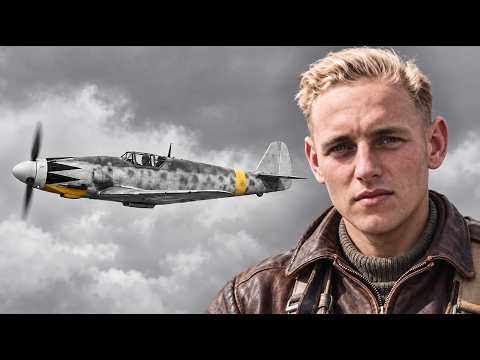
That final morning began with a simple mission. At 8:30 a.m., Hartmann took off with his wingman to find out how close the Red Army really was. The answer came fast. The first Soviet units were about 40 km from his airfield. Forty kilometers for a tank column meant just an afternoon away.
On the way, he spotted a Yak-9. Hartmann was cruising at roughly 12,000 feet, unseen—exactly how he liked to fight. He dove on the Soviet plane, fired from close range, and it went down. That was victory number 352. It was also his last.
He landed, and the ground simply ran out from under the war. The airfield sat a few kilometers outside a Czech town the Germans called Deutschbrod. By the time Hartmann climbed out of the cockpit, Soviet forces were within artillery range. There was nowhere logical left to fly and nothing left to defend.
So the unit did what defeated air units did in those final hours. They destroyed everything. Hartmann’s own Messerschmitt, bearing the “Karaya One” emblem, was blown up along with 24 other Bf 109s and huge stocks of ammunition. A fighter group that had been one of the most feared on the Eastern Front turned to scrap in a single day.
Then came the order. It came from General Hans Seidemann, and it named two men. One was Hartmann. The other was Hermann Graf, commander of the entire wing, JG 52, and one of Germany’s most famous pilots. They were to fly west to the British zone and surrender there. The rest of the wing would stay behind and surrender to the Soviets.
Think about what that order really meant. German commanders knew exactly how the Soviets would view these two pilots. Between them, they were credited with over 500 Soviet aircraft shot down. If anyone in that wing was going to be targeted in captivity, it was them. So the order was a lifeline. A few hours in the cockpit, a landing among the British, and a completely different future.
Hartmann didn’t do it. His explanation, given years later, was simple. He was the commander of his group, and he would not abandon his men. The ground crews, the young replacement pilots, the mechanics who had kept his aircraft flying for years—none of them had a plane to escape in. So he stayed.
Here’s a detail people often miss. Graf, who received the same order, made the same decision. But staying with his men didn’t necessarily mean handing them to the Red Army. There was a third option. American forces were advancing into western Czechoslovakia. So Hartmann loaded his men into vehicles and headed west, away from the Soviets and toward the U.S. Army.
According to his own account, fleeing civilians joined the convoy. Near the town of Písek, they reached the 90th U.S. Infantry Division and surrendered. On paper, it was perfect. He had refused an order to save himself and seemed to have found a way to save everyone. But he hadn’t.
To understand why the Soviets wanted him so badly, we have to go back to the first time he fell into their hands. August 20, 1943. Hartmann was twenty-one. He was escorting dive-bombers when debris from a Soviet plane he had just hit damaged his Messerschmitt, forcing him to land behind enemy lines. Soviet soldiers approached. There was no way out. So he started acting. He feigned internal injuries so convincingly that the soldiers put him on a stretcher and carried him to a truck. Later, he escaped and made his way back across the front lines.
Meanwhile, his crew chief, Heinz Mertens, heard Hartmann had gone down, grabbed a rifle, and went out to search for him. Three days after the crash, Hartmann returned to his unit. He kept this story because it explained two things. First, Hartmann had been a Soviet prisoner before and didn’t remain one. Second, the men around him were loyal enough to enter enemy territory for him. When he refused to leave them in 1945, that loyalty was mutual.
It also helps to know how he actually fought. Hartmann was not a dogfighter. His style, learned from older pilots in his unit, was simple. See the enemy first, make a decision, attack, then disengage. Get very close, often to 20 meters or less, fire a short burst, and leave before anyone can respond. And if the situation was bad, don’t attack at all. His personal motto was to fly with your brain, not your muscles. Pick your fights. Never take a fight you can’t control.
Remember that rule. In captivity, he broke it again and again.
The Soviets had their own reasons to remember him. By 1944, they knew his radio call sign. Post-war accounts claim Soviet command put a 10,000-ruble bounty on his head. They called him the Black Devil. For a time, he flew with a black tulip painted on his engine cowling, and he later claimed Soviet pilots often avoided combat the moment they saw it. His reaction tells you a lot about the man. He had the flower painted over because enemy pilots fleeing cost him victories.
By war’s end, he had flown over 1,400 combat missions and was credited with 352 aerial victories. No pilot in history has a higher official score. We’ll come back to that number because it isn’t as solid as it looks. But in May 1945, to the people about to receive him, it wasn’t just a statistic. It was an indictment waiting to be written.
There’s one more thing worth knowing about his history with the Americans. In 1944, while flying over Romania, Hartmann’s fighter ran out of fuel during a fight with P-51 Mustangs and he bailed out. As he hung in his parachute, one of the Mustangs turned and flew straight at him. The pilot, Lieutenant Robert Goebel, wasn’t attacking. He was making a camera pass to record the jump. He veered away at the last moment and waved as he passed. The last time Hartmann was at the mercy of the Americans, they let him go.
So why didn’t the Americans protect him? Here’s where the popular version of the story usually goes wrong. The popular version says something like this. The Americans captured him, then betrayed him, or neglected him, or traded him away. An ethical failure by an army. And you can understand why this narrative persists. He surrendered to the Americans. He ended up with the Soviets. Something in the middle must have broken.
Nothing broke. Everything went exactly as planned. Months earlier at Yalta, the Allied leaders had agreed on how to handle German prisoners. One rule was explicit. German soldiers and airmen who had fought against the Soviet Union must be handed over to the Soviets, regardless of which army captured them. Hartmann had fought most of his war in the East. Under that rule, the Americans had no decision to make. So they made none.
Hartmann’s men were taken to a large open-air compound and told to wait. Sources differ on the exact date of the handover. Some say May 14, others May 24. Either way, within weeks of the surrender, the U.S. Army handed Hartmann, his pilots, and his ground crew over to the Red Army.
Now look at that order he ignored with new eyes. It wasn’t just a convenient escape route. It was the only move that might have kept him entirely out of Soviet hands. No one can prove that flying west would have worked, but we know exactly where the road west led. And there’s a harsh comparison inside his own family. His younger brother Alfred had served as a gunner on a Stuka in North Africa. He was captured by the British and spent four years as a POW. Four years. Erich, who surrendered to the Western Allies on the last day of the war, was about to spend more than double that.
Here’s the first thing to understand about what happened next. The Soviet camp system didn’t want to kill Erich Hartmann. It wanted to use him. Most of what we know about his captivity comes from Hartmann himself, through the accounts he gave after his release. So treat the details as his version, but the pattern is consistent. At first, he was asked to spy on his fellow officers. He refused. The response was 10 days in solitary confinement in a concrete room four feet wide, nine feet long, and six feet high—too low to stand up straight. He slept on the floor. He was given only bread and water.
Then came the threats. According to Hartmann, his captors told him his wife could be abducted and killed. Then came the violence. During one interrogation about the Me 262 jet fighter, a Soviet officer hit him with a stick. Hartmann grabbed a chair and knocked the officer unconscious. He stopped and thought about where he was when he did it. A German officer inside a Soviet prison striking a Soviet officer. He expected to be shot. Instead, he was returned to the tiny cellar. That act tells you what the Soviets were really after. A dead Hartmann was worthless. A cooperating Hartmann could be extremely valuable.
And while all this was happening, there was something the prisoner didn’t know. In September 1944, Hartmann had married Ursula Paetsch, the girl he’d met as a teenager at school in Kornwestheim. Two of Germany’s most famous pilots, Gerhard Barkhorn and Wilhelm Batz, were witnesses at the wedding. Their son, Erich Peter, was born in 1945. A child his father never met. And in 1948, the boy died. He was three years old. Hartmann never saw him. According to Hartmann, his captors hid the news of the death from him.
So imagine the situation from the outside. In a Soviet camp, a man is subjected to isolation, threats, beatings, and pressure. And in Germany, his wife is raising a child he never held, then burying him, and waiting for a husband with no release date. Yet the prisoner still refuses, which raises the obvious question: what exactly were they asking of him? And what would it have cost him to agree?
The answer was a new career. The Soviets offered Hartmann a position in the East German Air Force. Think about what that would have meant. The most successful fighter pilot in history in an East German uniform helping build an air force allied with Moscow. For propaganda, there is nothing better. Hartmann refused. As he later recounted, he said that if they had made him an ordinary offer after his return to the West, he might have considered it like any business deal. But if they tried to force him, he would resist for the rest of his life.
Now, here’s where the story becomes uncomfortable. Do you remember Hermann Graf, the other ace named in that order to fly west? The man who also chose to stay? Graf also fell into Soviet captivity. And Graf returned home in 1950. Several of his former comrades began to believe he had cooperated with his captors to get out, and some never forgave him for it. Two men, the same order, the same decision on May 8. One adapted to the camp system and was released after five years. The other kept refusing and stayed. Neither path was free of cost. But this changes your view of Hartmann’s imprisonment. It wasn’t just something imposed on him. At several points, the door was open to him. But he kept closing it. And the Soviets were about to raise the price of that stubbornness.
On Christmas Eve 1949, Hartmann was formally arrested. Three days later, he was sentenced to 20 years in prison. The charges included committing atrocities against Soviet citizens and attacking military targets. Then there was the charge of destroying Soviet aircraft, which was framed as serious damage to the Soviet economy. In other words, one of the crimes he was convicted of was doing his job in the war. Hartmann protested the verdict repeatedly. According to later accounts, the investigation behind it was a mere formality.
Then in June 1951, a second charge was brought, this time for allegedly being a member of an anti-Soviet group. The second trial, in the Rostov-on-Don military district, brought much more specific accusations. Deliberately shooting 780 Soviet civilians in a village called Bryansk, attacking a bread factory on May 23, 1943, and destroying 345 expensive Soviet aircraft. Hartmann refused to confess. He conducted his own defense. According to him, the presiding judge described it as a waste of time. What was the verdict? 25 years of hard labor.
It would be easy to tell this story as personal revenge. One man so feared by Moscow that it fabricated a case just for him. And clearly there was special pressure on Hartmann. But if you look at the bigger picture, the scene changes. Around the end of 1949, the Soviet system convicted very large numbers of German prisoners, often handing down 25-year sentences based on vague charges that were not adequately investigated. Those sentences kept thousands of Germans in the camps for years after most prisoners had returned home. So Hartmann was both exceptional and ordinary. Exceptional in how hard they tried to win him over. Ordinary in the machinery they used to hold him. Keep that distinction in mind, because it will return at the end of this story.
Inside that machinery, Hartmann had only one weapon left: refusal. And according to his old rule, this was the worst kind of fight. A fight where the other side controls everything. He went on a hunger strike, saying he would rather starve than submit to what he called the Soviet will. The Soviets let it go on for four days. Then they forced him to eat. Think about the logic behind that. If they truly wanted him dead, they could have let him starve. But they didn’t. They needed him alive, and ideally, useful to them. Every refusal of his made him less useful and more dangerous as an example for everyone else.
There’s a small detail from those years that sums up the entire struggle. Hartmann had been awarded the Knight’s Cross with Oak Leaves, Swords, and Diamonds. At the time, it was the highest military decoration in Germany. During his captivity, he told his captors he had disposed of it. But he hadn’t. It was hidden in a small stream. Remember that cross. It still has its own journey to make.
After the 25-year sentence, Hartmann refused to work. In a forced labor camp, that’s not a simple protest. It’s a direct challenge to the very reason the place exists. He was put in solitary confinement. Then something happened the guards hadn’t planned for. Some of his fellow prisoners rebelled. They overpowered the guards and briefly freed him. Hartmann used that moment not to escape, but to make demands. He filed a formal complaint with the commandant’s office. He demanded a representative from Moscow, an international inspection, and a new trial to overturn his sentence. All his demands were rejected. Punishment came quickly. He was transferred to a camp in Novocherkassk, where he spent another five months in solitary confinement. A new court reviewed his case and upheld the original sentence. Then he was sent to another camp, this one in Diaterka in the Ural Mountains.
By then, the 1950s had begun. Stalin died in 1953. Most German prisoners had long since returned home. Hartmann was serving a sentence that wouldn’t end until the mid-1970s. Theoretically, he would be in his fifties before he gained his freedom. What eventually changed had nothing to do with Hartmann. It was politics.
In September 1955, West German Chancellor Konrad Adenauer flew to Moscow. The visit was meant to open diplomatic relations, but one issue overshadowed everything: the Germans still held in Soviet camps. Adenauer returned home with a deal. The last prisoners would be released. In Germany, these men were called Heimkehrer—the homecomers. Hartmann was among the last.
In October 1955, after more than ten years, he was free. He had entered captivity at twenty-three. He left at thirty-three. Ursula had waited the entire time. A life, a son, had begun and ended while he was behind barbed wire.
And the hidden Knight’s Cross? It came home too, smuggled into Germany inside a double-bottomed cigar box by fellow ace Hans Assi Hahn. In 1957, Erich and Ursula had a daughter, Ursula Isabel.
If this were a film, that would be the ending. But Hartmann did something that made the rest of his life far stranger. Within a year, he put on a uniform again. In 1956, West Germany created the Bundeswehr, and with it a new air force. Hartmann joined. Starting in 1957, he trained with American instructors at Luke Air Force Base in Arizona—the same army that had handed him to the Soviets was now teaching him to fly jets. In 1959, he took command of JG 71 Richthofen, the first jet fighter wing. He even had the black tulip painted on its Sabres.
But the trait that kept him in the camps was about to collide with his superiors. The cause was the Lockheed F-104 Starfighter. Hartmann considered it fundamentally flawed and unsafe. He was right in the worst way. German Starfighters crashed hundreds of times—269 crashes, 116 pilots killed in non-combat missions. Being right didn’t save him. His public criticism made him unpopular. In 1970, Colonel Erich Hartmann was forced into early retirement.
He kept flying anyway. From 1971 to 1974, he worked as a civilian flight instructor near Bonn. On September 20, 1993, he died in Weil im Schönbuch, the small town where he had gone to school. He was 71.
Even then, the story wasn’t over. In January 1997, after more than three years of his death, Russia’s chief military prosecutor reviewed his case. The verdict? Hartmann had been wrongly convicted. The civilians, the bread factory, the expensive aircraft—all of it was overturned under Russian law. It was one of many such rehabilitations after the Soviet Union collapsed.
There is one more correction we owe this story—the number 352. German records do show 352 claims. But his late-war paperwork is messy. His second flight log was lost, and his famous 1970 autobiography reconstructed part of the list from unreliable sources. It credits him with a kill on November 21, 1944, a day his unit apparently didn’t fly due to bad weather. And when you compare claims to actual losses, the picture blurs. On August 23–24, 1944, the days he passed 300, German pilots in that sector claimed 32 Soviet aircraft. Hartmann alone claimed 19. Research into the Soviet air army they fought shows no more than 11 losses over those two days, and only two in engagements with German fighters. Researchers who compared his claims to Soviet loss reports argue his true total may be far lower. That doesn’t make him a fraud. Pilots on all sides overclaimed. But it means the number that made him famous, and the number the Soviets turned into an indictment, was less precise than either side treated it.
So let’s go back to that airfield outside Deutschbrod on the last day of the war. Twenty-five fighters destroyed. An order that could have put him in British hands within hours. He refused it to stay with his men. And the road he chose led through an American camp to more than ten years in Soviet camps. What happened to Erich Hartmann after he surrendered to the Americans? He lost a decade and a son he never met. He was convicted of crimes the state itself later overturned. He came home, rebuilt his career, then lost it because of the same refusal that had kept him in prison. In 2016, his old wing, JG 71, painted the black tulip on its aircraft again. The flower returned. But the ten years never did.
On May 8, 1945, surrender looked like the moment his war ended. But it was actually the moment a much longer war began. A war he fought for the rest of his life with only one weapon. He kept saying: “No.”
What would you have chosen on that last day—obey the order and fly west, or stay with your men and face the consequences? Share your thoughts in the comments.
Report this article
Select a reason for reporting:






