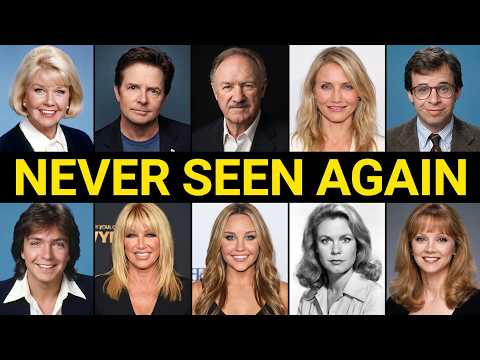
They were the faces that filled our living rooms, the names that defined an era of television. And then, at the height of their fame, they did the unthinkable: they walked away. Not a slow fade or a quiet retirement, but a deliberate, sometimes shocking exit from the very industry that made them stars. Some left to save their sanity, others to save their families, and a few because Hollywood simply broke their hearts. These are the stories of the ones who got out—and never looked back.
For every star who clings to the spotlight, there’s another who realizes the spotlight is burning them alive. The 15 actors on this list all reached a point where the cost of fame became too high. “I didn’t want to be a part of that world anymore,” one of them later admitted. Their reasons ranged from devastating injuries to matters of principle, from mental health struggles to the simple desire to be a present parent. And in almost every case, the decision came at a steep price.
Take David Cassidy, the ultimate teen idol of the 1970s. He was chased by screaming fans wherever he went, a level of mania he later said “overwhelmed me almost from the start.” When The Partridge Family ended, he didn’t try to extend the frenzy. Instead, he spent years trying to distance himself from Keith Partridge, the wholesome character who had made him a household name. The gap between who the public saw and who he really was became a chasm he could never quite close. Years of financial trouble and alcohol dependence followed, and in 2017, he revealed a dementia diagnosis. He died months later at 67, his family saying his final years were shaped by the toll of early, overwhelming fame.
Cassidy’s story is a cautionary tale, but not everyone’s exit was so tragic. Christopher Knight, who played Peter Brady on The Brady Bunch, simply chose a different path. “I never felt the same pull toward acting that some of my co-stars did,” he said. After the show ended, he studied engineering, built a career in technology, and largely stayed out of the spotlight—except for occasional nostalgia events. He proved that walking away didn’t have to mean falling apart.
Then there’s Amanda Bynes, a Nickelodeon darling who announced her retirement in 2010 via a single tweet. What followed were years of tabloid turmoil, mental health struggles, and a conservatorship. But Bynes eventually found stability, enrolling in fashion school and keeping a low profile. Her story shifted the conversation from scandal to sympathy, highlighting the pressures on child stars long before the industry started paying attention.
Cameron Diaz took a different route: she left on her own terms. After two decades as one of Hollywood’s highest-paid actresses, she stepped back to focus on family and her wine business. “I don’t plan to go back to that non-stop schedule,” she said, treating acting as an occasional choice rather than a full-time career. Her deliberate, business-minded exit became a model for veterans seeking balance.
And then there’s Gene Hackman, who simply vanished. After Welcome to Mooseport in 2004, he announced he was done, moved to Santa Fe, and spent 20 years writing novels and avoiding interviews. His near-total silence stood out even among this list, making his death in 2025 a moment of renewed awe at his discipline.
The reasons multiply: Rick Moranis left to raise his children after his wife’s death, turning down major roles without fanfare. Kristy McNichol walked away to manage her bipolar disorder, later explaining that leaving “allowed me to feel well again.” Michael J. Fox redirected his energy into Parkinson’s research after his diagnosis, building a legacy larger than any role.
Not every exit was voluntary. Shelley Long left Cheers for a film career that never materialized, a decision she later admitted she second-guessed. McLean Stevenson left M*A*S*H for stardom that never came, his character killed off in a twist that shocked audiences. Wayne Rogers walked over a contract dispute and became a stockbroker. Suzanne Somers was blacklisted for asking for equal pay. Elizabeth Montgomery quietly pivoted to darker TV movies, while Dick York left Bewitched due to crippling back pain. And Doris Day? She simply moved to Carmel, devoted herself to animals, and never looked back.
Each of these stars made a choice that cost them something—money, momentum, or the steady career that never quite returned. But in walking away, they found something else: peace, purpose, or simply a life that was their own. As one of them put it, “I found more peace working with animals than I ever had on a studio lot.” Their stories remind us that sometimes the bravest act is not to hold on, but to let go.
But what happens after the spotlight fades? For some, the silence is golden. For others, the ghosts of fame linger. And for a few, the decision to leave becomes a defining chapter in a life that was always more than just television. The full stories of these 15 stars—and the surprising turns their lives took after the cameras stopped rolling—are a testament to the fact that walking away is never the end. It’s just the beginning of a different story.
What makes these stories linger isn’t just the exit itself, but the strange afterlife of fame that follows. In an age of endless syndication and streaming, a star can never truly leave. A performer who walked away decades ago can still be discovered by a new generation every few years, their most famous character frozen in reruns while the person behind it has long since moved on. That disconnect—between the immortal character and the mortal actor—is the quiet tragedy running beneath almost every name on this list.
Consider the mechanics of it. A young actor signs a contract, becomes a face the world recognizes, and then spends the rest of their life being recognized for a version of themselves that no longer exists. Christopher Knight once noted that the identity of Peter Brady followed him for most of his adult life, regardless of what he actually did for work. He built an entirely separate career in technology, yet strangers still greeted him as the middle Brady brother. For some, that’s a warm, harmless legacy. For others, it’s a cage.
What separates the ones who found peace from the ones who struggled often comes down to a single factor: whether they had something to walk toward, not just something to walk away from. Doris Day had her animals. Michael J. Fox had his foundation. Wayne Rogers had finance. Cameron Diaz had her wine label and her daughter. The exit only became a beginning when there was a destination on the other side.
For those who left without that anchor—David Cassidy being the clearest and most painful example—the silence after fame could be deafening. The applause stops, but the need for it doesn’t always stop with it. Cassidy spent years trying to escape the teen idol image, only to find that the public wouldn’t let him, and perhaps he couldn’t quite let himself go either. That push-pull, wanting to be seen as something more while still craving the validation of being seen at all, is what makes his story the darkest on the list.
There’s also a generational shift worth noting. The stars who left in the 1970s and 1980s did so in an era before social media, when walking away meant genuinely disappearing. A Shelley Long or a McLean Stevenson could retreat to a quieter life and mostly stay there. Today’s stars don’t get that luxury. Even a low profile is a profile, and the internet never forgets a face it once loved. Amanda Bynes’s journey played out in real time, her struggles and recovery documented by strangers with opinions, a pressure her predecessors never had to endure.
What the industry has slowly begun to acknowledge is that these exits aren’t anomalies to be gawked at—they’re symptoms of a system that extracts everything it can from a performer and offers little in the way of a soft landing. Child stars, in particular, are often handed enormous fame before they have the language or the leverage to protect themselves. By the time they understand what’s happening, the contract is signed and the machine is already moving.
And yet, the stories on this list aren’t purely cautionary. There’s something quietly triumphant in a Rick Moranis turning down blockbusters to be home for bedtime, or a Gene Hackman writing novels in Santa Fe while the world begged him for one more interview. They proved that fame is not a life sentence, and that a career in Hollywood is not the only measure of a life well lived. The ones who walked away on their own terms, with their reasons clear and their regrets few, rewrote what success could look like.
Still, the question hangs in the air for every performer who’s ever considered the door. What do you owe the audience that made you? What do you owe the industry that built you? And what, ultimately, do you owe yourself?
Maybe the answer is simpler than we think. Every star on this list eventually made the same quiet calculation: the life they wanted was worth more than the fame they were giving up. Some made that choice with grace, others with grief, but all of them chose something over the spotlight.
That’s the thread running through all fifteen stories. Not tragedy, not scandal, but agency. They reminded us that walking away isn’t failure—it’s a decision, and sometimes the most important one a person ever makes.
So the next time you see a familiar face frozen in a rerun, remember the person behind it chose to leave. And that choice, whether it brought peace or pain, was theirs alone.
What would you walk away from, if staying meant losing yourself? Share your thoughts below.
Report this article
Select a reason for reporting:






