Sunday, March 18th, 1945. Camp Florence, Arizona. The dining hall fell into an eerie silence as Sergeant Orville Yates and his kitchen crew carried in the serving platters. Sixty-three German women prisoners sat rigid at their tables, their backs straight despite months of captivity, their faces carefully composed into masks of dignified neutrality. They had learned to expect the unexpected in this strange American desert camp, but nothing could have prepared them for what they were about to witness.
The first platter emerged from the kitchen doors, and several women visibly stiffened. Steam rose from perfectly roasted chicken, the skin golden brown and glistening with butter. The aroma that followed was something most of them hadn’t experienced in over four years. Real meat. Not the gray mystery substance that had occasionally appeared in their rations back home. Not the horse meat, or worse, that had sustained the Reich’s forces in the final desperate months.
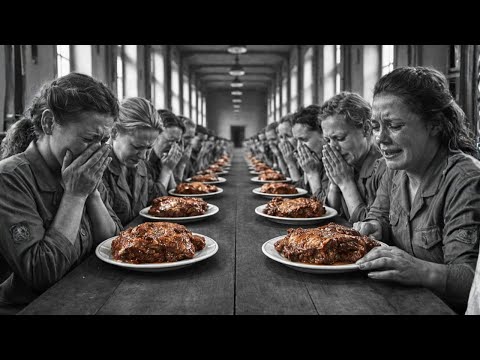
This was chicken prepared the way their grandmothers used to make it, the way they remembered from peacetime Sunday dinners that now seemed like memories from another lifetime. Twenty-seven-year-old Hedwig Newman, a former nurse from Berlin, was the first to break. Her hand flew to her mouth as tears spilled down her hollow cheeks. She had maintained her composure through her capture in France, through the humiliating transport across the Atlantic in a cargo ship’s hold, through her first bewildering weeks in this alien landscape of endless sky and red sand. But the sight of that chicken, accompanied by real mashed potatoes swimming in gravy, fresh green beans, and bread that wasn’t stretched with sawdust, shattered something deep inside her carefully constructed defenses.
Within moments, others followed. Twenty-two-year-old Leiselada Fischer, once a radio operator who had prided herself on maintaining professional detachment under pressure, found herself weeping openly. Beside her, Christa Vogle’s shoulders shook with silent sobs. Even twenty-nine-year-old Adelhyde Brawn, the most senior among them, and the one who had insisted they maintain military bearing at all times, sat with tears streaming down her face as she stared at the impossible abundance before them.
The American guards and staff stood frozen, uncertain how to respond to this unexpected display of emotion. Corporal Lester Goodwin, a young man from Oklahoma who had been taught to see these women as dangerous enemy combatants, felt his throat tighten as he watched their tears. This wasn’t the reaction of soldiers facing their captor’s charity. This was something far more profound and far more human.
Lieutenant Francis Whitmore, one of the few female officers at the facility, exchanged a glance with Sergeant Yates. They had anticipated gratitude perhaps or suspicion or even refusal. But this raw, overwhelming grief at the sight of a simple Sunday dinner revealed something about the war that no intelligence briefing had ever conveyed. These women hadn’t just been fighting for their country. They had been starving for it.
As the platters were placed on each table, the weeping intensified. Some women reached out tentatively to touch the plates as if to confirm that the food was real and not some cruel hallucination born of malnutrition and desperation. Six weeks earlier, on February 4th, 1945, a military transport truck had rumbled through the gates of Camp Florence, carrying its unusual cargo of German women prisoners. The landscape that greeted them seemed like another planet compared to the gray bomb-scarred cities they had left behind in Europe. Red sand stretched endlessly under a sky so blue and vast it felt oppressive in its clarity.
The women had been captured during the final chaotic retreat through France and Belgium, serving in various capacities for the Wehrmacht. Most had never fired a weapon, but their skills in communications, nursing, and administration had made them valuable enough to the German war effort that the Allies considered them legitimate prisoners of war. Hedwig Newman stepped down from the truck first, her nurse’s instinct automatically assessing the physical condition of her fellow prisoners. They all bore the marks of wartime Germany: hollow cheeks, prominent collar bones, skin that hung loose on frames that had once carried more weight. She herself had lost nearly thirty pounds since 1941, her nursing uniform now hanging on her like a borrowed coat several sizes too large.
The camp itself was smaller than the massive POW facilities housing German men elsewhere in America. Barracks designed for perhaps eighty occupants would hold their group of sixty-three. Barbed wire fences surrounded the compound, but they seemed almost decorative compared to the harsh barriers they had seen in European camps. Lieutenant Francis Whitmore stood waiting to receive them, clipboard in hand, her expression professionally neutral. At twenty-eight, she was one of the youngest female officers assigned to POW operations, chosen specifically because the army believed female prisoners required female supervision.
She had studied the files on these women during their Atlantic crossing and found herself unexpectedly moved by their stories. Most were young, barely out of their teens when the war had consumed their lives. The processing took three hours. Each woman was photographed, fingerprinted, and assigned a prisoner number. Their meager possessions were inspected: a few photographs, letters from home that had somehow survived the journey, worn prayer books, and in Hedwig’s case, a small wooden box containing medical instruments she had salvaged from her nursing days.
Leiselada Fischer clutched a battered journal filled with carefully coded notes, a habit from her radio operator training. Christa Vogel carried nothing but the clothes on her back, having lost everything in a bombing raid on Dresden. As the sun set over the Arizona desert, painting the sky in shades of orange and purple that none of them had ever seen, the women were led to their barracks. The beds, while simple military cots, seemed luxurious compared to what they had endured during transport. Each had a thin mattress, a blanket, and a pillow—small comforts that felt almost decadent.
That first night they lay in silence, listening to the unfamiliar sounds of the American desert, and wondering what fate awaited them in this strange land of abundance and enemies. The morning light revealed what the evening shadows had hidden. In the harsh Arizona sun, the true condition of the German women became impossible to ignore.
Sergeant Orville Yates, making his first rounds of the camp’s new arrivals, found himself stopping short at the sight of them gathering for morning roll call. He had served in North Africa and seen soldiers pushed to the edge of endurance. But there was something different about the hollowness in these women’s faces. This wasn’t the temporary deprivation of combat rations. This was the result of years of systematic hunger.
Hedwig Newman stood at attention with the others, her nurse’s training keeping her spine straight despite the fatigue that had settled into her bones. At twenty-seven, she looked a decade older. Her dark hair, once thick and lustrous according to faded photographs she still carried, had thinned noticeably. Her hands, which had once been steady enough to thread the smallest surgical suture, trembled slightly from vitamin deficiencies. She had treated hundreds of wounded soldiers during her service, but had been powerless to address the slow starvation that had gripped Germany’s civilian population and eventually its military personnel.
Beside her, Leiselada Fischer presented an even more striking picture of deprivation. At twenty-two, she weighed perhaps ninety pounds, her body having consumed its own muscle mass to survive. Her cheekbones stood out sharply, and her eyes, though still alert with the intelligence that had made her an excellent radio operator, had sunk deep into their sockets. She had grown up in Munich in a family of modest means, and even before the war, abundance had never been part of her experience. The ration cards had started in 1939, and by 1942, even those rations had become theoretical promises rarely fulfilled.
Christa Vogle at twenty-four bore the additional trauma of having survived the Dresden firebombing. She had been working in an administrative office when the first waves of bombers arrived on February 13th. The physical scars from burns on her left arm were visible, but the psychological weight of what she had witnessed showed in the way she startled at sudden noises. Before the war, she had been engaged to be married, planning a life of orderly domesticity. That fiancé had died at Stalingrad, and the life she had imagined had burned in Dresden’s flames.
The eldest of the group, twenty-nine-year-old Adelhyde Brawn, carried herself with the bearing of someone who refused to be broken by circumstances. A communications specialist from Hamburg, she had joined the Women’s Auxiliary Corps in 1941, believing in her duty to the fatherland. That conviction had wavered as the war dragged on and the reality of Germany’s situation became undeniable.
Sergeant Orville Yates had been running the military kitchen since 1942, feeding thousands of soldiers across three continents. At thirty-five, he was older than most of the men under his command, a career army man who had enlisted during the Depression when civilian jobs were scarce in rural Tennessee. His grandmother had raised him after his parents died in the influenza epidemic of 1918, and she had instilled in him two unshakable beliefs: that good food was an expression of love, and that no one, regardless of circumstances, should go hungry if you had the means to feed them.
But these were enemy prisoners. The distinction mattered to him, or at least it was supposed to matter. He had seen photographs of American POWs held by the Germans, men reduced to skeletons, treated with systematic cruelty. The reports from liberated camps were beginning to filter through military channels, stories that made his blood run cold. Yet, when he looked at these sixty-three women lined up for morning count, skeletal and exhausted, he didn’t see enemy soldiers. He saw his grandmother’s face during the lean years, saw his sister’s children during the worst of the Depression. He saw hunger, and hunger was something Orville Yates had spent his entire adult life fighting.
Lieutenant Francis Whitmore approached him after morning roll call, her expression troubled. She had been at Camp Florence for three months, overseeing the facility’s preparation for female prisoners. At twenty-eight, she was ambitious and capable, having fought hard for her commission. In a military that still viewed women officers with skepticism, she had expected to maintain professional distance from the prisoners—to see them as her duty rather than her responsibility. But the reality of their condition had shaken that resolve. These women needed medical attention, proper nutrition, and time to recover from whatever they had endured before their capture.
The camp physician, Captain Robert Hayes, had examined each prisoner upon arrival and submitted a report that made for grim reading. Malnutrition, vitamin deficiencies, untreated infections, dental problems from years of inadequate diet. Several showed signs of scurvy. Two had fractures that had healed improperly. The youngest, an eighteen-year-old named Marta Kline, showed symptoms of tuberculosis. Hayes had been clear in his assessment: these women needed sustained medical intervention and significantly improved nutrition or there would be deaths in custody.
Corporal Lester Goodwin, at twenty-three, the youngest of the regular guards, found himself unexpectedly affected by the prisoners’ arrival. He had grown up on stories of German cruelty, had been trained to see them as the enemy. The first meal served to the German prisoners at Camp Florence was oatmeal with brown sugar, toast with butter and jam, scrambled eggs, and coffee. By American military standards, it was standard breakfast fare—nothing special or elaborate. But for the women sitting in the mess hall on that February morning in 1945, it might as well have been a feast prepared for royalty.
Hedwig Newman stared at her tray with an expression that Sergeant Yates, observing from his position near the serving line, could not quite interpret. Was it suspicion? Fear? He had seen prisoners refuse food before, worried about poison or contamination, but this seemed different. This looked more like disbelief. The oatmeal was thick and creamy, made with real milk rather than water. In Germany, by 1943, milk had become so scarce that even children’s rations had been cut to nearly nothing. The oats themselves, plentiful and properly cooked, bore no resemblance to the thin gruel that had passed for breakfast in the final years of the war.
Hedwig lifted a spoonful slowly, inhaling the steam that rose from it, trying to reconcile this simple bowl of cereal with the reality of the world she knew. When she finally tasted it, the sweetness of the brown sugar, the richness of the milk, the texture of properly cooked grain brought tears to her eyes that she refused to let fall. Not yet. Not in front of her fellow prisoners, who were watching to see how she, as the eldest and most composed, would react.
The butter on the toast was what broke through Leiselada Fischer’s careful composure. Real butter, yellow and creamy, not the white ersatz margarine made from coal tar that had been standard in Germany since early in the war. She spread it on the warm bread and watched it melt, creating golden pools that soaked into the toast. Her hands shook slightly as she lifted it to her mouth. The taste triggered a memory so vivid it was almost painful: Sunday mornings at her family’s apartment in Munich, her mother setting out breakfast before church, her father reading the newspaper, her younger brother complaining about having to wear his good suit. That world no longer existed. Her father had died at the Eastern Front in 1943. Her mother and brother’s fate remained unknown, their last letters having arrived over a year ago.
Christa Vogle focused on the eggs—scrambled soft and fluffy, flecked with bits of cheese. She had not seen eggs, real eggs from chickens, in over two years. The protein rations in Germany had devolved to whatever could be synthesized or substituted, mysterious pastes and powders that bore only theoretical resemblance to actual food. She ate slowly, methodically, her administrative mind cataloging each sensation, each flavor, storing them away like precious documents to be reviewed later. Around her, the other women ate with similar careful attention, their movements almost ritualistic. Some ate quickly, as if afraid the food might disappear. Others savored each bite, making the meal last as long as possible. The coffee was perhaps the most shocking element: real coffee, not the roasted grain mixture Germans had learned to accept as coffee. The aroma alone was enough to transport several of the women back to peacetime, to cafés and conversations that seemed to belong to another universe entirely.
Sergeant Orville Yates sat alone in his small office adjacent to the camp kitchen on Tuesday evening, March 13th, wrestling with a decision that should have been simple but felt impossibly complicated. On his desk sat his grandmother’s recipe card, the one for Sunday dinner—the meal she had insisted on preparing every week, regardless of how tight money was during the Depression. “People need more than just food in their bellies,” she used to tell him while he sat on a stool watching her work. “They need to remember they’re worth caring for, that someone thinks they matter enough to put in effort.” He could hear her voice as clearly as if she were standing in the room with him, her Tennessee mountain accent softening the edges of her words.
The question before him was whether enemy prisoners deserved a Sunday dinner. Official regulations required that POWs be fed adequately according to Geneva Convention standards, which Camp Florence was certainly meeting. The daily rations provided sufficient calories and nutrition, checked regularly by Captain Hayes to ensure compliance. But there was a difference between adequate and generous, between feeding people and caring for them. And Orville was trying to determine where that line should be drawn for women who had served the Third Reich.
He had seen the reports coming out of Europe, the photographs of liberated concentration camps, the testimonies of survivors describing systematic starvation and cruelty. American POWs held by the Germans had returned home as walking skeletons, broken men who would carry the scars of their captivity for life. The evidence suggested that German forces had shown little mercy to those in their power, had used hunger as a weapon, as deliberately as bullets and bombs. By any measure of justice, these German women deserved nothing more than the minimum required by international law.
But when Orville looked at them during morning roll call, when he saw them in the mess hall carefully eating their adequate but unremarkable meals, he did not see the architects of atrocity. He saw young women who looked like they had been starving for years, whose bodies showed the effects of prolonged deprivation that had clearly begun long before their capture. He saw faces that reminded him of his own relatives during the hardest years, when dignity became a luxury and each meal was uncertain. His grandmother would have looked at these women and seen people in need, regardless of what flag they had served under.
Lieutenant Whitmore had noticed his preoccupation and stopped by his office that evening. “You’re thinking about doing something special for Sunday,” she said, not quite a question. Orville looked up, surprised that his internal debate had been so transparent. “My grandmother always made Sunday dinner special,” he admitted. “Said it gave people something to look forward to, reminded them that life was more than just getting through each day.” Francis Whitmore settled into the chair across from his desk, her expression thoughtful. “These are enemy prisoners, Orville. Some people would say special treatment sends the wrong message.” He nodded, having circled that same argument in his own mind. “But they’re also human beings who’ve been hungry for a long time,” he replied quietly.
The week leading up to Sunday, March 18th, began like any other at Camp Florence. But Hedwig Newman noticed something different in the air. As someone trained to observe subtle changes in patients’ conditions, she had developed an instinct for detecting shifts in atmosphere, and something was definitely changing in the camp’s routine. It started on Monday morning when Sergeant Yates requested additional help in the kitchen. Normally only two or three prisoners assisted with meal preparation under close supervision, but this week he asked Lieutenant Whitmore to assign six women on rotating shifts.
Christa Vogle was among the first selected, her administrative background making her useful for organizing supplies and managing inventory. She noticed immediately that the usual deliveries of canned goods and dried staples had been supplemented by fresh items she hadn’t seen since arriving at the camp. On Tuesday, a refrigerated truck arrived carrying what appeared to be fresh poultry. Christa caught a glimpse through the kitchen windows and felt her heart skip. She had not seen a whole chicken, fresh and unprocessed, since before the war began. In Germany, by 1943, even the idea of poultry had become a distant memory, reserved only for the highest Nazi officials. The chickens ordinary Germans encountered—when they encountered them at all—were scrawny things that had been picked over by multiple authorities before reaching civilian markets. These American birds looked impossibly large and healthy, and there were dozens of them.
Leiselada Fischer, assigned to kitchen duty on Wednesday, found herself peeling potatoes alongside Corporal Goodwin. Real potatoes, not the frozen or dehydrated varieties that had become standard even in military facilities back home. She worked in silence at first, the familiar motion of the peeler bringing back memories of helping her mother prepare Sunday dinners in their Munich apartment. Those had been special occasions, even before rationing, times when the family gathered around a table that held more than just sustenance. The potatoes she peeled now were large and clean, without the dark spots and rot that had characterized German crops in the final years of the war.
By Thursday, word had spread among all the prisoners that something unusual was being planned. The women who had worked kitchen duty reported back to the others in hushed German conversations during their limited free time. Adelhyde Brawn, ever the pragmatist, warned against getting hopes too high. She had learned during her years of service that disappointment was easier to bear if you never allowed yourself to anticipate anything good. But even she couldn’t quite suppress the flutter of curiosity when she saw fresh vegetables being unloaded on Friday morning: green beans, carrots, celery—items that existed in her memory but had vanished from her reality years ago.
Sergeant Yates worked with quiet intensity throughout the week, and those who observed him noticed something almost reverent in how he handled the ingredients. He tasted broths, adjusted seasonings, and consulted a worn recipe card he kept in his shirt pocket. It had belonged to his grandmother, stained with decades of use, and contained her instructions for what she had called a proper Sunday dinner—the kind that reminds folks they’re loved. On Saturday evening, as the last preparations were made, he stood in the kitchen and wondered if he was making a terrible mistake.
The dining hall on Sunday morning had been transformed in subtle ways. The usual utilitarian arrangement of tables remained, but someone had made an effort to make the space feel less like a prison cafeteria. Simple wildflowers gathered from the desert surrounding the camp sat in tin cups at intervals along the tables. The windows had been opened to let in the morning air, still cool before the Arizona heat would settle in. Lieutenant Whitmore had insisted on this attention to detail, believing that dignity mattered even in captivity—perhaps especially in captivity.
The German women filed in at eleven hundred hours, as they did for every meal, their movements mechanical from weeks of routine. But today, there was an undercurrent of tension and awareness that something different was about to happen. Hedwig Newman took her usual seat near the center of the room, flanked by Leiselada and Christa. Across from them, Adelhyde Brawn sat with her characteristic straight-backed posture, her face carefully neutral. The room filled with the soft sounds of women settling into their places, the scrape of benches against concrete, the rustle of their worn prison uniforms.
Then the kitchen doors swung open, and time seemed to stop.
Sergeant Yates emerged first, carrying a large platter. Behind him came Corporal Goodwin and two other kitchen staff, each bearing similar platters. The aroma hit them before their eyes could fully process what they were seeing—the smell of roasting meat, of herbs and butter, of food prepared with care.
Golden brown roasted chicken. Mashed potatoes whipped with real butter and cream. Green beans still bright green. Fresh bread warm from the oven, with butter that was actually yellow. And gravy, rich and brown, made from real pan drippings.
Hedwig’s hand rose to her mouth involuntarily. The tears began with her, but they spread through the dining hall like a wave breaking against a shore. “We haven’t seen real meat in years,” Leiselada whispered to Corporal Goodwin, her voice breaking. “Not since I cannot remember.”
Orville felt his own throat tighten. He had anticipated gratitude, perhaps suspicion—but not this raw, overwhelming grief at the sight of a simple Sunday dinner. These women hadn’t just been fighting for their country. They had been starving for it.
What would you have done, standing in that kitchen, holding your grandmother’s recipe card?
Report this article
Select a reason for reporting:






