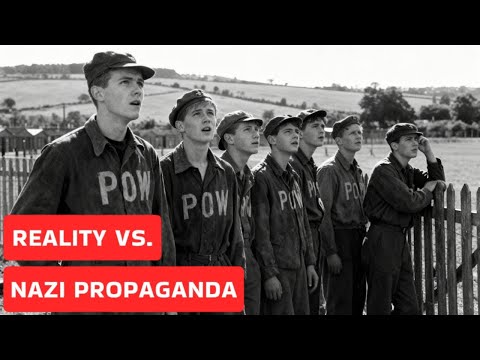
May 1945. The war in Europe was over, and over 400,000 German soldiers sat in prisoner of war camps, waiting to learn their fate. Among them was Hans Weber, a 24-year-old from Essen who had believed every word of Hitler’s propaganda for twelve years. He had been told that Britain was on its knees, bombed into submission, its people starving. He expected to see ruins, hunger, and despair when he was shipped to England.
But through a small gap in the canvas of a British military truck, Hans saw something that would crack his world open. Rolling green hills, intact stone cottages with smoke curling from chimneys, sheep grazing peacefully, children playing in a village square. Everything looked whole. Everything looked untouched. “This could not be real,” he whispered to himself. “This could not be England.”
Hans blinked hard, rubbed his eyes, and pressed his face closer to the gap. Other prisoners noticed and pushed in beside him. One man from Munich began to cry silently. Another whispered a single word: “Impossible.” But it was not impossible. It was real. The truck kept moving, and the green countryside kept rolling past, village after village, all functioning, all normal. Hans felt something crack inside his chest—the first hint that everything he had believed might be wrong. If Britain looked like this, then what else had been a lie?
The trucks arrived at Eden Camp in North Yorkshire late that afternoon. Barbed wire surrounded the compound, and guard towers stood at each corner, but the huts inside were clean and orderly. Hans expected watery soup and stale bread for dinner. Instead, the cook placed a thick slice of white bread on his tray—real white bread, not the dark, sawdust-mixed Kriegsbrot he had eaten for years. Next came margarine, strawberry jam, hot vegetable stew with visible chunks of potato and carrot, and a tin cup of tea with milk poured from a small pitcher. Milk. Hans stared at the white liquid swirling in his cup. He had not seen fresh milk in two years.
He sat down with the other prisoners. Nobody spoke. They just stared at their trays. One man squeezed the white bread gently, as if testing whether it was real. Another lifted his tea to his nose and inhaled the smell of milk. Then, slowly, they began to eat. Hans ate every bite and felt his stomach, tight with hunger for so long, finally relax. Later, he learned that each prisoner received 2,900 calories every day—more than German soldiers had gotten even in 1944. An older prisoner named Friedrich, a former school teacher, said what everyone was thinking: “They feed us better than we fed ourselves before the war started.” Nobody argued. It was simply true.
After two weeks, Hans was assigned to work on a local farm. The farmer, Mr. Thompson, had two tractors—old and rusty, but working. In Germany, most farms used horses because there was no fuel. Here, even with rationing, farmers had enough petrol to run machines. The barn had electric lights. The fences were properly maintained. Everything worked. Everything functioned. This was a country that had been at war for six years, and yet it still operated like a normal place.
Around mid-morning, Mr. Thompson’s wife came out with a thermos and a basket. She poured hot tea and handed cups to the prisoners. She smiled at them, not with pity or hatred, but with simple kindness. “You boys must be thirsty,” she said. Hans accepted the cup with both hands and nodded his thanks. She saw them as human beings, not monsters or enemies—just young men far from home.
That night, lying in his bunk, Hans could not stop thinking about what he had seen. The British were supposed to be finished. Goebbels had said so a thousand times. The V2 rockets were supposed to have destroyed their will to fight. But the countryside was unbroken. The lights still worked. The trains still ran. Hans found a scrap of paper and a pencil stub. He wrote carefully in small letters, hiding the paper under his mattress when he was done. The words were simple, but dangerous: If they lied about Britain, what else was a lie? He did not know the answer yet, but the question kept him awake long into the night.
That question followed Hans through the long, cold months at Eden Camp. It was still with him when the British camp commander ordered all prisoners into the largest hut on a Tuesday afternoon in November 1945. A projector whirred to life, and the images on the screen changed everything. Piles of bodies. Bulldozers pushing the dead into pits. Living skeletons reaching out with stick-thin arms. Bergen-Belsen. Auschwitz. Dachau. The narrator’s voice explained that millions had been murdered simply for who they were.
When the lights came back on, Hans could not move. His hands shook. He had heard whispers during the war and dismissed them as enemy propaganda. Now he understood. The propaganda had been on the other side. Germany had lied about everything.
That night he lay staring at the curved metal ceiling and thought of the farmer’s wife with her thermos of tea. The village children who waved. The nurse who bandaged his hand with such care. The British had every reason to hate Germans, and yet they fed them, housed them, treated them like men. He whispered into the darkness: “They treat us with more humanity than we treated anyone.”
Spring came, and Hans was sent to Sheffield to help rebuild bombed houses. He worked beside a British builder named George, who shared his cigarettes and taught him the English words for hammer, nail, saw, brick. One day Hans asked why he was so kind to German prisoners. George was quiet for a moment. “My son died at Normandy. He was nineteen. A German bullet killed him.” Hans’s face burned with shame, but George held up his hand. “War’s over, mate. You’re just a bloke now. Just a man. No point in hating you for what’s already done.”
Just a man. Not a Nazi. Not an enemy. The words cut through everything Hans had ever been taught. In the camp library he read about democracy, about the Nuremberg trials, about the Nazi leaders he had once called heroes now standing in a dock as criminals. The British countryside had been the first crack in his worldview. The films had shattered it. Now he was rebuilding himself, one new thought at a time, learning that strength was not cruelty or conquest—it was George sharing his cigarettes though his son was dead.
August 1948. Hans stood on a railway platform with a small cloth bag. Inside were a bar of soap, a tin of English tea from the farmer’s wife, and a set of carpentry tools Mr. Thompson had pressed into his hands. “You’ll need these more than I will,” the farmer had said. The train rolled south through the green hills one last time, and Hans pressed his face to the glass, memorizing every field and steeple.
Then the train crossed into Germany, and the world changed. Bomb craters beside the tracks. Burned-out tanks rusting in fields. Aachen a mountain of rubble. When he finally reached Essen, the station roof was gone, open to the sky. His mother’s building was half destroyed. She opened the door looking seventy at fifty-two, and pulled him into a sobbing embrace. “Hans. You’re alive. You’re home.”
That evening she made thin potato soup and apologized there was not more. She asked if the British had hurt him. Hans set down his spoon and looked at the cardboard covering the window. “Mutti, they fed us better than we are eating right now. They gave us warm beds and medical care. They treated us like men, not animals. And we—we believed we were gods.” His mother was silent a long time. Then she said, “We were lied to, all of us, for so many years.”
In the years that followed, Hans became part of the generation that rebuilt Germany. He used his carpentry skills to help build houses, and in 1950 he found the courage to write to Margaret, the secretary from Sheffield. She wrote back. They exchanged letters for two years, carefully and shyly, and in 1952 he traveled to England and married her. They returned to Essen and raised three children. When they were old enough to ask questions, Hans hid nothing. “I learned more about civilization in a Yorkshire prisoner of war camp than in twelve years of the Third Reich,” he told them.
In his final years, his grandchildren always asked about the war, and he always came back to the same memory: the canvas flap blowing open on that truck in May 1945, the green hills rolling away forever, the churches standing tall and whole. “Those green hills were proof,” he said. “You do not need to conquer to be prosperous. You do not need to be cruel to be strong. You do not need lies to have pride.” He looked out the window at the rebuilt city and smiled. “I went to war for a lie, but I was captured by the truth. And the truth was green and rolling and kinder than anything I had been told to believe.”
Hans lived to be an old man, and every day he tried to deserve that second chance to be human. But the question he first scratched onto a scrap of paper in 1945 is one that still belongs to all of us: when the lies we have been told finally crack open, will we have the courage to look through the gap and see the truth?
Report this article
Select a reason for reporting:






