It was never meant for the desert. Never meant for the SAS. The Vickers K machine gun was born to roar from the open cockpits of biplanes, a fast-firing answer to the fleeting seconds of aerial combat. Yet in the hands of Britain’s elite raiders, it would become something else entirely—a weapon of shock, speed, and legend.
When the first SAS mission ended in disaster, the unit’s future hung by a thread. Parachuted into the desert, scattered by weather, captured or killed—Operation Squatter nearly wiped out the Special Air Service before it could prove its worth. But David Stirling and his men refused to die. They turned to the long-range desert group and their rugged trucks, and then to something even more audacious: the Jeep.
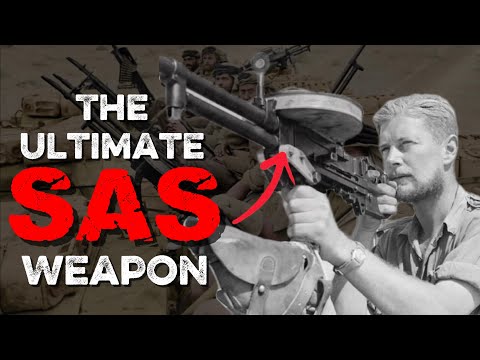
Stripped of windshields, loaded with fuel, water, ammo, and spare tires, these Jeeps became chariots of fire. And at their heart, twin Vickers K guns, their flat drum magazines perched on top like a deadly crown. Firing up to 1,200 rounds per minute, the Vickers K could shred a parked aircraft, a fuel truck, or a guard post in the blink of an eye. In a raid, there were no second chances—only seconds. The Vickers K made every second count.
The gun’s origins were far from glamorous. Developed by Vickers Armstrong in the late 1920s, it was an aircraft gun, designed for the tight windows of aerial dogfights. Its gas-operated system and open bolt allowed a blistering rate of fire, but the wide drum magazine made it awkward for wing mounts. As the RAF shifted to belt-fed Brownings, the Vickers K was pushed aside—relegated to second-line aircraft, airfield defense, and eventually, the hands of commandos and desert raiders.
In the vast Western Desert, where sand and heat jammed lesser weapons, the Vickers K earned a reputation for reliability. It was light enough to mount on a Jeep, powerful enough for hit-and-run attacks, and forgiving under brutal conditions. The Long Range Desert Group swore by it. Then the SAS did too.
At the airfield of Sidi Haneish, the Jeeps attacked in a single formation, guns blazing. Aircraft exploded, tents shredded, and the desert night lit up with tracer fire. The Vickers K turned a raid into a rout, and then covered the retreat as the raiders vanished into the darkness. It wasn’t just an offensive weapon—it was a lifeline. When pursuit came, the gun’s rapid fire suppressed, disrupted, and broke contact.
Its one weakness was the drum magazine, holding roughly 100 rounds—often loaded lighter to avoid jams. At such a high rate of fire, ammunition vanished fast. Gunners learned to fire in controlled bursts. But on a moving Jeep, that limitation mattered less than it would for infantry. Speed was the SAS’s armor, and the Vickers K was their sword.
By 1943, the SAS had moved beyond the desert—into Sicily, Italy, and eventually Northwest Europe. The Vickers K stayed with them, mounted on Jeeps and light vehicles, used by airborne scouts and raiding parties. It became more than a weapon; it became a signature. In photographs of SAS Jeeps, the twin Vickers K with its flat drums is unmistakable—a symbol of a unit that refused to play by the rules.
The gun was declared obsolete after World War II, but its legend only grew. For the SAS, the Vickers K was never just a machine gun. It was the sound of defiance, the spark of a second life, and the proof that sometimes, the right weapon in the wrong hands changes history.
But the story of the Vickers K did not end with the surrender of Germany. In the years that followed, as the British Army retooled for a new kind of war, the weapon faded from official records. Yet it lingered in the memories of the men who had fired it. Veterans of the desert raids spoke of it with a strange affection, the way one speaks of a comrade who had saved their life. They remembered the roar, the smell of cordite, the way the twin drums caught the sun.
Some of the guns found their way into the hands of new units—colonial police forces, irregular fighters, and the early special operations troops who would become the modern SAS. In Malaya, during the Emergency, a few Vickers Ks were reportedly mounted on armoured trucks and patrol boats. The old aircraft gun, designed for a war that no longer existed, kept fighting.
Collectors and historians later rediscovered the weapon. Museums displayed it behind glass, its flat drum magazine frozen in time. But for those who knew, the Vickers K was never a museum piece. It was a tool of violence and survival, a weapon that had been discarded by one branch of service and embraced by another.
There is a photograph, taken in North Africa in 1942, that captures the essence of the weapon. A Jeep, stripped bare, its crew coated in dust. Two Vickers Ks mounted in tandem, the gunner’s hands gripping the spade grips, his eyes fixed on the horizon. Behind him, the desert stretches to infinity—empty, indifferent, and deadly. The gunner is not posing for history. He is waiting for the next target.
That is the truth of the Vickers K. It was never meant to be iconic. It was meant to fire fast, fire hard, and then disappear. And in the hands of the SAS, it did exactly that. It was the right weapon at the right time, and that is all any soldier can ask for.
Today, the Vickers K is remembered as a symbol of a lost era of warfare—when small teams of men in light vehicles could change the course of a campaign. It was not the most accurate weapon. It was not the most modern. But it was fast, it was reliable, and it was there when it mattered.
And perhaps that is why it endures. Not because of its technical specifications, but because of what it represented: the willingness to fight with whatever was available, and the courage to use it well.
But there is another chapter to this story, one that unfolded not in the desert heat but in the humid jungles of Southeast Asia. When the Malayan Emergency erupted in 1948, British forces found themselves fighting a very different kind of war. Communist guerrillas moved through dense rainforest, striking without warning and vanishing before a response could be mounted. The old rules of engagement did not apply, and the old weapons did not always fit.
Once again, the Vickers K found itself in demand. It was mounted on armoured trucks and patrol boats, its rapid fire perfectly suited to the sudden ambushes that defined the conflict. The weapon that had once torn through parked aircraft now shredded the foliage where insurgents hid. It was an odd afterlife for an aircraft gun, but the men who used it did not care about pedigree. They cared about results.
In Kenya, during the Mau Mau Uprising, a handful of Vickers Ks appeared on armoured cars and improvised fighting vehicles. The gun’s reputation preceded it, and its presence alone was sometimes enough to discourage an attack. It had become a talisman as much as a weapon, a reminder of the men who had first carried it into battle.
Historians have noted that the Vickers K was never formally adopted as a special forces weapon. It was never the subject of a grand procurement programme or a doctrinal manual. It simply worked, and men who needed results reached for what worked. That is the way of elite units throughout history—they improvise, adapt, and make do with what is available.
By the 1960s, the Vickers K had largely disappeared from active service. The British Army had moved on to belt-fed general-purpose machine guns, and the old drum-fed aircraft gun was relegated to storage depots and the memories of old soldiers. But the legend refused to die.
In the 1970s and 1980s, a new generation of special forces operators rediscovered the photographs and the memoirs. They saw the twin Vickers Ks mounted on those desert Jeeps and understood something fundamental about their craft. Warfare is not just about technology. It is about spirit, audacity, and the willingness to fight with what you have.
The Vickers K became a symbol of that ethos. It appeared in films, in books, and in the training halls of special forces units around the world. Recruits were shown photographs of those desert Jeeps and told the story of Stirling and his men. The weapon became a teaching tool, a reminder that the SAS had been born from desperation and daring, not from bureaucracy and budgets.
Today, original Vickers K guns are highly sought after by collectors. A well-preserved example with its flat drum magazine can command a significant price. But the men who actually fired it in anger are mostly gone now, their stories fading with them. What remains is the legend—and the lesson.
The lesson is simple. A weapon is only as good as the hands that wield it, and the cause that drives them. The Vickers K was never the best machine gun of its era. It was never the most accurate or the most advanced. But in the hands of the SAS, it became something more than the sum of its parts.
It became a symbol of a moment in history when a small group of men, armed with discarded weapons and improvised vehicles, changed the course of a war. They did not wait for permission. They did not ask for better equipment. They simply fought with what they had, and they won.
And that, perhaps, is the true legacy of the Vickers K. Not the metal and the mechanism, but the spirit it represents. The spirit of the irregular, the outsider, the one who refuses to accept the limitations imposed by others.
In the end, the Vickers K was declared obsolete long before its story was truly over. It was removed from official inventories, sold off to foreign armies, and forgotten by the institutions that had once relied on it. But the men who carried it into battle never forgot.
They remembered the way it felt in their hands, the way it roared when they pulled the trigger, the way it spat fire and death at a rate that seemed almost impossible. They remembered the confidence it gave them, the knowledge that they could outgun anything they might face.
And they remembered the men who stood beside them, the ones who did not come home. The Vickers K was their weapon, and it was their memorial.
So the next time you see a photograph of an SAS Jeep in the desert, look closely at the guns mounted on the back. They are not just machines. They are monuments to a generation of warriors who fought with what they had, and made history with it.
And yet, for all its fame, the Vickers K was never meant to be a hero. It was a stopgap, a castoff, a weapon that had already been replaced when the desert war began. But history has a way of elevating the unlikely. The men who mounted it on their Jeeps did not care about its origins. They cared that it worked—that it fired faster than anything else they could get their hands on.
That is the final lesson of the Vickers K. Legacy is not granted by official adoption or careful design. It is earned in the dust, the heat, and the chaos of battle. The gun was obsolete before it became iconic, and that is precisely why it endures. It reminds us that the best tools are not always the newest—they are the ones that answer the call when everything else fails.
So when you see those twin drums in an old photograph, remember: the weapon was never the point. The men were. And their story—improvised, audacious, and utterly human—is one that will never be obsolete.
What other forgotten weapons do you think deserve a second life in the hands of history’s most daring warriors?
Report this article
Select a reason for reporting:






