The Japanese soldiers had a saying: “Java is heaven, Burma is hell, but no one comes back alive from New Guinea.” They weren’t exaggerating. The 18th Army, sent to seize New Guinea from the Australians, began with roughly 140,000 men. When the war ended, only 13,000 were still alive. Over 200,000 Japanese soldiers died across the entire island campaign—most not from bullets, but from starvation, disease, or simply vanishing into the mountains and swamps.
This is the story of how an army dissolved piece by piece in the most remote corner of the world, far from home—and of the Australians who stood on the other side of every disappearance.
New Guinea is the second-largest island on Earth. It sits directly north of Australia and south of the Philippines, stretching 1,500 miles long. Along its spine runs one of the most mountainous terrains on the planet, with peaks exceeding 4,000 meters. Beyond the mountains lie rainforests among the densest on Earth. Its rivers don’t flow so much as branch, and its coasts are guarded in many places by mangrove swamps that reach miles inland.
In 1942, most of it had no roads, many of it had no maps, and almost none of it had the kind of infrastructure any modern industrial army takes for granted.
Japan needed it in 1942 because controlling New Guinea’s northern coast meant possessing a shield in front of the great base at Rabaul—which was itself a shield in front of the home islands. Losing New Guinea meant Allied bombers from its northern airfields would soon be within reach of the Philippines, and after that, Japan itself. That was the strategic calculus. Holding it was, from the top, rational.
But what that calculus didn’t account for was the nature of the land.
Let’s start with the numbers. 140,000. 13,000. Subtract one from the other and you get 127,000 men. That is the number that vanished. Killed, wounded to death, drowned, starved, felled by malaria and dysentery, driven mad by the jungle, and lost forever in a country with no roads and no names on any map they could read. 127,000 Japanese men on an island most of them had never heard of before they were sent there.
The men in question, by and large, were not fools. They were regular soldiers of the Imperial Japanese Army. They came from Kyushu, from the Kanto plain, from the mountains of Ishikawa. They had trained hard. Their divisions had names and traditions and battle honors. They believed, as their leaders believed, that they were fighting for the survival of their empire. They were, on the day they arrived in New Guinea, an army in every sense of the word.
And when it was over, out of every hundred of them, nine were left alive.
That is the arithmetic of this story. What follows is the accounting of the reasons, one by one.
The 18th Army was formed in November 1942, on paper, at Rabaul on the island of New Britain. That is the great harbor at the northeastern tip of the island chain. The anchorage that gave Japan its bomber base and its supply hub for everything south of the Philippines. Its purpose was written in the order that created it. Its objective was to counter Allied landings on Japanese-occupied New Guinea.
Its commander was Lieutenant General Hatazo Adachi. He was 52 years old when the task was given to him. He was, in the words of one American opponent, a soldier devoted to his emperor. He had come up through the traditional path—elementary school, military academy, the Guards Regiment, the Staff College, to command of a division in China. Then came the promotion to his own army on an island he had never seen.
This army was built around three divisions. The 20th Division, raised in Kyushu in southern Japan, and the 41st and 51st Divisions, formed from men of the Kanto region around Tokyo. With support troops, engineers, artillery, signal units, air units, and naval infantry attached where needed. In total, over the course of the campaign, the army was supplied with roughly 140,000 men.
They were sent because the situation in New Guinea had already changed by early 1943. The Japanese advance toward Port Moresby had been stopped on the Kokoda Track in the Owen Stanley Range a year earlier by the Australians. The beachheads at Buna, Gona, and Sanananda on the north coast had been rolled back by Americans and Australians together during the summer. What was left of the former Japanese army in Papua was already, by January 1943, on the losing side of history.
Adachi’s mission and his army’s was to hold the northern coast of New Guinea and push the Allies into the sea before they crossed it.
The army was nicknamed in the traditional Japanese way with a single character: “Mo,” meaning fierce. That was the name the 18th Army carried unofficially throughout the campaign. It is worth noting, because it is easy to overlook at first, that this was not a random formation. It was a professional field army of one of the largest and most disciplined military organizations in the world. Its men had undergone the same rigorous training as their comrades in Manchuria and Malaya. Many of its officers were veterans of the China war. It arrived in New Guinea disciplined and with the instructions of an army that had spent a decade achieving victories.
Adachi himself is recorded, upon taking command, to have addressed his troops in an unusual speech. According to official Japanese history, he asked them to do everything with love. That was not the kind of speech a Japanese army commander of that era was accustomed to giving. The speech left an impression on the men who heard it. Whatever was said about Adachi over the next three years—and there would be hard things said—he began his command by urging his men to hold on to their humanity in a country that would try hard to strip it from them.
They never held on to it.
From the moment they arrived, they were on the defensive, and from the moment they arrived, their numbers began to shrink.
The first subtraction happened before their feet touched the ground.
In early March 1943, the 51st Division was loaded onto eight transport ships at Rabaul and sent south to Lae on the north coast of New Guinea, escorted by eight destroyers. American and Australian aircraft found the convoy in the Bismarck Sea two days out. Over two days of low-level bombing and strafing runs, they sank all eight transports and four of the destroyers with them. Roughly 3,000 men of the division were killed at sea. Some drowned. Some were killed on the decks of burning transports. Some were killed in the water afterward in a series of actions that Allied aircrews described in post-mission reports and did not much like to talk about later.
Adachi himself was nearly among the convoy. He was traveling separately on a destroyer that came under attack, but he survived. The men who reached Lae or were pulled from the water and returned to Rabaul were the remainder. About 2,400 of the division’s original strength were rescued and eventually landed. The rest were gone.
The division still existed on paper. It still had a commander. It still held a place in the order of battle. What it did not have was the 3,000 men it had been sent with, or the equipment they had carried, or the heavy weapons that had gone to the bottom with them.
That was one battle. The first battle, and the 18th Army had lost the equivalent of a full infantry regiment before a single one of its soldiers set foot on the ground he had been sent to defend.
There was a second consequence of the Battle of the Bismarck Sea, and it was more important than the numbers. After that convoy, the Japanese command at Rabaul made a decision it never reversed. They stopped trying to reinforce or supply New Guinea by ship on direct routes. From that moment, everything Adachi’s army needed had to come by smaller, more complicated means. Barges sneaking along the coast at night, submarines that could carry little, and occasional aircraft. The daily flow of supplies that kept the 18th Army fed and armed slowed, then in the months that followed, nearly dried up entirely.
The Battle of the Bismarck Sea did not just kill 3,000 men. It permanently changed what the rest of the army could get.
The second subtraction happened in the mountains in September of that same year.
The Australians took Lae in early September 1943. They took it in a two-pronged operation. One force landing east of the town from the sea, another dropping by parachute into the Markham Valley to the west and advancing toward it. The Japanese garrison at Lae and its associated garrison at the small port of Salamaua to the south chose not to fight for the town. Instead, they chose to withdraw north.
There was only one way to withdraw north. There were no roads. There was no coastal track left because the Australians had cut it. There was, west of Lae, a mountain range called the Saruwaged. It rose over 4,000 meters. It was covered at its summit by cloud forest and in some months by snow. No organized military force had ever crossed it before.
But it would be crossed now.
About 8,000 men were ordered up it. They were given rations for 10 days. They were told to walk over the top and down to the coastal plain in the north. More than 2,000 of them never came down.
They died of starvation because the 10-day rations were nowhere near enough. They died of exposure because the summits of the Saruwaged were cold in a way no man from Kyushu had any means to prepare for. They died of falls because the tracks they followed were not really tracks. They were only the trace of paths marked by the men who had gone before them. They died because they sat down in the mud one evening and did not get up in the morning. The men behind them stepped over them and kept walking.
There was no game to hunt at those altitudes. There were no villages to buy from or steal from. There was no fresh water that had not passed through the boots of the men ahead of them. At night on the summit, in the cold and the wet, men who had spent the last year in tropical lowlands tried to sleep without cover in soaked cotton uniforms. At 4,000 meters, the little sleep they got was not enough to restore their strength. Every morning they got up to walk, and every morning some of them did not get up.
The survivors came down the other side. They were, by any measure, a completely different army than the one that had gone up. They had left their heavy weapons behind. They had left their sick behind. They had left behind, in some cases, their confidence in the men who had ordered the crossing. They had walked, effectively, over the roof of the world in tropical kit, on rations that ran out in a week, over a mountain range that should never have been crossed on foot in the middle of a war.
Eight thousand went up. About six thousand came down. The rest are still up there. Their bones are somewhere inside the cloud forests at 4,000 meters.
That was the second subtraction. It was, from a purely arithmetic point of view, a smaller loss than the sea. But from a human point of view, it was worse. Because these men were not killed by an enemy at all. They were killed by geography. And by an order.
The third subtraction was slower, but it was the largest by every measure.
New Guinea in the 1940s was one of the worst places on Earth for a soldier. The air was hot. It was wet. The coasts were covered in mangrove swamps, the banks in kunai grass taller than a man, and the interior in one of the densest rainforests in the world. And it suffered, above all, from malaria. Malaria was present in it in a way and concentration that Western medicine did not fully understand until long after the war was over.
Malaria is transmitted by mosquitoes, specifically a type of mosquito that breeds in standing water in hot climates. New Guinea was a giant breeding pool for it. The Allies fought malaria with a combination of drugs—especially quinine and then a synthetic called atebrine—with disciplined use of mosquito nets, insect repellent, and preventive treatments. Their medical supply was built around this foundation. Their doctors monitored it. Their commanders punished units that slackened in vigilance.
The Japanese had almost none of that. They had some quinine at the start of the campaign. When the Rabaul routes and the sea routes north were cut, they had almost none left. They could not get supplies from home. They could not manufacture in the jungle. They watched, over the course of 1943 and 1944, what the mosquito did to their army that no Australian battalion could have done afterward.
The comparison in the medical records is stark. In an Australian infantry brigade fighting in the same area at the same time, malaria rates were often catastrophic on paper. Entire battalions went down with fever, but the Australian medical system caught almost all of them. Sick soldiers were pulled from the front lines. They were flown to a base hospital. They received a full course of treatment with the appropriate drugs. They received proper nutrition. They rested for weeks in proper beds, and most of them, afterward, returned to their units and served again.
In the Japanese battalions fighting in the same area at the same time, a soldier with malaria stayed where he was. He kept walking or he did not. He kept his ration or he did not. There was, in most cases, no bed, no plane, no ship, no medicine. The Australian sick went home. The Japanese sick died in place.
Malaria, by itself, does not usually kill a healthy adult man. It knocks him down. It puts him in bed for days. It returns in waves, weeks or months apart, and each wave takes something out of him he does not easily get back. If he is well fed and drinking water regularly and can rest during the acute phase, he survives. But if he is malnourished, or doing heavy labor or forced marches, or suffering from dysentery or beriberi at the same time, malaria will kill him.
The Japanese soldier in New Guinea from mid-1943 onward was suffering from all of it at once.
Dysentery is a bacterial infection of the intestines. It is spread mainly by drinking contaminated water. In a rainforest, in a war, with no ability to boil enough water for an entire battalion, everyone eventually gets it. It drains a man completely. It leaves him dehydrated and weak, and if untreated, he dies within days.
Beriberi is a disease caused by nutritional deficiency, specifically a lack of vitamin B1, found in whole rice, vegetables, and fresh meat. With the polished rice diet the Japanese army was increasingly forced to rely on, when supply lines were cut, beriberi appeared as swelling in the legs, then in the heart. In its advanced stages, the heart stops.
The soldiers of the Japanese 18th Army, once encircled, suffered from these three things at once. They kept them for months and then for years. There is no precise count of the men who died from these causes. Estimates for the campaign as a whole suggest more than half of all deaths were due to them. For the 18th Army specifically, later analyses suggest the vast majority of its dead perished from disease and starvation, not Allied fire.
When Australian doctors examined the survivors on Mushu Island after the war, they found that of the roughly 13,000 men brought in, more than a thousand died within weeks in the hospital from the diseases they had carried for years. In other words, the jungle killed more Japanese soldiers in New Guinea than the entire Allied land effort did.
The fourth subtraction is not a place or an event. It is a decision made by Adachi’s own high command in mid-1944.
During the first half of 1944, the strategy of the Americans under Douglas MacArthur was to bypass the strong Japanese positions on the northern coast of New Guinea entirely, rather than landing against Adachi’s main base at Wewak and fighting through it. The Americans landed to the west of it at Aitape and Hollandia on April 22, 1944. In one move, they isolated the 18th Army from any reinforcement, supply, or possibility of withdrawal to the west.
This was island hopping. It was not a new idea, but MacArthur used it in 1944 on a scale no one had before. Instead of grinding through every Japanese garrison along the coast toward the west, he simply bypassed them. He chose weakly defended stretches of coast, landed divisions there, built airfields on them within days, and then moved on to do the same thing a few hundred miles further along the coast. The strong Japanese positions in between were left where they were, on the theory that an army that cannot be supplied and cannot move is an army out of the war, regardless of how strong its garrison is on paper.
Adachi was placed on the wrong side of that theory. He had, on paper, an army of between 50,000 and 60,000 men still active in the Wewak sector. He had airfields. He had the largest Japanese air base in New Guinea. What he did not have, from April 22, 1944 onward, was any reliable route back, any reliable route to friendly forces, or any reasonable expectation of help.
Behind him, at Rabaul, the great base had already become useless. Air raids had reduced its naval fleet. The Solomon Islands campaign had cut its southern approaches. Its garrison, another army, stayed in place until the end of the war, tending gardens.
Five hundred miles west through the jungle ahead of Adachi lay the rest of the Japanese Second Army, which was impossible to reach on foot under the conditions and time available to his men.
The Imperial General Headquarters in Tokyo, faced with this situation, did what headquarters sometimes do when good solutions are absent. It ordered the 18th Army to be self-sufficient, to grow its own food, to live off the land, to conserve ammunition, and to take no strategic initiative that required supplies it did not have. In other words, to disappear from the strategic picture while continuing to exist.
The chief of staff of the 18th Army, Lieutenant General Kane Yoshihara, later described his army’s situation with a phrase that stayed with it. Death in staying and death in leaving. If they stayed at Wewak, they would starve. If they crawled west to try to join the rest of the army, they would starve on the way and never arrive. If they attacked the Americans at Aitape, they would expend their last ammunition and their strongest men in a battle they could not win. Every path available to Adachi and Yoshihara was a form of death.
The soldiers on the ground, of course, did not know this phrase. They did not know the strategic situation in that language. But they knew that the flow of supplies they had been receiving until April 1944 had stopped. They knew that their rice rations were being cut and cut and cut again. They knew that ships had stopped coming. They knew that when they got sick now, the sickness got worse and lasted, and they did not get better.
That was the physical manifestation of the decision made about them in Tokyo. From April 1944 until the end of the war, an active army of 50,000 to 60,000 men in New Guinea lived on rations that were not enough to keep them alive.
That is the fourth subtraction. It is a decision, and it lasted for 16 months.
The fifth subtraction was a battle, and it was Adachi’s own decision.
He could have done nothing. His leadership had effectively told him to. But Adachi was a particular kind of soldier in a particular kind of army in a particular kind of century, and sitting idle while his men starved was not an option in his moral world. He decided to attack.
The target was Aitape, 94 miles west of his headquarters at Wewak. There was an American garrison there holding an airfield, and if he could take it, he would take with it enough food, ammunition, and American medical supplies to keep his army in the field for another campaigning season. He had to march toward it. He had to fight for it in a country with no roads. He had to do it with what his men could carry on their backs.
He set out in mid-1944. His main axis of advance was on the Driniumor River and beyond it, a small stream between Aitape and Wewak. He was opposed by several American divisions of the U.S. Sixth Army under Lieutenant General Walter Krueger, entrenched behind the river with artillery, air support, and an effective supply line running to the beach.
Adachi himself took part in the main attack, on foot. He left his chief of staff, Lieutenant General Kane Yoshihara, at Wewak with the impossible task of keeping the attacking columns supplied. There were no trucks. There were, in most places, no suitable tracks. Every bullet, every biscuit, every field dressing, every mortar shell that reached the front was carried on a man’s back. Yoshihara’s supply parties walked forward, unloaded their cargo, and walked back to bring the next load. The men doing the walking ate from the same rice bowl themselves.
The daily rice ration for a soldier in Adachi’s attacking columns in the summer of 1944 is recorded. It was less than 12 ounces. Biscuits, when available, came every two or three days. Cigarettes came three at a time every 10 days. The men supplemented what they got with sago palm leaves cut along the way, eating grass, chewing the pith of certain trees, and malnutrition set in among the ranks, along with everything else.
Adachi initially ordered each column to cover 8 miles a night. That was a realistic distance in that country for a fed and rested army. But his army was neither fed nor rested. The advance slowed. The columns abandoned the stragglers who could not keep up. The men reached the assembly area on the Driniumor River while their strongest formations were already exhausted from the march to get there.
The battle that resulted, which the Americans called the Battle of the Driniumor River and the Japanese called Operation Aitape, lasted from July 10 to August 25, 1944. It was essentially a series of Japanese attacks across the river and a series of American counterattacks in terrain so dense that most of the fighting was at rifle range or hand-to-hand when the ground allowed, and with artillery when there was time to call for it.
American casualties were about 440 killed and 2,550 wounded. Japanese casualties were between 8,000 and 10,000 men killed and wounded. Contemporary Japanese sources put the figure at about 9,000. The exact record was never closed because many of the wounded died of infection in the days that followed in the jungle, and their bodies were not counted by anyone.
The attack failed. The airfield was not taken. The supplies were not seized. The army walked back east to Wewak with less than it had when it walked west, with a fight to the death waiting, as its survivors later put it.
That is the fifth subtraction, 9,000 more men on top of everything that had come before. By the end of it, every division of Adachi’s four divisions had been reduced, roughly, to the strength of a single regiment. That is a formal way of saying that three-quarters of every division had vanished.
The sixth subtraction is the one this channel follows in greater detail because it concerns the Australians.
By late 1944, the Americans were finished with the northern coast of New Guinea. They had more important targets. They were preparing for the invasion of the Philippines. They needed their divisions elsewhere. The Australians were assigned the task of eliminating what was left of the 18th Army at Wewak and around it, specifically the Australian 6th Division under Major General Jack Stevens, based at Aitape.
The Australians began arriving in October 1944. They took over the American positions. They looked at the ground in front of them, at the Torricelli Mountains running along the coast, at the coastal plain, at the Japanese base at Wewak and the supply gardens inland at Maprik. They planned two axes of advance, one along the coast east toward Wewak, the other inland over the mountains toward Maprik. They began advancing in November.
The campaign that followed, the Aitape-Wewak campaign, lasted 9 months. It continued until the end of the war in August 1945. It was, in the language of the time, a mopping-up operation. That description became controversial later, because by 1945, with no serious doubt about the outcome of the Pacific War, there was a case to be made that the campaign was not strictly necessary. But it was fought anyway.
The Australian view of the country in which the battle was fought was recorded by soldiers of the 6th Division in a way that captures the nature of the fighting. The coastal crawl moved through swamps and secondary jungle under almost constant rain along a strip of land between the sea and the Torricelli Mountains, where every stream was a crossing to be made and every ridge a potential ambush. The inland crawl moved up over the Torricelli Mountains themselves at elevations the Australians called foothills—because they had grown used to the word after a year of war, though they would be considered mountains in most other countries.
The New Guinean carriers who moved the wounded to the coast walked for days with stretchers suspended between bamboo poles to accomplish it. Some of the wounded survived the trip. Some did not.
For the Japanese, this was the final subtraction. Between November 1944 and August 1945, the Australians killed between 7,000 and 9,000 men of the 18th Army in combat. The tactics of their small units, their firepower, their air and naval support, and above all, their supply and medical services, were far superior to anything the Japanese had. Fighting took place at every position. In the end, almost every position was taken. In addition to battle deaths, another 14,000 men of the 18th Army died in the same campaign from starvation and disease. This is not a battle statistic. This is a slow catastrophe. Fourteen thousand men, most of them far too sick to fight, died in villages and gardens and jungle clearings away from the coast over 9 months while the Australians advanced in front of them.
The Australians lost 442 killed and 1,141 wounded in the campaign itself. They had more than 16,000 hospital admissions due to disease, because the nature of the country does to any army in it what it did to New Guinea. But the Australians could evacuate their sick. They had medicine. They had planes. They had ships. Most of their sick returned to duty or went home. The Japanese had none of that.
The coastal area of Wewak fell on May 15, 1945. The Australians took the town. What was left of the Japanese, some sick, some starving, some still capable of laying ambushes, withdrew into the mountains behind it. The crawl inland continued. It was still going on in scattered patrols when the war ended in mid-August.
That is the sixth and final subtraction. Twenty-three thousand more Japanese lives, between 7,000 and 9,000 of them in combat, and 14,000 of what the Australians in a hospital wing would have called the excess losses.
If you add up the six subtractions, you do not get the whole truth. The gap between 140,000 and 13,000 is larger than any single event. It is filled with smaller things. The individual operations on the Huon Peninsula in 1943, the Australian advance over the Finisterre Range in 1944, the naval bombardment of villages known to contain Japanese, the air raids on marching columns, the ambushes in the passes, the men who fell out of the ranks and were not counted in or out. And it is filled with what that phrase meant in practice over the last twelve months.
By early 1945 in the mountain villages behind Wewak, there were Japanese units that had run out of everything—ammunition, rice, medicine, salt, boots, uniforms that had not been replaced on their bodies. In some units, the men’s condition reached the point of eating grass, sago palm, and roots they dug from the ground with their bayonets. And in some units, at the extreme edge of suffering, they resorted to eating the dead. There are documents confirming this from both sides. This is not the whole story of the 18th Army, and it is not the story of most of its men, but it happened. And any honest accounting of what New Guinea did to these men must include the fact that it happened.
The soldiers who did not resort to that, and they were far more numerous, died in greater silence. They died in field hospitals that lacked medicine. They died on stretchers carried by comrades who could barely walk themselves. They died in beds made for them by their comrades in shelters of leaves in the middle of an open clearing. And the men around them buried them where they fell. Some of them, in the end, wrote letters home and gave them to their comrades in the hope that one of them might eventually get out and deliver the letter to Japan. Very few of those letters ever arrived.
Adachi, at Wewak, starved with them. This is documented in the records. He issued orders that no officer of the 18th Army was to eat better food than his men. He himself ate the same rations. And he gave priority in the available medicine to the sick who could be saved, not to officers who might continue to fight. That did not save many of them in the end. But it gave the army a discipline and internal loyalty that held it together in the records until the moment of surrender.
By early 1945, most of the men of the 18th Army had privately reconciled themselves to the idea that they would not be going home, without saying it aloud. The letters they wrote in those months and the diaries they kept say the same thing in different handwriting. They wrote about their families as people they would not see again. They wrote about their home villages as places they remembered, not as places they would return to. They wrote to their children as if addressing them from behind a wall. The saying they had once traded as a kind of dark humor had become, by the last winter of the war, an accurate description of their situation.
This is what that saying meant. Java is heaven. Burma is hell. But no one comes back alive from New Guinea.
On August 15, 1945, Japan announced its surrender. The news of the surrender reached the Japanese units still holding out in the mountains inside Wewak over the following days. Some of them, at first, did not believe it. Some small isolated garrisons scattered along the northern coast held out for another week before orders reached them.
On September 13, 1945, at a place on the coast called Cape Wom near Wewak, the remaining officers and men of the 18th Army came out of the interior and the coastal villages and formally surrendered to the Australian 6th Division. We are told it was a small ceremony. What is worth counting on this channel is not the sword or the surrender itself. It is what walked toward captivity that day and in the days that followed: about 13,000 men out of 140,000. 13,000 only.
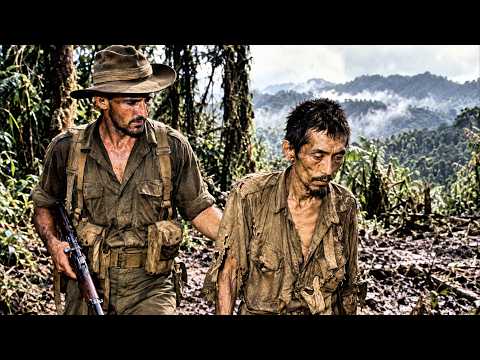
Most of them were sick. They were extremely emaciated. Their uniforms were rags. The Australian medical officers who examined them wrote notes on their condition that resembled famine reports, not surrender reports. They were moved offshore to Mushu Island to organize proper medical sorting, feeding, and eventual repatriation. Within weeks, more than a thousand of the survivors died under Australian care from the diseases they had already been suffering when they arrived. Even a modern hospital and a full ration cannot always reverse what years of malaria and starvation have done to a body.
On Mushu, the Australians organized the survivors under their remaining officers. They gave them work, rations, and medicine. They photographed the sickest of them. The photographs are still in the war archives. A weight of 40 kilograms was not unusual for a man who had been walking a year earlier with a full pack. Some of the worst could not sit up in their beds. The Australian doctors did what they could. Some men lived because of it. Others had reached a point where no medical intervention could save them. The rest were restored over months to a semblance of health, and then eventually shipped home to Japan.
They went back to a country that was itself in ruins. They went back to cities they had left as young men, and to families who had in most cases given up hope of their survival years earlier. They were the 13,000. The 18th Army was part of what happened in New Guinea. It is the part that fought the Australians in the longest and most bitter form, and it is the part this text has followed. The larger picture was worse. The New Guinea campaign, in its broad sense, extended from January 1942 to August 1945 and cost the lives of approximately 202,100 Japanese soldiers, sailors, and airmen. That is an official total derived from post-war Allied compilations and compared with Japanese records where those records survived. About 127,000 of those deaths occurred on the main island of New Guinea. Another 44,000 occurred on Bougainville. And 30,500 in New Britain, New Ireland, and the Admiralty Islands. In the related operations that encircled Rabaul, more than half of those 200,000 men died, by any reasonable estimate, from something other than bullets. They died of disease. They died of untreated wounds that could have been healed in a hospital. They died of starvation. Some students of the campaign put the non-combat death rate at 97%. That is a claim that has been debated, but even the most conservative estimates put the non-combat death figure well above half.
For the Allies, this campaign cost about 42,000 casualties, of whom about 7,000 were killed. American losses on the main island of New Guinea were about 7,000 killed. Australian losses were also about 7,000 killed. Across all the campaigns from Kokoda in 1942 to Wewak in 1945, the disparity in the accounts between the two sides was not because the Japanese were bad soldiers. It was because they were fighting an enemy that kept pushing them away from anything that could keep them alive.
The American general Robert Eichelberger, who commanded American forces in some of the fiercest and earliest battles on the northern coast, gave his final word on Adachi and his army after the war. He wrote in his memoirs: “The most bitter fighting of the Pacific island campaign was against Adachi’s 18th Army.” He knew that well. He had been on the other side of it.
Let us return now to where this story began. The Japanese soldiers had a saying: “Java is heaven, Burma is hell, but no one comes back alive from New Guinea.” They were not using rhetoric. They were describing reality. Java, with its plantations and its climate and its relatively comfortable occupation duties, was the place a Japanese conscript in the middle years of the war hoped to be sent. Burma, with its jungles and its British enemy and its long lines of communication, was the place he feared. New Guinea was the place from which, in their common phrase, no one returned.
The accounting is as follows: 140,000 men, 3,000 in the Bismarck Sea, another 2,000 in the Saruwaged Mountains, 9,000 at Aitape, between 7,000 and 9,000 at Wewak, 14,000 from starvation and disease in the final campaign alone, and more than a thousand after the surrender. And the rest were scattered over three and a half years, by mosquitoes and empty rice sacks and contaminated river water, and endless walking under a low gray sky, across a country that had never wanted them and had never wanted anyone else.
It was not a battle. It was a subtraction. A subtraction without end and without consolation. 13,000 in the end. And even that number is generous. Of the 13,000 who walked at the surrender, a thousand or more died within weeks of it. Those thousand lived long enough to see a flag come down. But they did not live long enough to see Japan again. If the count is of those who actually reached home, the number is much smaller. About 11,000 or 12,000 men out of 140,000 sent returned to the country that sent them. 92 out of every 100 did not return.
They were, in that end, men. They were not villains. They were not heroes. They were sent to guard a wall of jungle with equipment that could not do the job against enemies who could. And most of them did what soldiers do. They carried out the orders they were given. They walked where they were told. They dug their trenches and fought when there was no other choice. And most of them died, not with weapons in their hands, but with fever in a shelter of leaves, somewhere they should never have been.
The Australians who finished the campaign, the Americans who bypassed it, and the people of New Guinea who lived in the shadow of both, all wrote about it afterward in a similar tone. It was not a victory. It was an ending. A count that had been going on, one number at a time, for three and a half years was finally allowed to stop.
140,000 went in. 13,000 came out. That is what New Guinea meant for the army Japan sent to hold it against the Australians. That is what the saying meant. Java is heaven. Burma is hell. But no one comes back alive from New Guinea.
Adachi himself was among the last to emerge. He came down from the mountains in a uniform that had long since ceased to resemble one, carrying a sword that had never been surrendered, and he handed it to an Australian officer without ceremony. He was not a broken man. He was a man who had watched 127,000 of his soldiers disappear and had somehow kept walking anyway.
He was tried for war crimes after the war—not for the deaths of his own men, but for the deaths of Allied prisoners. He was sentenced to life imprisonment. He died in prison in 1947, still in his fifties, of a heart worn out by years of the same starvation he had shared with his army.
His final letter, written to his family from his cell, asked for one thing: that the men of the 18th Army not be remembered as a lost cause, but as soldiers who had done their duty in a place that gave them nothing back.
The Australians who had fought him for nine months read the letter in the newspapers. Some of them, veterans of Wewak and the Torricelli Mountains, wrote letters of their own afterward. They did not call him an enemy. They called him a soldier.
So the subtraction ended. 140,000 went in. 13,000 came out. And the jungle, which had never wanted any of them, kept the rest.
What do you think—was Adachi a villain for ordering his men into a battle they could not win, or a leader for refusing to let them starve in silence?
Report this article
Select a reason for reporting:






