In the early days of March 1953, the world held its breath. An American ambassador quipped sarcastically, “Uncle Joe is sick in bed, the blood runs fast in his head. If he can’t walk and he can’t talk, by whom now are the communists led?” But in Moscow, the mood was far from humorous. Joseph Stalin, the absolute dictator of the USSR for nearly three decades, lay dying. As his doctors desperately fought to save him, his subordinates scrambled for position in the looming power vacuum. On March 5th, Stalin’s final battle ended, and the dictator was dead. The official cause: a hemorrhagic stroke. Yet, whispers of foul play have persisted for decades, with some researchers suggesting he was poisoned. What really happened in those final hours?
Stalin’s health had been deteriorating for years, but he paid it little mind. He was a man of immense control, micromanaging every detail of his political life and even the construction of his dacha. But his personal health was a different story. He barely exercised, smoked heavily until 1952, and indulged in rich, meat-heavy meals. His insomnia and relentless work ethic took a toll, and by his final months, his only medical care consisted of a few drops of iodine in water for hypertension. His main medical adviser? A bodyguard with veterinary training. Even his daughter was shocked by the quack treatments.
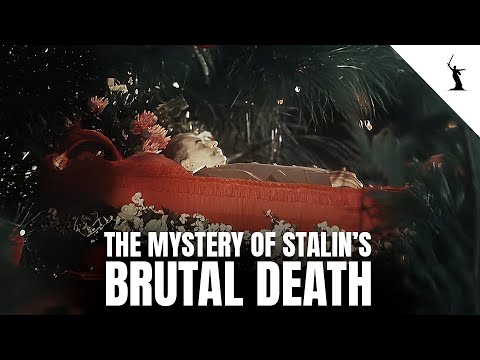
By March 3rd, doctors declared death inevitable. The Soviet government issued a statement admitting Stalin’s serious illness. As the world absorbed the news, a top-secret CIA report later revealed that the USSR was extraordinarily careful to avoid any implication of sabotage. On March 5th, Stalin’s condition worsened. He vomited blood twice, his blood pressure and pulse plummeting. This sudden turn surprised the doctors and aroused the suspicion of Nikolai Bulganin, who demanded an explanation. “Is that possible? Perhaps Stalin has stomach cancer,” he asked ironically. But the end was near.
With his last breath, Stalin suddenly opened his eyes and cast a terrible, insane, or perhaps angry and fearful look across the room. He raised his left hand in a strange gesture, as if casting a curse. Seconds later, he expired at 9:50 p.m. One assistant ran to the bed and began artificial respiration, but was quickly stopped. The room fell silent, contemplating the pitiful corpse before them.
The autopsy, published in Pravda, revealed extensive bleeding in the left cerebral hemisphere, significant hypertrophy of the left ventricle, and numerous hemorrhages in the myocardium, stomach, and intestines. The official conclusion: a hemorrhagic stroke caused by high blood pressure. But the report was brief and lacked detail. Just like Lenin before him, Stalin’s brain was removed and sent to the Brain Institute. The final report to the Central Committee stated the same: death by hemorrhagic stroke. Yet, the delays in treatment and the suspicious circumstances fueled speculation. Did his potential successors seize the opportunity to eliminate the paranoid leader? Or was it poisoning during that fateful night of drinking?
Each of Stalin’s closest associates had motives. Molotov’s wife had been arrested and exiled, and he harbored a deep grievance. Beria, Melenkov, and Khrushchev were all aware of Stalin’s declining health and the power vacuum his death would create. They harbored ambitions and feared Stalin’s unpredictable paranoia. Beria, in particular, is often considered to have had the most to gain. Rumors suggested he had fallen out of favor, and he made no effort to conceal his satisfaction. According to Molotov’s memoirs, Beria even boasted to the Presidium that he had eliminated Stalin and saved them all.
The conjecture that Stalin was murdered remains a topic of debate. The autopsy findings were consistent with a stroke, contradicting poisoning theories. But the autopsy was conducted in the Soviet Union, hardly a bastion of transparency. While there is no concrete evidence to prove poisoning, it is not beyond historical speculation. What is clear is that Stalin’s oppressive regime and brutal treatment of those around him fostered an atmosphere of fear and betrayal that contributed to his downfall. In an incident illustrating his growing distrust, he had a doctor arrested and imprisoned for suggesting he retire to reduce stress.
Now, let’s examine the poisoning hypothesis more closely. Although Beria likely had access to warfarin and a history of using poisons, it seems highly unlikely that Stalin was poisoned with it. First, Stalin himself was obsessed with the possibility of being poisoned. He had his food tested in laboratories and even kept rats as tasters. He encouraged his guests to drink heavily while he remained relatively sober. Even if Khrushchev’s account is correct and Stalin was a little dizzy that night, it is difficult to imagine a scenario in which Beria or another conspirator could have slipped an anti-coagulant into his drink. As Stalin himself said in 1951, “I don’t trust anyone, not even myself.” He would never have given his guests such an opportunity.
Second, warfarin is not a particularly effective poison for assassination. By 1951, it was known that vitamin K could neutralize its effects. With such a widely available antidote, it would have been reckless to use warfarin. Furthermore, while warfarin overdoses can cause gastrointestinal bleeding, it is extraordinarily unlikely that Stalin would not have presented with other symptoms of acute coagulopathy. In documented cases, symptoms included bruising, mucosal bleeding, and hematuria. Aside from his two episodes of hematemesis, Stalin showed no unusual bleeding. Additionally, it would have taken longer than 24 to 48 hours for symptoms to manifest. In one case, a family consumed warfarin-laced bait for several days before showing symptoms. In another, a patient delayed going to the emergency room for up to 9 days. The timeline for Stalin’s alleged poisoning does not align with his stroke.
Based on the evidence, it is almost certain that Stalin, a paranoid, inactive, and generally unhealthy man in his mid-70s with a long history of untreated chronic hypertension, died exactly as the Soviet government declared: of a hemorrhagic stroke in the left MCA secondary to his hypertension. Ultimately, it seems that Josip Broz Tito, dictator of Yugoslavia, was correct in his pronouncement on Stalin’s death: “Nature is allied with justice.”
And yet, the story doesn’t quite end there. Even if the medical evidence points toward a natural death, the political aftermath of Stalin’s stroke tells a different story—one of calculated silence and deliberate delay. When Stalin was found collapsed on the floor of his dacha on the morning of March 1st, his guards hesitated for hours before summoning help. They claimed they feared disturbing him, but the men who made that decision were not merely frightened servants. They were men who understood that the leader’s death would reshape the entire Soviet state, and every hour of delay served someone’s interest.
Consider the timeline. Stalin was discovered around noon, yet doctors were not called until the evening of March 2nd—nearly a full day later. By then, the stroke had already caused irreversible damage. His left side was paralyzed, his speech gone, his consciousness fading in and out. When the physicians finally arrived, they found a man who might have been saved with prompt intervention. Instead, they were treating a patient who had been left to deteriorate in a room filled with terrified men who watched him struggle for breath.
Who gave the order to wait? The records are murky, deliberately so. Some accounts blame Stalin’s guards, who insisted they had no authority to disturb the leader. Others point to Beria, who allegedly laughed when told of Stalin’s condition and said, “Don’t bother him. Can’t you see he’s sleeping peacefully?” Whether that quote is apocryphal or not, it captures the mood of the inner circle. No one wanted to be the one who called for help too early—and no one wanted to be blamed for calling too late.
There is another angle worth exploring: the doctors themselves. By early 1953, the Kremlin’s medical corps had been decimated by the so-called Doctors’ Plot. Stalin had ordered the arrest of some of the USSR’s most skilled physicians, accusing them of conspiring to poison him. Many were tortured, imprisoned, or executed. The few who remained were terrified. When they were finally summoned to Stalin’s bedside, they were not just treating a dying man—they were treating the man who had destroyed their colleagues. Some historians have argued that this fear may have influenced their decisions, that they hesitated to take aggressive measures out of self-preservation.
But the most compelling evidence against a deliberate assassination may come from an unexpected source: Stalin’s own behavior in the weeks before his death. He had become increasingly erratic, lashing out at his inner circle, threatening purges, and even hinting at a new wave of terror. On the night of February 28th, he had gathered Beria, Khrushchev, Malenkov, and Bulganin at the dacha for one of his infamous late-night dinners. According to witnesses, he was in a foul mood, mocking his guests and making veiled threats. If Beria or anyone else had planned to poison him, that night would have been the perfect opportunity. Yet the evidence suggests Stalin consumed only light drinks and ate from dishes that had been tested for poison.
The more one examines the circumstances, the more it seems that Stalin’s death was not a murder but a tragedy of his own making. A man who trusted no one, who destroyed his own medical system, who surrounded himself with sycophants and enablers, died alone in a room full of people who were too afraid to help him. It is a fitting end for a tyrant—but it is not the end of the story.
The aftermath of Stalin’s death was as dramatic as his life. Beria, the man who had boasted of eliminating Stalin, was himself arrested and executed within months. Khrushchev, the man who had been too afraid to act, eventually emerged as the new leader—and delivered the famous Secret Speech denouncing Stalin’s crimes. The power struggle that Stalin’s death unleashed consumed the very men who had stood at his bedside.
As for the poisoning theory, it remains a tantalizing what-if. The lack of concrete evidence, the implausibility of the timeline, and Stalin’s own obsessive precautions all point toward a natural death. Yet the secrecy of the Soviet system ensures that we may never know the full truth. What we do know is that Stalin died as he lived: in an atmosphere of fear, suspicion, and betrayal.
Perhaps Tito’s words were the most fitting epitaph: “Nature is allied with justice.” The dictator who had cheated death for so long finally met a force he could not control. His body failed him, and the system he built crumbled around him. In the end, the man who trusted no one was undone by the one thing he never thought to question—his own mortality.
But the questions linger. Was Stalin’s death a natural stroke, or was it the final act of a conspiracy that has been buried in the archives for seventy years? The evidence suggests the former, but history is rarely so simple. What do you think—did Stalin die of natural causes, or was his death the ultimate act of betrayal by those closest to him? Share your thoughts in the comments below.
Report this article
Select a reason for reporting:






