They wanted to look unstoppable. What they looked like was a Broadway cast dressed by a fascist IKEA catalog. From velvet capes to parade swords in the age of tanks, these were the fashion choices so over the top that even Mussolini raised an eyebrow. Welcome to the wardrobe of a regime that tried to conquer the world while dressed like evil extras in an opera no one asked to attend. This isn’t history’s darkest chapter—it’s just its weirdest runway show.
Before we unzip this parade of poorly tailored nightmares, go ahead and subscribe to the channel. You’re clearly into the strange side of history, and so are we. Also, drop a comment: Where in the world are you watching from, and what ungodly hour is it right now? Because if you’re here listening to Nazi fashion commentary at 2 a.m., we need to talk.
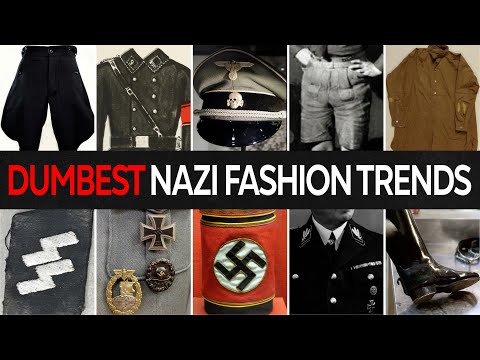
All right, let’s open the closet.
1. Overdesigned Theatrical SS Uniforms
Heinrich Himmler didn’t just want a uniform. He wanted a statement. A black, soul-devouring, silver-threaded, leather-polished stage production stitched onto human skin. The SS uniform wasn’t merely an outfit—it was quite literally a costume designed in part by artists and fashion consultants. It had more in common with a cabaret villain than battlefield functionality.
With its silver piping, ornamental death’s head insignia, military theatrics, and exaggerated sharp lines, the look was halfway between Dracula and space fascist. Foreign diplomats reportedly referred to them as “operetta Nazis”—and not in a flattering way. The design leaned so hard into visual intimidation that it tipped straight into parody.
Critics at the time noted how the uniform seemed tailored less for war and more for photo ops, podiums, and precisely choreographed torchlit marches. When you’re dressing like the villain from your own propaganda film, something has gone strangely meta. But for Himmler, the uniform wasn’t about utility. It was about mythmaking. Every polished seam was another thread in a fantasy of control, purity, and eternal order. Too bad it made them look like militarized theater kids with delusions of grandeur.
And if the uniform was the act, then the hat was the punchline.
2. The Black SS Death’s Head Cap
Let’s talk about that hat. A sleek black visor, high-gloss leather, perfect symmetry, crowned with a literal skull and crossbones. Not a symbol, not a metaphor, not some stylized abstraction—an actual human skull right on the forehead. Like a pirate got a desk job at a funeral home and took himself way too seriously.
The Totenkopf (death’s head) was meant to strike fear, but it mostly struck observers as, well, embarrassing. One British soldier described it as “something from a comic book supervillain’s closet.” Another American correspondent called it “Halloween for fascists.” The irony, of course, is that the Nazis were deeply concerned with not being laughed at. They wanted to be feared, revered, worshiped as symbols of harsh modernity. But instead, they often looked like they just raided the costume department of a B-movie studio—if that studio also manufactured furniture polish and war crimes.
Even within the ranks, the hat was polarizing: too dramatic, too much, too skull-forward. But Himmler liked it. And when you’re designing your empire like it’s a lifestyle brand, subtlety dies first. Still, if you thought the death’s head cap was a bit on the nose, wait until you meet the boots.
And if you’ve made it this far without laughing or cringing, congratulations—your taste in historical absurdity is elite. Before we dig into the footwear of fascism, take a second to subscribe to the channel. It helps us keep the lights on and the sarcasm flowing. Also, curious minds want to know: where are you watching from and what time is it over there? Because nothing says normal sleep schedule like analyzing dictator dress codes at 3 a.m.
All right, boots on. Let’s shine them to a blinding, impractical mirror finish.
3. High-Gloss Jack Boots
Nothing says military efficiency quite like boots so shiny they could signal aircraft. The high-gloss jack boots, standard issue for many Nazi officers, were less about terrain and more about theatrical flair. Polished daily, sometimes obsessively, these towering leather monoliths weren’t built for comfort—or even utility. They were built for appearances. You weren’t marching; you were gliding on a reflective surface of authoritarian vanity.
The ridiculousness didn’t go unnoticed. Soldiers often spent more time polishing than patrolling. Allied troops mocked them as “parade shoes for people afraid of dirt.” And if the function was questionable, the symbolism was deafening: rigidity, dominance, a pristine surface hiding rot underneath.
The boots were tall, stiff, and absurdly loud on marble floors—more suited to echoing through palace halls than slogging through mud. But then again, most Nazi elites weren’t planning on mud. They were planning on being seen. And seen they were—photographed, filmed, and obsessively admired, at least internally. But for the rest of the world, the boots weren’t frightening. They were fashion victims of their own regime.
And if their footwear was loud, their shirts were louder—just not in the way they intended.
4. The Brown SA Shirts
Few fashion movements have done less with more than the SA’s brown shirts. Take one cheap cotton shirt, make it the color of dried soup, and suddenly it becomes the outfit of a revolution—just not a stylish one. The Sturmabteilung, Hitler’s original street-brawling militia, adopted the brown shirt in the 1920s, mostly because it was cheap army surplus from World War I. But like most things in the early Nazi aesthetic, it was later mythologized into something far grander than it actually was.
To outsiders, though, it looked like a uniform designed by a municipal janitor. The color was drab, the fit was poor, and the stitching was inconsistent. Early brown shirts often looked like they were wearing slightly melted UPS uniforms. But what the outfit lacked in tailoring, it made up for in theater: marching in lines, shouting slogans, fists in the air. Brown became the color of street intimidation wrapped in bargain-bin bravado.
And while the brown shirt was supposed to symbolize order and loyalty, it mostly signaled chaos in formation. But the real comedy came later—when they put the same boys into tiny shorts and expected people to take them seriously.
5. Short Shorts: Leather Lederhosen-Style for Hitler Youth
If you’ve ever wondered what happens when a regime obsessed with discipline also wants its youth movement to look like they’re perpetually on their way to a Bavarian summer camp—behold the infamous Hitler Youth short shorts. These were not normal shorts. These were shorts so short they deserve their own censorship blur.
Made of stiff leather that creaked like an old staircase, they were worn year-round. Rain, snow, existential dread—didn’t matter. The goal was toughness, but the visual result was something closer to a confused boy scout who wandered too far from the picnic. Foreign observers noticed instantly. British newspapers joked that the Hitler Youth looked ready to perform a folk dance rather than march in formation. Americans compared them to costume extras in a musical that never got funded.
And the boys wearing them got to experience the joy of chafing as a state-sponsored activity. The leather absorbed water, froze in winter, and refused to break in like a stubborn mule stitched into pants form. But fashion in totalitarian movements is rarely about comfort. It’s about spectacle—even when the spectacle accidentally screams “underprepared hikers with delusions of grandeur.”
And if the shorts weren’t dramatic enough, wait until you see what the adults wore when they wanted to feel medieval.
6. The Quasi-Medieval Capes and Cloaks for Elite Units
Somewhere inside the labyrinth of Nazi aesthetics, a decision was made: what this modern authoritarian project really needed was capes. Full, flowing, theatrical capes—the kind worn by opera villains, stage magicians, and people with complicated relationships to drama. Certain elite SS formations donned these garments during ceremonies, transforming official events into something that looked suspiciously like a dress rehearsal for a Wagner opera.
The intention was grandeur, prestige, ancient authority. The effect, however, leaned heavily toward community theater cosplay. Imagine a group of stern-faced men trying their best to look intimidating while their capes swished in the wind like curtains caught in a draft. Even contemporaries found this hilarious. Diplomats and journalists quietly whispered comparisons to medieval reenactors who had accidentally wandered into the wrong century.
The capes didn’t help with movement either. Soldiers tripped, snagged on equipment, and occasionally got tangled in each other like fashion-conscious bats. But the Nazis weren’t going for practicality. They were building mythology, one swishy garment at a time.
And these capes were just the beginning. Because if you think the outerwear was excessive, wait until you hear what they did with their armbands—and just how large they made them.
7. Overly Large Swastika Armbands
Some design choices whisper. Nazi armbands shouted. Not just in meaning, but in sheer, unapologetic scale. The swastika armband wasn’t a mere identifier—it was a billboard strapped to the bicep. Comically oversized, the standard-issue band looked less like a military accessory and more like something you’d win at a fascist carnival for yelling the loudest oath.
In propaganda photos, it dominated the composition. In real life, it was reportedly distracting, absurdly conspicuous, and prone to sliding awkwardly down sleeves at the worst moments. The goal, of course, was branding: unified, intimidating, instant recognition from across the street. But foreign cartoonists didn’t see menace. They saw a visual punchline. Satirical papers across Europe mocked the armbands as “fashion crimes with fascist flair.” Diplomats privately called them “traffic signs for elbows.”
Soldiers complained about the fabric bleeding color in the rain, leaving red-streaked sleeves that looked more like a laundry mishap than a symbol of state power. But when the point is to be seen—even at the cost of being ridiculed—subtlety goes out the window. And nowhere was that more obvious than in the pristine absurdity of parade gloves that never touch dirt, war, or reality.
8. White SS Parade Gloves
Among all the grim posturing and military theatrics, few items captured the Nazi obsession with image over substance quite like the infamous white gloves. Issued to SS officers for parades, inspections, and theatrical displays of imaginary dignity, these gloves were always spotless—bleached, pressed, and policed harder than most borders. They were meant to symbolize purity and precision. Instead, they projected the exact opposite of battlefield readiness. You could commit a war crime in them, but you couldn’t change a tire.
Soldiers wore them while standing at attention for hours in the cold, while saluting oversized banners, or while executing perfectly timed turns that resembled something between a ballet and a cultic ritual. They didn’t touch anything. That was the point. In a regime obsessed with surface, the gloves were a metaphor: no fingerprints, no mess, just clean hands and dirt somewhere else.
Foreign observers were bemused. French newspapers called them “butler gloves for murderers.” American troops joked they’d seen magicians with grittier fashion sense. But the pageantry didn’t stop there. Because while some tried to look pristine, others leaned into ragged nostalgia, clinging to uniforms that looked like they were exhumed from a failed revolution.
9. SA Beer Hall Putsch Relic Uniforms
The SA, or brown shirts, were never known for subtlety, but even they outdid themselves when they started digging into their laundry hampers of history. By the mid-1930s, it became fashionable among SA members to wear their tattered, mismatched uniforms from the early days—particularly from the infamous 1923 Beer Hall Putsch. These outfits were supposed to evoke revolutionary grit, street-fighting courage, and a sense of romantic struggle. What they actually evoked was a drunk uncle showing up to a wedding in his old football jersey, claiming it still fits.
The result was a jumbled aesthetic of fraying fabric, off-color insignia, and uniforms that looked like they had been attacked by moths and poor decision-making. Foreign observers weren’t inspired. They were confused. Was this cosplay? Was this deliberate? Or had the Nazi dry cleaners gone on strike? The mythologizing of failed coups by wearing their uniforms like sacred relics only highlighted how much of the movement’s self-image was built on pageantry, not practicality.
But while the SA dug up their threadbare past, Hitler himself opted for something newer—if equally awkward and far more rigid.
10. Hitler’s Stiff, Boxy Great Coats
Adolf Hitler was many things, but a fashion icon was not one of them. His signature great coat—long, straight, and unfitted—looked less like outerwear and more like a mobile concrete form. The cut was brutally geometric, making him appear stiff and boxy, as if he were trying to impersonate a statue without the charm. Observers couldn’t help but notice how the coat’s length exaggerated his short stature, while the rigid shoulders gave him the appearance of a man being worn by his own jacket.
And yet this was by design—not fashion design, but ideological branding. The great coat was meant to cloak him in mythic imagery, to transform a failed artist into a statesman carved in stone. But if Hitler’s great coat was austere and severe, Hermann Göring’s wardrobe was its exact opposite: a pastel circus with medals.
11. Göring’s Self-Designed Reichsmarschall Outfits
If Nazi fashion was a theater, Göring insisted on playing every role, designing his own costumes, and demanding the spotlight never leave him. His uniforms were a riot of pale blues, whites, and silvers, often adorned with medals the size of dessert plates. He looked less like a military commander and more like the ringmaster of an authoritarian circus.
British cartoonists had a field day depicting him as a bloated peacock weighed down by his own vanity. The irony, of course, was that his flair for overcompensation only highlighted his insecurities—and those of the regime he helped prop up. But uniforms weren’t enough. Göring had textures, too.
12. Göring’s Obsession with Silk and Velvet Uniforms
While most Nazi officials stuck to wool, leather, and grim symbolism, Göring drifted off into the lush world of velvet lapels, fur-trimmed collars, and silk-lined capes. To him, military hierarchy apparently meant dressing like an aristocrat who’d lost his invitation to Versailles but showed up anyway. He wore powder-blue jackets with ivory buttons, donned capes like he was attending a masquerade, and accessorized like a man convinced that feathers could intimidate tanks.
Göring saw himself as a modern-day nobleman but ended up looking like a rococo painting that wandered into a propaganda film. It was theatrical excess masquerading as statecraft. And yet, even his most over-the-top ensembles couldn’t distract from what was sitting on many Nazi heads—Luftwaffe officers included—with proportions so off they could have doubled as satellite dishes.
13. The Dinner-Plate Luftwaffe Visors
Somewhere along the line, a Luftwaffe designer decided that the human head just wasn’t wide enough. Enter the infamous Luftwaffe visors: caps with brims so flat, broad, and gleaming they could have been used to serve hors d’oeuvres. These hats weren’t just military accessories—they were architectural features. The look was meant to be commanding, aerodynamic, and modern. Unfortunately, they ended up looking more like airborne waiters than elite aviators.
In stormy weather, they caught wind like sails. In sunlight, they reflected like chrome. Even among fellow Nazis, the Luftwaffe’s dinner-plate headgear became a quiet punchline. Still, it wasn’t the only case of cramming too much symbolism into too little space.
14. SS Collar Tabs Overloaded with Runes
The Nazi obsession with symbolism didn’t stop at flags or armbands. It went microscopic. SS collar tabs—barely a few square inches of fabric—were treated like mystical to-do lists. Runes, lightning bolts, oak leaves, double bars, unit codes, all crammed into a space better suited for a name tag. What began as an attempt to infuse uniforms with ancient Germanic gravitas quickly devolved into visual clutter. It was as if every tab was screaming for attention, each one more desperate than the last to say, “I’m in the special club.”
To outsiders, it looked like esoteric cosplay. Foreign military analysts struggled to decipher the dizzying array of symbols, many of which had no consistent application or clear logic. But perhaps nothing captured the full theatrical absurdity of Nazi accessorizing quite like the dagger.
15. Elaborate Dagger Wearing
There’s nothing like a decorative blade to make an ideological costume feel complete. Nazi officers, particularly in the SS and SA, were rarely seen without their ceremonial daggers—polished, engraved, and utterly useless in any real combat scenario. These weren’t weapons. They were status symbols. Each dagger was a small, sharp love letter to self-importance, featuring personalized mottos, intricate hilts, and sheaths that gleamed with more vanity than violence.
Wearing a dagger on your belt in the age of machine guns was the fashion equivalent of showing up to a space launch with a quill. But the dagger was only part of the costume. For maximum menace, you needed outerwear that screamed noir villain.
16. Overuse of Leather Trench Coats by Gestapo Agents
If ever there was a fashion item that became its own caricature, it’s the long black leather trench coat worn by Gestapo agents. This wasn’t just outerwear. It was a theatrical prop. The coat was tailored to suggest danger, efficiency, and mystery. But what it mostly achieved was the look of someone who took spy movies far too seriously. Worn with gloves and a brimmed hat, it turned ordinary men into walking clichés—the kind who seem like they should be delivering monologues in the rain rather than filing paperwork on dissidents.
The coat was hot in summer, cold in winter, and creaked loudly enough to announce its presence in any quiet hallway. Still, it became so associated with secret police intimidation that postwar films adopted it wholesale, cementing it in popular culture as the uniform of the bad guy. And if the trench coat made them look dramatic, just wait until you see what the Hitler Youth were wearing to stay dry.
17. Hitler Youth Rain Capes (Ponchos)
Nothing says “indoctrinated for life” quite like a shapeless beige poncho that looks like it was cut from a surplus tent. The Hitler Youth rain capes—stiff, oversized, and as aerodynamic as a potato sack—were meant to shield young minds and bodies from the weather. What they ended up doing was making kids look like they were being smuggled across a border in a sack of flour.
The capes weren’t tailored. They weren’t breathable, and they definitely weren’t flattering. They were one-size-fits-all in the cruelest possible sense, with each cape drooping off the shoulders like a defeated flag of conformity. To the regime, this utilitarian waterproofing was practical. To everyone else, it looked like a visual metaphor for everything wrong with the movement: mass-produced, humorless, and completely devoid of individuality.
And the worst part—they still saluted in them. Yet even those sagging silhouettes couldn’t compete with the retro absurdity of what the SA wore on their legs.
18. SA Knee-High Puttees and Gaiters
If you’re not familiar with puttees, you’re lucky. These long cloth strips, tightly wound around the lower leg, were a hallmark of World War I military fashion—which is to say they were already outdated by the time the Nazis got hold of them. But the SA, never ones to let a bad idea go quietly, adopted them with enthusiasm. Paired with their drab brown shirts and high boots, the result was a look that screamed, “We ran out of ideas in 1918.”
By the 1930s, they were about as useful as a monocle in a dogfight—time-consuming to wrap, uncomfortable to march in, and about as modern as a bayonet on a bicycle. Yet the SA clung to them, likely in a desperate bid to borrow legitimacy from old military traditions. And while their legs were tangled in the past, their upper bodies would soon be overshadowed by the most impractical parade accessories imaginable.
19. Ridiculously Huge Parade Flags Carried on Shoulders
There’s propaganda, and then there’s lifting an entire flagpole contraption like you’re training for the Olympic yoke walk. Nazi parades were infamous for their visual excess, but nothing exemplified this overkill quite like the massive banners—often several feet wide and topped with heavy metal emblems—that were strapped to the shoulders of flag bearers. These weren’t flags so much as monuments on sticks, and the unfortunate men beneath them often looked like exhausted human coat racks staggering down the boulevard.
These banners swayed wildly in wind, blocked lines of sight, and occasionally collided with each other mid-march, turning solemn parades into unintended slapstick. Even spectators loyal to the regime couldn’t help but notice the absurdity. And while their shoulders bore the weight of spectacle, their necks weren’t spared either.
20. Rigid High-Collar Tunics
Comfort was never high on the Nazi tailoring agenda, but the rigid high-collar tunic brought a special level of sartorial masochism to the mix. Worn by many SS and Wehrmacht officers, these collars were starched to the point of architectural stability. Designed to give the neck a clean, upright silhouette—the visual of control and command—they instead made the wearer look like a bobblehead jammed into a glass jar.
Turning your head was discouraged. Looking comfortable was treasonous. Foreign officers who observed German uniforms during meetings often noted how stiff and unnatural the collars appeared. It gave Nazi officers the posture of mannequins and the flexibility of a garden gnome. It was fashion by ideology: form over function, symbolism over breathing.
21. Long Ceremonial Swords at Rallies
By the 20th century, swords had largely retired from active duty. They belonged in museums, on walls, or in the occasional historical drama—not strapped to the sides of men trying to run a modern state. And yet, Nazi rallies routinely featured officers parading with long ceremonial swords, some so ornate and unwieldy they looked better suited to knighting a horse than leading an army.
The intention was clear: evoke the grandeur of the old Prussian military, conjure the image of noble lineage, and wrap the whole regime in the illusion of timeless tradition. What actually happened was more theatrical than terrifying—men in modern uniforms awkwardly bumping into one another with antique steel swinging at their sides like oversized cosplay props.
Foreign diplomats found the whole sword act so anachronistic that British intelligence once described it as military theater in the most literal sense. And the theatricality didn’t stop there.
22. Ornate Cuff Titles
Among the many visual oddities of Nazi uniforms, the ornate cuff titles remain one of the most ironically self-important. These were long embroidered bands sewn around the lower sleeve, typically black or silver, with bold Gothic lettering declaring the name of a unit, a campaign, or sometimes just a vague ideological slogan. Imagine military merit badges but on your wrists and with all the subtlety of a Vegas marquee.
In theory, they denoted elite status or distinguished service. In practice, they turned every sleeve into a scrolling credits reel for fascist fanfiction. The cuff titles were often difficult to read unless you were standing awkwardly close, and in motion during marches or rallies, they blurred into visual noise. Some SS divisions had multiple variations, which only made things more confusing. Even among Nazi leadership, there was debate over who had earned what and whether certain slogans belonged on a uniform or a propaganda poster.
23. Hitler Youth Oversized Belts and Buckles
If Nazi symbolism had a volume dial, the Hitler Youth uniforms had it turned to 11—and nowhere was that more literal than around the waist. Standard-issue belts for these adolescent paramilitaries came with comically oversized buckles, often etched with slogans like Blut und Ehre (Blood and Honor) and adorned with eagles and swastikas large enough to qualify as signage. The buckle wasn’t just a fastener. It was a manifesto you wore above your kneecaps.
Combined with short shorts and lanky limbs, the look was less youth uniform and more fanatical chimney sweep. The belts weren’t particularly practical either—many were stiff, overbuilt, and visually out of proportion with the rest of the outfit, drawing attention straight to the midsection in the most awkward possible way. And yet, this obsession with hyper-stylized accessories didn’t stop at the waist.
24. SS Black Riding Breeches
Somewhere between cavalry chic and fascist fashion experiment, the SS riding breeches carved out their own bizarre place in history. These trousers were tight in all the wrong places, dramatically flared at the hips, and aggressively tapered at the calves—a silhouette less suited for combat and more for performing dressage on a moonlit stage.
Technically modeled after equestrian wear, they were designed to evoke a sense of aristocratic dominance, hearkening back to a romanticized military past that none of these men had actually earned. Instead of gallant, the effect was cartoonish, like someone had tried to militarize a figure skater’s wardrobe. While Allied soldiers trudged through mud in canvas and wool, SS officers strutted in riding pants as if horses were still the primary mode of transportation.
25. Overdecorated Medals and Ribbons
In the Nazi aesthetic universe, moderation was for the weak—and nothing showcased this better than the absurd overuse of medals, ribbons, and ornamental pins, especially among high-ranking officials who seemed less concerned with warfare and more with personal pageantry. Uniforms became cluttered displays of self-congratulation, with entire chests engulfed in metallic clatter. Göring predictably led the charge, often appearing with so many decorations that his torso resembled a state-sponsored trophy shelf.
British journalists likened the look to “a Christmas tree in mourning,” while American cartoonists drew caricatures of Nazi generals so top-heavy with awards they could barely stand upright. It was theatrical excess passed off as honor, with ribbons issued for everything from imaginary bravery to bureaucratic efficiency.
In the end, these decorations revealed less about valor and more about the regime’s obsessive need for visual affirmation. In the Nazi world, fashion wasn’t just fabric—it was ideology sewn into every thread, every buckle, every exaggerated silhouette. And when the curtain finally fell, that obsession with appearance proved to be more than just bad taste. It was a warning written in silver piping and polished leather: when a regime cares more about how it looks than what it does, the costume is always the first clue.
So, dear viewer, which of these twenty-five fashion disasters made you laugh the hardest—and which one secretly haunts your nightmares? Drop your answer below, and tell us: if history had a runway, would you have the courage to walk it?
Report this article
Select a reason for reporting:






