In the spring of 1943, a young American pilot watched his P-47 Thunderbolt fall behind a Focke-Wulf 190 as it climbed effortlessly into the clouds. The German pilot didn’t outmaneuver him; he simply pulled back on the stick and vanished upward. It was a humiliation that repeated itself across the first brutal months of American escort operations over Europe. Pilots came home with harsh words for their aircraft. Don Blakeslee of the 4th Fighter Group, a veteran ace, delivered the most famous insult: “It ought to be able to dive. It certainly cannot climb.” He was right—and the engineers at Republic Aviation knew it.
But before the solution can mean anything, the story must begin with the man who built the machine, and with a sheet of paper on a moving train.
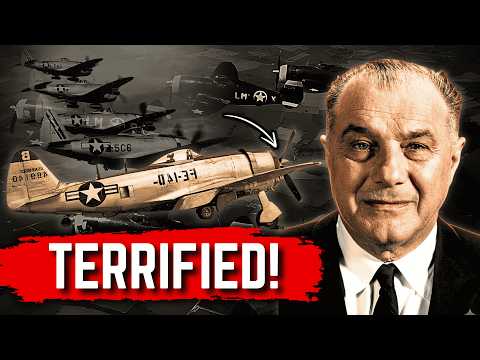
Alexander Kartveli was not a name that appeared in American newspapers. Born Alexander Kartvelishvili in Tbilisi in 1896, he survived World War I as an artillerist, took a wound in the leg, and was sent by the brief Democratic Republic of Georgia to study aviation engineering in Paris. He came to America in 1927 and soon found his way to the Seversky Aircraft Corporation on Long Island, run by another Georgian exile. When financial losses forced a reorganization in 1939, the company became Republic Aviation, and Kartveli remained chief designer. The name on the door changed, the genius at the drawing board did not.
By 1940, the Army Air Corps needed something decisive. Reports from Europe described German fighters at performance levels American aircraft could not match. The Army canceled Kartveli’s existing contracts and told him to start over. The moment that defined everything happened on a train ride from Dayton, Ohio, back to New York. Kartveli sat with his canceled contracts, took out a sheet of paper, and began to sketch—not a refinement, but something entirely new. The XP-47B that emerged was unlike anything the Army had asked for.
At over 12,000 pounds gross weight, it was nearly twice as heavy as its contemporaries. It was built around the Pratt & Whitney R-2800 Double Wasp, an 18-cylinder radial producing 2,000 horsepower—the most powerful aircraft engine ever developed in the United States at that time. The exhaust gases were routed rearward through twin pipes along the cockpit to a General Electric turbine that compressed incoming air and fed it back to the engine, maintaining sea-level pressure even at 30,000 feet. Nobody had integrated such a system inside a fighter airframe before. The Thunderbolt’s rotund fuselage—the shape that earned it the nickname “the Jug”—existed largely to house that complex internal architecture.
The prototype first flew on May 6, 1941. By the end of 1942, P-47Cs were arriving in Britain for the 4th, 56th, and 78th Fighter Groups. Pilots transitioning from Spitfire Mark Vs experienced genuine culture shock. Reginald Mitchell’s Spitfire was a precision instrument, a light-footed thoroughbred. The Thunderbolt communicated its intentions through sheer mass rather than finesse. Many pilots did not adapt easily, at least not yet.
The contrast was pointed because the pilots were comparing the Thunderbolt to the finest light fighter in the world. The Spitfire Mark V had already been under pressure from the Fw 190, which is why the Mark IX was rushed into service. Sydney Camm’s Hawker Typhoon, another RAF heavy fighter, was struggling with its own performance problems and being reoriented toward ground attack. Every major air force was wrestling with the same tension: power and durability versus agility and climb. The Thunderbolt sat at an extreme of that trade-off that its early pilots found difficult to accept—and that German pilots found easy to exploit.
When the P-47 finally met the Focke-Wulf 190 over France on April 15, 1943, the results confirmed the pessimists. Major Don Blakeslee scored the type’s first aerial victory that day, shooting down an Fw 190 near Dieppe. But the tactical picture that emerged over the following weeks was sobering. Kurt Tank’s fighter was fast, heavily armed, with an extraordinary roll rate and a reliable BMW 801 radial. The pilots of Jagdgeschwader 2 and 26 had already identified the P-47’s greatest weakness before the Americans fully understood it. The Thunderbolt’s problem at low and medium altitudes was its climb rate. The aircraft’s enormous weight worked in its favor in a dive—it accelerated downward with tremendous momentum. But when an Fw 190 or Bf 109G pulled into a steep climbing escape, the Thunderbolt simply could not follow.
German pilots learned this quickly and exploited it systematically. Engage, absorb the initial American pass, then pull into a vertical climb and watch the big heavy fighter fall away below. It worked with depressing consistency. American pilots reported losing kill after kill to an enemy who climbed out of reach, and critics—including experienced RAF pilots—began to ask whether the Americans had put all their engineering into the wrong aircraft.
The problem had two distinct components. The first was the propeller. The original Curtiss electric blades fitted to early P-47s were what pilots and engineers called “toothpick blades”—four narrow tapered shapes that looked almost comically inadequate for the massive aircraft. A propeller blade works by generating lift, the same aerodynamic principle that keeps a wing in the air, applied to a rotating surface. The wider the chord of the blade, the greater the surface area generating that lift. The narrow blades in denser lower-altitude air were leaving power on the table. The R-2800 was producing horsepower the propeller could not fully convert into thrust—and in a climb, that inefficiency was costing American pilots their lives and their kills.
Frank Caldwell, a long-tenured engineer at Hamilton Standard Propeller Company in Windsor Locks, Connecticut, had been developing a solution. He had designed what became known as the paddle blade propeller—a broad, muscular blade with a dramatically wider chord than anything then standard on high-performance fighters. The paddle blade looked almost wrong for an airplane. It was blunt and wide where fighter propellers were supposed to be sleek and narrow. The 13-foot diameter left barely 6 inches of clearance between blade tip and runway on takeoff and landing—a detail that required new operating procedures. It was not elegant. It was effective.
The wider chord gave each blade substantially more surface area to bite the air, and in the climbing regime where the old blades had struggled, the paddle blades generated noticeably more thrust from the same engine power. Curtiss-Wright developed their own version of the wide-blade concept, and the Army Air Forces approved both designs for fleet use—a reflection of how urgently the improvement was needed. Caldwell’s background mattered: he had been at Hamilton Standard since the early days of variable-pitch propeller development, the technology that allowed a blade to change its angle of attack in flight. Without variable pitch, wide-chord blades would have been an obstacle rather than an advantage. With it, the paddle blade could be set to a coarse angle for efficient high-speed flight and a fine angle for maximum thrust during the climb. The Hamilton Standard Hydromatic system, which Caldwell had helped develop, was the invisible enabler underneath.
The second component of the problem was chemistry. Any piston engine running a supercharged induction system faces detonation—sometimes called knock—when the fuel-air mixture ignites prematurely or unevenly, triggered by heat and pressure exceeding the fuel’s octane rating. For the R-2800 on the aviation fuel available in 1942, the safe power threshold sat at roughly 2,000 horsepower. Any more risked destroying the engine from within—not a recoverable condition at 30,000 feet over Germany. The engineers at Pratt & Whitney had been pursuing a solution that predated the war: anti-detonant injection, or ADI. If you could cool the fuel-air charge inside the supercharger before it reached the cylinders, you could raise the detonation threshold and run the engine at boost pressures that would otherwise destroy it. The most effective cooling agent was water, because its phase change from liquid to vapor absorbs enormous amounts of heat. But plain water froze solid in European winters. The solution was to mix it with methanol in roughly equal proportions. Methanol lowered the freezing point and contributed a modest amount of combustible energy.
When the water-methanol mixture entered the supercharger at war emergency power settings, it cooled the compressed charge, suppressed the thermal conditions that triggered detonation, and allowed the engine to run at previously forbidden boost pressures. The result was a jump from approximately 2,000 horsepower to as much as 2,800 horsepower at war emergency power—a burst available for roughly five minutes, limited by the water-methanol tank capacity and thermal stress on engine components. Eight hundred additional horsepower in a fighter that was already the heaviest single-engine combat aircraft in the war: that surge was the difference between an airplane that could follow a climbing enemy and one that could not.
The two modifications arrived at the Eighth Air Force’s P-47 groups in the closing weeks of 1943 and opening weeks of 1944. The conversion was a rolling process, aircraft by aircraft, squadron by squadron, as new propellers were fitted and ADI plumbing was installed and tested. By January 1944, Hub Zemke’s 56th Fighter Group at Halesworth—the Wolfpack, the most accomplished P-47 unit in the theater—had received the new equipment across most of its aircraft. Ground crews worked long nights in the English winter fitting the wide-blade propellers and checking water-methanol lines for freezing and leakage problems. The pilots were briefed on the emergency power system, told precisely how long it could be used, warned about what happened if they held it past its thermal limits.
The 56th Fighter Group’s position in this story deserves emphasis because the group was more than a testing ground for upgraded hardware. It was the organization that translated engineering potential into tactical reality. Zemke had built a culture of disciplined aggression that stood apart from other successful P-47 groups. Where the Fourth Fighter Group, with its Spitfire-trained veterans and lingering skepticism, fought effectively but never fully shed the sense it was flying the wrong aircraft, the 56th embraced the Jug on its own terms and extracted everything it offered. Hub Zemke grasped immediately what the upgrades meant for tactics. He had been flying combat since the RAF’s darkest days in 1940, had spent time as an observer with the British specifically to understand how the Luftwaffe fought, and had built the 56th into the highest-scoring P-47 unit in Europe through tactical intelligence and personal leadership his pilots respected without reservation.
When the new propellers arrived and the ADI system was tested in flight, Zemke rewrote his tactical doctrine. The core of the old doctrine had been altitude and the dive: stay above the enemy, force engagements where the Thunderbolt’s high-altitude performance gave it the edge, disengage vertically before the enemy could exploit the climb disadvantage. The new doctrine added one operational directive: When a German pilot pulls into a climb to escape, follow him. That was the revision. It sounds deceptively simple. In practice it rewrote the terms of every engagement over Western Europe for the remainder of the war.
The first meaningful test came on March 6, 1944, over Berlin. The 56th Fighter Group was part of the first American daylight bombing raid on the German capital, an operation of enormous symbolic and strategic significance. The Luftwaffe rose in force to defend Berlin, exactly as Allied planners had anticipated. German fighter controllers scrambled Bf 109 Gs and Fw 190s from bases across northern Germany. In the engagement that followed, German pilots who had been fighting P-47s for nearly a year found that the machine they thought they understood had become something unrecognizable. The old escape tactic—the steep climbing turn that had sent so many Thunderbolts falling away below—stopped working. The Jugs kept climbing. They climbed at angles and sustained rates that experienced Luftwaffe veterans had been certain were impossible for an aircraft of that weight and bulk. When the 56th mission was complete, they had destroyed 11 German aircraft without losing a single pilot. German formation leaders radioed reports back to their command that were initially not believed. The Americans’ heavy fighter now climbs.
The Bf 109 G units were equally disrupted. The Gustav, as it was known within the Luftwaffe, was a different threat from the Fw 190—faster in a climb at medium altitudes, capable of fighting well at 30,000 feet, powered by a Daimler-Benz 605 in-line engine whose liquid cooling made it precise and responsive. The climbing escape had been just as reliable a solution against early Thunderbolts for 109 units as for 190 units, because the principle was the same regardless of which German type applied it. That principle stopped being reliable in the winter of 1943–44, and the Gustav pilots found themselves in vertical engagements they could no longer assume they would survive by altitude alone. Meanwhile, Focke-Wulf was already developing the Fw 190 D-9, a lengthened, liquid-cooled variant with a Junkers Jumo 213 engine, intended to restore the type’s medium-altitude performance. The D-9 would arrive later in 1944, but by then Zemke’s Wolfpack had developed tactical answers sophisticated enough to meet those challenges.
There is a dimension of the ADI upgrade that technical accounts rarely capture, but the pilots described with striking consistency: the sound. When a P-47 pilot shoved the throttle to the war emergency stop, and the water-methanol injection engaged, the already thunderous R-2800 took on a different quality—a deeper, harder note that veterans described as “a roar within a roar,” the engine suddenly operating at a level of controlled violence that its normal running suggested but never fully delivered. That sound, heard from inside a German cockpit during an engagement where the American was supposed to be falling behind, became a specific signal that everything was about to go wrong. German pilots who survived those encounters reported it consistently in their debriefings. The Thunderbolt’s engine changed, and then the aircraft refused to fall behind.
Confidence in a known tactical system is one of the foundations of combat aviation. When that system fails without warning, the fracture it causes takes time and strong leadership to repair. The industrial dimension of the upgrade program was itself remarkable. Modifying a propeller installation on a single aircraft is a straightforward workshop task. Doing it to hundreds of P-47s distributed across airfields in England, Italy, and the Pacific—while simultaneously retrofitting the ADI plumbing, training pilots on the system’s operating limits, and sustaining combat readiness throughout—required exactly the logistical organization that defined American industrial warfighting at its best. Republic Aviation’s plants at Farmingdale, Long Island, and Evansville, Indiana, were producing over 600 Thunderbolts per month at peak output in 1944. Improvements that entered production on a new block were simultaneously being retrofitted onto earlier aircraft already in the field. The scale and speed of that process was something Germany’s dispersed, repeatedly bombed, and resource-constrained manufacturing base could not replicate.
The B-17 Flying Fortresses and B-24 Liberators attempting precision daylight bombing needed fighters capable of suppressing the Luftwaffe’s interception. The second Schweinfurt raid on October 14, 1943—60 B-17s lost from 291 aircraft—had proven beyond argument that unescorted daylight bombing of deep targets was not sustainable. The upgraded Thunderbolt worked in complementary fashion alongside the arriving P-51 Mustang. Where the Mustang’s Rolls-Royce Merlin engine gave it extraordinary range and high-altitude refinement for the deepest escort missions, the R-2800’s air-cooled construction gave the Thunderbolt a resilience that the Merlin-powered P-51, with its vulnerable liquid cooling loop, could not match. A single rifle bullet through a P-51’s coolant line could force it down within minutes. The Thunderbolt absorbed comparable damage and kept flying—a quality that saved pilots’ lives in numbers that do not appear in any single statistic.
At war’s end, the Thunderbolt’s record was unambiguous. Republic built 15,686 P-47s across all variants, more than any other American fighter of the war. In the European theater, P-47 groups claimed 3,752 aerial victories at a loss rate of 0.7 percent per mission, among the lowest of any combat aircraft in the theater. The kill ratio against Luftwaffe aircraft stood at 4.6 to 1. The paddle blade propellers and the water-methanol injection system were not inventions that required new science. Wide-chord propeller design was a known aerodynamic direction. The ADI concept had roots in pre-war laboratory work. What made them decisive was their precision, their timing, and the scale at which the United States could implement them.
The P-47 had a genuine weakness in the climbing regime. German pilots had found it, named it, and built it into their standard defensive tactics across 18 months of operational flying. The engineering response did not redesign the aircraft. It identified precisely which limitation was preventing the existing design from reaching its potential, removed that limitation as efficiently as possible, and delivered the result at a speed and scale that the Luftwaffe’s command structure had no answer for. Don Blakeslee had been right about the early P-47. He was simply wrong about the P-47 that it became. The aircraft that left Farmingdale in 1942 with toothpick propellers and an engine running at its thermal ceiling was not the aircraft that fought over Berlin in the spring of 1944 with a sound that German fighter pilots had learned to identify and dread.
Between those two versions of the same machine stood the quiet, meticulous work of engineers who did not receive headlines. The German pilots who pulled into their climbing turns that spring and found a Thunderbolt still there alongside them—still climbing, still armed—were experiencing the consequence of that work in the most immediate way it could be delivered. Kartveli had given the Thunderbolt its bones. Pratt & Whitney had unlocked its lungs. Caldwell had given it the grip. And the Wolfpack had given it teeth sharp enough to change the sky. The aircraft that Blakeslee had publicly dismissed as a machine that certainly could not climb would finish the European air war with a kill ratio that vindicated every engineer who had refused to accept the original limitation as permanent. Some problems in aviation are solved by replacing an existing machine with something entirely new. This one was solved by understanding precisely what was already there—and by having the precision, the patience, and the industrial reach to fix the right things before the war moved on without waiting.
The war moved on, but the lesson stayed. Airpower is not only a contest of airframes; it is a contest of adaptation. The Luftwaffe built better climbing machines and never imagined the Americans would answer with propellers and water-methanol. They did.
That spring of 1944, German pilots pulled into their familiar vertical escapes and found the sky crowded with a fighter they had already dismissed. The Thunderbolt was no longer a bathtub. It was a predator.
And when the war ended, the men who had cursed the Jug in 1943 spoke of it with something close to affection. The engineers who never made headlines had won a quieter victory.
If a weapon is only as good as the men who improve it, what does that say about the machines we trust today?
Report this article
Select a reason for reporting:






